Bishops call on Trump to extend protections for Haitians, warning Haiti is too dangerous for return
Two Catholic bishops who lead the U.S. bishops’ conference migration and international justice committees warned that conditions in Haiti remain too dangerous for people to return safely and urged the Trump administration to reverse its decision, which takes effect Feb. 3, to end Temporary Protected Status (TPS) legal status for hundreds of thousands of Haitians living in the U.S.

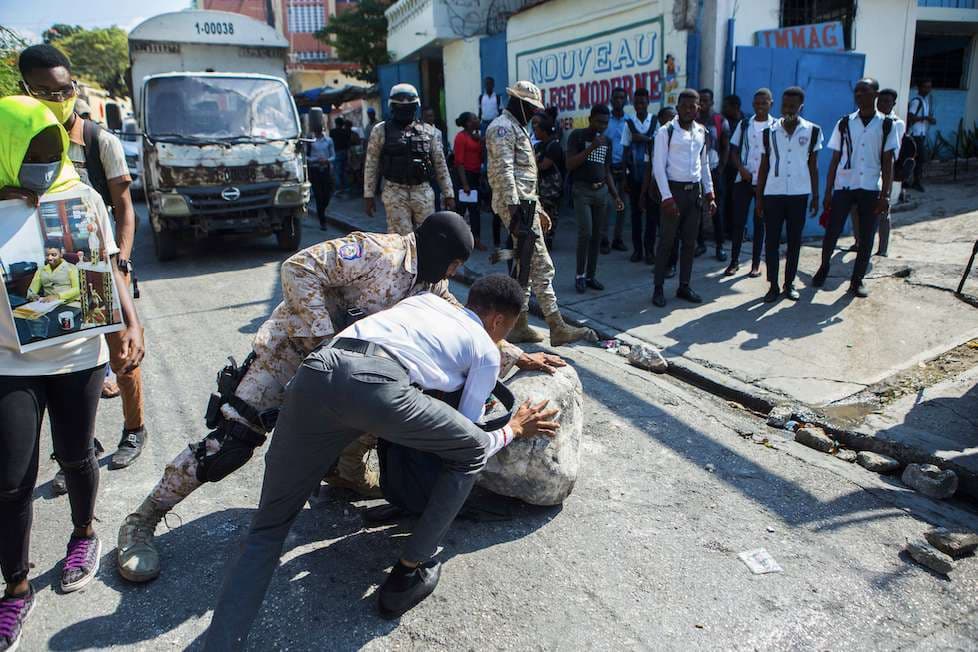
Two Catholic bishops who lead the U.S. bishops’ conference migration and international justice committees warned that conditions in Haiti remain too dangerous for people to return safely and urged the Trump administration to reverse its decision, which takes effect Feb. 3, to end Temporary Protected Status (TPS) legal status for hundreds of thousands of Haitians living in the U.S.
“There is simply no realistic opportunity for the safe and orderly return of people to Haiti at this time,” Bishop Brendan Cahill, chairman of the bishops’ Committee on Migration, and Bishop A. Elias Zaidan, chairman of the Committee on International Justice and Peace, said in a Jan. 29 statement.
The Department of Homeland Security (DHS) announced the change in November 2025. The DHS estimates that roughly 352,959 Haitians currently hold TPS under the designation.
Haiti's TPS Designation
TPS allows nationals of countries experiencing war, natural disaster, or other extraordinary conditions to remain and work legally in the U.S. when returning home would be unsafe. Haiti has held the designation since 2010, after a catastrophic earthquake killed more than 200,000 people and devastated the country’s infrastructure.
Haitians have been forced to seek asylum for decades due to a combination of recurring economic crises, collapse of basic state functions, corruption, and repeated natural disasters — including the 2010 earthquake, subsequent hurricanes, and a 2021 earthquake. Following the 2021 assasination of President Jovenel Moïse, armed gangs – estimated at about 90 distinct groups — control much of Haiti’s capital, Port-au-Prince, disrupting aid deliveries and fueling violence, according to International Crisis Group.
Haiti’s TPS designation has been extended repeatedly for the past 15 years, due to the country’s instability making safe return impossible. Earlier attempts during Trump’s first term to end TPS for Haitians were blocked by court rulings.
When she announced the termination, Homeland Security Secretary Kristi Noem said conditions in Haiti had improved enough that the country no longer met the legal requirements for the program, adding that “allowing Haitian nationals to remain temporarily in the United States is inconsistent with U.S. national interests.”
The bishops' statement
In their statement, the bishops pointed to the U.S. government’s own warnings as evidence of Haiti’s worsening security situation. The State Department lists Haiti under a Level 4 travel advisory — its highest — citing “life-threatening risks” including kidnappings, armed violence and civil unrest. The Federal Aviation Administration has also restricted flights from the U.S to Haiti’s capital.
The bishops acknowledged that TPS is meant to be temporary but said Congress has repeatedly failed to create a path to permanent legal status for people who have lived in the U.S for years under the program.
“So long as Congress fails in this regard, and the current conditions in Haiti persist, the onus is on the executive branch to act in a just and merciful way,” they said.
They urged the administration to extend TPS for Haitians, arguing that the program was designed precisely for situations like Haiti’s ongoing crisis and that ending protections now would endanger lives and destabilize families and communities.
“The Trump Administration still has the opportunity to do the right thing — to safeguard human life, to uphold the law, and to promote greater stability for people in this country and beyond,” the bishops said. “TPS was created by Congress with these very goals in mind, and the ongoing conditions in Haiti are precisely the sort warranting TPS. We urge the Administration to act accordingly by extending this vital relief for Haitians.”
Haitian TPS holders in the U.S.
Haitian TPS holders already face significant difficulties in assimilation, particularly in language access, economic mobility, and long-term stability even as Haitian immigrants continue to contribute through work, family life, and community involvement.
According to the most recent data from the Migration Policy Institute (MPI), 44% of Haitian immigrants reported that they speak English less than “very well.” In emerging settlement areas, such as Springfield, Ohio, where Haitians now make up a significant share of the population, local services have struggled to keep pace. Creole interpreters are in short supply.
The study also indicated that about 15% of Haitian immigrants live in poverty and that median household incomes trail averages for both immigrants and people born in the U.S.. Although labor force participation is high – about 69% among those ages 16 and older – upward mobility remains limited, as many work in lower-wage sectors such as elder care, hospitality, and manufacturing. The temporary nature of TPS, which offers no permanent legal footing, can also discourage employers from long-term investment.
Many Haitian TPS holders also have U.S.-citizen children, fueling anxiety over deportation and family separation. Cultural differences, discrimination, and heightened anti-immigrant rhetoric — particularly during the 2024–25 election cycle — have deepened feelings of isolation for some families.
.jpg&w=3840&q=75)
Comments