Cardinal Pizzaballa on Board of Peace: Peace in the Holy Land requires ‘concrete actions'
Cardinal Pizzaballa expressed reservations about Trump’s Board of Peace, saying that “concrete actions” will be needed for lasting peace in the Holy Land.
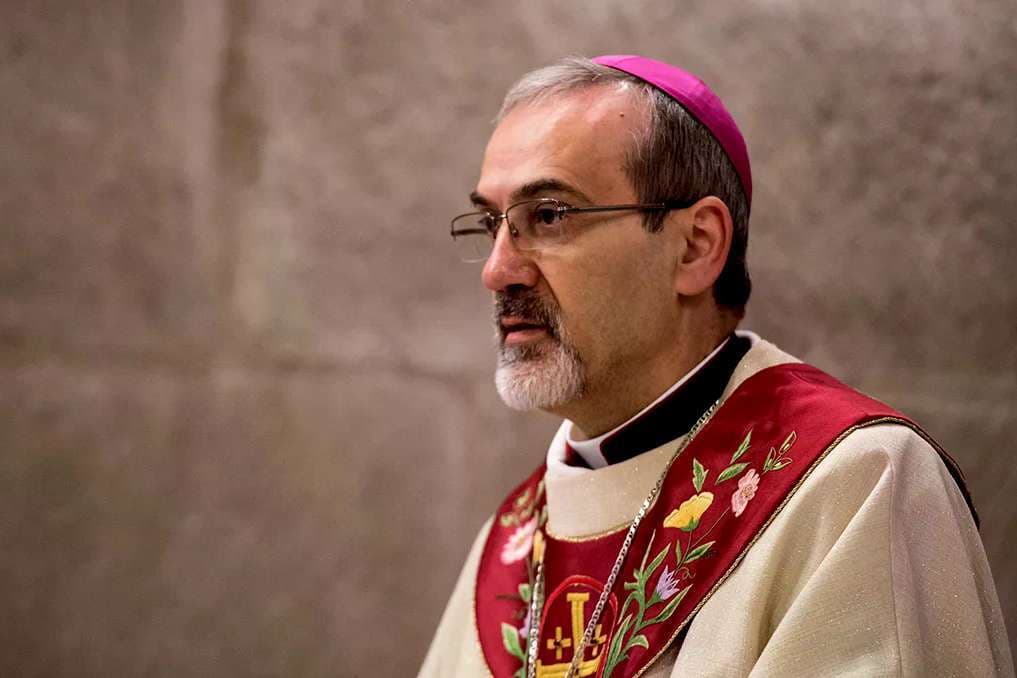
Cardinal Pierbattista Pizzaballa Jan. 6 expressed reservations about President Donald Trump’s Board of Peace, saying that “concrete actions” will be needed to bring about a lasting peace in the Holy Land.
“Peace and reconciliation are beautiful concepts, but they risk remaining mere slogans if they are not accompanied today by concrete actions, gestures, and testimonies that physically demonstrate the possibility of rebuilding trust,” Cardinal Pizzaballa said while speaking at an event commemorating the 800th Anniversary of the Death of Saint Francis of Assisi, at the Church of San Francesco a Ripa in Rome, according to the Latin Patriarchate of Jerusalem.
He said that the current state of the Holy Land is grim.
“The wounds are still deep, people are disoriented, with weak leadership,” he explained. “There is no clear vision of the future, of the other being beside you and, in some way, within you. Neither side wants to hear about the other: the relationship has broken down, and this is the first point to consider and from which to begin.”
Peacemakers must cultivate “opportunities for encounter” that “little by little help people to think differently,” he said. “Words are not enough.”
The cardinal stressed the need for both political and religious leaders to avoid anger and revenge. He also warned against allowing extremists to control the narrative.
Cardinal Pizzaballa also emphasized the importance of having a Christian presence in the Holy Land. He explained that Christians can be a sign of unity, comparing them to St. Francis.
“The Holy Land teaches us that being a minority is not a tragedy, if one has something beautiful and great to communicate,” he said. “And we do.”
The cardinal lamented that many people no longer believe that positive change is possible. He said that since he came to the Holy Land in 1990, the Christian presence there has “dramatically declined,” saying that just since the current war between Israel and Gaza began in 2024, 100 Christian families have fled.
He admitted that he and other faith leaders did not immediately realize the enormity of the Oct. 7, 2024, attack, and he did not anticipate the subsequent response from Israel.
“We thought there would be a retaliation, like many others that had occurred before, but instead all the parameters we knew collapsed," he said.
He recognized that a two-state solution may seem impossible, but he said that “it is something that must be worked toward.”
He also affirmed that Palestinians have the right to their own state, saying that recognizing this is “an act of justice.”
He concluded by imploring Christians to come on pilgrimages to the Holy Land.
“It is time to return,” he said. “Enough with emergencies; it is time [to] be courageous. One can come to the Holy Land, one must do so — Bethlehem and Jerusalem are safe. We need to see that the Church and the Christian community are present, physically present as well.
“It is also an act that says to Palestinians and Israelis alike that we too are here in this land, that we too have our roots here.”


Comments