Catholic University of America physics professor wins more than $1M in funding for AI-integrated research
The federally funded projects will use artificial intelligence (AI) to accelerate nuclear physics analysis and help future research facilities process large data streams in real time.

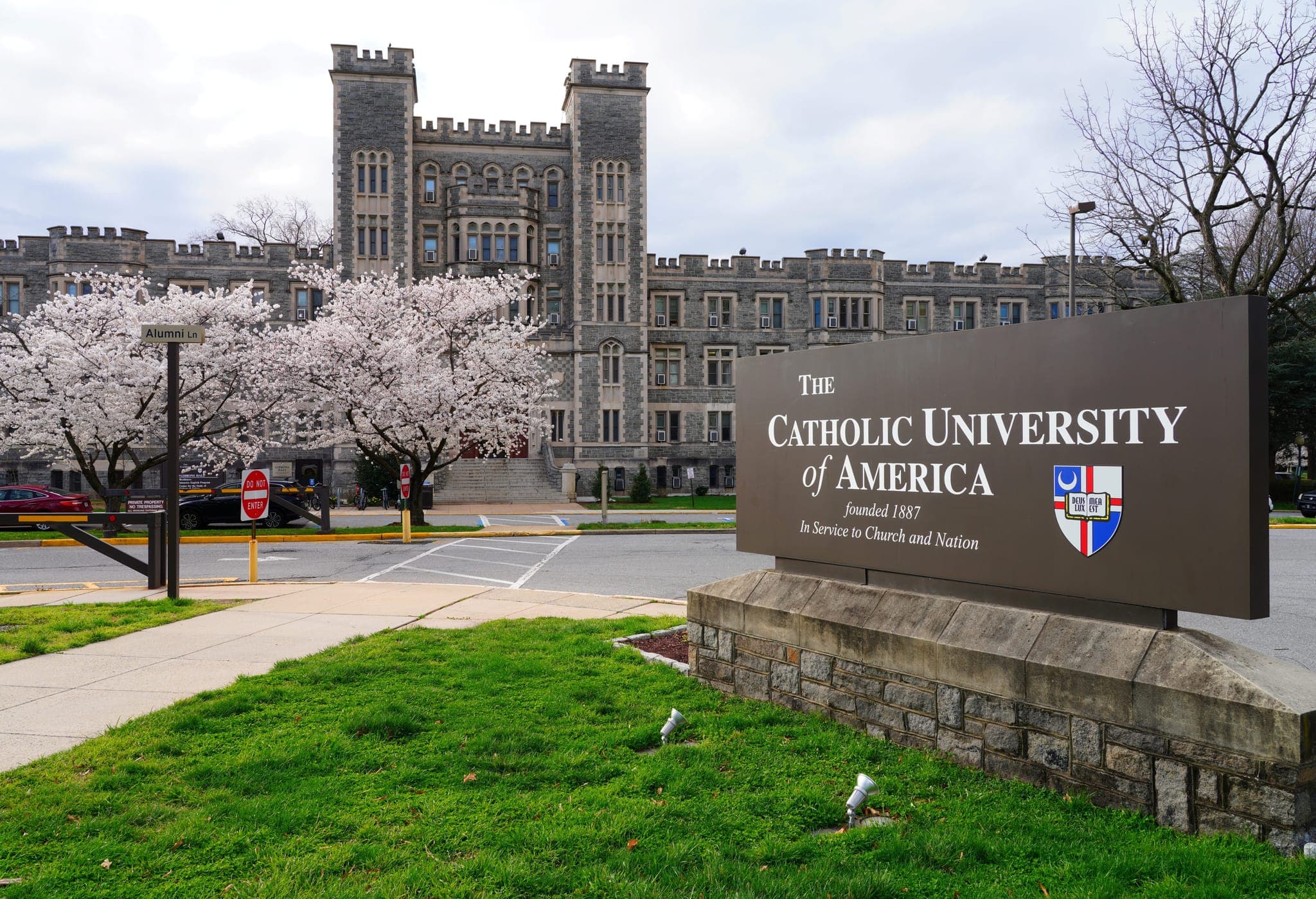
A physics professor at The Catholic University of America has secured more than $1 million in new federal funding for two projects that integrate artificial intelligence (AI) into nuclear physics data collection and analysis.
According to a July 24 university announcement, Tanja Horn, a professor in the university’s nuclear physics group within the College of Engineering, Physics, and Computing, received the grants in July.
The largest award, a $750,000 grant from the National Science Foundation announced July 1, will fund the project “Studies of Pion and Kaon Structure and AI to Expedite Science Output.” It aims to deepen researchers’ understanding of the building blocks of matter by using AI and machine learning to speed up data analysis and improve the efficiency of nuclear physics experiments.
On July 22, the U.S. Department of Energy’s (DOE) Genesis Mission awarded another $300,000 to Horn and her co-investigators — Catholic University computer science assistant professor Dominick Rizk and Jefferson Lab researcher Dmitry Romanov — for a project titled “AI-Driven Expedited Discovery and Background Separation for Petabyte-Scale Streaming Readout.”
According to the announcement, the researchers aim to integrate physics-aware AI directly into data streams generated by high-rate research facilities, including the DOE’s planned Electron-Ion Collider.
The collider could produce detector data at nearly 100 gigabits per second — a rate at which conventional systems may struggle to process information quickly enough, creating bottlenecks in data analysis. Horn said in the project abstract that the researchers plan to address this problem by using AI to distinguish important physics events from background data as the information is being generated, rather than waiting to analyze the full data stream afterward.
“This award leverages our team’s expertise in hadron physics research at the DOE National Laboratories and enhances it with cutting-edge AI capabilities,” Horn said in the announcement.
The DOE award comes as other federal agencies expand their use of AI under the government-wide Genesis Mission, an initiative launched by President Donald Trump in November 2025 to use AI to address scientific challenges. As Zeale News previously reported, the Department of Health and Human Services announced July 22 that its Bio Genesis Mission will use AI and advanced computing to accelerate research into chronic disease, pediatric cancer, and drug development.








Comments