EXCLUSIVE | Blessed memories of a life working with Fulton Sheen
Through her never-before-told stories, learn how a trusted bookkeeper witnessed the humble leadership, generosity, love, humor, and sorrows of a future saint.
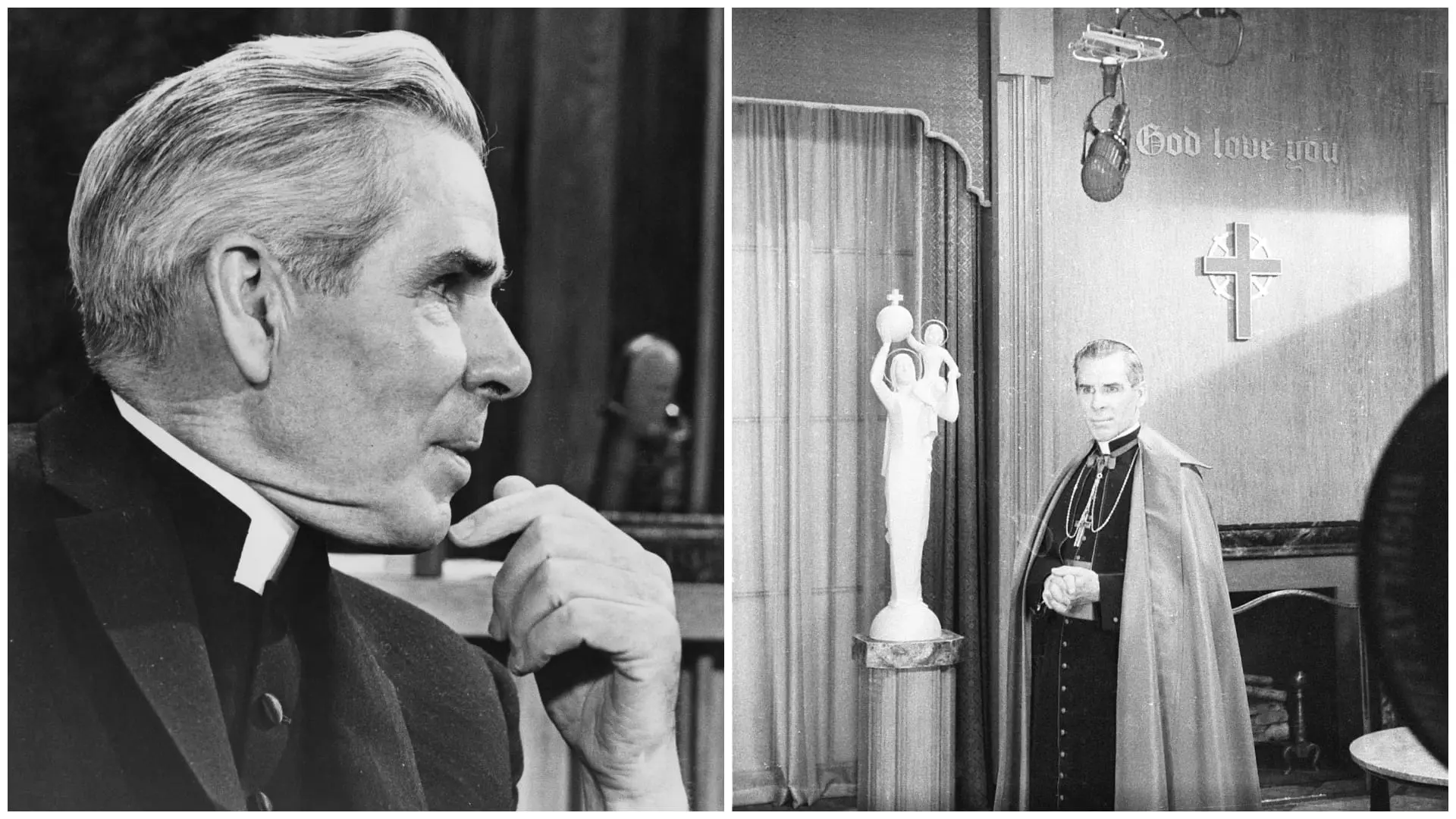
Agnes Claire Reitebech, 96, will be watching next week’s beatification of Ven. Archbishop Fulton Sheen from home. She has never spoken publicly of her long professional association with Sheen, which lasted from 1950 through 1966, and a friendship that stretched all the way to his death. Faithful, sunny, and smart, she was happy to finally speak of the memories she has treasured for 76 years.
The stories are unique, cinematic, full of respect for the missionary work of the Church and the charisms of the most vibrant priest in American history. Collectively, Agnes’ memories reveal Sheen to be a man who lived his own Life of Christ, gathering souls for the Lord, helping the needy, shouting the Gospels, and suffering until death.
At age 20 and fresh out of college Agnes was hired as a bookkeeper at the Society for the Propagation of the Faith. Months later, Sheen was appointed to head the New York office of the Vatican’s global missionary outreach. All Agnes knew was that he was a monsignor and had taught at the Catholic University of America.
“There was no great first impression,” she recalled with a laugh. “He was just the new man coming in and running the show.”
It didn’t take long, however, for Agnes to realize that Sheen was a “kind, easygoing” boss.
The office was on Fifth Avenue opposite the Empire State Building and Sheen lived nearby, commuting on foot. Agnes’ duties included managing the “Gift Annuity Program,” handling correspondence with Rome, and documenting the money received from the Vatican as well as all grants and distributions to missions around the globe. She, Sheen and the rest of the staff enjoyed reading letters from missionaries in many nations who wanted to let the Society know how good works were sponsored by the grants.
Team Rosary
Monsignor Sheen would come out of his private office at 3 p.m. daily on the dot, moving into the large central room where a number of desks including Agnes’ stood. Long rows of file cabinets were against the wall, with aisles between them for access. The entire staff would gather with beads in hand. Monsignor knelt, everyone else knelt, and then Sheen would lead the team in the Rosary. Agnes’ fondest memories are of those moments, when love of the Blessed Mother filled the room with grace.
“But it was funny how many typewriter repairmen showed up just about 2:45,” Agnes remembered, “and policemen and firemen, too, would have a reason to appear. They’d hide between the cabinets to join the rosary with us. Word was out and people would just show up!”
‘He wasn’t fussy’
Sheen was friendly with everyone and “would greet any of the employees who were going down the hall as he happened to pass.” This drew all the staff to him, and they became united in their fondness for their boss. He would also joke with them, displaying the humor the nation would later see on TV.
Immediately after the Rosary concluded Sheen and Agnes would meet to review the “daily numbers” of donations and outlays. “It was a standing appointment.” Though he usually retreated into the office after the Rosary for their meetings, one day Sheen simply walked over to Agnes’ desk, “swept a corner clear and knelt on the floor” to sign some documents. Poised there while she stood, he asked dramatically, “Agnes Claire, how many men have been on their knees to you?” To which she replied, “Not enough!”
In February 1952, Sheen began recording “Life Is Worth Living.” Agnes went to every single taping of the show over the years it aired. Viewers will remember the cassock and fuchsia cape that Sheen wore. Agnes explained that there were two long rows of tiny buttons that needed to be fastened in order for the garments to remain secure. Sheen stood meekly while his personal secretaries Eleanor Browner and Florence Lee fastidiously fastened the buttons in proper order.
As Sheen’s fame grew, celebrities would show up at the Society’s office, often for spiritual direction. Frequently, he would bring them out to the big room and introduce them to the staff. Agnes remembers Clare Boothe Luce as “an interesting person who always chatted with us,” particularly when she visited while U.S. Ambassador to Italy. Another regular visitor was a “very gracious” football star “who all the girls were thrilled to meet.”
His generosity was endless
Eventually Monsignor became Bishop and the office grew even busier. What was consistent, though, was Sheen’s generosity to both his staff and strangers he met. Sometimes he’d arrive without a scarf, his gloves or even a coat because he’d given them away on his walk to a soul who needed them more. Those were cash-only days before credit and debit cards. Agnes recalled him coming to her regularly after arriving at the office, his pockets empty “because he’d spotted someone on the street who needed help” and gave the stranger all he had. Agnes would open the cashbox and give him cash for the day.
At one point, Sheen happened to learn from another staffer that Agnes’ mother and sister were planning a trip to visit extended family in Germany. Sheen came to Agnes and asked why she wasn’t going. “Well, I can’t afford it,” she replied. He put his hands in his pockets and pulled out a couple of hundred dollars, saying, “Here. You have got to go.” Gratefully, she did.
The generosity was spiritual as well. Agnes’ niece, Elizabeth Fusilier, remembers how Sheen came up to Yonkers to preside over her father’s funeral Mass when she was 14. His holiness made a tremendous impression on her. He came out of loyalty to Agnes and made sure that Elizabeth had steady work at the Society’s office in the summers. He also knew each employee’s birthday. Elizabeth’s was in August, and each summer Sheen would call her into his office to wish her a happy birthday and hand her a bottle of Arpege perfume. Everyone in the office was treated just as well.
When Agnes’ father died, Sheen came up to lead the Rosary at the wake, which was held at the Reitebech family house. It was a house Sheen visited regularly for his brother Joseph lived nearby, and during the TV years Sheen owned a weekend home in Yonkers so he could quietly prepare his presentations.
Mr. Reitebech “was big with the unions,” and a lot of union men were at the wake to honor him, as was another local bishop. After the wake was over, however, Sheen couldn’t find his hat. Later, one of the union men called the house and asked for the local Bishop.
“I’ve got the wrong hat,” he said.
The bishop asked him to describe it and the man said it had “FJS” embroidered inside.
“That’s Fulton Sheen’s hat,” the bishop replied. “You come over right now and give it back!”
The man refused.
“Well, if this is Fulton Sheen’s hat, I’m keeping it!”
The bishop protested, “Oh, for Heaven’s sake, Sheen must have paid two hundred fifty dollars for that hat!”
“Fine, then I’m sending you a check for two hundred fifty dollars and keeping the hat!”
The man hung up, but that’s what he did, and the check was deposited by Agnes into the mission banking accounts. Everyone knew that Sheen would be happy with the money going to the Society’s work.
Bringing in the dimes
Agnes sat stunned during one taping when Sheen pleaded with his audience of 30 million households, “Send a dollar! Send a dime!” Indeed, an avalanche of dimes taped to letters and posters soon arrived. The postal service would collect the donations in huge bags and send strong men to carry them into the offices. Local government officials came over to inspect the office, and the Society’s bank got so mad at the chaos it picked a young officer to deal with the whole thing. The entire staff got involved in the operation, too, led by Mr. Moffett, who came up with the idea of placing cardboard inside all the bathroom sinks, then soaking the taped dimes to free the donations, which were mostly from schoolchildren. Everyone pitched in to peel and collect the coins.
“It was a wondrous time,” Agnes recalled, and she particularly marveled at the cardboard building one school made for the Society. “The walls were made of quarters, the walkways were made of dimes, and the bushes made of dollars – ones, fives, and tens.” Sheen made so many trips to the overseas missions fed by these small donations that she “couldn’t keep track of the places he went.”
Calm in the storm
The frenzy had its dangers, too, and the 50s and early 60s were an era without much private security. Weird and aggressive strangers would sometimes come into the reception area, demanding to speak with Sheen. If the person seemed needy, they would be treated with compassion and sometimes saw the boss. If the person seemed threatening, the front staff would alert the senior staff with the words, “Back to Mr. Moffett!” Then they’d rush into Sheen’s office, and guide him out a separate entrance.
One day, there was such an uproar that they ran the good bishop into the offices of the rug manufacturer at the end of their floor. The rug man put Sheen inside the freight elevator, then got some employees to grab large area rugs and encircle them around the calm prelate to hide him, leading him down to safety.
When the threat was over and Sheen came back in through the common work area he announced, “Well, I’ve never been in an elevator wrapped in a rug before!”
The dark night
In 1966, Sheen was called down to a meeting with Cardinal Francis Spellman. Agnes was still at work when he returned. Sheen walked silently through the offices, not greeting everyone as he usually did. He went straight into the empty boardroom and shut the door. It was a moment like those when Jesus told the disciples he was going separately to the mountain, to confer with His Father in prayer. He was being appointed Bishop of Rochester, but he spoke only to God about it until the news hit the press. He never complained and never discussed the transfer with the Society team. He seemed sad, though, because he so loved the work he was already doing.
One day around the time he got the news of his transfer, Sheen walked out of his office to go to the restroom and locked the office doors as he left. He didn’t explain why he’d locked them, and it was unusual because employees were in and out of there all day, even if he was absent or traveling. Eventually someone notified Agnes, who was the only one who knew where the spare keys were hidden. Agnes assumed he’d received a letter regarding his changed circumstances that he didn’t want others to see.
Sheen took not a single staffer with him to Rochester, not even his personal secretaries or priest assistants. In fact, he never kept in touch with the team at the Society during the Rochester years. It was as if he had chosen to undergo the trial alone. Remembering that time, Agnes cried, “Oh, how we missed him!”
Redemption
Agnes huddled with her colleagues in the pews at St. Patrick’s Cathedral on October 2, 1979. She was close by when Pope John Paul II waited at the rear of St. Patrick’s Cathedral to be introduced to Sheen. She craned for a view as her boss was led out, weak after several open-heart surgeries and hospitalizations. He was “very frail,” so ill that his personal physician was hidden behind a pillar in case Sheen collapsed. She saw the Pope’s embrace of the boss she loved, and heard clearly when John Paul said, “You are a loyal son of the Church.”
The crowd of thousands stood, and Agnes chuckled while recalling the moment, confessing that she thought, “Well, he’s stating the obvious!”
The memories of Agnes Claire Reitebech reveal the light in Sheen’s soul. We can all take their lessons of Sheen’s life into our own spiritual lives. Help whoever needs it. Put yourself last. Be obedient to authority. Smile at others because you never know who just needs a smile to get through their day. Above all, pray the Rosary daily. In these ways, we witness Christ. Let soon-to-be Blessed Fulton J. Sheen show us how we can become saints, too.




Comments