A ‘barometer’ outside myself: How Fulton Sheen’s books have formed me in faith and journalism
Get to know Zeale News’ editor-in-chief as she reflects on several major works by Ven. Archbishop Fulton J. Sheen ahead of his beatification Mass in St. Louis.

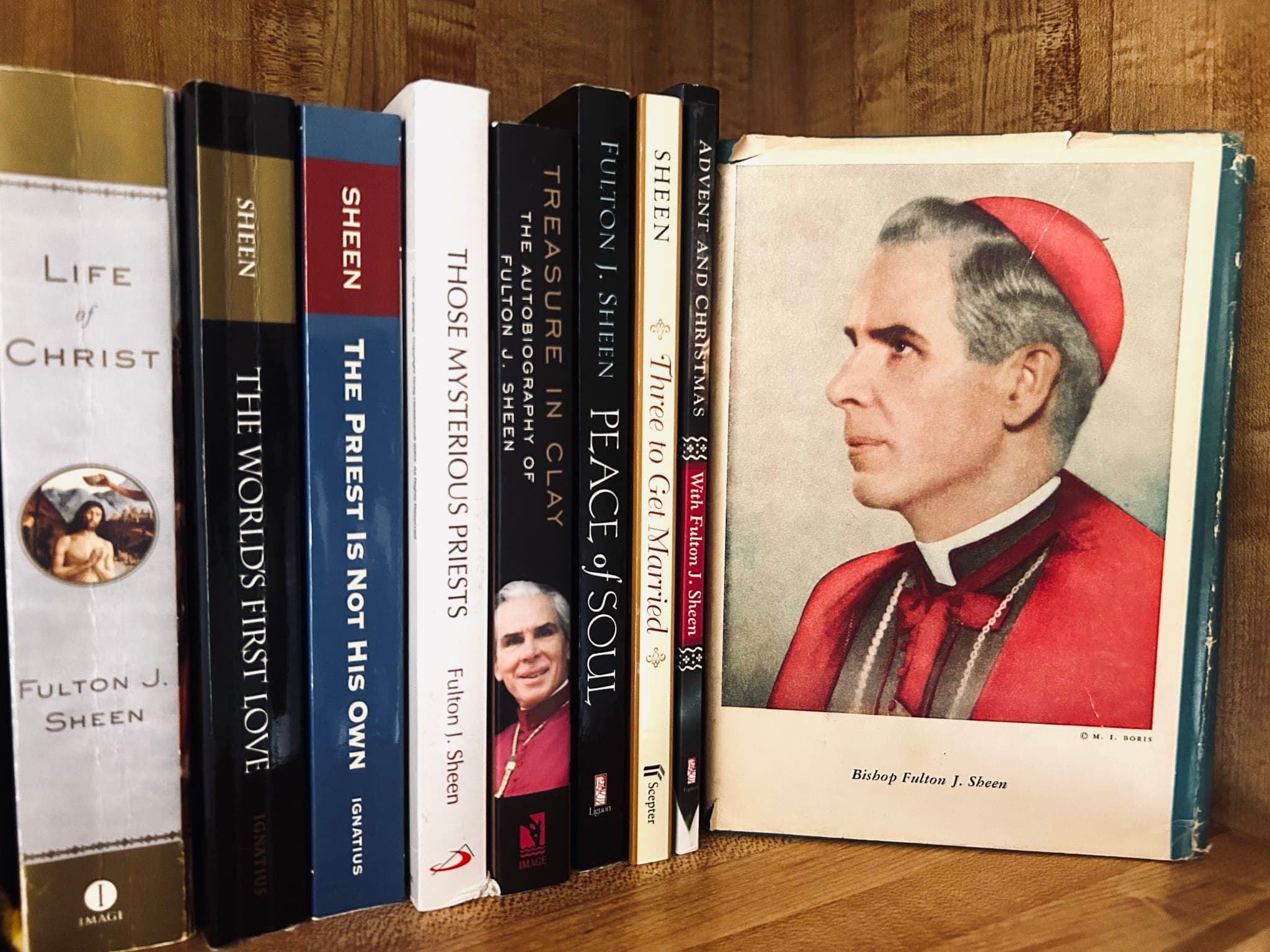
Joy filled my heart earlier this year when I heard the beatification of my saintly friend Ven. Archbishop Fulton J. Sheen was on once again. His writings, homilies, and broadcasts make him feel remarkably near for generations who were not yet here to watch his show when it first aired. Even though our earthly lives just missed overlapping, I like to think some small part of his torch was passed on to me — a fellow American Catholic communicator with Irish heritage.
A priest, erudite scholar and educator, award-winning television personality, retreat leader, philanthropist, daily holy hour enthusiast, and prolific writer, Archbishop Sheen was known for many things. However, it’s the last of these that has influenced my faith and career the most. With his final step before canonization just a few weeks away, I recently reflected on what his books have meant to me on my faith journey and in my newest professional role as editor-in-chief of Zeale News.
Growing closer to the ‘Life of Christ’
An almost ridiculous number of fluorescent tabs jut out of my copy of Life of Christ. The 658-page work published in 1958 is the first Fulton Sheen book I read, and I smile at my former self as I revisit the passages that have helped me better understand Our Lord and become more of who He means for me to be.
At the time of my first reading, I had parted from a longtime career as a magazine editor and was not yet in Catholic media, nor was I feeling that pull — yet. I had a lot to learn, and Sheen was, in large part, going to be the one to teach me.
As I dove back into the faith after too long away, reading this book was like entering a crucible. Through Sheen’s words, I was melted down, re-formed, and sent into the world as what felt like a new person.
“There must always be an emptying of the human before there can be a filling with the Divine, as the Divine emptied Himself to fill the human,” Sheen wrote in Chapter 8.
His writing was easy to understand but carried a depth and truth I hadn’t encountered before. The only way to communicate these scriptural and historical insights about Jesus so clearly was to have an uncommonly profound understanding and knowledge of them first, something I greatly appreciated as a writer and something I would later learn were the natural fruits of the author’s academic acumen and the supernatural fruits of his rich prayer life.
Expanding my Marian heart with ‘The World’s First Love’
Now I knew I needed to deepen my own prayer life. But how? In 2017, a friend pointed me toward Marian consecration. Honestly, I thought that was for much more serious Catholics than I was, but I believed my friend when she said a deeper relationship with the Blessed Mother is meant for us all. I completed the 33-day consecration to the Immaculate Heart of Mary, in which you dedicate your life to Jesus through Mary. Something fundamental changed in me again, and I was wanting to know even more about Our Lady.
Enter The World’s First Love: Mary Mother of God (1952). This book, which I’ve heard was his favorite, is also one of mine and is adorned with the same fluorescent multicolored tabs. Sheen’s love for the Blessed Virgin Mary is perhaps what endeared me to him most. He delves into the life of Mary, including events such as the Annunciation and the wedding feast at Cana as well as her apparitions at Fatima and dogma such as the Immaculate Conception with deep spiritual insights.
Throughout the book, he stresses how much all of mankind needs the Mother of God. He writes vividly about when Jesus gave his mother to us via John from the cross in Chapter 9, and he opens the book with a dedication and heart-melting devotional poem.
Dedicated to the Woman I Love
The Woman Whom even God dreamed of
Before the world was made;
The Woman of Whom I was born
At cost of pain and labor at a Cross;
The Woman Who, though no priest,
Could yet on Calvary's Hill breathe:
"This is my Body; This is my Blood"
For none save her gave Him human life.
The Woman Who guides my pen,
Which falters so with words
In telling of the Word.
The Woman Who, in a world of Reds,
Shows forth the blue of hope.
Accept these dried grapes of thoughts
From this poor author, who has no wine;
And with Cana's magic and thy Son's Power
Work a miracle and save a soul -
Forgetting not my own.
Understanding why ‘The Priest Is Not His Own’
Developing a Marian character has helped me come closer to understanding the mystery of the priesthood. It certainly has been key in understanding the priests whom I’ve been fortunate to call friends. Reading about Sheen’s own vocation and his description of the priest as victim in The Priest Is Not His Own (1963) deepened my appreciation for these other Christs who walk among us.
“The priesthood of Christ was different from that of all pagan priests and from the Levitical priesthood of the family of Aaron,” he wrote. “In the Old Testament and in pagan religions, the priest and the victim were distinct and separate. In Our Lord, they were united inseparably.”
No matter how much you get to know these men of God, they are still set apart and thus mysterious — part of the title of another one of Sheen’s books worth reading: Those Mysterious Priests (1974).
Discovering a ‘Treasure in Clay’
Everyone interested in his life, should read about Sheen in his own words. Born Peter John Sheen in El Paso, Illinois in 1895, he was ordained in the Diocese of Peoria in 1919 and rose quickly through the ranks of the church. He wrote humbly about himself in Treasure in Clay (1980), his posthumously published autobiography. I relished seeing photos of him and getting to know more about his family, his tenure at The Catholic University of America, and some of his lesser-known activities such as raising hundreds of millions for the poor as national director of the Society of the Propagation of the Faith and donating $10 million of his own earnings (only mentioned by the author of the preface), as well as his experience as part of the Second Vatican Council.
Around the time I was reading his autobiography, I pinpointed a specific day in his life to explore — the one when he visited my parish, Our Lady of Grace in Greensboro, North Carolina. At this time, I had also started dipping my toe in the world of Catholic media as a freelancer (and later as a staff writer) for my diocesan newspaper in Charlotte, North Carolina. Soon I was commissioned to write a book about St. Benedict, the first Catholic church in Greensboro. When I was researching that, I decided to look up some of my church’s history because I had already heard stories about Sheen’s visit in November 1976 — a major factor in the closeness I feel to him. With the help of one of the local librarians, I unearthed a news story about his visit with an exclusive interview. I had found a treasure in print!
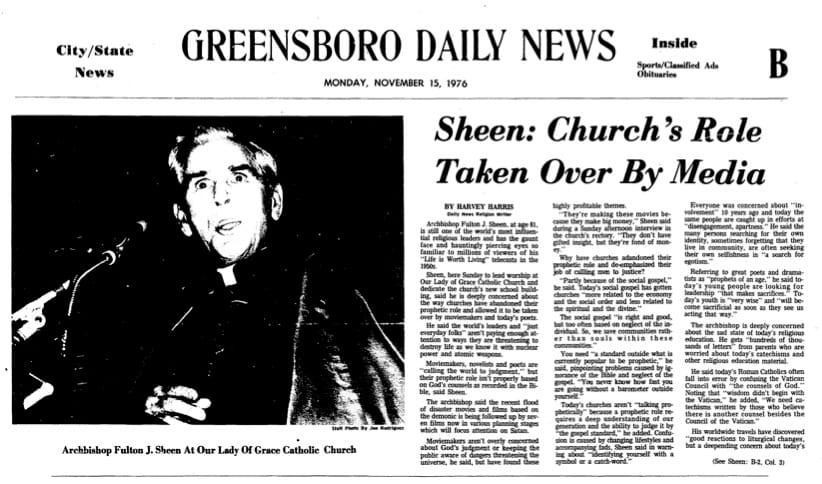
“Why have churches abandoned their prophetic role and deemphasized their job of calling men to justice? Partly because of the social gospel,” Sheen told then-Greensboro Daily News’ Harvey Harris.
Today's social gospel has gotten churches “more related to the economy and the social order and less related to the spiritual and the divine."
The social gospel “is right and good, but too often based on neglect of the individual. So, we save communities rather than souls within these communities.”
You need "a standard outside what is currently popular to be prophetic,” he said, and noted problems that come from ignorance of the Bible and neglect of the Gospel.
“You never know how fast you are going without a barometer outside yourself,” he added.
Inspired by this interview, I wrote a story in 2020 for the Catholic News Herald exploring what Sheen’s visit meant to my parish and interviewed a few of the parishioners involved. He celebrated Mass Sunday, Nov. 14, 1976, and blessed our church's organ and the school's then-new wing, which includes a gym. It was recently dedicated to Sheen and adorned with a plaque.
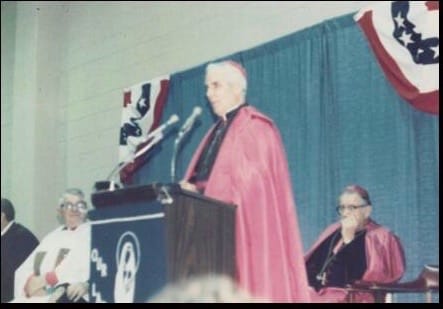
My children have walked those hallowed halls and have heard preaching at least twice a week from the same ambo. Our pastor has a gift similar to Sheen’s for connecting the Gospel to everyday life in the modern age, and I’ve seen the fruits of this in my children’s understanding of the faith.
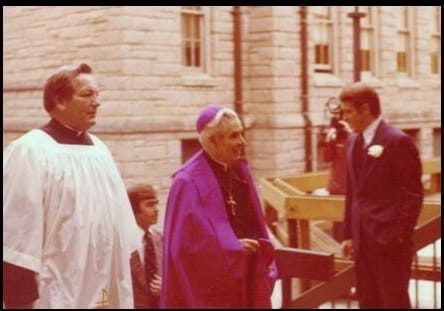
This is a very special moment for Our Lady of Grace. Fellow parishioners are embarking on an organized pilgrimage to Sheen’s beatification in St. Louis, including at least one who was present for Sheen’s visit in 1976. I look forward to seeing them there as Zeale News covers the event.
Finding ‘Peace of Soul’
During the pandemic, I had plenty of time to delve into Peace of Soul (1949), a book about inner conflicts, psychotherapy, and the peace of mind that can result from such interventions. Sheen explains that many issues people face are a result of guilt and can be expiated through confession, bringing a deeper peace of soul that only God can provide. It was even more philosophical than the other books, and there was more time in the early 2020s to reflect on his observations.
I underlined a passage containing Sheen’s description of a disordered sense of freedom.
“A stage is eventually reached where there is no acknowledged limit to self-expression. The most traitorous deeds are defended as civil rights; the defense of even the natural law is ridiculed as ‘medieval.’ This lawlessness, if widespread, creates such confusion in society that a tyrant soon arises to organize the chaos through force. Thus is fulfilled the dictum of Dostoevsky that ‘unlimited freedom leads to unlimited tyranny.’”
Why ‘Life Is Worth Living’
Two Septembers ago, I accepted an opportunity to lead a brand-new Catholic media outlet, Zeale News. One of the first things I told the editorial team about myself was my love for Fulton Sheen. For Christmas the next year, my husband gave me a first edition copy of Life Is Worth Living (1953), based on Sheen’s Emmy Award–winning television show. It even had the original handwritten receipt in its pages! The book contains 26 scripts transcribed from the tapings. Breaking up the text are illustrations by Dik Browne about which Sheen made a self-effacing comment concerning his artistic abilities and called the new ones an improvement of his on-air chalkboard drawings.
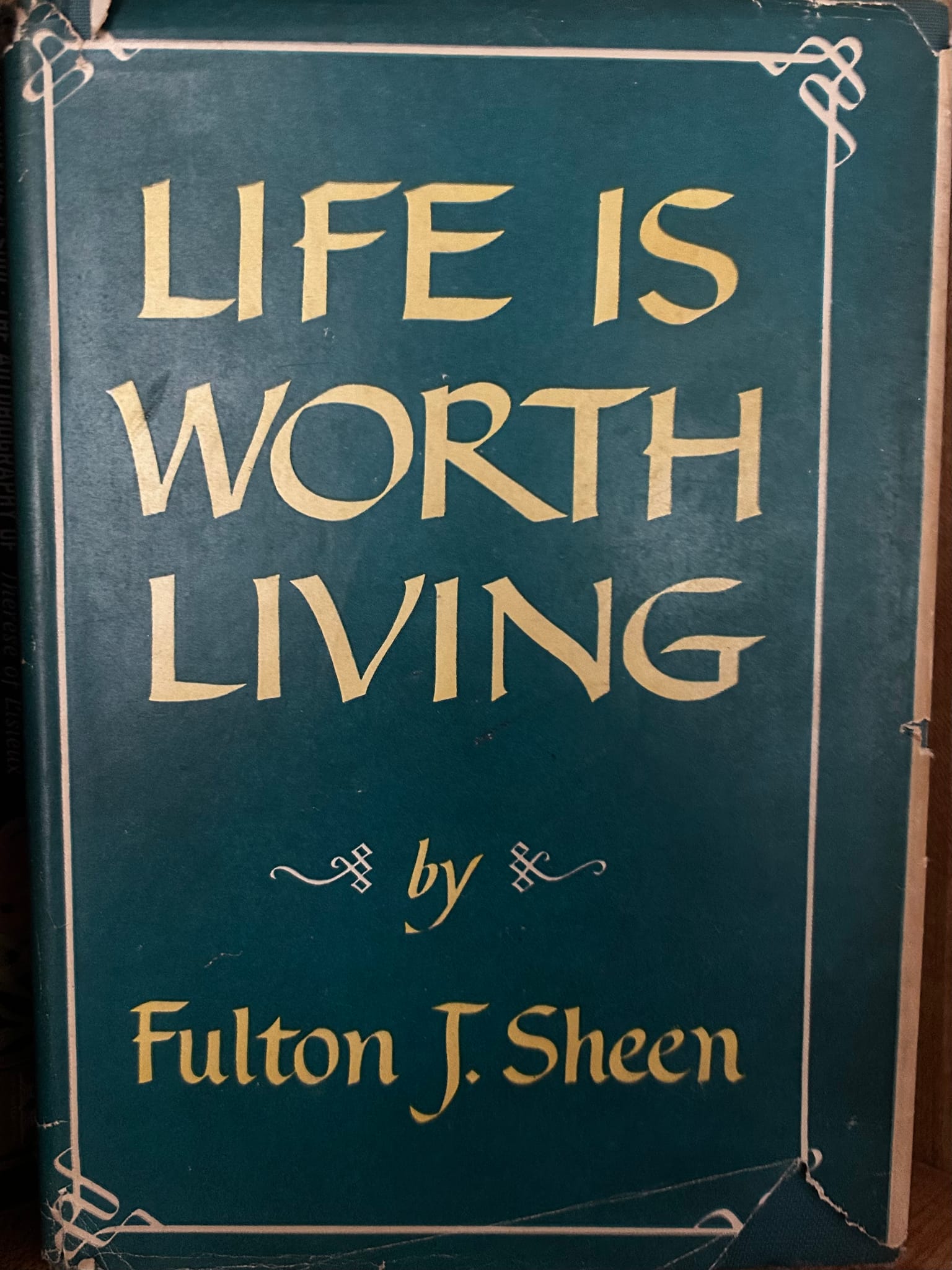
Reading Sheen’s prophetic words about war, pain, suffering, anxiety, socialism, and communism in these pages is certainly applicable to my work and reminds me of the importance of our team’s mission.
On war he wrote, “If true peace is to be won, it must first be won in our own hearts. Let us turn back to God and establish justice in our souls.”
Throughout his ministry, he warned extensively about communism and socialism, concerns that are especially relevant in today’s political landscape.
“If rights come to us from God, then no state, no parliament, no dictator can ever take them away!” he wrote in Life Is Worth Living. “If they come from the Socialist state, then the Socialist state can take them away.”
On the role of America, he wrote: “We are destined, under Providence, to be the secondary cause for the restoration of the freedom and liberties of the peoples of the world. We are the secondary cause; God is the primary cause. To fulfill that role, we shall have to make ourselves worthy of it.” Amen.
Exploring these works has helped me live St. Paul's advice about not conforming yourself to this age and instead “being transformed by the renewal of your mind” (Rom 12:2). Yet this collection, as meaningful as it is, only scratches the surface of Sheen’s 66 books. I can’t wait to see what other titles will shape my journey and to celebrate Sheen on Sept. 24, the blessed day of his beatification. Meet me in St. Louis!







Comments