How to cultivate an interior life: Virginia bishop reflects on prayer with Catechism and Scripture
Though cultivating a relationship with God through prayer may sound like a daunting endeavor, Scripture and the Catechism of the Catholic Church offer profound insight about what prayer is, how to practice it, and the transformative effects it can have, according to Bishop Michael Burbidge of Arlington, Virginia.

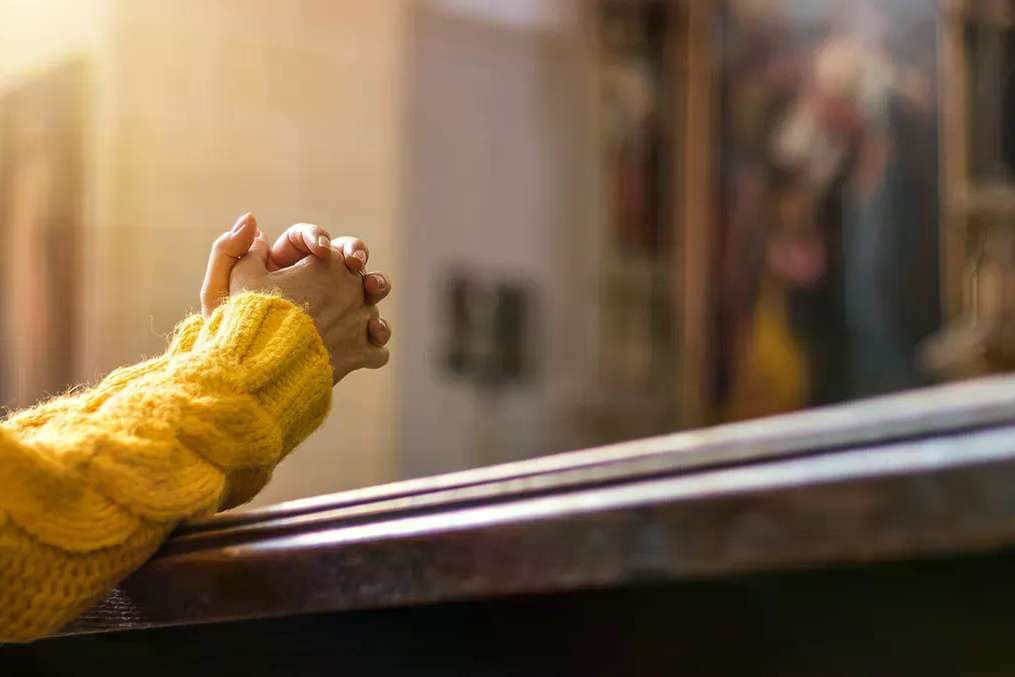
Though cultivating a relationship with God through prayer may sound like a daunting endeavor, Scripture and the Catechism of the Catholic Church offer profound insight about what prayer is, how to practice it, and the transformative effects it can have, according to Bishop Michael Burbidge of Arlington, Virginia.
“The Catechism of the Catholic Church (CCC) presents prayer precisely in this way — as an act and habit that forms and shapes us, drawing us into deeper communion with God,” Bishop Burbidge wrote in a reflective article released on the National Eucharistic Revival website just ahead of the start of Lent. He described prayer as “a school of the heart and mind” that enables one to grow closer to God, make decisions, and encounter what is true.
“Sacred Scripture and the Catechism remind us that our interior life is cultivated through deliberate actions,” he added, “including our conscious turning away from the superficial and toward the One who knows us intimately: ‘Even before a word is on my tongue, Lord, you know it all’ (Ps 139:4).”
The bishop explained in the Feb. 11 article that the Catechism defines prayer as lifting one’s mind and heart to God. However, this does not mean that the human being is credited with making the first action in the relationship with God, according to Bishop Burbidge.
“We should realize that prayer is not primarily our own effort, but a response to God ‘who first seeks us’ and who ‘thirsts that we may thirst for him,’” he wrote, citing CCC paragraph 2560. “Although prayer often is spoken and manifest visibly, it springs from an interior desire of the soul that God himself prompts within us.”
Bishop Burbidge added that deepening the interior life requires a person’s intentional effort and action, including choosing to reject what is superficial and look to God in acknowledgement of one’s total dependence on Him. External and visible signs of prayer flow from this interior recognition, as is evident in Scripture. Bishop Burbidge observed that David points to this reality in Psalm 63, which expresses the soul’s yearnings for God as one thirsts for water in a desert.
Bishop Burbidge explained that prayer brings one into the depths of his or her own heart, as the Catechism states that Scripture tells us it is the heart that prays” and that it is a place of both truth and encounter.
“The heart is the inner room where all the faithful, by virtue of having been united with Christ in Baptism, may enjoy communion with God through prayer,” Bishop Burbidge wrote.
Prayer is also “a battle” against oneself and always requires effort, according to the Catechism. Bishop Burbidge explained that Christ prayed in the agony in the garden for the Father’s will to be done, and that the Catechism notes that prayer helps shape the heart to fit God’s will.
“This is not always easy because the allure of distractions, the experience of dryness, and other temptations threaten to pull us away from relationship — yet these very struggles help school the mind and heart in attentiveness, sincerity and perseverance,” the bishop wrote.
Further, it is imperative to pray daily, especially on days when one is not particularly interested in doing so, as Saint Paul said to “pray without ceasing,” Bishop Burbidge recalled, adding: “If we want to further our relationship with the Lord, we simply must find ways to integrate prayer into the rhythm of daily life — whether through morning offerings, evening recollections, or spontaneous conversation with God amid our daily tasks.”
He encouraged the faithful to pray vocally and mentally, through meditation and contemplation. Eucharistic adoration is “a wonderful means” of exercising these various ways to pray, Bishop Burbidge wrote.
“When we pray in Adoration, whether vocally, through meditation or in a contemplative way, we place ourselves in the presence of Christ who redeemed us all in an act of sacrificial love,” he wrote. “Realizing this great truth trains our minds and hearts to take on the features of Jesus and to give ourselves in loving service to God and neighbor. In this way, the ‘inner room’ of our hearts becomes a kind of sanctuary where the Lord nourishes us with his grace and where we can hear his voice quietly sending us forth to be his missionary disciples in the world.”



.jpg&w=3840&q=75)



Comments