In Holy Thursday Chrism Mass, Pope Leo calls Church to renew its missionary identity
Pope Leo XIV presided over the Chrism Mass at St. Peter’s Basilica on Holy Thursday, blessing the holy oils used in the sacraments across the Catholic Church for the coming year and leading priests in the renewal of their ordination promises.

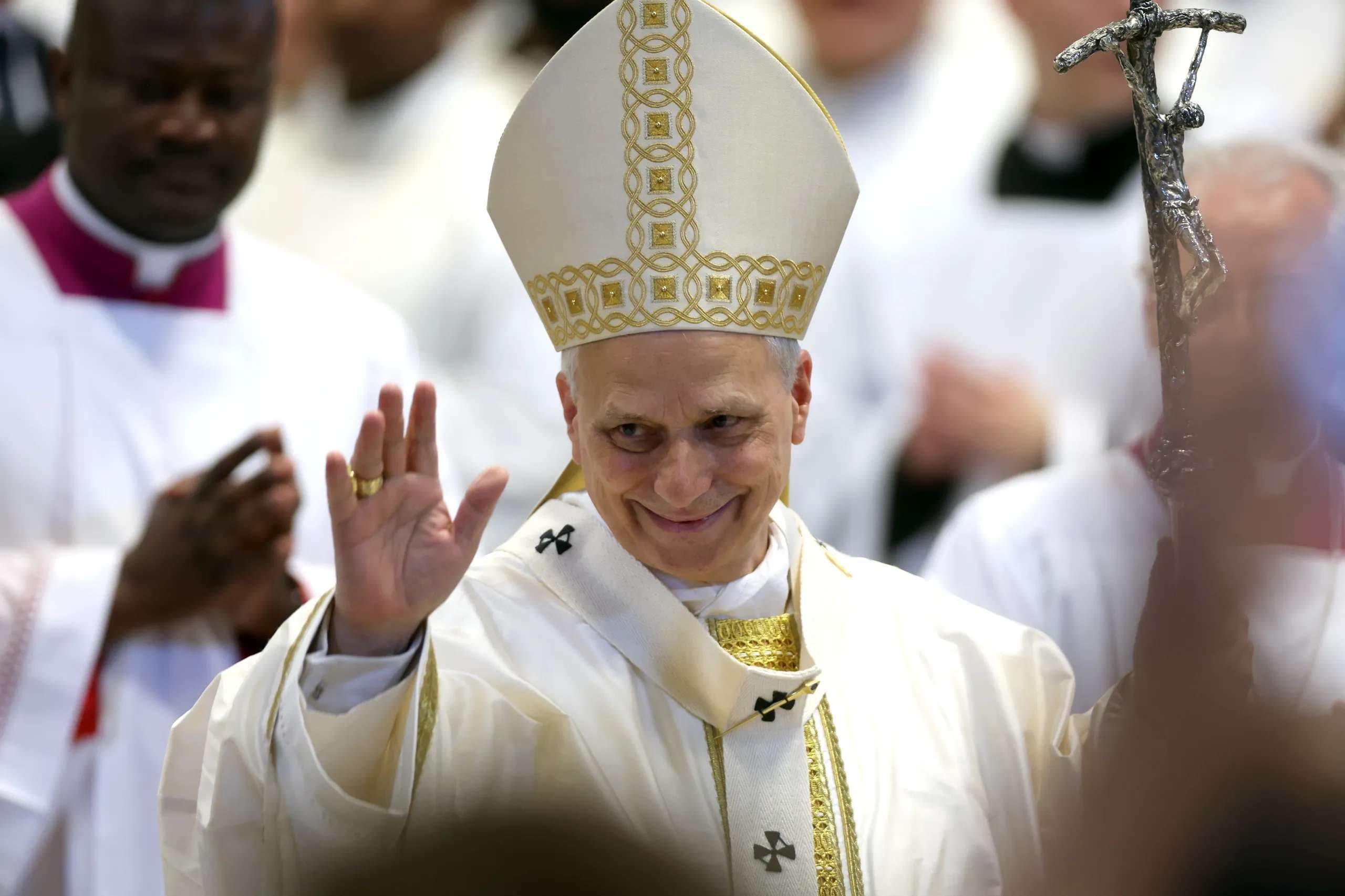
Pope Leo XIV presided over the Chrism Mass at St. Peter’s Basilica on Holy Thursday, blessing the holy oils used in the sacraments across the Catholic Church for the coming year and leading priests in the renewal of their ordination promises.
In his homily, the Holy Father reflected on the Church’s missionary identity, calling the faithful to proclaim Christ’s Passion to the world in “this dark hour of history.”
The liturgy — held in the morning as tradition dictates before the evening Mass of the Lord’s Supper that begins the Triduum — drew cardinals, bishops, priests, and the faithful to the Vatican. He centered his homily on the Church’s shared calling rooted in Christ’s sending by the Father and connected the day’s readings from Isaiah and the Gospel of Luke to the Easter Triduum.
“We are now on the threshold of the Easter Triduum,” Pope Leo said. “Once again, the Lord will lead us to the culmination of his mission, so that his Passion, death, and Resurrection may become the heart of our mission.”
He called on the faithful to reflect on the Christian calling in which each person participates “according to our own vocation in a deeply personal obedience to the voice of the Spirit” and in communion with the entire Church.
“Bishops and priests, as we renew our promises, we are at the service of a missionary people,” Pope Leo said. “Together with all the baptized, we are the Body of Christ, anointed by his Spirit of freedom and consolation, the Spirit of prophecy and unity.”
He described the Church and its mission as “apostolic,” noting that God “consecrates in order to send.” Just as Christ declares in Luke 4:18 that he has been sent by God, so too, “we, as members of his Body, speak of a Church that is ‘apostolic,’ sent out, driven beyond itself, and consecrated to God in the service of his creatures,” Pope Leo said.
The Holy Father highlighted three aspects of the Church’s mission: detachment from the familiar and the certain, genuine encounter with others, and the real possibility of rejection.
Reflecting on detachment, Pope Leo said every apostolic effort begins with “that kind of self-emptying in which everything is reborn.” He said there is “no mission without reconciliation with our past, with the gifts and limitations of the upbringing we have received; but, at the same time, there is no peace without setting out, no awareness without detachment, no joy without risk.”
He then turned to the “law of encounter,” which he said history has often distorted by a desire for domination — something “entirely foreign to the way of Jesus Christ.”
“Neither in the pastoral sphere nor in the social and political spheres can good come from abuse of power,” he said. “The great missionaries bear witnesses to quiet, unobtrusive approaches, whose method is the sharing of life, selfless service, the renunciation of any calculated strategy, dialogue and respect. It is the way of the Incarnation, which always takes the form of inculturation. Salvation, in fact, can only be received by each person through his or her native language.”
He urged Christians to “go where we are sent with simplicity, respecting the mystery that every person and every community carries with them.” Pope Leo added that by doing so, and by walking together as the Church, the faithful can bring Jesus’ word “to the inmost soul of our cities.”
“As Christians, we are guests,” he said, adding that this is true even for bishops, priests, and religious. “To be hosts, in fact, we must learn to be guests ourselves. Even the places where secularization seems most advanced are not lands to be conquered or reconquered.”
Lastly, Pope Leo reflected on “perhaps the most radical” dimension of the Christian calling: “the dramatic possibility of misunderstanding and rejection.” He described the cross as an unavoidable part of mission and encouraged the faithful not to retreat in the face of opposition, but to pass through trials as Christ did — trusting that hardship can lead to renewal and transformation.
Throughout his homily, Pope Leo returned to the theme of unity, emphasizing that mission is not an individual endeavor but the work of the entire Church.
Concluding his message, the Pope urged Catholics to reject fear and a sense of powerlessness and instead bear witness to hope as they proclaim Christ’s death and Resurrection.
“In this dark hour of history,” he said, “it has pleased God to send us to spread the fragrance of Christ where the stench of death reigns. Let us renew our ‘yes’ to this mission that calls for unity and brings peace. Yes, we are here! Let us overcome the sense of powerlessness and fear! We proclaim your death, O Lord, and we proclaim your resurrection, as we await your coming.”


.jpg&w=3840&q=75)

Comments