On first day of apostolic visit to Spain, Pope Leo urges ‘renewed fidelity to the Gospel among believers’
Beginning his fourth apostolic journey, Pope Leo XIV arrived in Madrid, Spain, June 6 and met with the king and queen of Spain, as well as diplomatic corps, whom he extolled in an address to protect conscience and religious freedom, the pursuit of peace, and dialogue within the country.

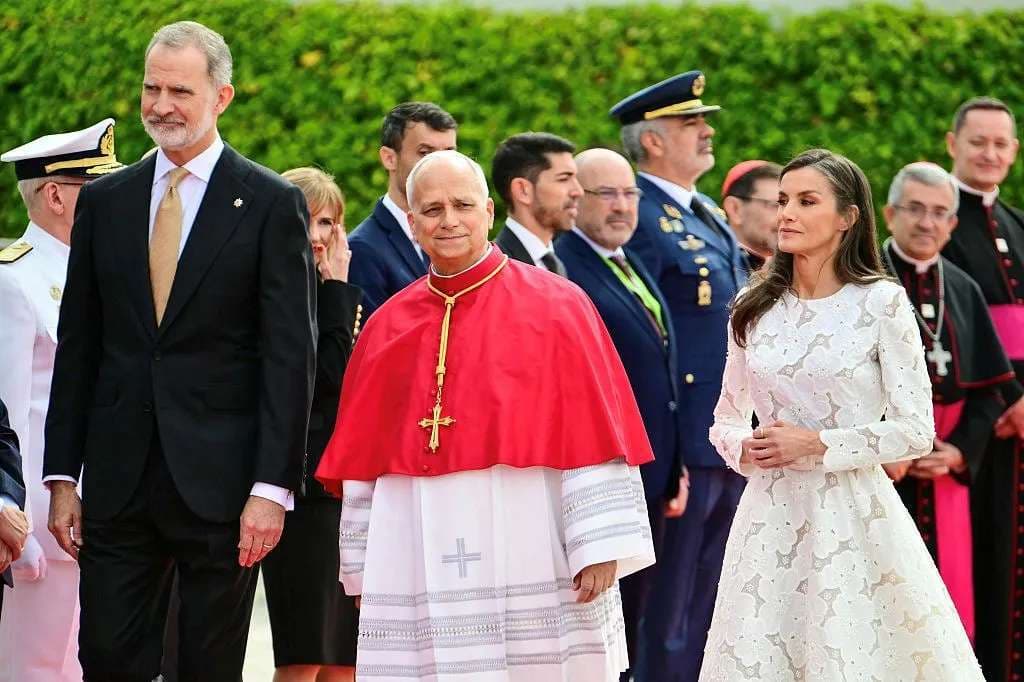
Beginning his fourth apostolic journey, Pope Leo XIV arrived in Madrid, Spain, June 6 and met with the king and queen of Spain, as well as diplomatic corps, whom he extolled in an address to protect conscience and religious freedom, the pursuit of peace, and dialogue within the country.
The Pontiff was greeted in a welcome ceremony upon his arrival at the Royal Palace in Madrid, where he then held a courtesy visit with King Felipe VI and Queen Letzia of Spain. The royal family’s two daughters, Princess Leonor and Infanta Sofía, also attended the meeting.
After this, the Pontiff gave an address to authorities, diplomatic corps, and civil society at the Royal Palace. He began by greeting the royal family and those present, expressing gratitude for the opportunity to travel there. He reflected on Spain’s historic connection to Christianity, noting the initial evangelization of the Iberian Peninsula is linked to James the Greater. He said the country’s artistic and musical heritage, charitable groups, and other elements of its culture witness to Jesus’ encounter with the people of the country.
Continuing, Pope Leo said, “I come among you to affirm, encourage and instill a renewed fidelity to the Gospel among believers, as well as a deeper reconciliation and collaboration among the various elements of this nation.”
“After all, your own history suggests that a culture of encounter, not confrontation, is what fosters stability and prosperity,” he said. “In reality, the message of peace, which at present unfortunately strikes some as naïve and others as confrontational, is welcomed by those who do not shut themselves off in preconceived ideologies, but are rather open to the truth.”
He emphasized that because the truth is always greater than us, it “draws us toward paths of purification and reconciliation, in which dialogue with others — and with the Other with a capital ‘O’ — becomes fundamentally important.”
Noting how the present age is marked with darkness, Pope Leo then recalled the witness of two prominent saints from Spain: John of the Cross, author of The Dark Night of the Soul, and Teresa of Avila, author of The Interior Castle. He explained that St. John of the Cross grew to appreciate his experience of interior darkness as enabling his soul to detach “from what it presumed to know and possess” — an experience in which he encountered God.
Because the experience of darkness can be so distressing, the world needs men and women in public and private life who can see light in darkness and pursue truth and peace.
Citing his encyclical Magnifica Humanitas, the Pontiff then urged for a renewal of cherishing human dignity.
“Our age, seemingly shaken by terrible imbalances and conflicts, cries out from its depths for peace,” he said, “for a new understanding of the human person and its inviolable dignity, for a civilization of love.”
He also called for religious freedom and freedom of conscience to be protected; he explained that St. Teresa of Avila refers to the human soul as the interior castle, and that as one goes further in toward the innermost chamber of “one’s own heart, the sanctuary of truth,” he or she finds that “the space enlarges, the mind opens, challenges are overcome, tensions dissipate, others find their place, and the universe becomes a home.”
He said this is not escapism into oneself, but “a radical openness” to God that is “achieved when we return to ourselves.”
He continued: “This dimension of the human person is the reason why religious freedom and freedom of conscience must be protected.”
“Today, the temptation to gain popularity by fanning the flames of polarization seems to have grown rather than diminished, and human dignity continues to be violated,” he added. “This is why we need culture, interiority, and free quality education; we need transcendence. And yet, even in these dark nights, men and women who are faithful to the truth have been driven to advance from one room to another until justice and peace embrace in their conscience. It is through their freedom that we learn to be free.”
He also told the political leaders that the Catholic Church, through the witness of the Gospel, is ready to support the pursuit of peace and reconciliation. He urged everyone to “set aside the divisive and polarizing narratives of your societal reality and history,” but to rather learn to appreciate the complexity of the history and preserve critical thinking amid developing technologies.
Those with economic, political, and institutional responsibilities should “make a qualitative leap forward — a change of direction in investment in schools, universities and research, as well as in local communities and civil society as a nurturing ground for participation and cultural mediation,” he urged.
He said that security is “best achieved by learning to move forward alongside one another,” rather than through “weapons and walls.”
“Your own history bears witness to this. The presence of Islam on the Iberian Peninsula, for example, constituted a long-standing political, cultural, and religious reality,” he said. “During that period, there was not only confrontation, but also an attempt to create a space for contact, conversation and dialogue on the meaning of truth among Christians, Muslims and Jews.”
He noted that 13th-century King Alfonso X of Castile and Leon promoted the School of Translators, in which “experts from all three religions collaborated” on translating Arabic, Greek, and Hebrew texts, and that the cities of Córdoba and Toledo “became centers of dialogue between languages, religions and knowledge.”
Pope Leo also recalled how Spanish saint Ignatius of Loyola, a soldier who left behind his military career for religious life, promoted exercises of discernment. His discernment “led him to prefer peace over arms and the saints to the powerful,” Pope Leo said.
“Let us establish standards for discernment — the dignity of the human person, the universal destination of goods, the preferential option for the poor, care for our common home and peace — and let us translate these standards into practices such as responsible planning, the assessment of human and social impact, the inclusion of the most vulnerable, the promotion of digital literacy and guiding research and industry toward justice and peace,’” he said, quoting Magnifica Humanitas.
Concluding, he expressed gratitude for Spain’s “faithful adherence to international law and multilateralism, which is reflected in an active commitment to peace and solidarity among peoples.”
“At the same time, I encourage you to cultivate as well dialogue and civic friendship within your own country,” he said, “to take into account the perspectives of the poor and the young when envisioning the future, to harmonize the claims for autonomy and unity, and to advance the cause of unity in Europe — not in opposition to other powers, but as a gift to the entire human family.”
On the first day of his visit, he also held an audience with the staff and beneficiaries of the Cedia 24 Horas Social Project, an organization that supports migrants, and held a prayer vigil with young people.
During the apostolic journey, Pope Leo will also visit Barcelona, Montserrat, and the Canary Islands. The Holy Father’s apostolic journey will conclude June 12 when he departs from the Canary Islands after several meetings and Mass.
.jpg&w=3840&q=75)

.jpg&w=3840&q=75)

Comments