Cardinal Sarah to EU leaders: Crisis of the West's loss of identity is linked to Church's crisis
In his wide-ranging keynote address, the cardinal denounced gender ideology and Islamic fundamentalism as two distinct “apocalyptic beasts” that threaten to destroy man himself.

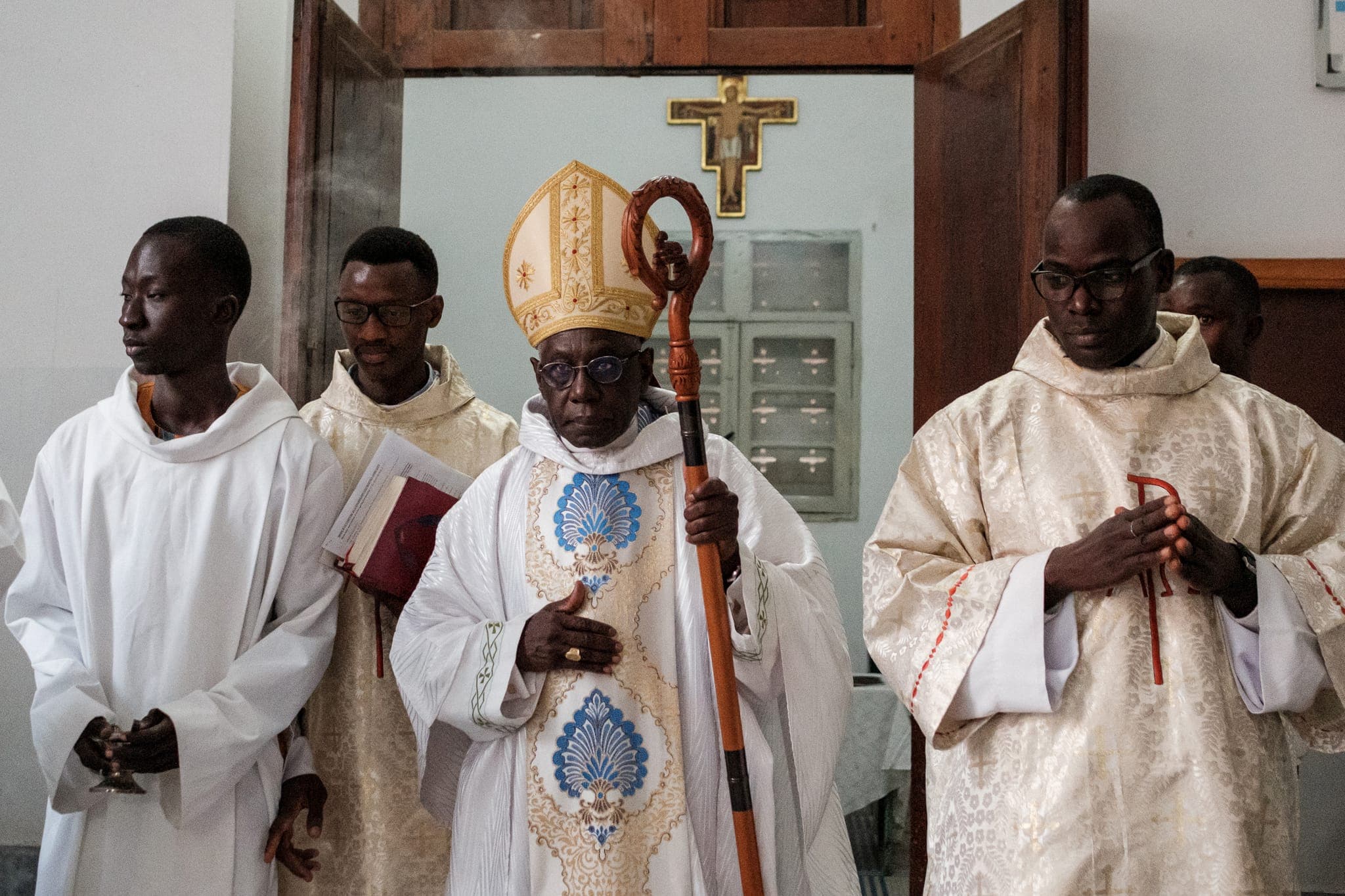
In a speech at the European Parliament (EP) this month, Cardinal Robert Sarah warned that Europe is losing its identity due to the diminishment of the Church’s role in public life, calling on leaders to look to Africa for an example of how to recover Europe’s cultural and political integrity.
Speaking at a July 15 EP conference in Brussels, Cardinal Sarah, the archbishop emeritus of Conakry, said “the crisis of the Church in the West and the crisis of the West itself are, at bottom, the same crisis.”
“It is because the Church in many European nations has lost her own identity, her prophetic voice, that the West itself has lost the sense of its own civilization,” he explained.
With “respect” but “without reservations,” he appealed to both secular and religious leaders in the West to heed the voice of Africa.
“Respect its cultural sovereignty,” he said.
If Europeans approach Africa in a spirit of “free cooperation” and without imposing “ideological agendas” on the continent, he said, then the “tired West” can receive from Africa “the testimony of a living faith and of a sense of the family, which can help Europe itself to rediscover its own logos.”
Islamic fundamentalism and gender ideology: two apocalyptic ‘beasts’
The cardinal spotlighted Islamic fundamentalism and gender ideology as two forces that regard man as something that can be “rewritten,” because both reject the logos, that is, reason in accordance with God’s nature. When logos is lost, Cardinal Sarah said, religious freedom and the dignity of the human person are at risk.
“I have many times denounced, and I repeat today in this venue, the will of certain powers to impose false values through political and financial arguments,” he said. “In some African countries, veritable ministries dedicated to gender theory have been created in exchange for economic support.”
He recalled when a Secretary General of the United Nations “came to Africa to ask for the decriminalisation of homosexuality as a condition of civilization,” decrying the official’s attempt to “impose on the poor this kind of absurdity, while hospitals, schools, drinkable water are lacking.”
“The material poverty of Africa does not take away its dignity,” Cardinal Sarah insisted, “nor its right — indeed it gives it perhaps a stronger title — to judge for itself what is good for its own children.”
Recounting his 2015 remarks about Islamism and gender ideology during the Synod on the Family, Cardinal Sarah said “I do not retract today a single word,” reiterating “that gender ideology and Islamic fundamentalism represent, each in its own way, two ‘apocalyptic beasts’, threatening to destroy not only the family, but man himself, image of God.”
Despite the obvious differences between the two movements, both “share the pretension of rewriting man according to their own liking — one in the name of an alleged progress, the other in the name of an alleged return to an original purity — denying in every case that religious freedom and that dignity of the person which I have placed at the centre of this Lectio,” Cardinal Sarah said.
The danger of losing, or subverting, the meaning of words
Cardinal Sarah cited a statement Pope Leo XIV made in January during a speech to the diplomatic corps: “We need words to express once again, unequivocally, certain realities. Only in this way can an authentic dialogue, free of misunderstandings, resume.”
The cardinal also cited the Holy Father’s warning that the world is undergoing “a crisis of the logos, of reason.”
The cardinal had begun his address by asking whether Africa and Europe can still “understand one another,” questioning whether words such as “human rights,” “dignity,” “development,” “gender,” “family,” and “freedom” have the same meaning in both continents.
The answer to that question will be decisive for the future of both Europe and Africa, he said. As things currently stand, language is not used “to reveal reality, but to conceal it or even to invert it” in exchanges between the European Union and Africa, the cardinal said.
He gave the example of the euphemistic use of the term “sexual and reproductive health” to refer to the expansion of the abortion industry.
“If words no longer mean what they say,” he asked, “how can there be authentic dialogue? How can Africa trust a Europe which speaks with equivocal, double-meaning words?”
As an alternative, he invited leaders to return to using language in truth, especially when it comes to matters affecting the family, the human person, and cooperation between the EU and Africa.
The crisis of language is rooted in the crisis of reason itself, Cardinal Sarah explained. He pointed to what he described as Pope Benedict XVI’s “prophetic lucidity” in diagnosing in 2006 the present evil, now “unfolding in its fullness.”
“Logos — the Pope explained — means both reason and word. A creative reason, capable of communicating itself precisely as reason,” Cardinal Sarah said, quoting Pope Benedict again: “Not to act in accordance with reason, not to act with the logos, is contrary to God's nature.”
Cardinal Sarah said that the “primacy of the logos, threatened by juridical and economic positivism, finds its most direct and most painful application precisely in the question of gender ideology.”
He recalled that Pope Benedict pushed back in 2012 on the notion that “one is not born a woman, one becomes one.” The man who makes such a claim “denies his own nature,” the late Holy Father said, regarding it not as a “pre-constituted fact,” but something he himself creates. “Where the freedom to do becomes freedom to make oneself,” Pope Benedict said, “one necessarily arrives at denying the Creator himself.”
Abortion and gender ideology
Cardinal Sarah pointed out that treaties between the EU and the African countries are riddled with contingencies relating to “sexual orientation,” “gender identity,” and “sexual and reproductive health education.”
“These,” Cardinal Sarah said, “are not neutral categories: they are the political and juridical application of that very negation of given nature, of that very refusal of the Creator, of which Benedict spoke to us.”
He denounced the manifestation of gender ideology in educational programs and conditioned aid, particularly in binding agreements that attempt to “[redefine] the person and the family according to secularized Western standards….” He urged the officials present to protect the true meanings of words like “man,” “woman,” “marriage,” and “family,” and not to allow them to be “reduced to social constructs manipulable at the whim of ideological fashions of the moment.”
He later criticized the EP’s resolutions, adopted in 2022, prioritizing “universal access to safe and legal abortion” and proposing the inclusion of abortion as a fundamental right in the EU’s charter.
“Here the reversal of the logos or of reason reaches its most dramatic point: the lack of access to abortion is defined as ‘violence’, while the conceived — the weakest, the most innocent among us — is deprived of any word, of any representation, of any right,” Cardinal Sarah said.
Christianity is not a recent or a foreign element of African identity
Cardinal Sarah emphasized that Africa contributes significantly to the defense of logos and the preservation of Christian tradition, with a deeply rooted Christian identity dating back to the fourth century.
“It is perhaps not superfluous to recall, in this venue, that Christianity is not for Africa a recent importation nor a residue of European colonialism, as is sometimes insinuated in certain secularised circles,” he said. “Long before Europe evangelised sub-Saharan Africa in modern times, North Africa and the Horn of Africa had already given to the universal Church some of its greatest teachers: Tertullian, Cyprian, Athanasius, and, above all, Augustine of Hippo, whose reflection on the relationship between faith and reason nourished for centuries theology and the entire Western culture, including, not by chance, Pope Benedict XVI himself.
“Ethiopia preserves an uninterrupted Christian tradition since the fourth century. When, therefore, we speak of the religious self-determination of the African peoples, we are not defending a ‘tribal particularism’, opposed to an alleged European universalism: we are defending the freedom of a continent that has contributed, from the origins, to shaping that very Christian logos of which Europe today risks losing the memory.”
He emphasized that this overturns “the implicit narrative of a certain development cooperation, which treats Africa as a perpetual learner and Europe as a definitive teacher: the history of the Church tells us, on the contrary, that the gift of faith has always been reciprocal, and that Africa has as much to give back as it has received.”
Conclusion: A call to recommit to using language that reflects reality
Cardinal Sarah emphasized that without using language that reflects reality, dialogue, even within the Catholic Church, cannot take place, as Pope Leo has warned.
“And I add: without logos, diplomacy and international cooperation degenerate into a game of force disguised as technical language,” he said. He thus invited the entire EP to reexamine its use of language, particularly regarding human rights, gender, and family, and consider “whether these definitions truly respect the dignity of the person and religious freedom, or whether they betray them, under an apparently neutral language.”
Concluding, he reiterated his call to uphold the dignity of the human person, saying this is crucial for trust between Africa and Europe.
“One last word, born from the heart of an African pastor: the history of the faith on my continent teaches us that the Church grows, often, precisely in the seasons of trial, and that the peoples who guard their own religious and cultural identity, against every external pressure, are, in the end, those who best serve the cause of a true universal fraternity,” he said.
“I do not ask of the European Parliament an act of faith, but an act of reason: verify, with the very instruments of your juridical wisdom, whether the words you pronounce truly honour the human person, the family, the freedom of peoples. If they do, Africa and Europe will walk together. If they do not, no treaty, however well written, will be able to bridge the distance that the ‘betrayed words’ will have dug between us.”
.jpg&w=3840&q=75)


Comments