US ambassador to Holy See visits Taybeh day after settler attack on locals, European diplomats
The visit came the day after masked Israeli settlers attacked European diplomats and Palestinian civilians, near Taybeh Oct. 17. In a statement condemning the attack, Church leaders in Jerusalem also denounced a rabbi’s recent religious ruling allowing Jews to take Palestinians’ olive harvests.

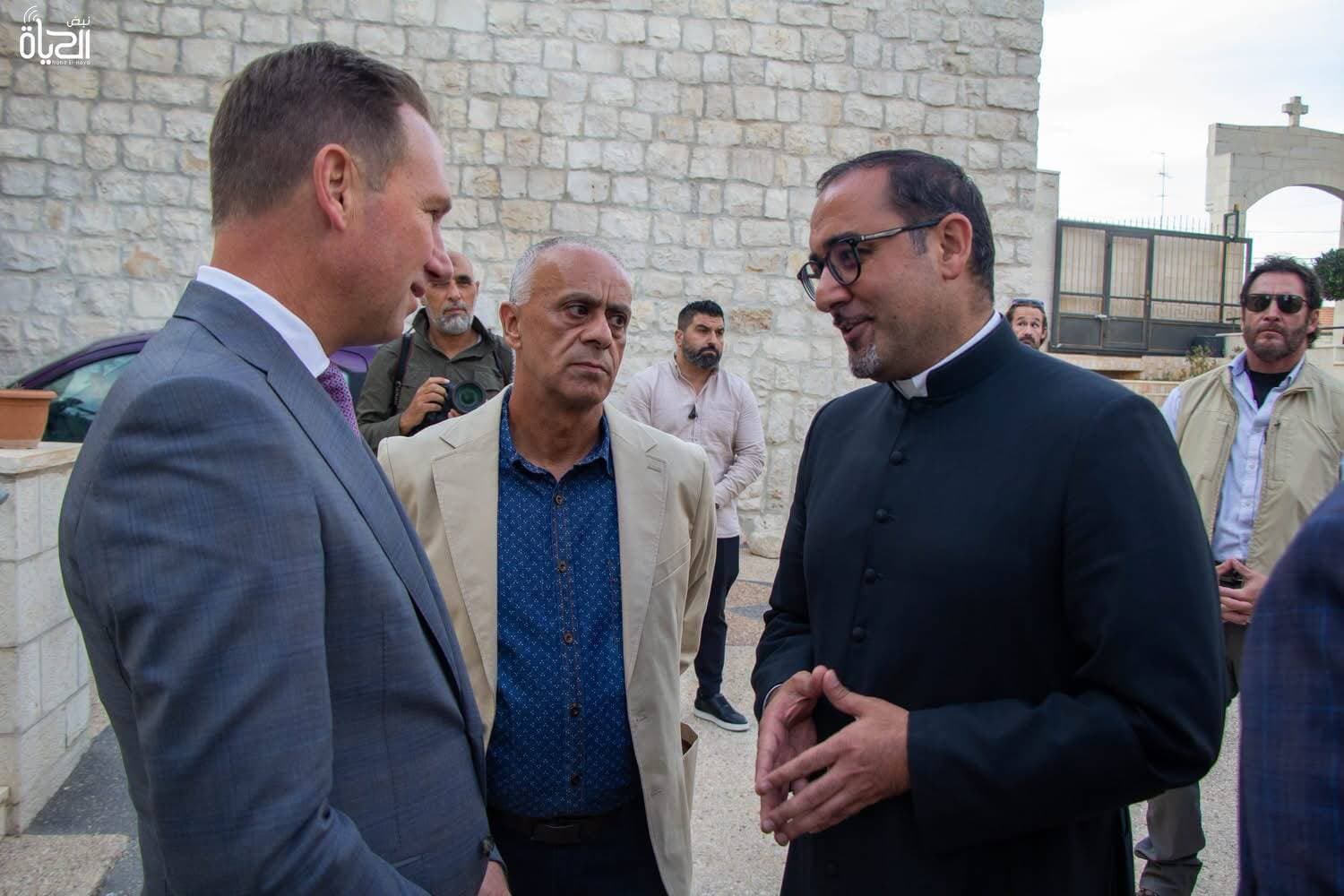
U.S. Ambassador to the Holy See Brian Burch visited the West Bank Christian town of Taybeh Oct. 18, just one day after settlers attacked residents and European diplomats in the town. The attack was denounced this week by the Patriarchs and Heads of Churches in Jerusalem, who stressed that it is not an isolated incident but a part of “wide-scale terror by settlers.”
The church leaders described the attack as “heinous” and outlined that it was perpetrated by masked settlers during the olive harvest. They said it was carried out against local residents of Taybeh “and against the foreign guests, including diplomats and officials from European countries, who were with them in a visit of solidarity to the areas sustaining continuous attacks by similar groups of settlers.”
Burch visited Taybeh along with several other U.S. diplomats, including Riley Barnes, the assistant secretary of state for democracy, human rights and labor. Local church officials informed Zeale News that Burch met with Father Bashar Fawadleh, parish priest of Christ the Redeemer Church in the Christian village at the Latin monastery of Taybeh. According to Reuters, the U.S. diplomats were also set to meet with Taybeh residents.
"His visit was focused on understanding the security and safety issues facing this historic Christian village," a statement posted to the ambassador's X account Oct. 20 read. The visit to Taybeh was part of a four-day visit to Israel, where Burch also met with Cardinal Pierbattista Pizzaballa, Latin Patriarch of Jerusalem. Burch also met with Israeli President Isaac Herzog, U.S. Ambassador Mike Huckabee, as well as Israeli Ministry of Foreign Affairs officials, including Ambassador George Deek, Israeli's Special Envoy to the Christian World, according to the statement.
The visit to Taybeh came one day after masked Israeli settlers attacked diplomats from Belgium, France, and Poland, as well as a French mayor and Palestinian civilians, near Taybeh Oct. 17.
“This wild attack on the Christian village of Taybeh and against its peaceful population is not an isolated incident,” the Patriarchs and Heads of Churches said in the Oct. 20-issued statement. “In the past weeks the Palestinian villages of the West Bank have been exposed to a wide-scale terror by settlers, which is reaching a peak during this time of the olive harvest, when families go to their lands to collect what they need to live and renew their generations-long bond with their lands.”
“In this regard, we consider the religious ruling recently published, allowing Jews to take the olives of Palestinians, as unfounded, very worrying and dangerous, and absolutely unacceptable,” they added. “We very much appreciate that several rabbis and Jewish voices have publicly rejected it.”
According to The Times of Israel, religious leader Rabbi Dov Lior last week made a religious ruling — which the Israel Police said Oct. 19 they were looking into for potential wrongdoing — permitting Jews to harvest olives that belong to Palestinians in the West Bank.
Lior “wrote in a ruling of Jewish law on Friday that Palestinian land had essentially been stolen from Jews, since the Jewish people never willingly relinquished their property in the Land of Israel,” the Times of Israel reported. “Lior wrote that Jews were therefore permitted to harvest olive trees on Palestinian property, including trees that Palestinian owners could not access due to prohibitions by security services, ‘in order to show to the public our ownership of the land.’”
The outlet reports that on Oct. 18 the organization Rabbis for Human Rights filed a complaint against Lior, alleging incitement to racism and soliciting the theft of property.
Continuing their Oct. 20 statement, the Patriarchs and Heads of Churches in Jerusalem then thanked Israel President Yitzhak Herzog “for his words of condemnation.”
“Unfortunately, the facts on the ground show that these attacks continue because of the impunity enjoyed by those who commit them,” the Church leaders continued. “We recognize the action taken by the Israel Police and the arrests carried out following this attack, and we express our hope that this enforcement will continue in a serious and consistent manner and will not remain an isolated measure.”
Israeli police said Oct. 19 that they have arrested 10 suspects in connection to the investigation into several violent incidents that took place in the West Bank over the weekend, including the attack in Taybeh and a separate attack on a Washington Post photojournalist, Heidi Levine, who was reporting on a Palestinian olive harvest.
The Patriarchs and Heads of Churches in Jerusalem concluded their statement by reiterating their solidarity with Taybeh and calling for justice.
“We call upon the competent authorities to bring those responsible to justice, and we urge the international community to intensify its efforts to ensure the protection of the people of Taybeh and the West Bank, as well as all those who visit these areas to express their solidarity,” they said. “We renew our full support to the community of Taybeh and its churches, and we will continue, as in the past, to do everything possible to preserve the Christian presence there.
“We lift up our prayers for the people of Taybeh and for all the people of the Holy Land, that they may live in safety, justice and peace.”



Comments