Taybeh Christians urge US to turn concern into action against settler violence
Local representatives asked American diplomats to press for accountability, protect access to farmland, and support Christian families’ livelihoods, according to a Taybeh-based media outlet.

Representatives of Taybeh, the last entirely Christian town in the West Bank, urged U.S. officials to turn expressions of concern over Israeli settler violence into concrete protections for residents, warning that preserving churches alone will not ensure families can remain in their homeland.
According to a report by Taybeh-based media outlet Nabd El-Hayat, local representatives asked the U.S. during an Oct. 18 meeting to follow up on documented attacks, ensure safe access to farmland, and provide economic support for Christian communities.
As Zeale News previously reported, U.S. Ambassador to the Holy See Brian Burch and other American diplomats visited Taybeh Oct. 18, a day after masked Israeli settlers attacked Palestinian civilians and European diplomats near the town.
>> US ambassador to Holy See visits Taybeh day after settler attack on locals, European diplomats <<
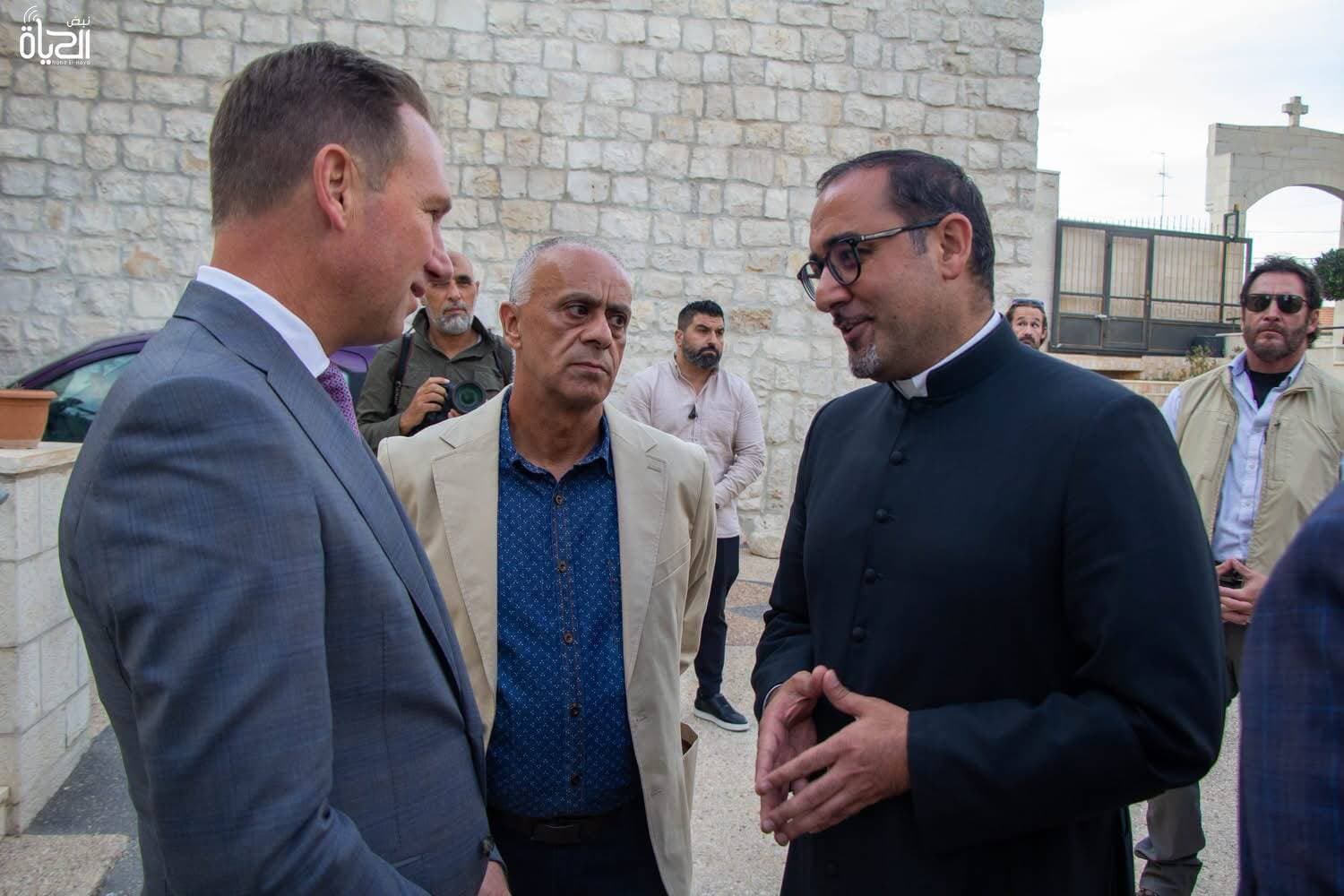
Local church officials told Zeale News that Burch met with Father Bashar Fawadleh, parish priest of Christ the Redeemer Church, at Taybeh’s Latin monastery. According to Nabd El-Hayat, the delegation also met with Sanad Sahelia, executive director of the Christian Presence Observatory-Holy Land.
The outlet reported that Father Fawadleh outlined concerns about civilian safety, farmers’ access to their land, freedom of worship, property rights, and accountability for the attacks.
He cautioned against assuming that every attack had a religious motive, while warning that combined security, economic, and social pressures threaten Palestinian Christian communities’ ability to remain in their homeland.
He also described difficulties facing Christians elsewhere in the West Bank, including Birzeit, Aboud, Beit Sahour, Bethlehem, and Zababdeh, where restrictions on movement and settlement expansion have made it harder for families to plan for their future, the outlet reported.
Sahelia similarly emphasized that protecting Christian heritage requires supporting the people who sustain it. According to the report, he said Christian families need employment, opportunities for young people, and the ability to build a future in their communities.
The delegation also reviewed photographs, videos, and documents concerning reported attacks and received a position paper requesting that U.S. officials raise cases with Israeli authorities, press for investigations and accountability, and designate a U.S. contact for follow-up, according to the outlet.
Nabd El-Hayat reported that Burch told participants, “You are not alone,” and that he shared priorities between Washington and the Holy See concerning religious freedom, human dignity, and vulnerable communities.
Riley Barnes, the assistant secretary of state for democracy, human rights and labor and a member of the delegation, described the accounts as shocking and stressed the need to inform the American people and religious institutions about conditions facing the town.
“The American people are largely unaware of what is happening here,” he said, according to the outlet. “There is more to be done.”
David Brownstein, deputy chief of mission at the U.S. Embassy in Jerusalem, reportedly acknowledged residents’ frustration with the response to their appeals but said their concerns were reaching the relevant authorities.
“We need to do better, and we are working on it,” he said, according to the report.
After the meeting, the delegation visited western Taybeh and heard residents describe how repeated attacks and threats had disrupted their homes and livelihoods. According to the outlet, Bashir Kouna said the violence had prevented him from moving into his new home, and another resident, Roland Basir, said attacks had halted operations at his concrete plant and quarry for more than three months.
As Zeale News reported in its coverage of Burch’s visit, the Patriarchs and Heads of Churches in Jerusalem condemned the recent attacks in an Oct. 20 statement, warning that settler violence across the West Bank has intensified since the recent start of the olive harvest.
“This wild attack on the Christian village of Taybeh and against its peaceful population is not an isolated incident,” the church leaders said. “In the past weeks the Palestinian villages of the West Bank have been exposed to a wide-scale terror by settlers, which is reaching a peak during this time of the olive harvest, when families go to their lands to collect what they need to live and renew their generations-long bond with their lands.”
The leaders reiterated their solidarity with Taybeh, offered prayers for its residents and those in the Holy Land, and urged authorities to “bring those responsible to justice.”






Comments