Pope Leo celebrates Mass July 4 in Lampedusa, prays for migrants who died at sea
The Holy Father drew attention in his homily to the importance of compassion and reflected on the parable of the Good Samaritan.

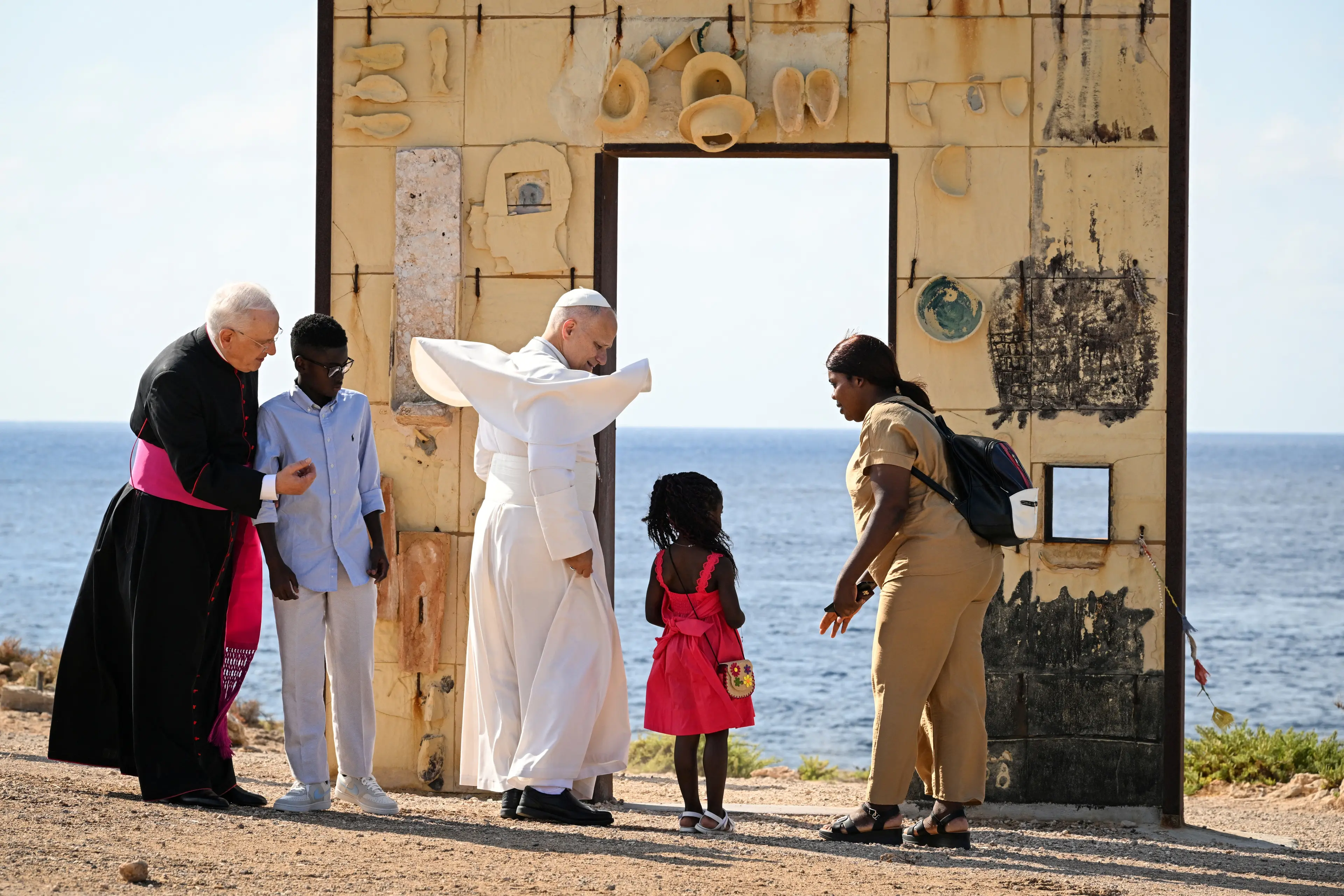
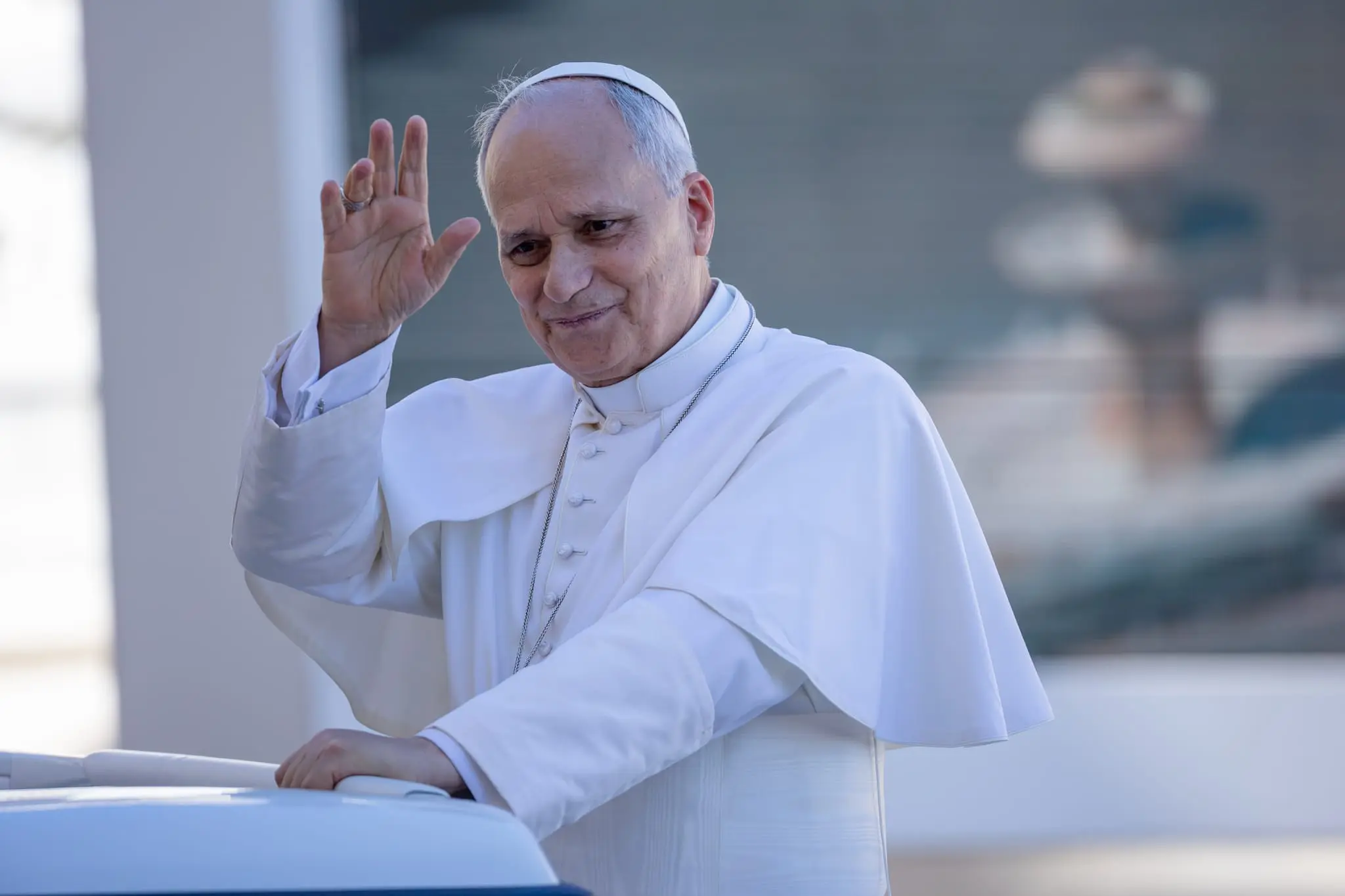
On the morning of July 4, Pope Leo XIV traveled to Lampedusa, an island in the Mediterranean Sea, celebrating Mass with thousands of local residents and praying especially for migrants who have died while attempting to reach Europe.
Upon landing in Lampedusa, Pope Leo first went to the local cemetery to pray. According to Vatican News, the gravesite has a section dedicated to “Muslims and Catholics, for young and old, black and white, all of them lost at sea as they searched for freedom.”
The Holy Father also visited the “Gateway to Europe” monument, which reflects the hope of people who arrive at the island on their way to the continent, the outlet noted.
Pope Leo then went to Favaloro Pier, where he met with a migrant family. According to a separate Vatican News report, this pier, which was officially dedicated to Pope Francis during Pope Leo’s visit, is the landing site for many migrant and refugee boats coming from North Africa. Visiting Lampedusa was the first trip Pope Francis made after being elected pontiff in 2013.
“Countless men, women and children fleeing war, persecution and poverty have landed on its shores, particularly during the Arab Spring in 2011 and amid the Syrian conflict in 2015,” Vatican News reported. “In one week alone in 2023, nearly 10,000 people arrived on the island, a figure almost double that of Lampedusa’s resident population.”
Afterward, Pope Leo celebrated Mass with thousands of people at Lampedusa’s sports field. During his homily, he praised the residents’ hospitality toward those who arrive on their shores.
“The Apostles, as you know, sailed the Mediterranean and experienced the hospitality of the inhabitants of its islands and coasts, which have been a crossroads of civilizations for millennia,” Pope Leo continued. “The Gospel resounds where peoples meet, people welcome one another, their lives intertwine and different cultures engage in dialogue. It falls silent, however, when each person makes him or herself an island, avoiding contact and cutting off exchange.”
The Good Samaritan and the importance of compassion
Pope Leo drew on the parable of the Good Samaritan, which was related in the Gospel for the Mass, likening the path Lampedusa lies along as being just as dangerous as the road from Jerusalem to Jericho.
“Here you have seen not just one, but thousands of human beings fallen into the hands of robbers who have taken everything from them, beat them brutally and walked away, leaving them half-dead,” he said, adding that others have died at sea, unable to reach where they had hoped to arrive.
“Yet we feel their presence, which challenges us no less than that of those who have landed in need of attention and aid,” he continued. “Indeed, before any intellectual consideration or ideological conviction, the encounter with those who lie before us, stripped of everything, calls us to be close to them.”
One becomes a neighbor by acting like one, according to the Pope, who also emphasized that St. Paul’s Letter to the Hebrews urges remembering those who suffer. He thanked those in Lampedusa “for the solidarity that so many of you have shown,” saying that “the miracle of compassion has [again] taken place.” He recalled that the Gospel states that Christ Himself had compassion when He saw the crowds.
He thanked the volunteers, teachers, doctors, security forces, civil institutions and organizations, Coast Guard, and local politicians serving the common good over the years, as well as religious sisters, priests, and deacons who have acted with love.
“Yes, it is love that has taken shape among you,” the Pontiff remarked. “Compassion, which recognizes a brother or sister in peril at sea, is its first stirring: a profound call to do what you might never have imagined possible.”
He also greeted the migrants present, saying that they “have not only received solidarity but have often shown it on their journey, as the poor helping the poorest.”
The Pontiff then emphasized what the parable of the Good Samaritan reveals about freedom, outlining how one’s choices can either help or hinder others’ flourishing. He said the parable shows “that love is always rooted in freedom” and that “freedom lies in the decisions we make.” He noted that some people choose to not be a neighbor or make no decision at all.
Pope Leo: Do not 'pass by' those who are suffering
“Those who have lost their lives in this sea are victims both of decisions that were made and of decisions that were not made,” Pope Leo continued. “Indifference to the common good and corruption in their countries of origin; a global economic system that generates poverty and exclusion; fear that fuels prejudice and contempt; the belief that such problems do not concern us; the criminal calculations of those who profit from the suffering of others; the slow and difficult transition from mere emergency management to the development of comprehensive and shared policies — all are present-day echoes of the haste to ‘pass by’ in the Gospel narrative.”
Pope Leo reflected on how both a priest and a Levite saw the man on the side of the road by chance, and chose to continue walking past him.
“Unfortunately, in every age there are those who fear being ‘contaminated’ by contact with others, thus denying — even in the face of suffering and death — our common origin in God, the infinite dignity of every human being and the call to boundless love,” Pope Leo said. “It is time to recognize and affirm that religious affiliation must never become a reason for discrimination, as if faith had boundaries rather than being a universal call to salvation.
“Where there were walls of separation, Christ broke them down. There is no love of God without love of neighbor, and there is no neighbor if I do not draw near. To pause, to be moved, to bend down, to weep before another’s pain — as Jesus did — means entering into the dynamic of love, the very movement in which God has revealed Himself.”
He emphasized that those who cultivate compassion and mercy have their lives transformed and become citizens who build up the “civilization of love” spoken about by Popes John XXIII, Paul VI, and John Paul II.
“Together with a great number of prophets and martyrs of the last century, they understood that only mercy can respond to the depths of the human heart and the horrors of war by opening the way to a new beginning,” Pope Leo said. “Now, standing on the shoulders of these giants, we have entered a millennium in which we must give spiritual, cultural, legal, political and economic expression to the civilization of love. May the enormity of the suffering we witness help us grasp the radical nature of this call.”
He emphasized that the faithful can follow the example of the Good Samaritan and change plans and direction, recognizing that resources are available to live this out and serve those in need.
“We, too, must recognize that ‘the civilization of love will not arise from a single or spectacular gesture, but from the sum total of small and steadfast acts of fidelity that serve as a bulwark against dehumanization,’” he said, citing Magnifica Humanitas. “To this, friends of Lampedusa, you are witnesses! Here, as we encounter each other, we gain a better understanding of our era, and each of us can assess the direction of our own lives.”
Europe's responsibility and role
Pope Leo also acknowledged that the phenomenon of migration poses a “momentous challenge” to European societies, and said that the continent has a unique potential and responsibility in this regard that is rooted in its history and culture. He said its geographical location and institutional framework enable it to comprehensively address the crisis, providing immediate relief support and long-term planning to receive, protect, support, and integrate migrants.
At the same time, Europe can support developing countries “so that no one is forced to emigrate,” Pope Leo said. “All of this must be done with vigilance, ensuring respect for the dignity of every person. This is a task not only for public institutions but also for civil society as a whole and for the Church.”
Pope Leo also encouraged those on vacation to not avoid the reality of the plight of migrants, noting that rediscovering charity is a means to genuine rest.
“[T]he culture of hospitality has a tourist dimension, which, unfortunately, can feel threatened by migration routes and give rise to indifference, or even opposition, to their dramatic aspect,” he said.
He observed that many people experience vacation as a mere “distraction” and a lighthearted moment of “carefree enjoyment.”
“It then seems as though an invisible wall has to be erected between the sea of shipwrecked migrants and the vacationers,” Pope Leo said. “Have the courage to think differently.”
“Little by little, with a bit of creativity, you will be able to ensure that anyone who spends time on this island, even if only for rest, becomes more humane, inspired by your charity, what the sea has taught you and the encounters that have formed you,” he continued. “There is authentic rest when the meaning of life is rediscovered, and true well-being when the economy is just and fraternal. In such an economy, care for creation and social friendship come together in a synthesis that humanity is seeking today.”
The Pontiff also encouraged cultivating hospitality and community on a parish level by welcoming and accompanying one another, following the Gospel.
He noted that beside the altar is an image of Our Lady of Safe Harbor, the patroness of Lampedusa, and recalled how St. Augustine likened human life to a voyage across a perilous sea and the destiny is “a safe and secure harbor.” The Pope encouraged considering daily difficulties as a chance to witness to faith.
“May your faith, dear friends, be strengthened by these years of trial and generous commitment,” he said. “May this venerated image speak to you once again with the same power as in days past, when those who handed down this devotion entrusted themselves to the Virgin’s intercession with radical sincerity. In God we all have a safe haven, and every Christian community is called to be a reflection of it on earth.”
He concluded with a traditional greeting of the people of Lampedusa, saying, “And to you, the communities of Lampedusa and Linosa, may you never lack the breath of faith, hope and charity: “O’scià!”
Later in the day, Pope Leo returned to Rome and visited the residence of the U.S. Ambassador to the Holy See, where he enjoyed a Fourth of July celebration.

.jpg&w=3840&q=75)
Comments