Supreme Court sides with Trump administration to allow White House ballroom construction for now
The 5-4 ruling lifts a lower-court barrier to the project but stops short of deciding whether the administration may build the ballroom without congressional approval.
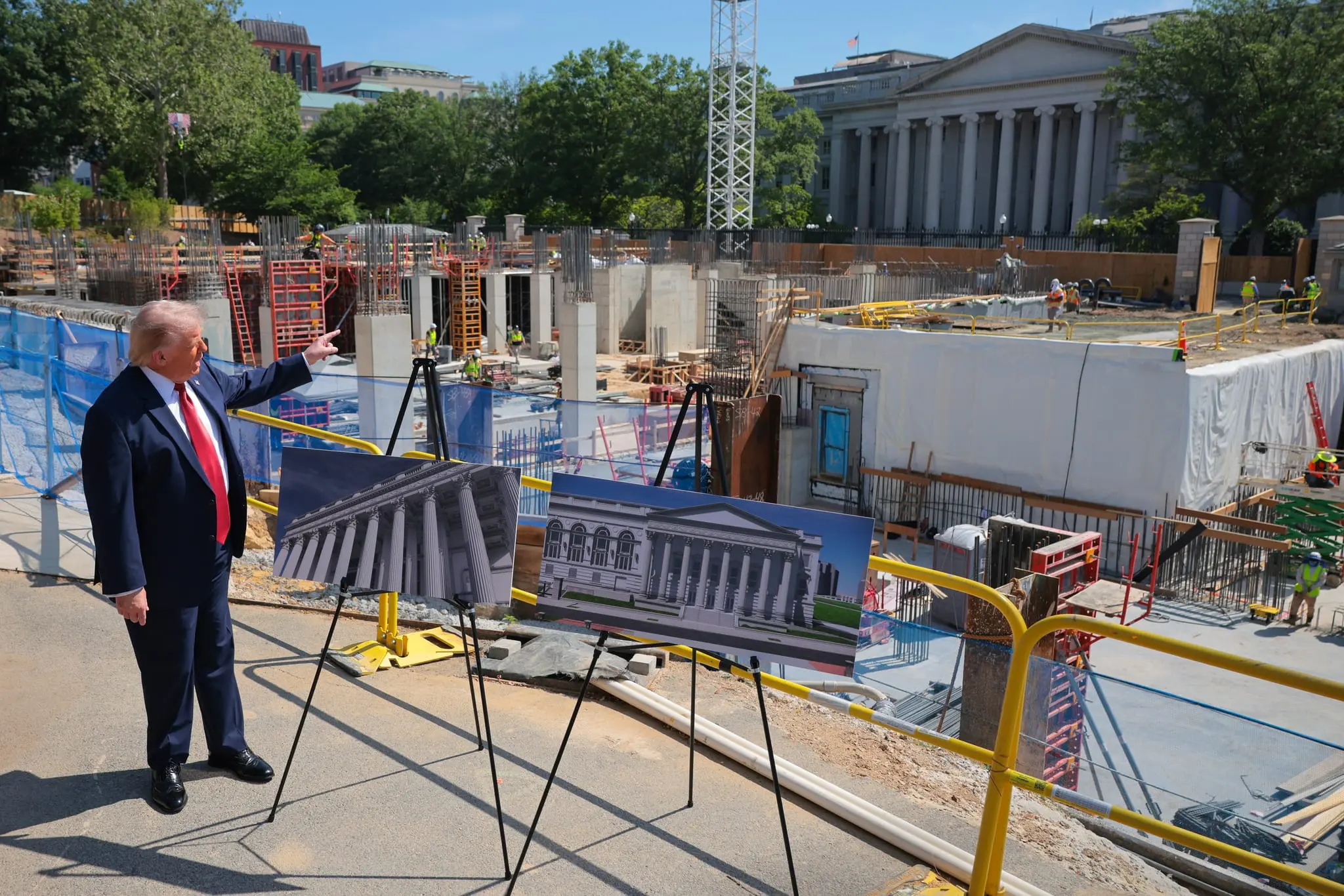
The Supreme Court on Aug. 31 allowed President Donald Trump’s administration to continue construction of its $400 million White House ballroom, ruling 5-4 that the historic preservation group challenging the project likely lacks legal standing to sue.
The Aug. 31 decision granted the administration’s request to stay a preliminary injunction that would have halted most above-ground construction while litigation over the 90,000-square-foot project proceeds.
The majority stressed that its decision did not settle the underlying dispute over whether the administration has legal authority to construct the ballroom without congressional approval.
“Today, we do not pass upon the legality of the government’s East Wing project,” the court said.
Instead, the majority concluded that the government is “likely to prevail in showing that the Trust lacks Article III standing to challenge the project in federal court.”
Chief Justice John Roberts joined liberal Justices Sonia Sotomayor, Elena Kagan, and Ketanji Brown Jackson in dissent.
The case stems from a lawsuit filed by the National Trust for Historic Preservation after the administration demolished the White House East Wing and began constructing the ballroom and an accompanying underground security complex.
U.S. District Judge Richard Leon previously ordered the administration to stop most above-ground work, although he permitted underground construction and work “strictly necessary to cover, secure, and protect” the President and White House staff members. The U.S. Court of Appeals for the District of Columbia Circuit upheld Leon’s injunction in a 2-1 decision Aug. 7.
The Trump administration appealed to the Supreme Court, arguing that the project is an integrated military and security complex and that stopping construction would jeopardize national security.
Solicitor General D. John Sauer told the justices that the ballroom will provide a secure venue for major White House events while the larger project will provide protection for presidents, their families, staff members, and foreign dignitaries. The administration said the overall project was approximately 65% complete when it sought Supreme Court intervention earlier this month.
As Zeale News previously reported, Roberts temporarily blocked Leon’s injunction Aug. 21 while the court considered the administration’s application. That administrative stay prevented the construction shutdown from taking effect.
Trump revealed in March that the military was building what he described as a “massive complex” underneath the ballroom, saying the ballroom “essentially becomes a shed for what's being built under,” according to previous Zeale News coverage.
The White House has said the underground portion serves national security purposes but has declined to disclose many details.
Security concerns surrounding the ballroom received renewed attention after the April 25 shooting at the White House Correspondents’ Association Dinner. Trump subsequently argued that a permanent White House ballroom equipped with bulletproof glass and protections against drones would offer a safer location for major presidential gatherings, as Zeale News reported at the time.
The National Trust has argued that the president cannot fundamentally alter the White House complex without authorization from Congress. The administration, meanwhile, maintains that Congress has already provided sufficient authority for presidents to make alterations and improvements to the property.
Monday’s decision leaves the ballroom construction free to continue while the legal proceedings move forward.





Comments