Theologian defends returning tabernacles to the altar
A former seminary dean dismantled an argument offered in the progressive National Catholic Reporter that supported relegating the tabernacle to a corner or closet.
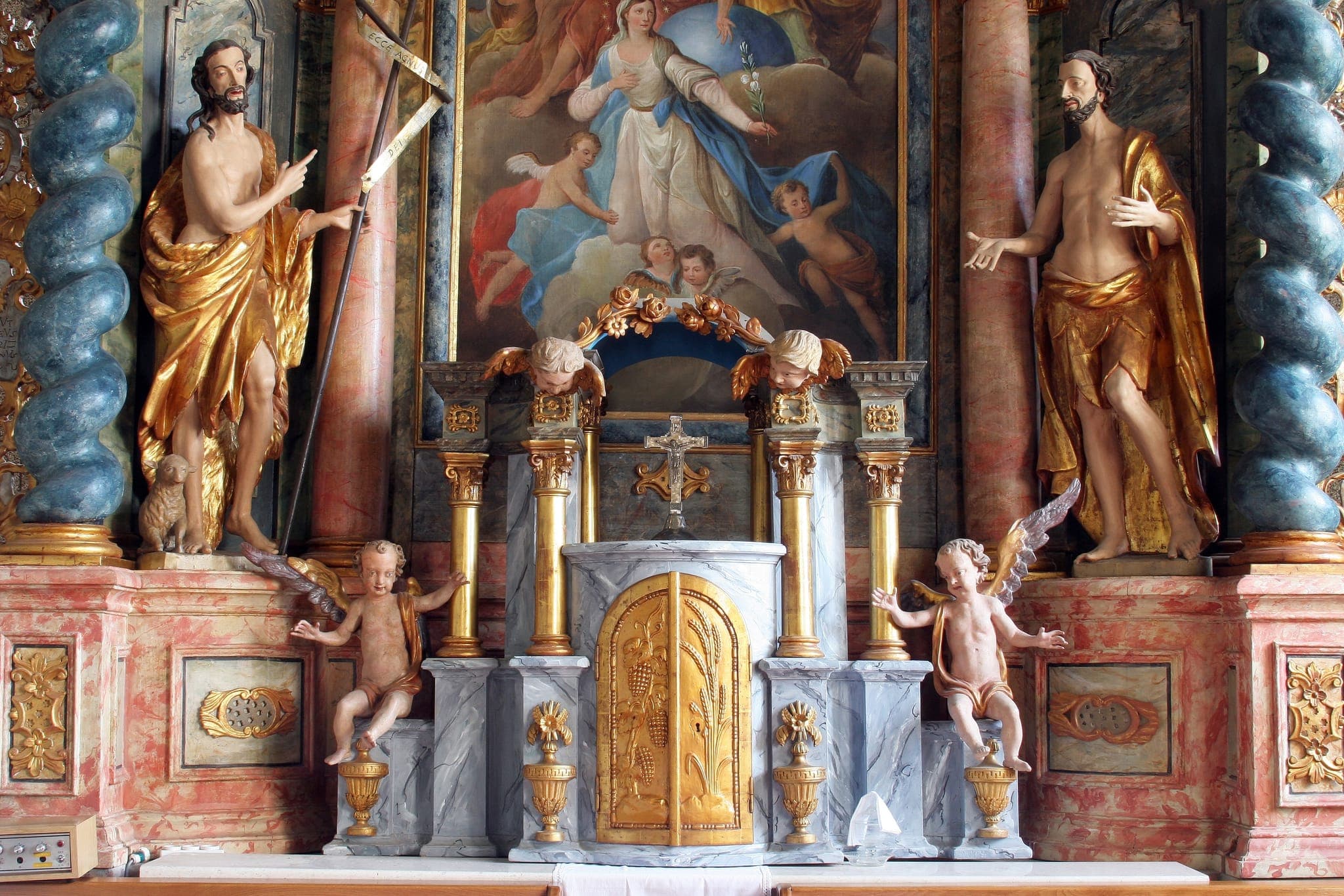
In a recent National Catholic Reporter op-ed, author Michael Sean Winters beseeched pastors to leave tabernacles relegated to the corners and sides of churches, but his arguments did not go unanswered.
“What is this fetish for returning tabernacles to the main altar?” Winters asked in his Aug. 31 essay.
He recounted visiting the Cathedral of St. Patrick in Norwich, Connecticut, which had undergone extensive renovations following the Second Vatican Council, such as removing the tabernacle from the main altar and placing it off to the side, “close enough to get to the tabernacle as needed, but separate enough to invite quiet, prayerful reflection before the reserved sacrament,” Winters wrote.
By 2013, however, further renovations had restored the tabernacle to the cathedral’s altar and moved the bishop’s seat or cathedra to the side, which Winters contended was not a positive change.
“It is difficult to see the bishop and he has to step forward several feet to lead the congregation in the opening and closing rites of the Mass,” he wrote. “The tabernacle competes with the altar of sacrifice for the eye's attention. And, if one wishes to pray before the Blessed Sacrament, you are now in the vast nave instead of the more intimate Blessed Sacrament chapel.”
According to Winters, placing the tabernacle on the main altar is a crypto-traditionalist response to the reforms of the Second Vatican Council, since many churches and chapels built prior to the 16th and 17th centuries placed their tabernacles in separate chapels, common features in European cathedrals. It was predominantly, he said, American churches built in the 19th and early 20th centuries which placed tabernacles on or above the main altar.
“A comprehensive historical perspective should trump 1950s nostalgia in almost all cases, and theological considerations should trump historical precision in most cases,” Winters wrote. “I understand that in a small parish church the only realistic place for a tabernacle may be behind the main altar. But in a cathedral?”
John M. Grondelski, a theologian and former associate dean of the School of Theology at Seton Hall University in New Jersey, responded to Winters’ plea in a Sept. 2 op-ed in Crisis Magazine, lambasting Winters’ arguments as hypocritical and flawed. He wrote that he could not sympathize with Winters’ cry of “stop moving the tabernacle,” since progressives like Winters had sidelined tabernacles in the first place.
He wrote, “I didn’t hear any such standing athwart in the 1960s,” when a handful of liturgists decided to move the tabernacles, regardless of the sensibilities of the congregation.
Winters argues from the assumption that the stylistic and liturgical changes of the 1960s and 1970s were correct, Grondelski observed, and that any attempt to return to traditions or devotions practiced prior to the Second Vatican Council “is liturgical regression.”
Grondelski also suggested that many of the changes of the latter half of the 20th century were actually damaging.
“After all, the phenomenon of lost faith in the Real Presence and lost reverence in churches is evident,” he wrote.
Though poor catechesis, rising secularism, and other such factors have likely contributed to a decline in belief in Christ’s actual presence in the Blessed Sacrament, Grondelski argued that moving tabernacles off the altar also has played a role in the weakening of that belief.
“But I’d also suggest one reason is what your symbolism says,” he wrote. “A reality located in ‘the central focal point of the sanctuary’ says this is important; a reality you have to search for in the corners says it isn’t.”
Grondelski also refuted Winters’ claim that placing tabernacles on the altar was an innovation of the past five centuries and an aberration from the norms of the Early Church. While he agreed that a “return to the sources” of liturgy was not a detriment, Grondelski argued that it would be damaging to strip away the more than 1,500 years of organic development of the liturgy.
“[I]mplicit in that slogan is an assumption that is ecclesiologically problematic. The Holy Spirit is always active in the Church. The Holy Spirit did not leave with the end of the Western Patristic era, only to fly back into Holy Mother Church once ‘good Pope John’ opened one of his vaunted windows,” he wrote. “The Holy Spirit was also active in the Church in the medieval, Renaissance, and post-Tridentine eras. The liturgical development of that time cannot just simply be cast off because it didn’t exist before A.D. 500.”
“Liturgists who want to shunt the tabernacle off to the sidelines usually also love to insist that the early Church did not reserve the Blessed Sacrament in the church but perhaps kept some of the sacred species for Viaticum in the priest’s residence,” he wrote. “Yes, devotion to the abiding presence of Christ in the Blessed Sacrament came slowly and flowered in the Middle Ages — perhaps because, during periods of persecution where churches did not exist, the architecture did not facilitate that development.”
“But it did develop and it did flourish, to the point that tabernacles came into existence, were made ever more noble, were put in churches, and eventually … made ‘the central focal point of the sanctuary,’” he continued.
“To overturn that process is to say that the Holy Spirit had a hiatus until the Annibale Bugninis of the world came along with new design plans in the 1960s,” he concluded, referring to the Italian cardinal who was secretary of the commission responsible for reforming the Mass following the Second Vatican Council. “If that sounds risible, it’s because it is.”
The debate and controversy comes in the midst of several high-profile efforts to restore more traditional practices in churches. In 2021, for example, the tabernacle in Nashville’s Cathedral of the Incarnation was restored from a side chapel to its original place in the high altar. A 2024 renovation to Good Shepherd Church in Alexandria, Virginia, likewise saw the parish tabernacle placed above the main altar, directly beneath the crucifix.
Last year, St. Lawrence parish church in Muncie, Indiana, restored its tabernacle to the high altar, where it had been from the church’s dedication in 1895 until shortly after the Second Vatican Council. Immaculate Conception Church in Fort Smith, Arkansas, actually built a new back altar specifically to house the tabernacle so that it would be visible from any angle in the church.




Comments