In this episode, we’ll explore the extraordinary lives of Saints Cyril and Methodius.
Transcript
Read the full transcriptAuto-generated · 934 words
Welcome, young history buffs and curious minds, to My Daily Saint, the podcast that digs deep into the incredible lives of the saints, those remarkable people who shaped history and continue to inspire us today. Forget dusty old portraits and boring stories. Today, imagine a world without Google Translate. Imagine trying to explain the most important message in the universe to someone, but you don't speak their language. And worse, their language doesn't even have an alphabet yet. We are traveling back to the 9th century.
It is a time of empires, spies, and dangerous missions. And our heroes today are two brothers who were basically the special ops agents of the Church. Their names were Cyril and Methodius. Born in 827 and 826, Cyril and Methodius grew up in a noble family. They had money, status, and power waiting for them. But here is the first twist. They walked away from it all. They renounced their wealth and their high status to become priests. They were Greek, living in a monastery on the Bosphorus, probably thinking they would have a quiet life of prayer.
But the world had other plans. First, the Khazar Empire called. They needed a Christian missionary to come from Constantinople. Cyril was the man chosen for the job, and his brother Methodius refused to let him go alone. Now, this wasn't a vacation. To succeed, they actually learned the Khazar language so they could minister to the people and preach the gospel effectively. And they were good at it, so good that their reputation began to spread across borders. Soon, officials in a place called Moravia, which is in the modern-day Czech Republic, sent out a distress signal.
They needed help. German missionaries had been trying to work in the region, but they were failing. Why? Because they couldn't connect with the people. The officials requested Cyril and Methodius, ecifically, to travel there to preach and celebrate the liturgy in the local dialect. But there was a massive problem. The Slavonic language didn't have a written alphabet that worked well for Christian texts. How do you translate the Bible if you can't write the words down?
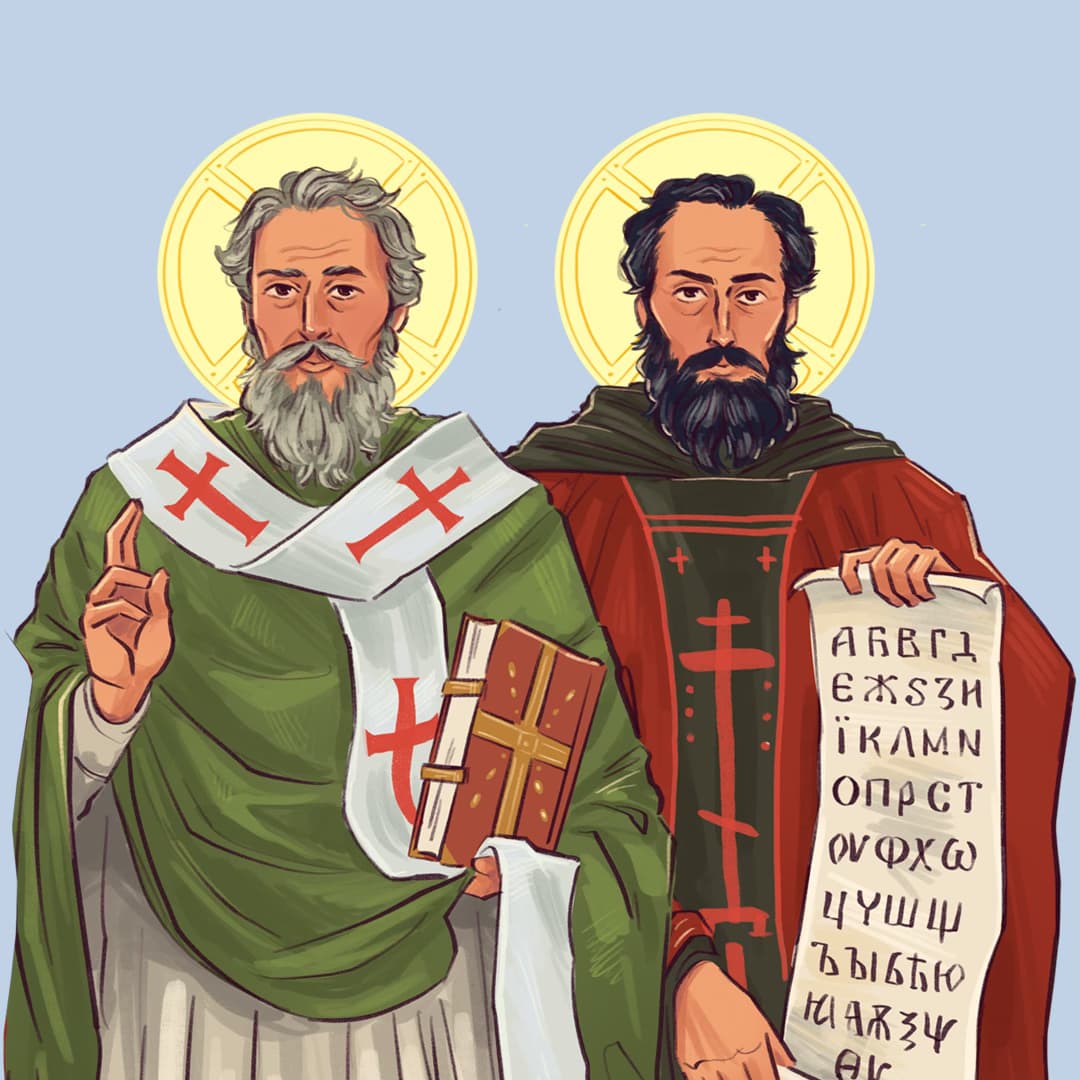
This is where the brothers became legends. They didn't just learn the language. They hacked it. Cyril and Methodius took the Greek alphabet and adapted it to fit the Slavonic language. This invention resulted in what we now call the Cyrillic alphabet. With this new code, they were able to translate the Bible and liturgical books. Suddenly, the people of Moravia could hear the Word of God in their own familiar language.
The brothers served there successfully for four years because they bridged that communication gap. But, whenever you disrupt the status quo, you make enemies. Using the local language, the vernacular, instead of Latin or Greek, was viewed with major suspicion by other Catholics. It was a controversial move. However, Pope Adrian II saw what the brothers were doing. He approved their methods and ordained both of them as bishops. Sadly, the partnership was cut short. Cyril died in Rome in the year 869. Now, Methodius was on his own.
Methodius returned to Moravia to shepherd a new archdiocese established by the Pope. But the German church officials in the region were furious. They were angered by the presence of this new archbishop and the fact that he was independent of them. Then things got ugly. The Germans actually had Methodius deposed and thrown into prison, and he sat in that cell for three long years, until a new pope, John VIII, stepped in. The pope demanded Methodius be freed and reinstated him, even putting him in charge of an additional region in modern-day Poland.
Once he was free, Methodius didn't take a break. He went into overdrive. With the help of some Greek priests, he translated the entire Bible into Church Slavonic. Before Methodius died in 885, he made sure the mission would continue by choosing a successor from the native Slavs he had evangelized. He wasn't just building a church. He was building a legacy that belonged to the people. The impact of these two brothers is absolutely massive. Their work paved the way for the conversion of Ukraine and Russia in 988.
The alphabet they developed became widely used in large regions of the world. Because of their incredible influence, Pope St. John Paul II named them patron saints of Europe. But that's not all. If you look at their spiritual resume, they are the patron saints of Bulgaria, North Macedonia, the Czech Republic, Slovakia, and Serbia. In art, you will often see them wearing liturgical vestments, holding a cross, and a book of the Slavic language, the tool they used to unlock the gospel for millions of people.
These brothers realized that if you want to reach people, you have to speak their language, not just literally, but culturally. They didn't expect the people of Moravia to become Greek. They brought the truth to them where they were.
Think about someone in your life. Maybe a younger sibling, a grandparent, or a friend at school who feels left out or doesn't understand something important to you. Don't just wait for them to figure it out. Like Cyril and Thotius, try to translate your kindness. Adapt your approach. If you are trying to explain something or help someone, do it in a way that they understand, even if it takes extra work on your part. Thank you for joining us on My Daily Saint. We look forward to sharing another incredible story of faith and courage with you tomorrow.
More from My Daily Saint

Listen Next
September 26: The Troublesome Dominicans
The American Catholic Daily Reader Podcast
Women of Chivalry: The Genius of Courage
The Shield and the Cross
The Virgin of the Poor: Mary's Smile in the Cold of Banneux
Mother's Mantle
Hallowed Hollows: From Hidden Gems to Discovered Treasures
Hollows of the Faithful