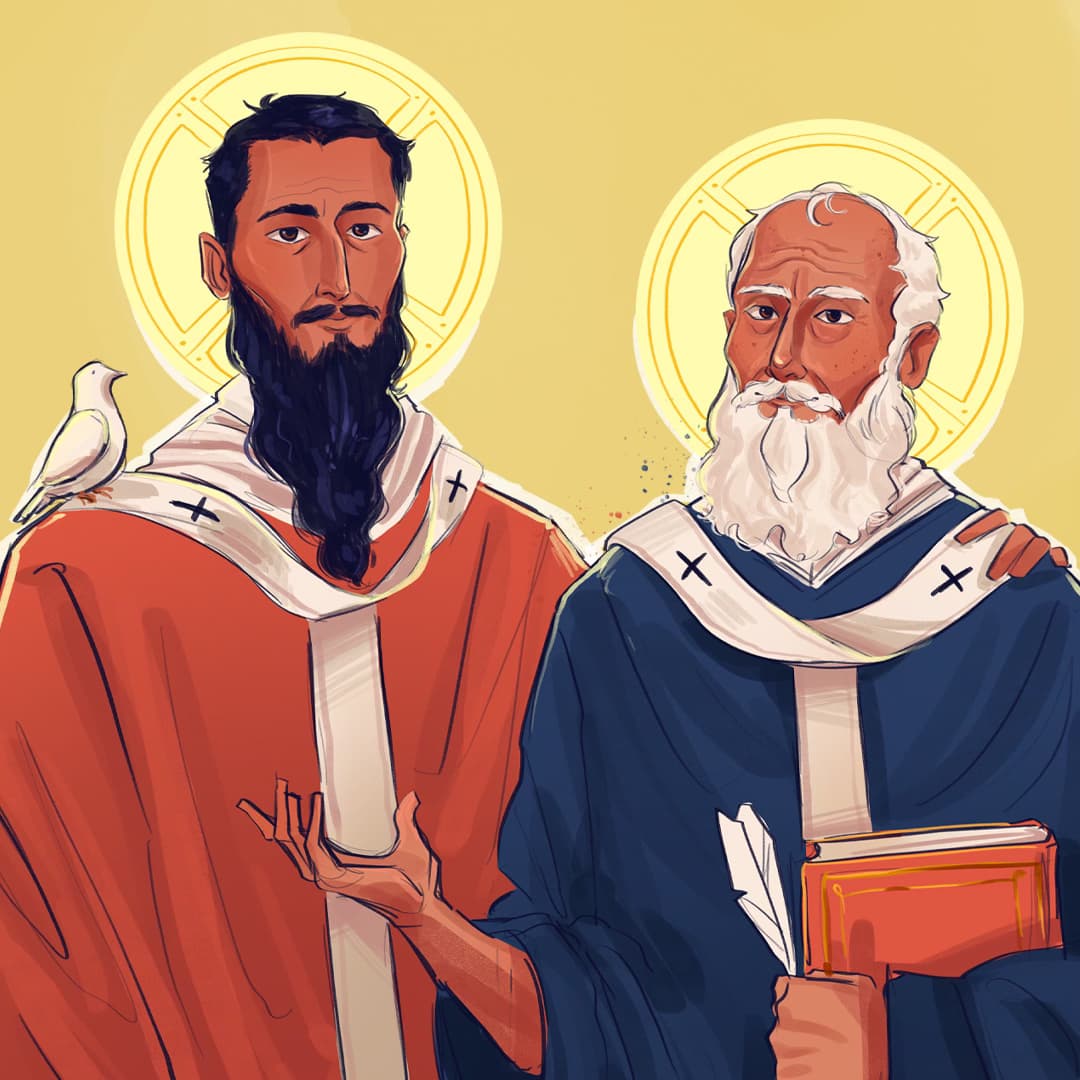
In this episode, we’ll explore the extraordinary lives of Saints Basil & Gregory.
Transcript
Read the full transcriptAuto-generated · 1,202 words
Welcome, young history buffs and curious minds, to My Daily Saint, the podcast that digs deep into the incredible lives of the saints, those remarkable people who shaped history and continue to inspire us today. Forget dusty old portraits and boring stories. Today, we're diving deep into two lives in a time when the world was a swirling mix of ancient empires and new ideas, where faith was both a guiding light and a battleground. It was a time of emperors and philosophers, of great cities and humble villages.
And in the midst of it all, two towering figures emerged, not with swords or crowns, but with the sheer power of the divine. And in the midst of it all, two towering figures Power of their minds, their unwavering compassion, and an unshakable belief that would not only change the course of history, but also touch the lives of countless people for centuries to come. These are the stories of St. Basil the Great and St. Gregory, two brilliant minds who would become lifelong friends and spiritual giants.
Born into the heart of the Roman Empire, in what is now modern-day Turkey, Saint Basil, born in 330 AD, came from a family so devout, so steeped in holiness, that both his parents would become saints themselves. Meanwhile, St. Gregory, born around 325 AD, was equally destined for greatness.
These two intellectually ravenous young men journeyed across the ancient world to the most prestigious schools of their time, from Caesarea to the grand city of Constantinople, and finally to Athens, the intellectual heart of the world. It was in Athens, amidst the ancient scrolls and lively debates, that a A pivotal moment occurred. St. Basil met St. Gregory, and a profound friendship was forged, one that would endure for decades, even through disagreements, and inspire generations. They absorbed everything they could, mastering theology, philosophy, and all the sciences.
They could have had lives of comfortable scholarship, but destiny, and a powerful call to a deeper truth. ...pulled them in another direction. Inspired by a quest for deeper spiritual devotion, Basil embarked on a journey across the known world to visit monasteries, seeking out the essence of a life devoted to God. Returning, he founded his own monastery in Pontus and penned a revolutionary rule of life for monks that would earn him the title of Father of Oriental Monasticism, laying the groundwork for other great monastic leaders like Saint Benedict.
Gregory, drawn to a life of asceticism and simplicity, even joined his friend's religious order for a time. But their friendship, though powerful, wasn't without its challenges. Basil later asked Gregory to take an episcopacy, or bishopric, in the small town of Sasmia. However, Gregory had no desire to become a bishop and refused. This disagreement, unfortunately, put a damper on their relationship, which lasted until Basil's death. Eventually, Gregory later accepted priestly ordination in Nazianzus, helping his own father and courageously working to battle the Arian heresy raging in the church at the time, which denied the divinity of Christ.
This was a dangerous and critical fight for the very core of Christian belief. As for Basil, his dedication and wisdom didn't go unnoticed. After founding several monasteries, he was ordained the Bishop of Caesarea. As bishop, he became a fierce champion for justice and a compassionate defender of the poor. He bravely fought against simony, which was the sinful practice of buying or selling church offices. He also provided crucial relief for those suffering in a devastating famine, literally saving lives by feeding the hungry and organizing aid.
And he wasn't afraid to clean house, doing his best to reform the clergy of his time. But perhaps one of his courageous acts was his stance against an awful injustice. He excommunicated those involved in widespread prostitution trafficking in Cappadocia. This shows us a saint who was not afraid to confront the darkest evils of his society head-on, protecting the most vulnerable and standing firm for what was right, no matter the personal cost or the powerful opposition he might face.
Meanwhile, a new hope dawned for Orthodox Christians when Emperor Valens, a strong supporter of the Arian cause, passed away. Gregory traveled to Constantinople to provide support for the Christians there. The city had become deeply divided by theological disputes, and Gregory endured much hardship attempting to keep peace. He was soon named Bishop of Constantinople, where Gregory preached to his new congregation about the nature of the Trinity and the dual nature of Christ. In his audience during this time was a young man named Jerome, who was also destined to To become a doctor of the Church.
These extraordinary individuals, standing shoulder to shoulder, played a monumental role in shaping the very foundations of Christian belief. Together with St. Athanasius, Basil and Gregory helped to establish the truth of the Church at the famous Council of Constantinople. Their greatest contribution was to the definition of the Trinity, helping to explain the ...deeply important and somewhat mysterious concept of God as Father, Son, and Holy Spirit, and clarifying the consubstantial nature of the Father and the Son, meaning they are of the same divine substance.
After his vital work at the Council, Gregory soon retired as bishop. He chose to live a life of prayer and seclusion, and found solace in writing poetry. Sometimes called the theologian, Gregory is famous for his profound writings on the Trinity and the Holy Spirit.
Saint Basil the Great died in January of 379 A.D., leaving behind a legacy that continues to inspire. Saint Gregory died later in 389 A.D. Both are recognized as Doctors of the Church, a special title given to saints whose writings and preachings are particularly important for all Christians.
St. Basil the Great is the patron saint of hospital administrators. This makes perfect sense when you think about his incredible compassion and his remarkable organizational skills in running monasteries, providing aid to the sick and poor, and reforming the church. As for St. Gregory of Nazianzus, he is known as the patron saint of a good harvest and poets. Both saints Even as brilliant scholars and powerful bishops never stopped learning and growing, always seeking to deepen their understanding of faith and life. They then used their immense knowledge and their positions to serve others, fighting injustice, defending truth, and helping those in desperate need.
You, too, can embrace a spirit of continuous learning and selfless service. Maybe you can make a habit of reading or learning something new each day, whether it's about your faith, history, a science topic you love, or a skill you want to develop. Then, just like St. Basil and St. Gregory use their gifts to help others, you can actively look for ways to use what you learn to make a positive difference in your own community. These things can help you to make a difference in your own community.
Two great saints show us that a powerful mind combined with a compassionate heart can truly change the world. Thank you for joining us on My Daily Saint. We look forward to sharing another incredible story of faith and courage with you tomorrow.
More from My Daily Saint

Listen Next

September 26: The Troublesome Dominicans
The American Catholic Daily Reader Podcast

Women of Chivalry: The Genius of Courage
The Shield and the Cross
The Virgin of the Poor: Mary's Smile in the Cold of Banneux
Mother's Mantle
Hallowed Hollows: From Hidden Gems to Discovered Treasures
Hollows of the Faithful