In this episode, we’ll explore the extraordinary life of Saint Anthony of Padua.
Transcript
Read the full transcriptAuto-generated · 998 words
Welcome, young history buffs and curious minds, to My Daily Saint, the podcast that digs deep into the incredible lives of the saints, those remarkable people who shaped history and continue to inspire us today. Forget dusty old portraits and boring stories. Today, imagine that you have a life-saving, critically important message to share, but the crowd is completely ignoring you. They're mocking you, turning their backs, and refusing to listen. So, what do you do? If you're the guy we're talking about today, you don't just give up and go home.
You walk right up to the water's edge, look down into the waves. And suddenly, a massive school of fish pokes their heads out of the water, lining up in perfect rows, just to listen to you. Or imagine a guy who performs absolute medical marvels, like reattaching a young man's severed foot, or even bringing a dead toddler back to life.
Today, we are looking at one of the most famous, action-packed saints in history. He's the guy your mom probably tells you to pray to when you can't find your phone. Saint Anthony of Padua. Our story starts way back in the year 1195 in Lisbon, Portugal. Back then, his given name was Fernando. For a while, Fernando lived a pretty quiet, comfortable life. He entered a religious order called the Canons Regular of Saint Augustine, and he really loved the disciplined life of prayer and intense study.
He was incredibly smart, and probably on track for a nice, respectable career in the church. But then… A massive plot twist happened. The turning point? Dead bodies. Specifically, the relics of brave Franciscan martyrs who had been brutally killed while out preaching about Christ. Seeing the bodies of those martyrs completely shattered Fernando's worldview. That confrontation with martyrdom stripped away any illusion he had that religious life was just a refined, safe career path. It was hardcore. It required giving up absolutely. Everything. So, Fernando made a massive pivot in his life.
He left his comfortable order, joined the Franciscans, changed his name to Anthony, and set his sights on going out as a fierce missionary. But God sometimes redirects our plans, and he redirected Anthony to Italy. At first, he was hidden away from the spotlight, but one day, he was unexpectedly asked to preach, and boom, his hidden gifts exploded for the world to see.
Anthony didn't just give boring lectures. He brought the fire. While he is famous today for finding lost things, his real greatness was his stern, powerful calls to conversion as a preacher. He preached against heresy, sure, but he also went hard against real-world problems—immorality, corruption, and the exploitation of vulnerable people. His sermons were aimed at concrete conversion. He demanded repentance, told people to make restitution, which means paying back what they stole. And insisted on showing mercy toward the poor.
And he practiced exactly what he preached. He was a brilliant teacher of theology for his fellow Franciscan brothers, but he lived incredibly simply as a friar. He was totally poor, completely obedient, and always available to those who needed him. Anthony perfectly showed how a saint can hold together deep, quiet contemplation and intense, world-changing action.
Because of all his incredible work, he became insanely popular with the people of Padua, earning the awesome nickname Wonder Worker. And we aren't just talking about a few nice coincidences. His life was packed with wild miracles. Remember that story about the fish from the beginning? That happened in a town called Rimini, where a group of heretics completely refused to listen to him, so he preached to the fish instead. He also famously made a starving, hungry mule bow down in front of the Blessed Sacrament to prove to a skeptic the reality of the real presence of the Eucharist.
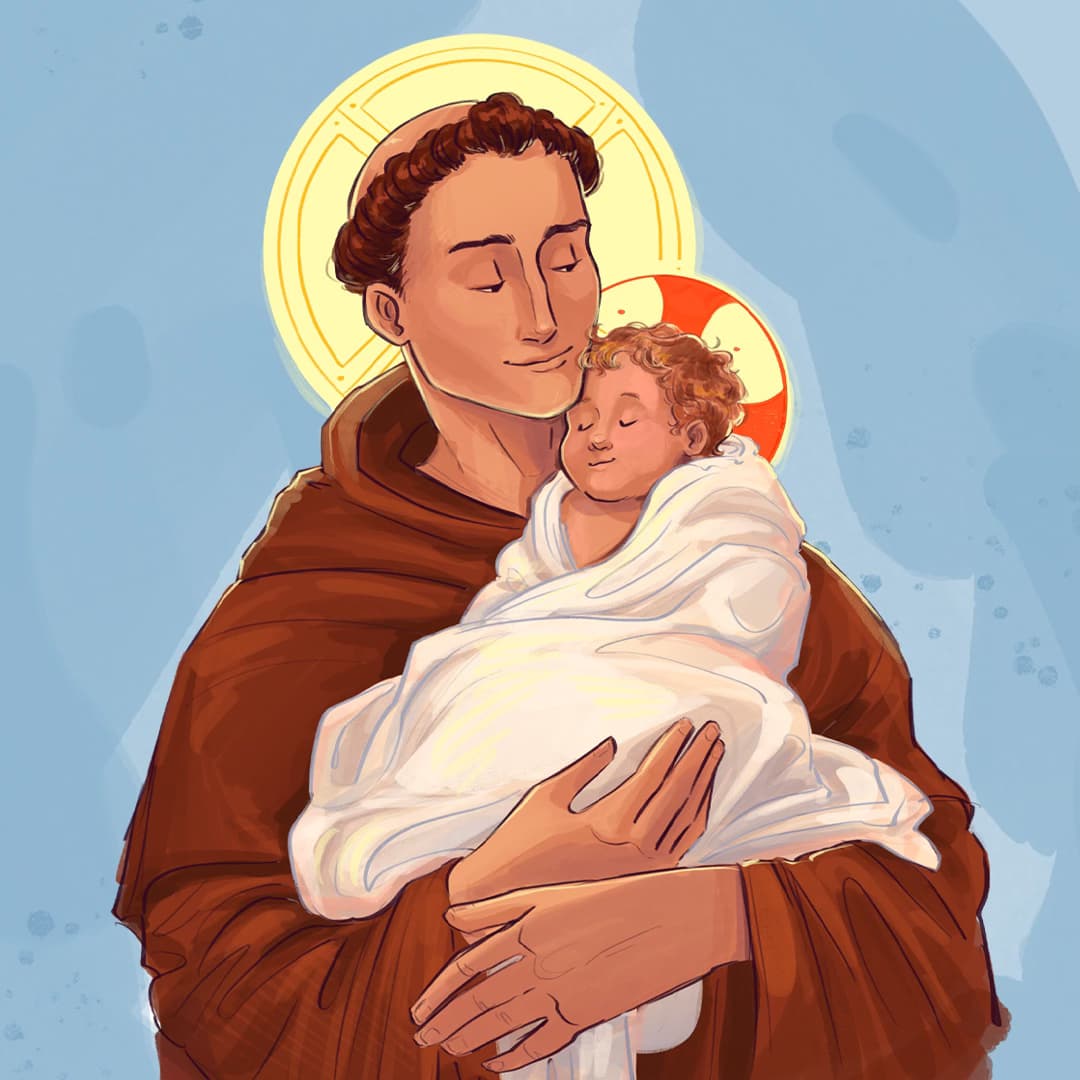
Add that to reattaching the foot of a young man named Leonardo and resurrecting a toddler known as Little Tomasino, and you can see why this guy was legendary. He was also deeply spiritual. In fact, people saw him several times entirely in ecstasy, holding the baby Jesus right in his arms.
This amazing scene actually determined the way he is represented by religious art today. If you've ever seen a statue or painting of St. Anthony, you'll often see him holding the infant Jesus, along with a lily, or a lily, or a lily, or a lily, or a lily. A book and bread for the poor.
Eventually, Anthony's non-stop labor wore him down, and he died young on June 13, 1231, in Arcella, right near Padua. Pope Gregory IX canonized him a saint in 1232, just one year after he died. Later, in 1946, he was even proclaimed a doctor of the church because of his brilliant teachings. You probably know that Saint Anthony is the patron of lost items, but he is also the patron of lost items. Also, the patron saint of the poor, of travelers, of pregnant women, of his home country of Portugal, and of the city of Padua.
But let's go back to that lost items thing. Why is he the guy we go to when we lose our headphones or our keys? Well, his biographers say that his connection with finding lost things is actually because, during his life, he was an expert at helping people find what really matters—truth, repentance, and the courage to change. So, the next time you lose something, by all means, ask St. Anthony for a little help. But don't stop there. Challenge yourself today to find an opportunity to show mercy to someone who is poor, lonely, or struggling, just like he did.
Anthony didn't settle for a comfortable, easy path. He sought moral clarity and concrete action. You can do exactly the same in your everyday life today. Thank you for joining us on My Daily Saint. We look forward to sharing another incredible story of faith and courage with you tomorrow.
More from My Daily Saint

Listen Next

September 26: The Troublesome Dominicans
The American Catholic Daily Reader Podcast

Women of Chivalry: The Genius of Courage
The Shield and the Cross
The Virgin of the Poor: Mary's Smile in the Cold of Banneux
Mother's Mantle
Hallowed Hollows: From Hidden Gems to Discovered Treasures
Hollows of the Faithful