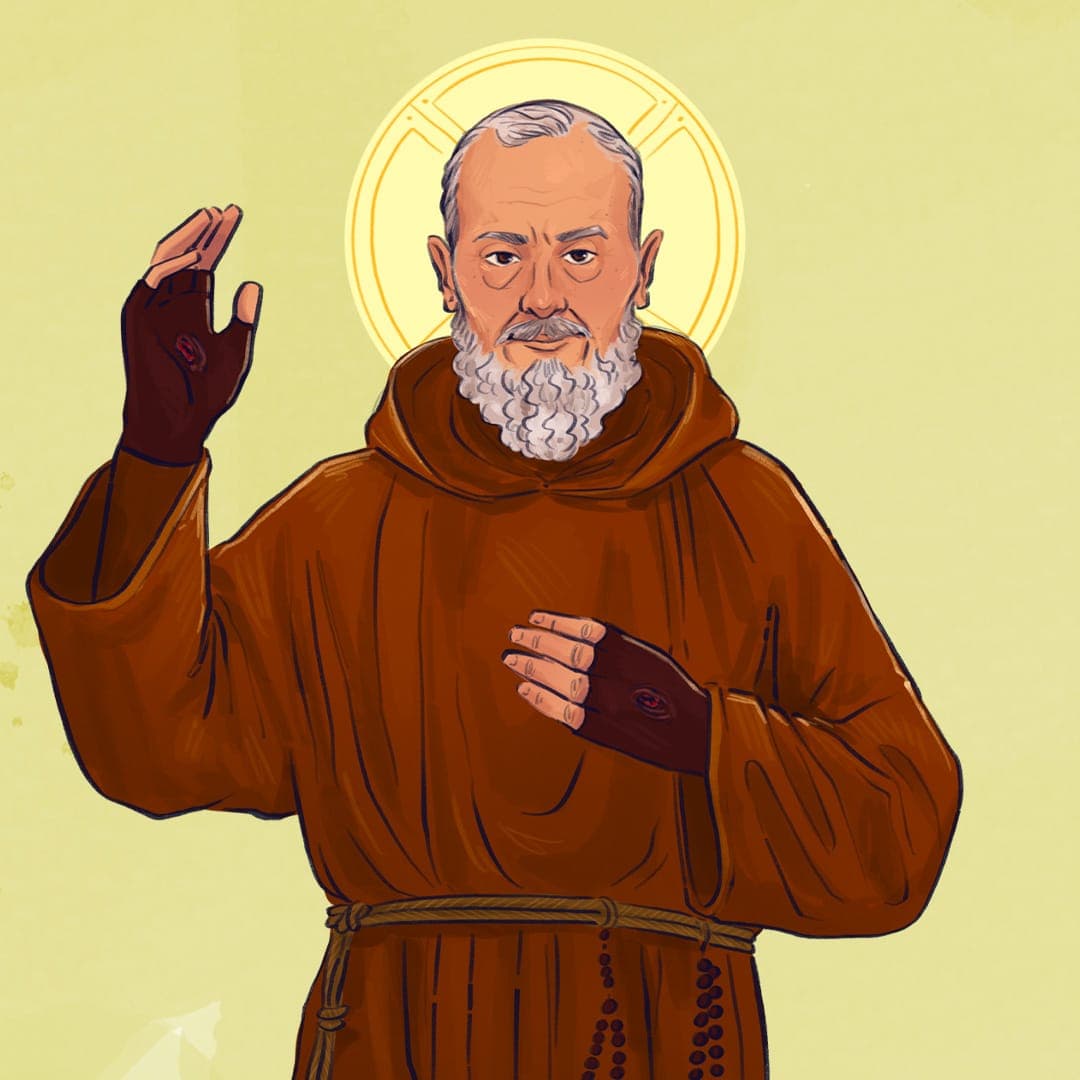
In this episode, we’ll explore the extraordinary life of Saint Pio of Pietrelcina, who is also known as Padre Pio.
Transcript
Read the full transcriptAuto-generated · 929 words
Welcome, young history buffs and curious minds, to My Daily Saint, the podcast that digs deep into the incredible lives of the saints, those remarkable people who shaped history and continue to inspire us today. Forget dusty old portraits and boring stories. Today, imagine walking into a small, dimly lit church in rural Italy. You step into a wooden confessional box. Before you can even open your mouth to whisper the things you've done wrong, the priest sitting on the other side starts listing your sins for you.
You're shocked. And as he raises his hand to bless you, you notice something even more startling. He's wearing half gloves to cover mysterious bleeding wounds in the center of his body, and his hands are covered in blood. You're shocked. And as he raises his hand to bless palms, wounds that perfectly match the ones Jesus received on the cross.
Today's episode is all about Saint Pio of Pietrelcina, better known to the world simply as Padre Pio. Born on May 25, 1887, in a small, poor farming town in southern Italy, his birth name was Francesco Forgione. From the time he was a young boy, Francesco was different from the other kids. While most kids were just playing in the dirt, Francesco was experiencing intense visions of Jesus, the Virgin Mary, and his own guardian angel. These spiritual experiences actually brought the young boy a lot of confusion, fear, and intense interior struggle.
At just 15 years old, he joined the Capuchin Franciscan Order and took the name Pio, but his journey had a rocky start. His early years were plagued by terrible chronic illness. He kept getting so sick that he frequently had to leave his religious community and go back home just to recover. For a long time, people weren't even sure if he would survive or be able to continue his calling.
But Pio didn't quit. In 1910, he was ordained a priest. From that moment on, his entire world revolved around two realities, the Eucharist and confession. People said that when he celebrated Mass, it was incredibly intense and deeply prayerful. It visibly looked like he was stepping directly into the sacrifice of Jesus.
Then came the moment that changed history. In 1918, while Padre Pio was praying in front of a crucifix, something unbelievable happened. He received the stigmata. The stigmata are the visible wounds corresponding to the wounds Christ suffered during his Passion. Now, a few other saints in church history have had this, but usually just for a short time.
Padre Pio bore these painful, bleeding wounds for 50 straight years, all the way until his death. You'd think everyone would immediately realize he was a living saint, right? Wrong. This brought him crazy international attention and heavy scrutiny. Doctors came to examine his hands. Church authorities investigated him over and over.
Some people questioned if the wounds were real, while others worried that the massive crowds treating him like a celebrity were a distraction. Eventually, the Vatican stepped in with strict rules. They completely banned him from celebrating Mass in public, hearing confessions, or even writing letters to his spiritual followers.
If you were accused of faking something you weren't, or silenced for no good reason, you'd probably try to defend yourself, right? Not Padre Pio. Even though he believed the restrictions were totally unfair, he simply obeyed. That takes incredible, heroic strength.
Eventually, the church lifted the bans, and when they did, Padre Pio's ministry exploded with even more intensity. People from all over the world traveled to his town of San Giovanni Rotondo just to go to confession with him. He would sit in that tiny confessional box for 10 to 12 hours a day.
And this is where that mind-reading superpower came in. People reported the unsettling experience that he knew their sins before they spoke them out loud. If you tried to hide something or lacked sincerity, he could be very direct, sometimes even severe. But he didn't do it to be mean. He did it to wake people up and lead them to true conversion. Many people who ran away feeling scolded came right back when they realized he had seen straight through their defensive walls. In 1956, he founded a massive hospital called the House for the Relief of Suffering.
He wanted to provide top-notch medical care combined with Christian charity, proving that true spirituality extends into real, organized service to others. Padre Pio died quietly after Mass on September 23rd, 1968, and right before his death, those famous stigmata wounds completely disappeared, leaving absolutely no scars. In 2002, Pope John Paul II officially declared him a saint. Today, St. Pio is the patron saint of civil defense volunteers, the suffering, confessors, and those seeking healing.
So, what can we take away from this amazing saint for our own lives? He had a famous saying, pray, hope, and don't worry. He didn't just say this to sound nice. It was a rule for life built on a disciplined trust in God, even when circumstances were tough. Our suffering isn't meaningless if we unite it to Jesus on the cross. It is never wasted. So today, when something annoying or painful happens, instead of complaining, just pause, take a deep breath, and remember His words, pray, hope, and don't worry.
Give that stress to God, and trust that He's got your back. Thank you for joining us on My Daily Saint. We look forward to sharing another incredible story of faith and courage with you tomorrow.