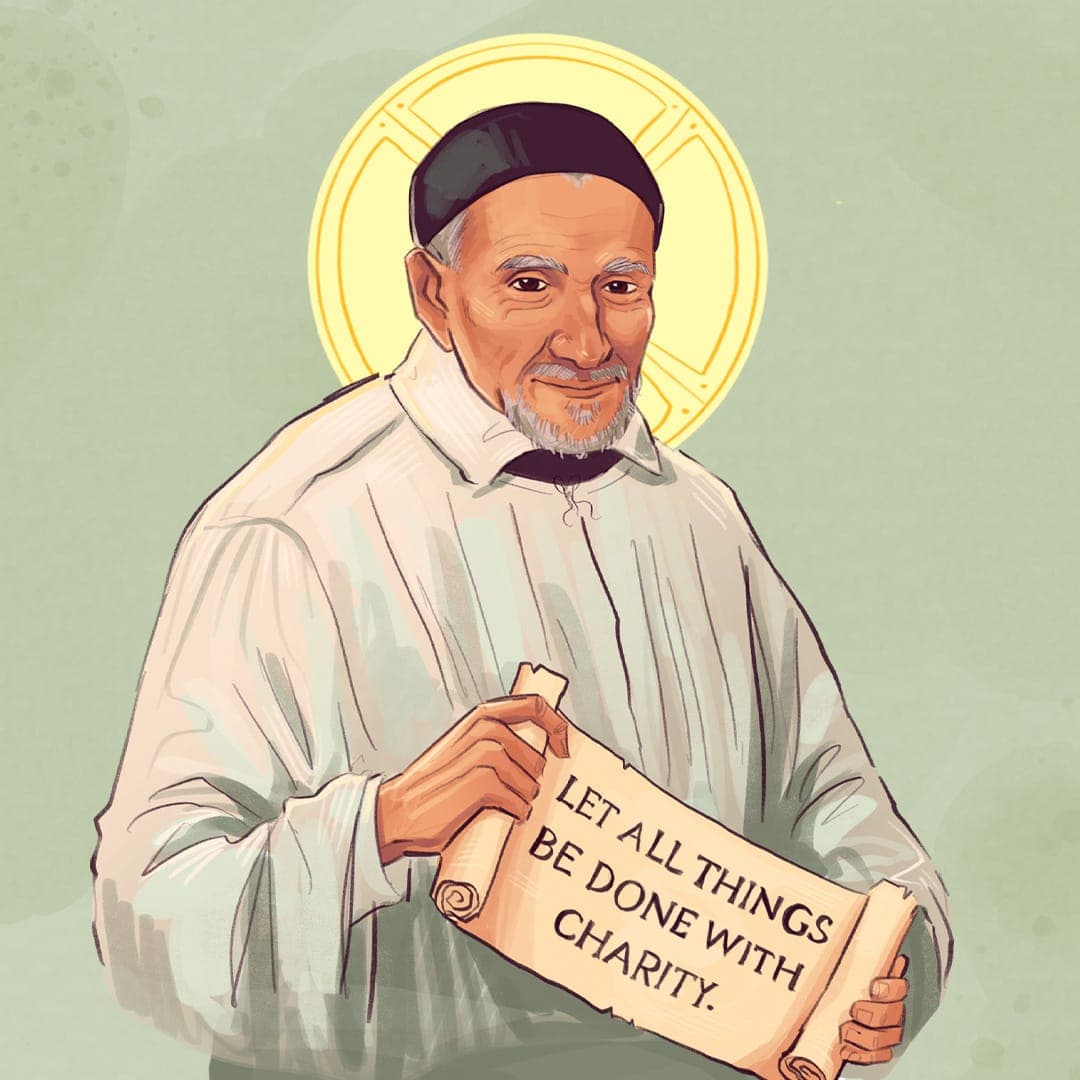
In this episode, we’ll explore the extraordinary life of Saint Vincent de Paul.
Transcript
Read the full transcriptAuto-generated · 809 words
Welcome, young history buffs and curious minds, to My Daily Saint, the podcast that digs deep into the incredible lives of the saints, those remarkable people who shaped history and continue to inspire us today. Forget dusty old portraits and boring stories. Today, imagine growing up dirt poor on a farm in 16th century France. Your feet are muddy, your stomach is rumbling, and you realize something very quickly. You want out. You want a good job, a steady paycheck, and a comfortable life. So, what do you do?
You decide to become a priest. Wait, what? A priest just for the money and stability? Yep, you heard that right. Today's saint didn't start off with glowing halos and angels singing. He was looking out for number one and his family. But then, a dramatic turning point, a deathbed confession, and a realization that would spark an absolute revolution. This is the story of Saint Vincent de Paul, the absolute mastermind and Architect of Organized Charity Born on April 24, 1581, in a tiny French town called Pouillet, Vincent de Paul was the son of struggling peasant farmers.
His early life was all about survival, hardship, and practical necessity. When he first became a priest, his motivation wasn't purely spiritual. He spent his early years as a priest basically wandering, searching for a good position, and battling his own ambitions. He just wanted a comfortable career.
But God had a totally different plan for Vincent. His transformation wasn't an overnight lightning bolt. It happened gradually. The massive, life-altering plot twist happened when he encountered people who were completely spiritually neglected. Specifically, he was called to the bedside of a dying man in rural France. As Vincent listened to the man's confession, he was hit with a shocking realization. The people in the countryside were entirely ignorant of their faith. They were spiritually lost.
Vincent realized something crucial right then and there. Poverty wasn't just about not having enough money or food. There was also a massive poverty of formation. People didn't know anything about their faith, and nobody was helping them. From that exact moment, Vincent's entire life flipped upside down. He stopped chasing comfort and started chasing change. He started organizing massive missions, traveling out to those forgotten rural areas to preach, hear confessions, and teach people the basics of what it meant to be a Christian.
He was so successful that he actually founded a whole new group of priests dedicated to evangelizing the poor, known as the Congregation of the Mission, or the Vincentians. But he didn't stop with the priests. He knew he needed an army of helpers. So, he started mobilizing laypeople, especially wealthy women who had the resources to make a difference. This led to something totally revolutionary at the time, the Daughters of Charity. Back then, religious women, nuns, were mostly cloistered, meaning they stayed locked away in convents, praying all day.
But Vincent's Daughters of Charity? Nope. They were out in the streets. They lived and worked right in the middle of the world, getting their hands dirty by directly caring for the sick, the abandoned, and the poor. Before Vincent, if people wanted to help the poor, they might toss a few coins to a beggar or randomly give away food. It was nice, but it wasn't solving the bigger problems. Vincent realized that good intentions are simply not enough.
He insisted that charity could not be improvised. It had to be organized, disciplined, structured, and sustained. He was a realist. He built massive, organized charitable structures, hospitals for the sick, orphanages for abandoned children, support networks for victims of war, and he even set up assistants for galley slaves, prisoners chained to the oars of massive ships.
He completely transformed how the world viewed people in need. He used to tell his followers, the poor are our masters. He believed that serving the poor wasn't just a nice, optional thing to do if you had some spare time. It was absolutely essential.
By the time he died on September 27, 1660, in Paris, his work had entirely reshaped Catholic charitable life, not just in France, but across the world. His legacy is still alive today in countless institutions completely dedicated to service. Pope Clement XII canonized him in 1737.
St. Vincent de Paul is the patron saint of charities, the poor, social workers, hospitals, and prisoners. This week, don't just wait for a random opportunity to do something good. Plan it out. Make it a real, disciplined plan. Remember Vincent's rule. Charity must be organized, not improvised. And treat the people you help with massive respect, because as Vincent said, the poor are our masters. Thank you for joining us on My Daily Saint. We look forward to sharing another incredible story of faith and courage with you tomorrow.