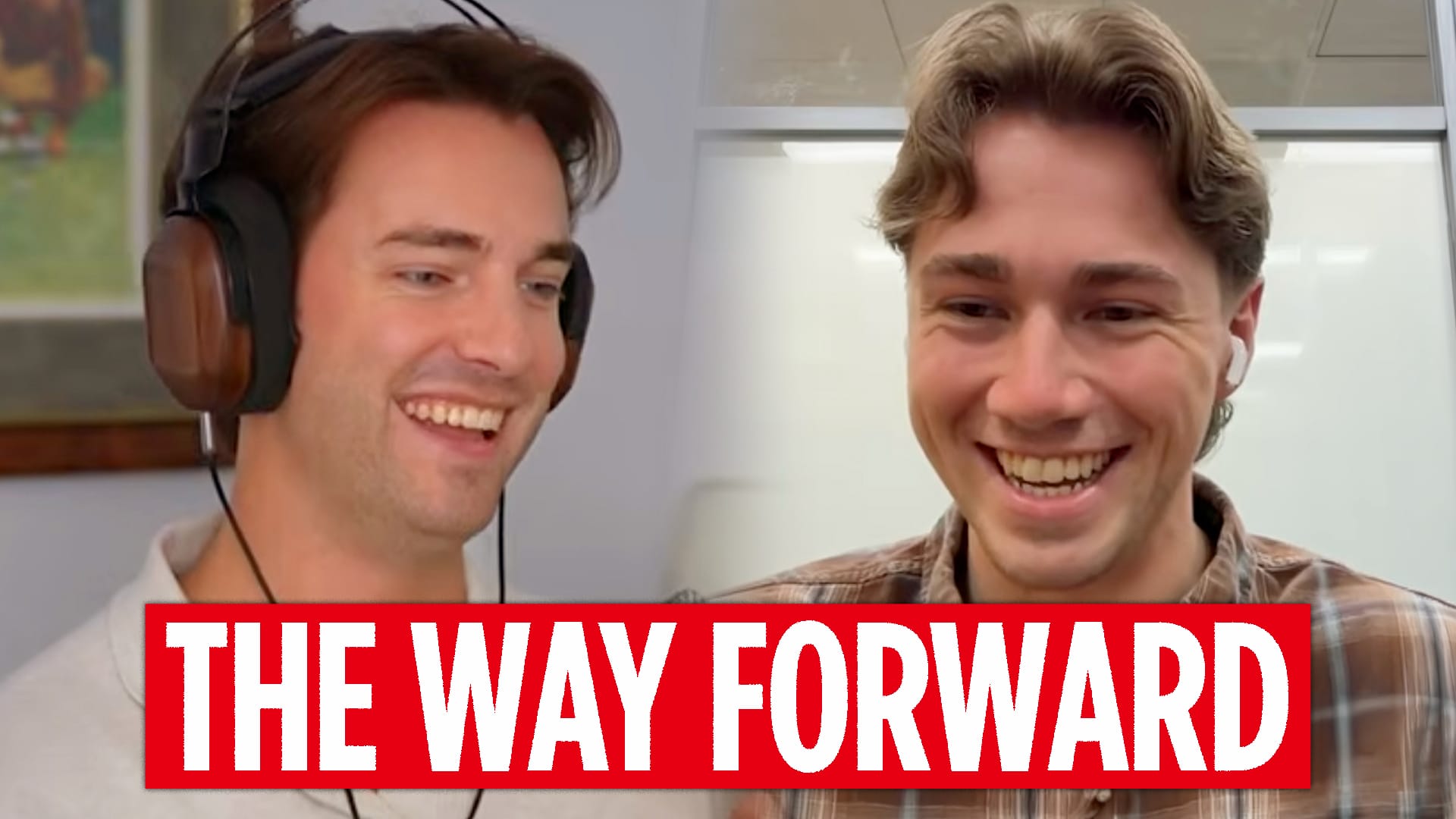
Kai Schwemmer on Campus Debates, Midterm Blowout, And The Way Forward
Hey guys, CatholicVote is out on a retreat, in the meantime here is my interview with Kai Schwemmer. He has been hitting college campuses across the country on the "Pick Up The Mic" Tour, all over internet debates, and actively getting involved youth engagement. I've admired his joyful warrior attitude from afar and was excited to get his perspective.
00:00 Campus Debates Post Charlie Kirk
7:02 The Youth Vote Swing
13:59 The Biggest Disconnect
17:52 Why Do You Work "In The System?"
21:41 Things That Need To Change
31:36 Getting Involved
36:31 Jubilee Debates
44:20 New Debate Tactics
56:00 Mormon Young Marriage Success
Get your FREE PHONE as a new Charity Mobile user with every new line — and FREE SHIPPING — with promo code LOOPCAST at https://bit.ly/LOOPcast-CharityMobile
EMAIL US: [email protected]
SUPPORT LOOPCAST: www.loopcast.org
Check us out on Zeale: https://zeale.co
Subscribe to the LOOP today!
https://catholicvote.org/getloop
Apple Podcasts: https://podcasts.apple.com/us/podcast/the-loopcast/id1643967065
Spotify: https://open.spotify.com/show/08jykZi86H7jKNFLbSesjk?si=ztBTHenFR-6VuegOlklE_w&nd=1&dlsi=bddf79da68c34744
All opinions expressed on LOOPcast by the participants are their own and do not necessarily reflect the opinions of CatholicVote.
Transcript
Read the full transcriptAuto-generated · 12,671 words
Today, I'm really happy to be joined here by Kai Schwemmer, College Republicans of America Political Director. I think I've seen you describe yourself as a TikTok politician. Is this true? Probably, sarcastically. I even hate the word influencer, but I suppose that's kind of what I am, and I definitely did get my start on TikTok. I can't deny it. It is who I am. Yeah, but I think the difference is you took that and then actually put it into some grassroots, on-the-ground type activism.
Where are you calling in from today? I know we talked about the background, but... Yeah, so I am in the HBLL, which is the abbreviation for the library here on the BYU campus. It's this huge public library. Well, actually, technically, it's private, but I'm calling from one of the group study rooms that I've reserved, so hopefully nobody kicks me out. That's how you know you're about that action. Yes, sir. I've been seeing the clips you post on YouTube. I mean, the one that really jumped out to me was the conversation with that university professor.
I think it was in a Michigan satellite. Yes. I also saw you in the MAGA versus America First debate, and the two people that stuck out, I just talked to John Doyle last week, brutal, right before the election where he told everyone to vote Republican. I felt so bad, he's just getting ripped up in the comments, but I really appreciated getting into his mind. And you were the other person that really stuck out. And one of the things I really appreciated was the jovial nature, which I think just shines through all the clips, but just a willingness to be honest, but keep the eye on the ball somewhat.
And then, of course, now I'm seeing you on the tour, the Pick Up the Mic tour. Now, my first question is, what is the energy like doing events, picking up a mic after the very visible public assassination of Charlie Kirk? What's that energy been like? Yeah, that is a good question. I mean, unfortunately, the shadow of political violence is always being cast over these events. You know, the fact that there is security there is something that, you know, nobody is ignorant of and we are very grateful for, but it is also, you know, a sad reminder that this is what is necessary to, you know, speak freely on campuses these days.
A lot of people will ask, how do I feel going and doing these events? I will be honest, I try not to think about it. I go into these interactions, you know, trying to have a positive political conversation. But I had an event at the University of Idaho a couple of weeks ago, and there was this one guy that walked up who had his hands in his pockets, hoodie up, and this was one of the few moments where I've really been kind of sussed out by one of these people that I've seen.
And so, like I said, that shadow is always kind of looming over what you do, and whereas maybe two years ago, you wouldn't have even thought that somebody would come up and attack somebody doing one of these events, now it's pretty commonplace. And it's frightening because, look, there are some of these campus speakers and debaters who do a more rage-baity kind of interaction performance type thing. I try not to do that at all. I try to be the complete opposite of that because I think that this is the way we improve the discourse, and I think it's also been missing a little bit lately.
But even still, there will be, in fact, we actually just had a story come out about this this week. You'll have people just looking at, you know, pro-life organizations and students tabling on their campuses, and they'll get threats. You know, on Yik Yak and these college apps, you'll get messages saying, the one about this campus in Ohio, I believe it was, said literally, how many, you know, dining dollars for somebody to go kirk the pro-life table. And that kind of stuff is just ubiquitous these days, and it's really unfortunate to see.
It really is. And before we get back to Kai, I want to talk about our sponsor of today's episode, Charity Mobile. Now more than ever, it's important to do business with companies that stand with you and your beliefs. Charity Mobile is a pro-life phone company that serves pro-life customers and supports pro-life, pro-family causes. They send 5% of your monthly plan price to your favorite charity, and they have sent millions of dollars to charities over the past 30 years. Not only that, there are no sacrifices when you switch to Charity Mobile.
All of their plans start under $50 before taxes and surcharges, and their nationwide coverage is the same as the major carriers. And their friendly, pro-life customer service team is based right here in the United States. Plus, Charity Mobile is running a special promotion for our audience. Use promo code LOOPcast to get their free phone offer with every new line of service, plus free activation and free standard shipping. Switch to Charity Mobile and buy the way you believe. To get started, visit CharityMobile.com and use promo code LOOPcast.
That's CharityMobile.com, promo code LOOPcast. Let's get back to the episode. I was curious because you just see the clips, and so, of course, I've seen the worst of the worst ones going around Twitter of someone coming up just laughing, talking about how they wish it happened to you type thing. But I was curious, too, like, are there people coming to this that maybe we don't see that have actually been, even if they disagree, more appreciative of the fact that, like, wow, you're doing this, you know, submitting your opinion, having good faith conversations in your case amidst this type of thing, and this is actually something I want to engage with, maybe even more good faith than I did before because I recognize it's necessary.
Yeah, that's an interesting question. I don't know if I would go all the way to say that, you know, it's better than it was prior. That was my hope. My hope is that, you know, seeing the violence against Charlie and against a lot of campus debaters, people would come up and they'd say, hey, I'm trying to be different. And there are definitely cases like that, you know, where left-wing students will say, I'm so sorry that there's people who, you know, engage with you and react to you so violently, so negatively.
But I don't know if it's quite. As large of a percent or as many students as I would hope. That being said, there are these breakthrough moments where you have human interactions with people, and on these college campuses, one of the things that I have been reiterating time and time again is how unfortunate it is that when we show up to the campus, the democratic socialists or students for democratic society, the college democrats, what they will do is they will post on their Instagram, hey, so-and-so is going to be here speaking, doing these debates.
Do not engage. Don't go up to them. Don't debate. That is really unfortunate, and I make a point to mention that, trying to invite those same people up to have a conversation, and every once in a while, you will see somebody come up, and I had a situation at the University of Montana where such a case actually occurred. It was kind of funny because the guy comes up, and he goes, wow, well, I was likely in that body of students who was not planning on engaging with you and talking with you.
Right. But I genuinely felt kind of called out by what you said, and I should come up, and I should speak my mind and ask a question. So, I appreciate you saying that. And then I was like, okay, awesome. Well, what is your question? The question they had was what I thought about the furry community. And it was not even a rage bait question. It was totally sincere, but it totally threw me off because I am expecting, okay, this guy is going to ask some prominent political issue, but no, what do you think about the furry community?
But, hey, at least they were brave enough to come up. That is what I am saying. You know, on that point, too, I am curious your perspective on this. It felt like, in 2024, it was, for the first time in my lifetime, cool to be a Republican, cool to be a conservative, cool to be on the right.
Truly, like, I was at, I waded through some of the lamest Tea Party conventions when I was 12, you know, God bless my dad, he would take me to go fight, you know, fight people on the street. Not physically, with ideas, of course.
But even that, I kind of recognize, like, this is kind of like rabble-rousing for, like, 40-year-olds, you know, like, and so, I mean, such a testament to Charlie, like, he came and was a big part of that youth swing, and if I look now, there's, I believe in the midterm elections, a 48-point swing Democrat, and kind of what you were mentioning before is, like, the DSA, those types are kind of in vogue right now. It's at least how it feels from afar.
You're definitely on the ground, and it might even speak to The idea that there is kind of this... I don't know if you see Gen Z as less ideological, like less plant the flag down, I am Republican, I am Democrat, I'm never going to switch. And I went back through Charlie's interview with Tucker, again, not to set off red flags, like it's kind of before, whatever, whatever you think about him. He came with a very clear message of like, I am just the messenger for the under 30s.
This is their reality, and it's an economic problem. And it seems like the numbers are really bearing that out. Do you feel kind of similar going to college campuses, talking to kids? Okay, this is now in vogue, partially because the Republican coalition was unable to answer the direct problems or concerns that I'm hearing on the ground now talking to people, and so therefore, they'll just go to the other side, like whoever's going to fix this.
Yeah, I think that's part of it. Certainly, there was a big part of the midterm election result that came as a protest to what has been going on. Of course, rather, what hasn't been going on in the last two years when the right wing has truly been ascendant in the country. Now, I have an interesting kind of analysis of this whole political dynamic. I don't believe it is the case that conservatives in 2024 suddenly became ideological liberals. And part of that is what you're saying.
It could be the case that they are just less ideological in general, but I don't believe that somebody who has a conservative disposition wakes up one day and becomes a liberal. And we actually see that in some of the ways that certain conservative propositions ended up passing anyway, even when Republicans lost their races in those same states. Right. However, one factor here that is important, especially when it comes to observing the trends in youth votes, is the role that popularity, the role that...
What social narratives have in affecting how excited somebody is to turn out for a certain cause? People, and especially young people, love the underdog, and they love who they can identify as like a rebel, somebody fighting against, you know, the prominent culture. And this is exactly, by the way, what mobilized so many people to vote for Trump in 2016. It was a pushback against, you know, this kind of oppressive, woke culture that was suffocating free speech, that was suffocating political disagreement and dissent.
And so, people turned out to vote for what was countercultural. They voted for, you know, this rebel, and people love that narrative, too. They love to attach themselves to those kind of stories. The problem is that the right wing has not realized, in many ways, that we won, and you were right. In 2024, it was cool to be a conservative. You would go to the Charlie Kirk events, and there were, you know, hundreds of your peers standing all around you. I saw the crowds at Purdue were absolutely insane.
At UVU, that final event, there were thousands of people there. This is, you know, proof that the right was ascendant. However, we didn't really switch the messaging up. We continued pushing, you know, party rhetoric and a platform that came across as if we were imagining ourselves as the underdog. And if you imagine yourself as an underdog, but the reality is that you're actually, you know, you have a unified government, you have the executive legislative and judicial branch. You have everything, brother, yeah.
Yeah, what it does is it falls on deaf ears, but even more than that, you look out of touch. You completely move away from what your voters are actually feeling, and if you pursue the same kind of rhetoric you were pursuing when you were actually being discriminated against by social media companies, by the federal government, then it will fall on deaf ears, and people are going to migrate to what is actually countercultural. And to some extent, the Democrats have done a good job of actually embodying that.
They've taken the sentiments about the economic situation of America. About the war, about the corruption, and they've been able to adopt those positions for their benefit. Now, do I think that they're sincere in all those aims? Of course not. Do I think they care about justice for the victims of the Epstein sex trafficking ring? Absolutely not. But they're smart enough to realize that they need to stake out these positions. And what's funny is this has produced a reality where if you talk with somebody and they're telling you about how there is a global cabal of baby-eating elites who are pedophiles, You're more likely to be talking with a Democrat than with a Republican at this point, which is really funny.
Yeah, it really is. Because there's the narratives game. There's also the hard economic reality of it, too. Basically, I'm really blessed, right? If gas prices go up, if you're kind of top 50% of the economy, yeah, that's annoying, it hurts, but it's not the difference between me paying bills or going into debt. But for 50% of the country, that's truly a reality.
And then also, you pour in college debt at this point, and then the average age of a homeowner has gone up, I believe, 10 years since 2008. The rents that you have to pay now go up. So, post-2020, the winners of the economy have been people that already owned things or were already near retirement age. Stock's going up great, and it's hard to buy into a system that you don't have any path towards becoming a part of, in particular, private property, but then ownership or equity in some way, and you're just constantly behind the eight ball.
And, like, you look at... The districts in Texas, for example. Swung so hard for Republicans, all Hispanic districts now come crashing back blue, and people are saying, oh, it's because of ICE. No, most of them said it's the economy. I mean, you can't pay to fill up your car at that point. Yeah, and so you have to think those Hispanic voters, you know, a lot of them, they hate illegal immigration, but, you know, they suffer the same workplace effects, you know, if not worse, right?
So, yeah. And immigration was actually the one issue, according to exit polling, that Republicans actually motivated the base to come out. Vote on. So, the lesson, of course, you know, you're hearing Trump kind of mumble a little bit about amnesty at this point. It's kind of like, hey, that would be the ultimate Greek tragedy portrayal of, like, you come onto the scene. So, deportation, mass deportations, and then to go back, and that is just insane to think about. But from your perspective, Kai, because I have you here, in what areas, like, it was great to hear you come to that debate on the MAGA versus America First, and just be very honest about how you see things, what people are telling you.
You're on these college campuses now. Where's the biggest disconnect between, I guess, the current reality of MAGA, and then, say, you know, a generally conservative leaning or right-wing? But maybe not super politically active, just wants to have a good future, have a good family. Where's the disconnect right now?
That is a good question, and I think you used the word that I am trying to use, which is honesty. We do not at all benefit by sticking our heads in the sand about some of the negatives of our political situation. I do not think that means you throw the baby out with the bathwater and tear down the Republican Party. I believe in the party. I believe this is the infrastructure that exists to help conservatives win elections, but I believe it has to be pushed in the right directions, and the only way that you actually improve anything is by admitting your shortcomings.
The big disconnect, I would say right now, between the average, you know, conservative voter and this kind of MAGA base is that there are people who are hesitant to criticism of things that are truly worth criticizing. We're looking at the Gapstein Files. We're looking at the Iran War. We're looking at the corruption in the administration by individuals therein, Susie Wiles, her daughter, you know, Lewandowski.
Yeah, Gilfoyle out in Greece, yeah. Just obvious in your face, ballroom donations. It's crazy that people even defend it at this point. It's just like, shouldn't we all be against corruption? Yeah, and that is actually, like, this idea we're talking about, about how crazy it is that people are even defending it, that's what's putting voters off. What's putting voters off is that you repeat to them 30 times, 30 plus times, that the Iran war has been won, and they can see, and by the way, their pockets are feeling the same reality, that that is just not true.
Second, when you, you know, campaign on being anti-corruption, but then you have such, you know, butchered releases as... The Epstein files, right? You have a lack of transparency on other issues, and then, of course, as well, the issues of corruption with members of the admin. That, as well, comes off incredibly hypocritically to voters, and they are so turned off by that. It is not because the message that you ever ran on was incorrect. It is because you started to prefer support for the president and the party over ideological consistency and a true victory on those issues.
There's other kind of nitty-gritty policy issues we could dive into, but at the end of the day, the biggest problem that people have is that they see commentators and politicians defending what really doesn't need to be defended, and when you do that, you lose credibility and you lose the respect of the voting public.
Not all of them are geniuses, but most of them are smart enough to realize when they're being lied to in this kind of bald-faced way. For sure, and I guess the great debate of our time right now is like, Everyone's on there, but all these people that feel like we're now a part of something that's going to be special, like golden age of America. These weren't just small promises, something really special. Now, basically sitting back, if I had to describe how I feel like a young Catholic American is.
How do I even find a lane in which I can get the bare minimum of just not being spied on in my churches or discriminated against because I'm a white man? These were real realities in the early 2020s, and now it's like, well, I got to be in this weird shell where it feels like MAG is really in the decline for a lot of self-inflicted reasons that I'm not going to defend. However, I acknowledge that just because Mamdani changed out of his CCP outfit and then is now wearing a suit and tie, gets a mustache, that they haven't really changed.
Yeah. So, the debate seems to be, okay, do we stay outside? I'm just so done with the party. I'm so done with the sick fans. I'm outside. I want to watch it burn. Go vote for the other side, whatever, or now you're taking the approach and staking your reputation on, no, I'm going to stay within the operation. I'm going to stay and push, and I just see that as really rare quality. Most people's temperament would just be a kind of. Throw you a middle finger, I'm out of here.
I'm not going to be doing this game. So, I guess you're doing this, and I'm curious your rationale as to why you're choosing to stay within the apparatus and push for positive change. You must feel as though it's possible. Yeah, part of it just begins with the optimism, right? It is a question of how you look at the world. Do you think things can get better? And that does not mean you have to assume, you know, this idealist view that all human nature is benevolent, which we know is not the case.
You know, being religious and especially being informed by a Christian worldview, we understand that, you know, human beings are flawed. They are flawed and they have fallen, you know, since the fall of Adam. So, you have to understand the way that that, you know, interacts with politics, the different motivations. The kind of real politic that occurs. However, you also need to realize that to build is what we need. There are a lot of people who are interested in tearing things down, and don't mistake what I'm saying here.
I don't believe that protesting bad policy and bad politicians is tearing things down. A lot of people conflate these two ideas. If you abstain from voting for a politician who does not represent your issues, that doesn't actually equate to tearing down the Republican Party. That is actually a way of engaging with electoral politics in the way that I'm describing, which is making demands and also working to have those demands, you know, be adopted into party platforms, but what that requires is for you to be in a position where your voice is considered valuable, and you are only considered valuable in electoral politics if you are willing to wield your vote, and if you are willing to use it only to support policies and items that you actually do agree with, and if we have a bunch of people who are actually mobilized, who actually will vote, If we can show the Republican Party that, yeah, you know, this is a demographic, especially, you know, Christians and young men, if you're willing to show them that this demographic is going to turn out to vote in margins that are higher than the national average, they will start to listen to you more.
But all of that requires you to actually think about, you know, investing in the system. There's also a practical consideration, which is that, look, we have a two-party system. It's not going away anytime soon. We don't have a Teddy Roosevelt who's going to draw away a third of the votes. I don't think Trump is capable of doing that at this point. And understanding that, you know, we have a structure that exists, and to the extent that our views are ever going to be reflected in the political system, in the two-party system, we have to be able to sway one of the parties, which is more closely aligned with our views, more to our side.
And that is possible. It's been done in the past. It was done in 2016. I look at the people who are disenfranchised with all of politics now, and I ask them, okay, I understand. That we had very high expectations, like you were saying, of a golden age, but think about where we were before 2016. What happened in 2016 was unthinkable, and the unthinkable in politics actually happens quite routinely. Despite contrary belief, despite what social media may tell you, sometimes things do happen.
I know how tempting it is to believe that nothing ever does, but at times, things do happen, and they can happen again in the future. So, it's interesting you say this, because you're like, well, if you can... Mobilize young men, young Christians, and prove that they can become an electoral force, then they'll start listening to you. And it feels like this last election, clearly, I showed you the numbers, was a protest vote. We do not want any part of what you just did, maybe not any part, maybe some parts, but we just are so upset at either some of the betrayals, or the direction, or the corruption, or whatever, that we're sitting this one out, or voting the other way, just to twist the knife.
Okay, so we're now at this playing field. A lot of people's votes are up for grabs, in particular, young people. That did come out for Trump before that I just know for a fact didn't vote. They didn't vote for Democrats, but they didn't vote because they're so mad. If you had to give advice, you know, your lips to God's ears or whoever's looking to maybe pick up some of these sincere, you know, right-leaning, conservative, Christian in character, young men, what advice would you give concrete policy examples of things that need to change or improve to win over that young vote?
Yeah, that's a really good question, and I think it's just to be firm. If there's anything that I've observed in my own life, and also, you know, in the lives of my peers, and of anybody with a conservative disposition, it is that we actually respond incredibly well to firmness. We actually respond incredibly well to people who want more of us. In fact, the thing that has disenfranchised a lot of young men is that they don't feel like much is being required of them.
They feel like all the blame is being put on them, but very little, you know, responsibility is actually being passed. I'm not saying you have to give people jobs. I'm saying that you should prioritize them over, you know, an Indian that's graduated from an Indian college who's brought in on an H-1B visa. And, you know, Vivek Ramaswamy had this absolutely terrible line at a libertarian conference in... I forget exactly where I was. This is like a nightmare ad lib you're setting up here.
Vivek Ramaswamy, Libertarian Conference. This sounds like a nightmare, yeah. Dude, it's terrible. What he says, which was hilarious because he got an instant reaction, he goes, my generation, we've already made it. And everybody there is like, no, what are you talking about? We're the ones who can't afford homes. Gen Z is screwed for sure. That was one of 20 examples of, yeah. Yeah, I was right there behind his Texas flag jacket and cowboy hat. The LARP is unreal with this guy.
But anyway, the policy objectives, they reflect that idea that I'm talking about, which is firmness. Immigration needs to stop. You need a border wall. You have to complete it. This is one of the best pieces of policy, because it can't just be removed with the snap of an executive order by a future president. This is a physical structure. Next, what you need is you need a severe restriction as well on the kinds of foreign visas that we allow into the country, because the H-1B visa problem is one that affects particularly this group of young men.
When you have these young men who have been told when they were growing up in elementary school and middle school... They should go into STEM fields, that they should learn to code, which is what I heard ad nauseum when I was growing up in my primary education. Then once they get into college and once they graduate, they find out that all of their jobs are being offshored or that people are being shipped in to do them for cheaper. This is an economic reality now that you've exposed people to that you pushed on them.
You told them these things. You told them that they should pursue these careers. Then you, through legislation, through immigration, enabled their replacement. And now, instead of telling people to learn to code, you're telling them to learn to plumb, you know, learn to become a plumber.
And so, this is one of the big problems. That whole thing frustrates me, too, because the trades might not even be a bad solution, per se, but now it feels like the reason you're bringing it up is so bad, Faith. Like, for example, I grew up in the Midwest, and it's shocking to see the...
It literally feels like sometimes the runes of the Roman Empire going into some of these rust belt towns. Beautiful skyscrapers, intense capacity, and they're all just rusted and sitting there. These decisions were not made by so-and-so factory worker in the 80s to get rid of their job when they're in their 30s, 40s, and send that overseas, and then, okay, you got to tell them to code. Now, all of a sudden, coding is either AIs on the forefront. So, immigration, I think, is...
It seems to be the final leg of MAGA that everyone is on board with, of like, this cannot be compromised in any way, shape, or form. I mean, I was shocked going through the timeline today. Like, Bill Malugan, or Malugan, I'm not sure exactly how to pronounce, but he's been a reporter on the immigration front for a long time. He's tossing out potential hypotheticals. I don't know if it was just for fun, but he's like, well, what if we gave amnesty to people who were here for 10 years plus, but in return, we got real ID and a couple other things?
And the immediate response was, no, absolutely not. It's almost like, why do we need to compromise at all? You should just leave the country. Americans should be prioritized, period. That was why Trump got elected. That will be why he burns, if he does not end up pulling this off. And it feels like a lot of betrayal in that regard. One thing that I'm sure you have to hear on college campuses is, and J.D. Vance said it himself, we need to revisit this relationship with Israel.
Clearly a hot topic on the MAGA versus America First, but I'm really shocked when people are unable to engage with younger people out of accusations of anti-Semitism or whatever else, just truly bad faith. Sentiment on the ground, you know, what do young people need to hear in order to even entertain? I guess I'm just saying from my personal experience.
I wasn't really alive or politically conscious during the war on terror, and yet now I look back academically, and it just seemed like so settled. This was a total disaster. We didn't get anything out of it. It inflated our dollar. Americans died, and the fact that we would even be entertaining potentially another Persian Gulf excursion here, and I know people are like, well, not many people died, whatever. No one voted for this. Actually, we voted on quite the opposite. Trump ran, scourging these people, and now all of a sudden, they just seem to be back in the orbit, and then are unwilling, of course, to look at this midterm disaster and be like, Yeah, this was actually kind of the reason.
I mean, it pretty obviously was. So, votes up for Grab here, 2028. You know, what do people need to hear to actually get behind someone again? Yeah, they want to hear the same thing they heard in 2016 and 2024, but they just want to see a delivery on it, which is no new foreign wars. And it's funny, you know, people will play this whole game, and this goes back to my point about just being more honest with people. They'll play this whole game of, well, Trump never actually said no new wars.
Well, there's like a billion campaign videos where he says, I'm not going to be a president who starts wars. Hillary Clinton was the one who started wars. There's no need to do mental gymnastics, right? The voters We're hearing a message, and that message was anti-war. It doesn't matter what the particular verbiage was. The sentiment during the campaign was at least that we were not going to have another war in the Middle East, especially not another Persian Gulf War. And part of the criticism of those prior involvements in the Middle East is part of what got Donald Trump elected in 2016.
So, anybody who's trying to come up with some kind of sophistry. To explain away Donald Trump's verbiage and why he actually has always been in favor of a war in Iran. Those people just need to be completely shut out. So, the very easy policy objective is stop the war and don't engage in another one. The more difficult one, but one that young people need, is stop these foreign entanglements. The relationship we have with Israel, it's like we are the senior partner.
They are the junior partner. That means if we want to have a peace deal, they need to listen to us. And part of me is optimistic that with the change in government, and it is quite possible right now that the opposition party in Israel forms a coalition with the Arab party, which would be a hugely unprecedented thing in the state of Israel. Of course, they are not going to hand over the security control to the Arab party or to a member of the Arab party, but it is going to likely improve the situation security-wise, and it will likely improve as well the ability for the United States.
To engage in diplomacy with Iran and also get cooperation from Israel. But I think that the average American voter, and especially young people, they want to see American sovereignty and supremacy asserted. Right now, it looks like we can't even assert it. It looks like we are afraid to say that we are the big dog here, that Israel is a tiny country in the Middle East that depends on us for weapon sales, that depends on us for parts of their security. And if we are willing, or rather, if we recognize ourselves as the senior partner in this relationship, we should be willing to do anything possible to extract the concessions that are necessary to get peace.
And right now, it looks like they've got us on a leash. Or at the very best, the leash is, you know, mutually applied, but it shouldn't be that way. We should have them on a leash. We should be willing, we should be, you know, conceptually willing to tolerate the idea of a weapons embargo or sanction. But the fact that so many of our politicians think that that is like an electoral death sentence is a big problem. The opposite is actually, you know, we just saw an electoral death sentence, and it's such a...
It makes me feel like I have psychosis. At the same time you hear, Israel can take care of herself. She's fantastic. She's very powerful. Great. I'm actually happy for that. Then take care of yourself. You don't need our aid. You don't need us to fight your wars. You could have gone to war with Iran, but it was us that here from Marco Rubio, we went to this war rampantly on behalf of Israel, which is just the crazy. I can't believe that even came out of someone's mouth from an America First perspective.
It just feels incredibly frustrating on the ground. On multiple fronts. But you're here with a smile on your face. You're engaging. I'm actually curious a little bit more on your work with the young Republicans. It feels like the pitch now is, hey, there's an opportunity to go silver linings with this. I remember what the conversation was pre-Trump. It was cut taxes, cut regulation, and then amnesty for everyone. That was the extent of the political conversation. You couldn't talk about demographics. You couldn't talk about...
Like, demographic replacement, certainly not. I mean, you'd be racist and cast out. I think Trump did have a lot of positive impacts, in particular, pointing out anti-whiteness, in particular, smashing media bias. I think we're at that point now. So, it feels like there's an open field. Have you noticed, even after maybe the demoralization of such a bad loss, a renewed interest in actually wanting to get a part of the... The work, essentially. Because the problem with online politics, maybe you've felt this on TikTok, is it feels kind of circular.
It's like, well, we had a conversation about it. Awesome. And then I don't actually know who's doing the hard work behind the scenes or if anyone's actually done that work. So, have you seen any renewed interest on actually getting a part of the machines of how to make progress? Totally. Absolutely. There have been record high rates of signups to young Republicans and college Republicans clubs around the country. TPUSA is feeling a similar stimulus. This is something that we are seeing, is that young people realize that the opportunity is here.
This is a historical moment. The message has been given across or has been shown to the party so clearly that it is unmistakable. And that message is that the young people Absolutely, you know, we're off-put by what was being done, and now they realize that that carries electoral consequences. They're going to be much more likely to listen to young people, and also just as a matter of demographics, for every, you know, member of the golden generation who is passing away, for every baby boomer who's going to be passing away in the next couple of decades, if the Republican Party wants to continue, they have to court newer voters.
Which means you have to establish a conservative electoral beachhead with Generation Z. Obviously, we know that just looking at demographics and looking at the way the demographics tend to vote, the chances that Gen Z becomes an overwhelmingly conservative generation are far lower than generations historically. Because far less of Gen Z is white, far less of that vote will be plastic, and the considerations are a little bit different coming from somebody who has immigrated here. A generation ago versus somebody who has been here for hundreds of years or their family has.
So, understanding all of that, I think that the party really needs to hone in on young people, but I also think that young people see that opportunity, and I hope that they take it up. I hope that the integration is not just into the campus organizations, but is then to connect with the party apparatus that exists in every state. Every single state has an executive board.
Executive board members are elected by a state central committee or something similar, and those positions you can run for. You can become a state delegate. You can absolutely gain your way into the actual structural organization of the Republican Party, and I think that is the next step for young people. It is to cross just from passive participants in online politics and commentary. To actually changing the party platform and, you know, getting very involved in these primary elections and local races.
Yeah, I... I've seen the thing where it's like, oh, the right-wingers, they're more conservative than even their grandparents were at one point. And the point I always bring back, too, is that's actually on a much smaller scale. They're not going to be majority conservative. If anything, you look at the broader trends, they're going further left. And demographics do have something to say about that, of course. But I do think...
I've been thinking about this a lot. How many people are actually just online lurkers? They're not even posting online. The amount of people that actually post online is maybe, every once in a while, about 10% of the internet, and then 1% are actually full-time content creators regularly making something. It actually is a little bit skewed. It might feel discouraging, but if you become a part of the 1%, think about how much influence you have, therefore, over the 10% that kind of post sometimes, but then the 90% that are just basically doing nothing.
Totally. So, I think the opportunity is ripe, and I was trying to think of where I was going to go next with you, Kai. Oh, yeah. So, you self-described as a debate kid, which I love. That might be a leading indicator for a lot of people. I was in debate, too. Let's go. What event did you do? I was a part of a homeschool debate club. It's called Grace Debate, so they did... Okay. We would have...
So, it was like an hour and a half debate. There'd be two partners. Each one would do two speeches. I think they're about eight minutes long, six minutes long, and then there'd be a three-minute cross-ex, and there's a panel of judges. Like public forum? PF?
I'm not sure. I wasn't a part of the national. It was a little bit... I'd have to look it back up, but great time. Yeah, very good time. And then you would have to do it on... You'd win either on significant solvency or inherency, and then the opposing team would have to win over just one of those. So, if you didn't adequately address one of those three, and they won it, they would win the round, and then there'd be five rounds in a day, two rounds in the next day, and then they would do finals in front of everyone, which was hilarious in hindsight, because our topics were about arm sales to Taiwan or Bahrain.
Yeah, when I was 16, I had a really good grip on that. How would you be? I think my case was like, we should send F-16s to Taiwan, which is hilarious in hindsight. One of them was actually what we could do about how we fund colleges, and that was actually pretty interesting. People came up with some pretty interesting resolutions, but anyway, all that to be said, you've been kind of in the national game debating for a little while, and I'll just say, kind of observing from the outside, sometimes they feel very frustrating.
Like, this Jubilee was kind of fun in the beginning, and now it just kind of feels like it's going to be a lot of fun in the future. What are we doing here? Yeah. Well, you're making a face. Do you want to speak on that before I say anything? Yeah. Yeah, dude, I can't. Yeah, I've actually wanted to go back and do some of them, and I'm really sad, you know, that I missed some of these people. Like, I wish I could have debated Harry Sisson.
He and I, you know, we came up on political TikTok around the same time in like 2019, 2020. Quite the hair rivalry between you two. Dude, yeah. Well, back in the day, I was winning because my hair was like to my shoulders. I looked like a hippie. Whatever, just subvert the expectations, but it is just a tag on consequence of COVID, but there are a lot of these debates that I would like to do, but I watch them, and frankly, I am going to call out our side here.
The right-wing debaters get so rage-baity, and very rarely do you hear a good argument. It is so difficult to listen to these Jubilee debates, because people come in and you can tell they have their clip, they've got their line that they're going to say, and it just doesn't land. It looks blatantly obvious to anybody watching what you're trying to do, and you have the people in the middle who come in with that same expectation, and so the well has been poisoned.
There is no good faith in these Jubilee debates anymore. And, you know, it was funny, I did the 4v4 pro-Israel versus anti-Israel conservatives. And the idea of doing a fact-check debate sounds really good. It is like, oh, you have live fact-checks. Everybody is being totally clear, and they are using numbers and statistics. But functionally, what ends up happening practically is that you get fact-checked because we actually started sending arms to – we started selling arms to Israel in like 1949 instead of 1948 or whatever the year is.
I thought we learned our live fact-checking lesson during the Trump debates because – It would just be like whoever, whatever network was covering it would have their live fact checker on, and of course, you can find the right facts to check and the right facts to not check, you know? Yeah. So, I agree, like in practice, it doesn't sound as fun, but I guess my concern about that is it just feels too saturated right now, and so I wonder what next kind of...
What iteration is going to come from this? And like you said, people come in with their clips, and then those get out, and the people that kind of already supported them before just are like, yeah, go off. Nailed it. You got that guy, because I hate that guy before. I've just realized kind of in my own consumption, some people make me so mad. I just mute them. I just disagree with you so wholeheartedly. I can't continue. And then there's the people, I'm like, oh man, he's making really good points.
I really like that. But at the end of the day, it's like... How do we actually, how do we actually approximate truth? Yeah. Like, we have a lot, it feels like we have a lot of sophistry going on, and I guess, how do you consider that? Like, the medium, the environment, and then also your goal, I assume.
Best intention would be, I would like to move the conversation forward. I would like to approximate truth. Realizing that you're dealing with people that maybe don't share the same, or they're coming in with clips, but also you knowing, hey, for me to get my message out, I got to get clips too. How do you deal with all that tension? Yeah, well, as a varsity high school debate captain, which, you know, is the line that got all the ladies to chase after me, I have some ideas on this subject, and what I'll say first is it's so frustrating for me because Actually, one of the impacts that people don't think about is when I go and review what people are saying about my debate performances, oftentimes I can't trust that what they're saying is reflective of reality, because I know that there is a bias that exists in the minds of every person in favor of their political worldview.
So, if somebody aligns with me, no matter whether or not I'm right, no matter whether or not I won the debate, they'll likely say, oh yeah, Kai totally crushed this kid, this liberal's totally wrong. They'll disagree with the liberal because they disagree with the worldview rather than whether or not he's actually incorrect in the debate. And so, for me, it becomes a lot more difficult because I don't know where to adjust. I don't know if what I'm saying is actually true, and it matters a lot more if it's a high-stakes debate where you have an audience that's more intellectually honest and is going to say, hey, you really lost this one.
So, that's one of those effects that you don't really tend to think about until you have to go and gather information from people. So, that is one fear. As far as what is going to shape the commentary landscape after the debate circuit is done, I hope it is not man-on-the-street content. That is my only opinion. I think long-form content that is more intellectually rigorous, that's, you know, a compilation of material specific to a... To a particular issue, I think that is going to start to take more root in the discourse and in the media that people are consuming.
That is what I hope. I wish there were more podcasts that did deep dives into specific issues, and maybe half of that is my fault. Maybe I need to just start. True, yeah. I wonder how much is just we are impacted by the environment as well, the medium. It is like, well, you are just kind of funneled down, and you just get your dopamine hits however you get them. It takes time to really refine.
Do you have any… Inspirations, I guess, of people that you feel like do a really good job with that and are fair-minded and help you improve. Yes. So, my inspiration for doing the campus debates, and I've mentioned this at a couple of them, is the original, the OG of OGs. And in the modern context, everybody thinks about Charlie Kirk with the Prove Me Wrong, or Change My Mind. No, Prove Me Wrong. But the prototype, right, was the Change My Mind with Stephen Crowder.
Crowder, yeah. And he was one of the first guys that I watched back in 2016 when I was getting into politics, and I loved his conversational style. It was long form. He brought a binder of facts with him. Like, he was well prepared. His research documents still hold up. They're very good. And it felt very intentional, very deliberate. Now, sometimes, and I think this is probably part of why that he started to do them less, sometimes the topics were just less, you know, interesting.
People love hearing about immigration. They love hearing about abortion. They love hearing about this, this, and that. But even now, it's like people are less interested even in those abortion debates than they are, you know, like. Whatever the most polemic take on transgenders is. And that's what's frustrating, is I feel like now the polemics and the analytics are driving a lot of the content, but we don't necessarily need an oversaturation of that kind of content. The right wing kind of won on this trans issue.
We really did win, and Democrats have kind of abandoned the point. Now, don't get me wrong, I don't think they've actually abandoned it, but they haven't campaigned on it because they realize it's off-putting to people. And what it creates is this kind of very vicious cycle of just producing content that isn't actually... Adding to the, you know, wealth of knowledge that exists in the conservative movement, and frankly, is also, you know, it's very divisive. The trans issue in particular is one where we stand to gain very little politically, and also, there's a huge increase in, like, you know, security risk by going really hard on this issue, and Charlie actually said that very thing before he was killed.
Right. He said that he was likely not going to pursue, or he was likely not going to prioritize this issue because it was one that he viewed that conservatives had won. And also, it posed the most significant threat to his life, and that was entirely vindicated. It's really crazy. It's interesting observing the landscape, too, because how Democrats ran these successful candidates that previously were very extreme. I mean, even the new governor of Texas, shock, very progressive in terms of policy, but then looking how she ran, you'd be surprised.
It'd be actually hard to find that out through advertisement. Two things. One, I think they really pulled back on... The trans issue, number one, and then number two, actually, they pulled a lot of their advertisement over immigration, because immigration, it's almost like, the funny thing about politics is if you solve a problem, it can almost be a bad thing sometimes. Like, immigration was solved so soundly in terms of closing the border, and the trans issue was decided so decisively, 80-20, all the legislation's passing, that to watch that be trotted out by Republicans, and I'm now reading some tea leaves of what was going on in the decision rooms in the White House or whatever, where The pollsters were coming forward and being like, actually, you know, tripling, quadrupling down on this is not going to be very satisfying to the public because we're getting hammered on war, we're getting hammered on economy, and that's exactly what, you know, like, Abdul El-Sayed, say what you want, but ran on affordability.
He ran, seemingly, a very mega campaign, backed away from many of his controversial issues, and won resoundingly. And so, part of that is frustrating because you're like, well, how much was even possible? Because the mistakes were so big, they're so public. There were so personally felt in terms of gas prices, personal costs, campaign betrayals, but at the same time, it was frustrating seeing, I was seeing advertisements on the trans thing, and I'm like, this. It's not to say that when they get into power, they might not do it, but this decision is not front of mind for people.
We're not able to fully address the front of mind things, either through humility and that we shouldn't have done this, or some type of action to alleviate, say, ending the war sooner or something. So, it's really a hard... And I think about that for what you're doing, too. They're challenging headwinds. It was challenging headwinds. There was a lot of good candidates, really solid candidates. I'm here in Indiana that lost, that in any other circumstance would have won. I mean, Indiana is a red state.
And that's really frustrating to me. I look at Brandon Herrera, and it's like, man, this guy's golden. This guy is so good. He really embodies this zeitgeist that we have with young people in any other election he would have won. And your point about running these ads about transgenderism, you're so spot on about this. And it goes back to what we were saying earlier, which is, look, dude, if we are ascendant, if we have won. You can't just repeat the same talking points as if you're fighting a vicious battle where, you know, you don't know what the outcome is going to be.
Yeah, then you just look, you know, kind of foolish, and you almost look like you don't even appreciate the victory. And if Democrats abandon those talking points, then you're kind of just talking to a brick wall. And they did. They did abandon these talking points. You know, James Tallarico even went as far as saying, oh, yeah, you know, I made this statement about how there's, you know, six genders, and, you know, that was kind of foolish. Like, they're, you know, taking this on the chin because they realize they can totally move on to these issues that voters actually are, you know, mobilized on.
And we hand Democrats a very, like, a very powerful talking point, which, frankly, is correct when they say the only people talking about trans people now are Republicans. Like, what's up with that? They're obsessed with trans people. What's going on? That, honestly, is a golden talking point, and they're right. And the right dude, so anyway. The other thing that I kind of see on the horizon now, because, and I'm curious how you approach this, I see DSA Ascendant and people talking about socialism as though it's very normal, and I can understand the reflex of the right to immediately jump to communism.
However, defending the current status quo as a Republican. is not a successful strategy to me, because we currently do have many socialistic policies. Actually, the reason that I'm frustrated with many of them are because they're socialism, but it is the status quo. So, when people are like, well, they're running as a socialist when they're promising Medicare for all or whatever else, I'm like, well, we do kind of have Medicare. We do kind of have Social Security. I mean, these are socialist policies.
And so, by saying, well, they're a socialist, I'm like, well, the current reality is socialism, and that's actually why prices are so high. My services is bad, like the entitlements might bankrupt the country. So, that is why I really thought that the strategy to go after waste, fraud, and abuse was undeniably smart and salient for the electorate, because who would possibly defend waste and abuse? And it was like, every day, you could find a new scam kind of being brought about on the American people on the taxpayer expense, and then the people that defend it look like they are defending corruption.
And I am like, it was frustrating to go away from that messaging. But now I see this kind of wind-up of like, okay, we're really going to hammer, you know, Al-Sayed or Telerico as like the new communists, right?
And, you know what, I can't read their minds. I don't know their political persuasions. I can only look at their policies. Yes, their policies are heavily socialist, and if you get into the nitty-gritty, pretty extreme. Like, Medicare for all would also include gender reassignment surgeries. I have no doubt. Abortion for all.
That I'd be paying for, but it almost feels similar to that, like, attacking the trans issue or attacking the border when it's not a problem now, and also being so frustrated with the status quo that defending, like, what's going on now, like, I guess the example that I give is, like, buy into the economy for under 30s. Like, if you can't own a home, and you're getting crushed by raising prices or increased prices, and you don't really own stocks and opportunity to do so, And you can't find a job because of AI.
It's just like a horrible recipe I see on the horizon. I guess I don't know how to really solve that or give advice, but I don't know if you've thought about this. What would be an effective line of attack? What would be an effective shift for Republican messaging in terms of policy to actually address head-on what we're dealing with? Yeah, I think there is some aspect of it where we can just, you know, there are certain policies where we can say, yeah, you know, some of these economic, like mixed economic systems and proposals are not the worst in every part of the economy, and part of it is just going to be necessary.
I look at like a child tax credit. I look at paternal and maternal leave. I think that is really good, and if we begin to condition these on conservative lifestyles, like actually getting married, et cetera, et cetera, before you have access to some of these things. And of course, this is worked out and tailored in policy so that a widow is not disregarded, etc. But if we can propose those kind of things, I think we win over a lot of voters.
That kind of a message is extremely popular. When there are restrictions, when we advocate for restrictions on the food industry and some of the negative practices that they have and pushing food to us that is really, really poisonous, you find that that activates an entire base of voters that we had formerly never even tapped into, this maha mom event. It is such a big deal, and there were MAHA candidates that won over MAGA-endorsed candidates in a couple state primaries. So, I think, you know, those kind of ways that we can tackle these kind of more interesting and niche, you know, sectors of the electoral map, our positions on the electoral map, that is something that we absolutely need to pursue.
But the reason it hasn't been working is because it falls on deaf ears because it looks hypocritical. You can't pursue, you know, you can't talk about, well, socialism is this big problem, while you are doing a bunch of stuff that makes affordability, you know, way worse. Right. And I'm going to be honest, I actually do support the idea.
Of a tariff policy. I think it's important for national security, and I think, yes, you know, it could be important to nationalize, or not nationalize industry, but bring industry back to the United States. I think that's a really common sense. I think the problem, and it's funny when people get all riled up about that, like, of course that's common sense. The way that it was gone about was not common sense. Like, why are we tariffing small islands that we have no trade with in the most chaotic way possible?
Yeah, it's a lack of executive competence, and that's what we need. You know, whoever it is in 2018, they need to be a good executive. They have to be policy-minded, or they need a really good cabinet when it comes to these issues, and they need really good policy makers, but the problem is that even if we pursue the tariffs, and even if we understand that is going to have a negative economic effect, it is going to drive up prices, we need to not simultaneously pursue another thing that makes the economic situation far worse, like a war, like increased spending, like an increase to the deficit.
That was the issue. Is we are saying conservative things, and we're saying, you know, we want to bring down prices, we want to make things more affordable for Americans, but then we're also increasing, you know, our spending, we're increasing the budget and the deficit constantly on a bunch of things that we didn't need to be pursuing simultaneously. So, I think that tariff policy is possible, but it also has to come alongside, you know, certain tax cuts for middle-class Americans, and, you know, it's crazy.
You get a guy like James Tallarico, who's proposing... During this time, you know, of conflict, a cut to the gas tax. That's awesome. That is a conservative economic policy. Indiana did that. Yeah, but because Republicans, at least in the national level, are, you know, pursuing all of these different things at the same time, we often, you know, abandon positions to the left. And, like, bear in mind, the reason that the left has had an electoral victory is not because their ideas have won out.
It's because they've... Basically, swap their position to more closely resemble the winning message of 2024. Now they're talking about corruption. Now they're talking about affordability. Now they're talking about, you know, ending foreign wars. And those are the issues that got us to win in 24 and that actually now have gotten the Democrats to win in 26. And you and I are absolutely right in this assessment that when they do push through their agenda, it will come with all of these more democratic, you know, or with these more socialist and radical proposals.
Including, and Abdul El-Sayed was even asked about this, universal health care, Medicare for all, it includes for him gender transitions paid for by the taxpayer. That is a big problem. It pays for abortions, absolutely. And he won't admit that he would, in fact, he will not even agree with the idea of coming to a compromise that includes Medicare for all, but, or universal health care, but no, you know. State-funded transitions and puberty blockers and hormone treatment for children. He won't even engage with it because, of course, that's a part of his preferred outcome.
Yeah, absolutely. And you're talking about political capital. How to smartly use political capital? Because the thing with immigration, I think everyone understood and totally signed on with, is, hey, if we have to disrupt this shadow force of illegal immigrants that don't have benefits, that are getting taken advantage of, but maybe make more money here than they would elsewhere. Yeah, it might make strawberries a little bit more expensive. It was so funny watching people defend illegal immigration on strawberries being like a dollar cheaper.
I'm like, I think most Americans understand what they're signing up for here. But many of those jobs, including the H-1B jobs, not just, of course, ag jobs, those are all jobs that would go to Americans, and it would actually require an arduous process of reordering the American economy in a much more just way, in my opinion, in which you can actually have people that have full citizenship doing jobs not being taken advantage of. And, yeah, mass deportations, yeah, was going to be expensive, too, by the way.
I mean, it was like everyone understood what they were signing up for, I think, maybe not everyone, and if it actually was pulled off at the level that they were promising. I don't think, but of course, then you have to spend your political capital there. So, that was one of my favorite arguments against the Iran war is like, we are wasting so much political capital on this that we need for what I consider an existential fight, which would be the immigration fight.
If we can't enforce our immigration laws, we're not going to have a country very soon. You're in the young marriage capital of the United States. Yes. Shout out to the Mormons on that one. You guys are killing it. You are going around on campuses and seeing the dynamic between young men and young women. This is totally like end of interview. I got to hear your perspective. Is it as much of a wasteland as it appears online? Do you have any encouraging signs or any lessons maybe from your culture that have translated into these blossoming young marriages that maybe we can export to the rest of the country?
What's your sense in all of it? I think it's faith. I genuinely think that the religious core in the state of Utah is the reason that marriages have been successful, right? It is not an accident, and the reason why the marriages are successful is, yes, we make it a priority, but we also do the things and engage with our religion and faith in a way that makes marriage sustainable. You and I are probably both familiar with the statistics of divorce, and people will say, well, 50% of marriages end in divorce.
Well, hold on. If you include a couple of variables, if you include a couple of factors, the divorce rate is... Is drop from 50% to 1%, and it is if you go to church every Sunday, and if you pray every night with your family and read the scriptures. If you do that, your chances of divorce drop so significantly, and I do not like the way that conservatives are so doom and gloom about it. That being said, there is a serious problem with masculinity and femininity in this country, and there is very toxic femininity that exists in the Republican Party.
And, you know, the big one I'm watching right now, and I don't just think it's the femininity, I think there's also, you know, an aspect which is maybe racial or demographic, but Harmeet Dhillon, I don't know if you've been seeing what she's going off on on Twitter, and this is not me defending the things that are said to her, which are mean, you know, people are calling her like a demon worshiper for the Sikh prayer that she gave at the RNC.
I don't think that was the venue to give that prayer. It's also like, you know, Republicans have no clue what a Sikh is. They have no idea about Sikhism. This is probably not the right venue. But concerning just the reactions, I think the Republican Party is absolutely, and conservative politics has suffered an excess of toxic femininity, and in many ways is more feminist than even the Democratic Party at times. And so, there needs to be a drawback there. But I also think that my perspective in the state of Utah, Is that, you know, marriage and relationships are about companionship.
There are guys who I talk to who I think might not get married because they, like, they based themselves out of marriage, where it's like, well, I can't ever be in a relationship with somebody unless I hit this list of based characteristics. That's a crazy phrase, dude, based themselves out of marriage. Well, and it's so true. It's like, dude, you read a list of things on Twitter that, you know, an anonymous user who's probably from India wrote. If your wife isn't all these things.
My brother in Christ, I promise you, if you invest in yourself and if you make marriage a priority, then you will attract a woman who is of a generally similar moral stature, and I promise that marriages, if both parties want them to work, can. If you go into it thinking about it, it's disillusioned immediately. Of course, you're going to be more likely to make that a self-fulfilling prophecy. So, that's what I would say is base it on the religion, and then be careful the expectations that you set up, both for yourself and for your partner.
Yeah, you did that beautifully. I think the struggle is a lot of people are unwilling to address that elephant in the room that there actually is a feminine component. There's a feminist component that's making this really hard, and some people just want to blame the men, which I'm like, as a dude, I'm grabbing some of my boys, giving them noogies. I understand, like, basically what you said, like, hey, the list is getting a little crazy here, whatever. There's certainly also structural issues with, I believe, 7% of men are unemployed right now, or young men unemployment, 4% for female, all of the job gains in the last job report went to women.
So, we have kind of this feminization of the economy that's really frustrating, and like an obvious reality would be, if you're not able to make a living, women are not going to be attracted. I mean, that's just a reality. That as a man, you need to provide. But I think the one cool thing at the end of this is that I always remind us, yes, you can chalk off all of the structural problems that we should work to improve, but at the end of the day, you are a man.
You have all of these advantages because you are a man. You are made unique from women. At the end of the day, the ball is in your court. Similar to our politics problems or whatever else, you literally were blessed by God to be a man. Being a man is awesome. True masculinity is amazing. It should excite you. I understand you can get frustrated and you can get down, but one of the things from that Charlie interview I watched, just to get ready for this one, is that this kind of The victim mentality actually is very corrosive and parasitic to the soul.
Totally. Why am I talking about these things? I'm talking about them because I want them to change, because I want them to improve. I'm not talking about them because, woe is me, I'm so sad, I'm going to remove myself from society.
You are a man. You are blessed by God to be a man. Go out there and get it done. And I would love to see this kind of masculine re-energization in politics, as you said, in the Republican Party.
It's certainly not happening with the Democrats. I hate to break it to you, if you're a white man, it's not going to go over super well. I remember living through 2020. That lane is there, at least in the Republican Party, even if they have the feminist issues, even if they have foreign policy issues right now, the venue is there for people that want it. And so, if you were to give a closing pitch, and I'm keeping you in the library a little bit longer, you're frustrated with current events, you're in your 20s, you want to make a real difference, how is that venue?
Young Republicans, what do you have to offer them? Yeah. Join the college Republicans. Join the young Republicans. Join your state party. You need to be everywhere where these decisions are being made, and then you need to invite other people to join as well. Remember that it is about outcomes. It is not just about showing up once. It is not just about being together, although that is a good thing, but think about what you are trying to achieve, and then do what you can to organize events to achieve that goal.
Make those political connections, and then ask for opportunities. There are lots of opportunities out there. If you're willing to ask for them, if you are willing to pitch yourself, and if we are all willing to do that, I promise that the party is absolutely going to shape to us, but the same kind of initiative is true of what we were just talking about, which is dating. You need to make it a priority. You need to date with intention. Don't just allow yourself to exist in a sphere or in a context where women are around.
You need to be intentional about... Making plans and doing these things for a specific goal. We can do that politically. We can do that in our personal lives. We should do that with our faith. We should set goals for how we can grow in our faith and our testimony, and additionally, we should make the goal, of course, of making more Americans. That is what this all comes down to. So, if we can do that, then we will never hear another argument for immigration because of fertility problems again.
No need, no need. Kai Schwimmer, thank you so much for the time, man. I appreciate you taking it. Thank you. Thank you for having me, man.
More episodes from LOOPcast

“Blue Tsunami,” Reacting to Historic Midterm Election Results

Samuel Sey Detained by ICE, Midterms Enter the Final Stretch, and Bishops in the Oval Office

French Protests Explode Into Riots, Fr. Ripperger News, And Vivek's Insane Ad