American Seafood: For Our Health and Economy
For two hundred miles off each of America’s costs, our nation owns the oceans. And those oceans are filled with a vast, diverse array of nourishing seafood. But onerous regulations make it near impossible to benefit from all that bounty. As a result, our food supply is filled with foreign-caught and foreign-processed fish that comes to us from countries with inadequate, even unhealthy production standards.
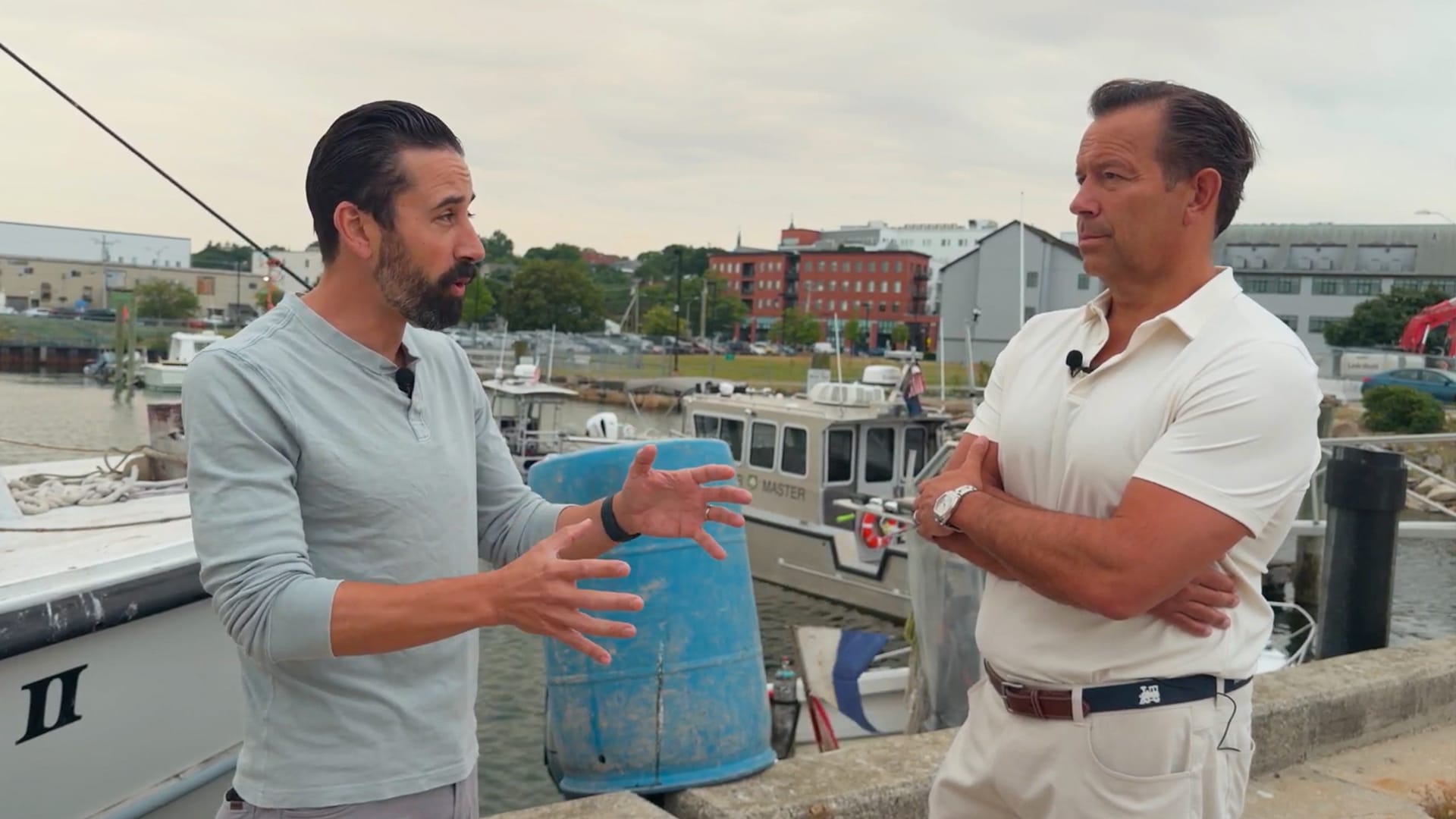
Join Steve Cortes in Maine as he learns how listening to frontline fishermen would lead to a healthy, highly-sustainable supply of delicious domestic fish, even lobster, at much lower prices than we see now.
Transcript
Read the full transcriptAuto-generated · 5,546 words
America is an ocean superpower, blessed with unmatched sea resources, and yet we import the vast majority of the seafood we eat, about 80% in total. In fact, the amount of imported seafood has doubled over the last 20 years, while the amount of domestically produced and processed seafood has actually gone down. Even with a growing population, how is this disparity possible? Why are we not making full use of this incredible gift of bountiful oceans all around us? We should be eating quality American seafood at far, far higher rates, both for our health and for our economic vitality.
It's not like we lack access to oceans. In fact, America has the second largest exclusive economic zone, or EEZ, fishing rights on planet Earth. Right now, the seafood industry supports over a half million total jobs. It's a really critical business in America.
But it should be bigger, and it should be even better, if government would just stop regulating fishermen out of business, and stop sending our seafood business overseas, where quality standards are lax at best, and environmental stewardship is non-existent.
To learn about seafood, and some of the most iconic fishermen in America, Chef Andrew Gruhl and I went to Maine. He went to college there and worked on a lobster boat, the beginning of a professional journey that led to his success as a chef and seafood restaurant entrepreneur, currently the owner of Calico Fish House in Huntington Beach, California, where this former Maine lobsterman brings a taste of New England to Southern California diners.
So, Andrew, we are here in Maine, on the coast. This place means a lot to you. Tell us about your past with Maine. Well, so I went to college here in Maine, and then I got into the restaurant industry in Maine, started working at a local lobster seafood shack, and learning about the lobster industry, the seafood industry, and I got the bite. Dropped out of college and ended up in the restaurant industry immediately thereafter. And did you have plans on getting into the seafood business?
Oh, absolutely not. No, no, no. No plans at all. I mean, I needed a summer job and was living on a property with a buddy of mine in a seafood shack, no electricity, and there was a seafood restaurant right across the water, and it's like, well, that'll be a fun place to work. I was just boiling lobsters, shucking clams, frying seafood, and watching all the lobster boats come in, and absolutely fascinating. I mean, a lot of the guys I was hanging out with were lobster fishermen and, you know, kind of grew up in the lobster world, so immediately my sense of curiosity was...
Peaked, because I wanted to understand about the supply chain, why it cost so much money, why lobster was a dollar on the dock at the time, but we were selling lobster rolls even then for, you know, $15, which was the late 90s. Now, the irony is that I then went on to open a business that was built on lobster rolls, but in California. Okay, so let us fast forward to that. So, you now operate Calico Fish House, where I have been.
It is amazing. I mean, I love the setting, love the food. All of it, you and your wife own and operate. That now that you're on the consuming side, right, you're the buyer, essentially, of a lot of seafood. What's that vantage point like for you? When I opened up Slapfish, which was my first concept, I started as a food truck in 2011, and then we grew it to like 40-plus locations, franchised it, and our number one seller was the lobster roll, right?
We were the lobster roll, the lobster burger, you name it. It was lobster everything. I knew I needed a high-ticket item, and lobster was something that I was already familiar with, and I wanted to merge kind of Maine with California, so we created the California version of the lobster roll. I dove right into buying lobster. We probably over the years purchased well north of a million pounds of lobster. What I noticed was the way in which the price of lobster fluctuates so much, not just at the dock, but through the supply chain.
And especially between 2005 and current day, so 20 years, how much of the lobster that's caught here in Maine is then shipped and processed in Canada, shipped back to the U.S., and then purchased by the consumer. At a premium that has doubled, if not tripled, over the years. The lobstermen aren't making that money, right? So, if lobster price has gone up 4x over 10 or 15 years, the lobstermen are actually making less at the end of the day. And that's where you look at this supply chain and you say, okay, everybody's making a cut through the supply chain, except the lobstermen.
Lobstermen are shutting down. The total catch every year is going down. And this is the most iconic fishery of... Any other fishery in the United States, if you ask me, and the most memorable of any species of fish in the world, you can only catch the species of New England lobster here in Maine, a little bit of southern Canada, maybe down into New Hampshire, and that is pretty much it. You do not get lobsters with claws anywhere else in the world.
Lobstermen are being crushed on regulations. The price of lobster is skyrocketing. We are shipping this to Canada in order for it to be processed, and then you have got the restaurateur that has got to charge in California $50 for a... A lobster roll to even make a dollar on that, and heck, even right here in Portland, I had dinner last night, and a lobster roll was $35, and they're dropping them right over here. Yeah. And that high price for lobster and for other seafood, is it largely driven by onerous and unnecessary regulation?
100%. So, let us take the labor piece. Why are we shipping 65% of our lobster to Canada in order to be packaged and processed? Because they have invested in cheap labor. In the United States, the labor cost has gone up so much. There are so many lawsuits, frivolous lawsuits, labor wage lawsuits, etc. That we're seeing all the processing facilities, not just for lobster, but for all seafood, shut down along the coast, right? All the way from Portland, Oregon, to Portland, Maine, and everything in between that horseshoe.
They've all been shut down. Over 80% of the seafood in the United States that is caught here is exported overseas. It's processed in China, and it can be labeled as U.S. wild, U.S. caught. It's processed in China, it's processed in Indonesia, it's processed in Vietnam. We don't know what chemicals they're using on that. They're using slave labor. I mean, you've got traces of chlorine, malchlite green, all these antibiotics, cocaine residue, you name it. We've seen the stories. We've seen the headlines.
But the U.S. fishermen who are catching the most sustainable, clean, pristine product are getting put out of business by bureaucrats in Washington, D.C., who in many cases have never even been out to one of these docks. They're just clicking numbers and cells on a spreadsheet. Yeah. Let's talk about that. So, I mean, this is an iconic scene, right? It's very picturesque here. Yep. But life is tough for fishermen, right? I mean, this is not an easy living, right? No, no. It's a pennies business, right?
These guys are getting up at... Five o'clock in the morning, four o'clock in the morning, they're going out, they're dropping traps, you know, they got to pay now extra for these special type of lines that they use, because they don't want to. Lobsters hypothetically get right whale entanglement. They've got to have specific traps now that are set forth by the National Marine Fishery Service and probably some state agency as well to even get the lobster sold. They've got to market it.
They've got to sell it, because lobstermen, it's generational, right? Your grandfather did it. His grandfather did it. Now, you do it. Now, these guys, we're at the end of the rope, pun intended. They're shutting down because they can't make money anymore. Yeah. Let me ask you about this issue of the whales, and specifically the right whales, because I hear a lot of complaints from people in Maine. That this is a scam, essentially. That the lobstermen are not harming these whales, and yet we put this ridiculous, crushing regulation on the lobster industry.
You're right, and what's happened is that the lobstermen have become the scapegoats for the decline in population of the right whale. Their population has been going down, and we're seeing right whales wash up on shore, right? Nobody knows exactly what it is. There's speculation that it could be the wind farms. There's speculation that it could be the water temperatures. They could be getting hit by... Various commercial boats or even a lot of the cruise lines, but guess who's getting blamed for it?
The lobster fishermen. They're saying that the right whales, which swim kind of towards the surface of the water, are getting entangled in the lobster lines, right? So you drop the lobster lines, you have a buoy at the top, and then you've got your trap at the bottom. The lobstermen go out in the morning, they pull up their traps, and they see whether they got any lobster in there, and they're saying the right whales are getting entangled in these lobster lines. Well, guess what?
There's not a single documented case of a right whale entanglement in a lobster line, but the lobstermen... Are now the ones who are being blamed for this, and they're having to change all of their lines. They're having to use specialty ropes, specialty traps, et cetera, and pay for the decrease in the population of the right whale, both literally and figuratively, when they're not the culprit.
Now, thankfully, the fishing industry does have important allies in Washington, people like Senator Susan Collins of Maine. Thanks to Susan Collins, she was able to, you know, put a stay on a lot of these whale regulations, and without Susan Collins, we would be in a total mess right now. As Senator Collins observes here, The Biden administration came after the Maine lobster business with such radicalism, vitriol, and unworkable rules that they nearly shut down one of the most iconic businesses in America.
In 2022, the Biden administration proposed regulations that posed a threat to the very existence of the lobster fishery. If implemented, it would have shut down the lobster industry. But fishermen in Maine, and all over America, they need a lot more allies. They also need more capital, and more reasonable regulations and rules. They also need protection from predatory trade practices, with companies importing junk seafood into American stores and restaurants, often mislabeling and misrepresenting the products being served. That regulatory burden right now, it's so onerous upon American fishermen that massive amounts of seafood that is wild caught in American waters, it's sent all the way across the world for processing.
Often to China and Vietnam, only to be re-imported back into the United States. That massive round-trip journey of American seafood, it actually explains a lot of the U.S. trade deficit. Look at this chart of shrimp production, domestic versus foreign imports.
The domestic take has been going sideways for decades, while imports have spiked. Often imports of junk shrimp that are raised on garbage pellet food, rather than healthy American shrimp from places like Louisiana. This is the fascinating part of the Maine lobster fishery. It is inherently sustainable, and it has been managed by the fishermen themselves. All of the stock management, the mechanisms by which they maintain the stocks, have been set forth by the fishermen, not by the government. Now, the same can't be said about a lot of industries, right?
You have the government that's coming in and telling you all these things you have to do, and you go from being a fisherman to a compliance officer, or a chef to a compliance officer. That rubric plays across an... Any industry. But when it comes to the main lobster fishery, I will give you a couple of examples. The females, right, that are the egg-bearing females, if you catch those and they have all the eggs on there, then you are losing the next population of fish, right?
So, the main lobster fishermen, they would put like a V-notch in those tails and they would throw it back. And then other lobstermen who would pull up a tail, if they saw the V-notch in there, they would throw it back because another random fisherman said, I should not catch this. So, they kind of had this unspoken code in addition to the fact that the large... breeding males, they would throw those back as well. So they had these ways in which they would keep the stock fortified.
They didn't need the government to tell them to do that because they knew if they overfished their product, then their grandkids weren't going to have an industry upon which they could make a living. Yeah. So, the fishermen themselves were the best stewards of the environment. The best stewards, and I always say this. The fishermen, the ranchers, the farmers, the produce providers, we are the best stewards of our own environment, right? We are the guys who are out on the water every single day, or me as a chef, right?
I am the one who is touching the product and understanding the produce every single day. I know what is coming in and what is the right product, and when I go out and talk to the farmer, he knows what his land looks like. He knows what types of harmful externalities. personalities are associated with the surrounding ecosystem or the marine ecosystem, right? Who knows better when they go out every single morning to assess the ocean, the lobster fishermen or the fin fishermen in general.
You know, you don't have the guy in Washington, D.C. in the heart of the bureaucracy coming out here to, you know, see what's floating up to the surface in Maine. Yeah. So we're always the best stewards of the environment. Yeah. Let me ask you, Andrew, about this gift that America has of the oceans, right? I mean. You know, we're not landlocked, right? We're not Austria, okay? We have massive coasts. We have massive ocean resources, and I think it'll shock a lot of people.
It shocked me when I first learned this, that we import the majority of our seafood. Yeah, yeah. Almost 75 or 80% of the seafood that we consume in the United States is imported. We export the majority of our seafood, and of that 75 to 80% of the seafood we import, over 60% of that is farmed. We are the only developed country without an open ocean aquaculture policy. So, what we're doing is we're saying, well, we're not going to do any open ocean aquaculture, right?
Farming in our oceans, because that's dirty and not in my backyard, and all the environmental groups are telling us not to do it. So, instead, we let other countries do it, unregulated, treat it with chemicals, ruin their oceans, and then we buy it back, right? So, ignorance is bliss.
I'm not suggesting that we should be farming all of our seafood, but we haven't even given it a shot, right, when we're buying in seafood that's unregulated. So, that's number one. Number two, we have the most sustainable fisheries of any other country in the world. By virtue, legislatively, of the Magnuson-Stevens Act, I think it was like 1978, and what that does is that mandates that we have to manage our fisheries to keep them at a maximum sustainable yield, MSY, if you ever read an article and see that.
So, what they do every year is that you have these statisticians that determine what's the The biomass we need of this stock for it to continue reproducing, right, and to maintain that maximum sustainable yield, and then whatever is kind of above that is what the allowable catch is. It is called the total allowable catch. We manage that across all of our oceans, right, and our oceans is included in the exclusive economic zone, the EEZ. So, from the coastline out 200 miles, every country owns their ocean.
So, if you actually look at a map, and you kind of take that 200 miles all the way around America, we actually own the majority of the ocean, or the fishable ocean, if you will. And not only do we own it, but it is the most diverse set of species of all different types of fish and crustaceans of any other ocean in the world. But we don't eat any of that in the United States. Not only do we not eat any of that, but the...
Per capita consumption of seafood in the United States is one of the lowest of any developed country in the world, right? So, it is about 16, 17, might be up to 18 pounds per person now. Take Japan or Korea or any of these countries that actually live longer, and they are consuming upwards of 100 pounds per capita, per person, a year of seafood. So, if you draw the correlation of the Western diet, right, high hypertension, diabetes, all of these autoimmune disorders that are… Killing us, chronic disease.
We've heard about it over the past couple of years extensively. You've talked about it. This is the genesis of Maha. That is a result of eating way too many omega-6 fatty acids. Well, what is great about seafood is it is all omega-3 fatty acids, DHAs, the healthy fats, right? So, we have a deficiency of those omega-3s in our diet, okay, and we have a surplus of those omega-6s. That is essentially the definition of the Western diet, right? Yeah. When you look at those countries where they live longer and they eat more seafood, and even a lot of these blue zones, it's all about, once again, the seafood that they consume.
So, we have a bounty of the best seafood in the world, the most sustainable fisheries in the world, and we don't eat any of it. And that which we do eat is treated with chemicals, and it's imported from questionable countries with questionable practices, and that's what we eat here. So, when you're sitting over there at a restaurant on the water, and you're looking out, and you're saying, oh, this seafood tastes delicious, it was Probably caught right over there. No, it was actually farmed in China and shipped in, and what was caught right over there is shipped over to Canada to get processed.
It's backwards. Let me ask you here locally in Maine, do these fishermen have an ally in Susan Collins and the senator from Maine? They do have an ally in Susan Collins because, just generally speaking, she's shown that she's willing to look at deregulating and letting the industry themselves do the work, right? She has a voting history which proves that. And it is not just important to keep Susan Collins there, but could you imagine if we had a big government, you know, quasi-communist in there representing these fishermen?
They are the enemy. To the communists. They are the enemy to the big government democrat because they don't like entrepreneurs. It's like me in California. As a single-unit restaurateur, or even as a multi-unit restaurateur, I am the enemy of the state, and they will do everything they can to stick their hand into my bank account and take out as much money as possible, just to the point where I go bankrupt, but they'll leave a little bit in there so that I can continue surviving for a while, and then eventually they'll pull it all away from me, and then I'm stuck.
And what do I need to do? Rely on the government, right? Because the more these fishermen that they put out of business, they see it as, these guys are going to rely on us for the unemployment checks, and then ultimately, we'll give them a job making pittance in the government. That's communism. Andrew, let's talk solutions, right? We want this industry to be stronger. We want fishermen to thrive. We want Americans to be healthier. What are the solutions? First and foremost, we need to get rid of the gratuitous and onerous regulations that are keeping the fishermen off the water and in front of a clip pad, right?
We need to make sure that there's more capital that's accessible to the fishermen and the fishing industry, and that can be private investment, but they need to know that the industry is going to be sustainable and not shut down by the government. We need to catch more fish. It's that simple. We've got so many areas in which we're not allowed to catch fish. The ocean is the most resilient organism in the world, the most resilient resource.
We do rehabilitate over time, and stocks do rebuild themselves, and I think that we've overmanaged the stocks. Number one, so we need to make more product available to the fishermen to catch. That also goes along the lines of making more licenses available, making the seasons longer, right? And we can work with states and local jurisdictions if we need to manage it on a quick basis where we shut down a fishery because of X, Y, and Z. But the government, the federal government, needs to stop micromanaging what our producers are doing on a local level.
Now, no one cares for the ocean. And for our wild sea resources, more than American fishermen. They are the true stewards of our waters, the most important environmentalists of all. These fishermen should also be allowed to pursue ocean farming or stock fortification operations here, which all of our competitor nations have, but is nearly impossible in U.S. waters right now. We should be harnessing the power of our oceans to fortify stocks through responsible aquaculture, in addition to catching wild stocks of fish.
But not only should we grow and strengthen our seafood industry for economic reasons, but also for our national health. Seafood is, by definition, some of the best and healthiest food we can possibly eat. An amazing source of quality protein that should form a staple of American diets.
America suffers from crisis levels of obesity, diabetes, and inactivity. But seafood, seafood is practically a superfood solution to these issues. So, Andrew, your passion for food is really obvious. It's contagious. It's wonderful. You clearly, you love feeding people, and part of that, though, is I think you want them to be healthy, right? You want people to be properly nourished. Correct. Talk to us about how does seafood fit into that view of yours. When I have to give people one sound bite of information, it's eat more seafood.
Eat more of the right types of fats. And fats aren't the enemy, and it's these types of healthy fats, right, that we see in seafood and omega-3s and the good quality lean proteins that we need to eat more of, and we have that bounty of product here, and once again, we're not consuming it. Because we had a couple situations where fish was high in mercury, like swordfish and tuna, we said don't eat seafood. That's two species out of a million, right?
We should be eating more wild Alaskan salmon. We should be eating more mackerel, fatty, oily fish, and consuming less. Of the cheap omega-6 fatty acids, right, that we find in imposter proteins, I call it. They're in every single one of our highly processed foods that were served that are in a box on the shelves, and they tell us, get your omega-6 fatty acids. It's good for you. It's lower in saturated fats. You remember how many times we saw that food marketing machine do its work?
And now, fast forward 20, 30, 40 years, and we've got chronic disease peppered throughout our entire society. 20 plus percent of the entire federal budget is going towards health. And it's only increasing. The USDA, the FDA, the HHS in general has only doubled in size, so the government's gotten bigger. The government, which was directed to make us healthier, we've gotten sicker. We're dying at a younger age, and we're spending the majority, well, at least 20 plus percent of our money, our federal taxpayer dollars, on trying to solve this medical crisis, when we can be doing it right here by eating more seafood.
Right. So, if we eat the products of our own ocean, we're going to be happier, healthier, and ultimately, as a country, save money. We're going to save money. We're going to have a stronger local economy. We're going to rely less on all of our imports, which means we're going to be stronger from an international trade perspective. One of the largest trade deficits behind oil and automobile is seafood.
I mean, oil, automobiles, seafood, right? It's right up there on the list. That's a major trade imbalance. Why are we going to put all of our eggs in that basket when all there has to be is some international dispute or something happens like a COVID where we can't import all of these products anymore because the supply chain has been broken and we have no food to eat? We fix it by deregulating the industries that put food on our plates, not to the degree we think regulation is safety.
Regulation and safety are not the same thing. Okay, regulation is about making a few people rich in the government and hurting the people who produce the product, right? Number one. Number two, we need to subsidize it to some degree. Now, we don't subsidize it with government dollars, but we need to inject money into the economy. There's so much cash on the sidelines right now, but young, independent entrepreneurs don't have access to that capital. I know it as a restaurateur. I've been in restaurants for 15 plus years, and I still can't get an SBA loan to the degree that I need to.
I talk to other... Qualified chefs across the industry, none of them have access to capital. We do not make cash accessible because it is not either being backed by the government or people do not believe that the industry is going to be strong enough in five or ten years so it does not pro forma out. But if the government came in and said, hey, you know what? We are going to market U.S. wild seafood, and we are going to back it, right, the same way we back SBA loans, and we are going to make sure that the industry explodes, and we make that part of our mission.
Well, guess what? You're going to see private capital come off the sidelines, go into those industries, and you're going to see hundreds of young, independent, strong, able-bodied entrepreneurs get into this industry. Yeah. I think a lot of Americans, thankfully, are waking up. Part of it is the Maha movement, but a lot of Americans are waking up to, you know, we want to locally source things. We want to support local growers, or in this case, local fishermen. And is it important for Americans to realize that we should be supporting American-produced food?
Yes. We should be supporting American-produced food, not just because it's a national security issue, as we talked about, but you are single-handedly, with your fork or with your wallet, you're building that local economy, right? So, let's take Alaskan seafood as an example. You've got these limited fishing seasons where people go and buy a license, and then they go up to Alaska, and then they'll catch as much as they can in a certain period of time, and that is going to then sustain them for the rest of the year.
That's their salary, if you will. All that money is going. It's going back into that local economy. It's going back into the wallet of the fishermen that then they're spending it locally, as opposed to buying all the seafood from China, buying salmon that's been caught in Alaskan waters and shipped to China, by the way, and then sent back to the United States. China's eaten our lunch, quite literally. So, I'm always going to get that product that was caught by a fisherman in Alaska, processed in Alaska, and then packaged and sold to a U.S.
consumer. That's key. The same goes for lobster here in Maine. So, let's make it cheaper, higher quality, abundant, and domestic. Well, nobody better to eat a lobster roll with than Chef Andrew Gruhl. Tell us about Maine lobster, about a lobster roll. This is the state dish, as we know, or as Barstool says, the state sandwich. Yeah. But this is more than just a state sandwich. Right here, this is an entire economy in a bun. This is what's made this state economy, in my opinion.
The cost is one thing that we should take note of. This was $36, okay? So, You're buying lobster at the dock here for like $4 or $5 a pound whole, and maybe you got two lobsters out of here, and it's a pound and a half lobster, so $3 at $8, so $18, and then they're doubling on this to make the profit. That's not a good profit margin, right?
If 25% food cost is what you want, if I just double the raw cost of this, that is 50%, I am losing money on this. So, at $36 in Maine, they theoretically are still losing money on this. Yeah. So, even though, and that is a very expensive sandwich, of course, right? Most people simply can't afford that kind of sandwich often, right? That is too expensive for most folks. But you are saying, even at that price, because of the regulatory burden that we put on this industry, this is way more expensive than it needs to be.
It is. It is. And this should be like $10 or $15. So, what that comes down to is... Fuel costs, license costs, equipment costs, the cost of getting it here, just obviously general inflation overall, and then from a restaurateur's perspective, is the cost of doing business. Just like California, Maine probably has an excess amount of regulations for wage and hour stuff, and all of these different elements that make the cost of doing business higher, and that is really, at the end of the day, what is coming down on the plate.
Yeah. Now, let me ask you about the business here, because we have tried our best, you and I both, to get on a boat, to get on an actual lobster boat and talk to a lobsterman about their challenges, and they all have the same complaints, right? They all have the exact same legitimate complaints. They don't want to come on camera because they're worried. There's a culture of intimidation. Can you speak to that? There is, because they are afraid that no matter what they say, there's going to be weaponization, either by the government or by any of the local organizations.
You've got to understand, too, here's one important... The other thing to mention about lobster fishermen, they're very territorial over their waters as well, right? And they take their business very seriously, but they're also private people. And so, when I talk to them and I say, hey, you want to go on camera and tell me about all the problems you're having? They're like, I don't have time to deal with any of that. I'll tell you the problems, and then you go message that.
Right. They don't want any of the state to come down on them. They don't want any of the organizations to come down on them, the NGOs. And I get that, because as a restaurateur in California, It is the same thing. Nobody wants to speak out. When I started speaking out during the pandemic, all these other restaurateurs were reaching out to me. Thank you so much for saying this. I wish I could say it. Well, thank you for having the guts. You have the facts and the guts to be that spokesperson.
Well, guts are stupidity, one or the other. America is blessed with oceans. Let us harness the full potential of that resource, and by doing so, get healthier. And wealthier. Let's act like the sea power that we truly are, from sea to shining sea.