Atlanta archbishop: Avoid spiritual danger of attending SSPX liturgy
The archbishop’s message joins a number of advisories from bishops across the U.S. about the SSPX schism.

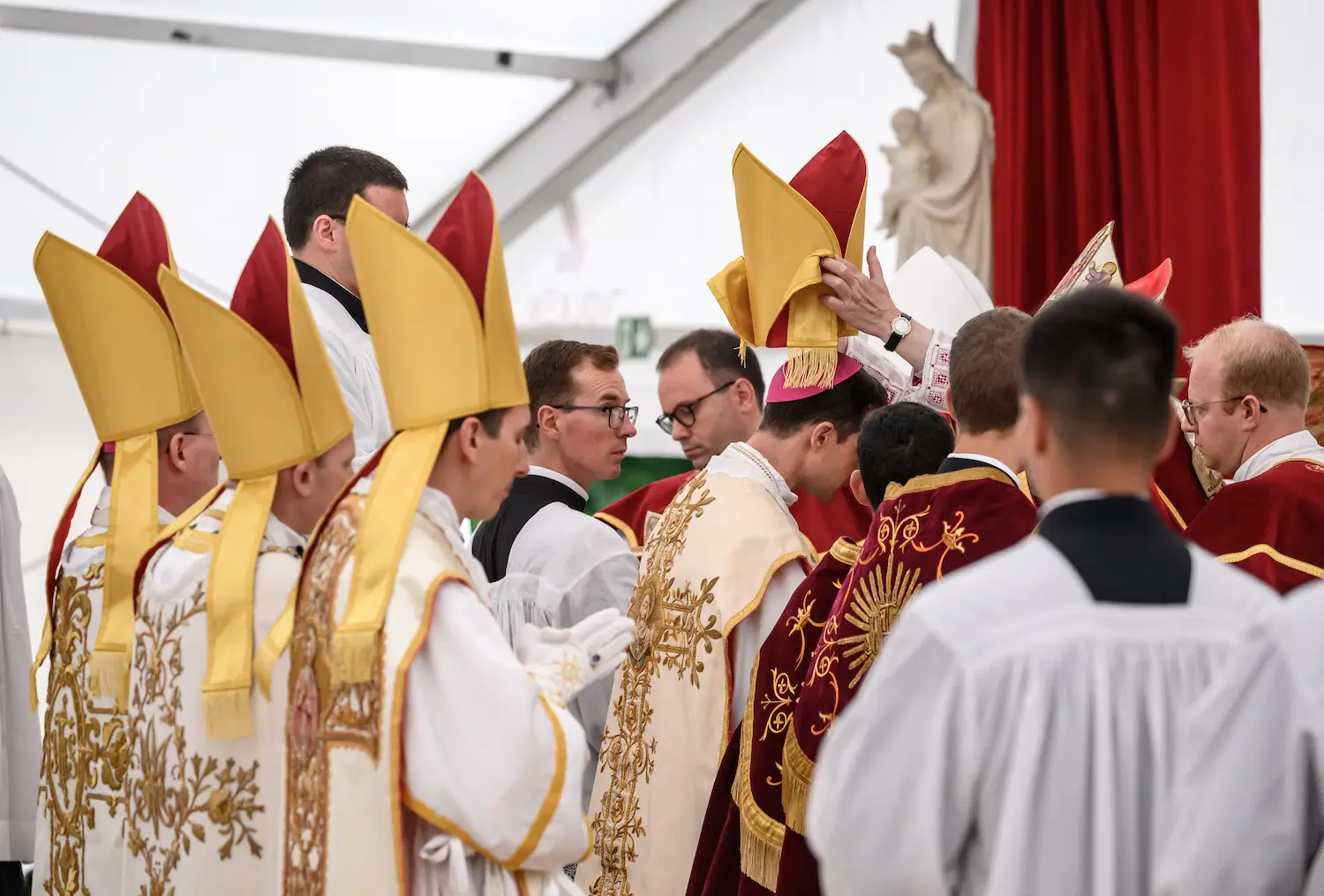
Archbishop Gregory Hartmayer of Atlanta issued a pastoral letter regarding the schismatic act committed July 1 by the Society of St. Pius X (SSPX) and advised the faithful to avoid attending SSPX liturgies for their own spiritual protection.
The letter, published July 13 by the archdiocesan newspaper The Georgia Bulletin and dated July 6, acknowledges that the archdiocese’s geographic territory includes Saint Michael’s Catholic Church, which the Archbishop Hartmayer said is publicly associated with the SSPX. The archbishop noted that he writes “with a father’s concern for the unity of the Church and the salvation of souls,” especially to offer pastoral guidance to those who have had contact with Saint Michael’s.
Archbishop Hartmayer recalled that the Holy See declared the SSPX’s illicit episcopal ordinations on July 1 a “schismatic act” in which the involved bishops incurred latae sententiae excommunication after carrying out the ordinations without the papal mandate, or the Pope’s approval. He noted that the Code of Canon Law requires a papal mandate to ordain a bishop and that obedience to the Vicar of Christ is essential for Church unity. Further, he added, sacred ministers in the SSPX are considered in schism and subject to canonical consequences.
“The Catholic Church is visibly united in the profession of the same faith, in the celebration of the sacraments, and in communion with the Roman Pontiff and the bishops in communion with him,” he said. “Schism is a grave rupture of that communion. Canon law defines schism as the refusal of submission to the Supreme Pontiff or of communion with the members of the Church subject to him. Because schism wounds the unity of Christ’s Body, the Church attaches to it the serious penalty of excommunication.”
He warned the faithful that the SSPX clergy “do not exercise ministry in full communion with the Roman Catholic Church” and that their celebrations of sacraments are illicit.
“The Holy See has specifically warned that the sacrament of penance administered by them and marriages assisted by them are illicit unless competent ecclesiastical authority supplies or grants the required faculty or delegation in a particular case,” Archbishop Hartmayer wrote.
As of July 13, the SSPX has filed a formal appeal of the Vatican’s July 2 decree, stating that the request, according to canon law, suspends the execution of the decree, which had imposed the penalties of excommunication and sacramental restrictions.
At the time of the letter, Archbishop Hartmayer noted that Saint Michael’s “is not operating in communion with the Roman Catholic Church and is not subject to the ordinary pastoral governance of the Archdiocese of Atlanta.”
Catholics are thus urged to not participate in SSPX-promoted liturgies, sacramental celebrations, catechetical programs, fundraising, devotional events, or other activities “when such participation would express support for, adherence to, or cooperation with the schismatic separation from the Holy See,” the archbishop added.
The July 2 decree from the Holy See also declares that those who formally adhere to the SSPX are in schism as well; Archbishop Hartmayer emphasized that the decree makes a distinction between “inactive attendance” and “adherence.”
“A person does not necessarily become schismatic merely by having attended a Mass out of confusion, curiosity, family pressure, habit, or a sincere desire for reverent worship,” Archbishop Hartmayer said. “Formal adherence to schism requires knowledge, freedom, actions, and a deliberate refusal of communion with the Roman Pontiff or with the bishops in communion with him.”
“Nevertheless, Catholics must avoid placing themselves or their families in spiritual danger,” he continued. “A love for the Church’s liturgical tradition must never become separation from the Church herself.”
He added that adherence to the SSPX is not the same as attachment to the Traditional Latin Mass.
“The faithful who desire the liturgical patrimony of the Church should seek it only in communities and parishes that are in full communion with the Roman Pontiff and properly authorized by competent ecclesiastical authority,” Archbishop Hartmayer said.
The archbishop then offered practical guidance reiterating that the faithful should not seek Confession or marriage preparation from SSPX clergy and advising people to contact the archdiocese for a review of one’s situation if their marriage was witnessed by an SSPX priest or if they have confessed to an SSPX priest. He also advised parents to ensure their children are catechized by teachers and clergy in full communion with the Church.
He also urged that people who have been drawn to the SSPX or to Saint Michael’s must “be received with patience, respect, and pastoral solicitude, while also being guided firmly toward full communion with the Church.”
Finally, the archbishop emphasized his pastoral concern for those who have attended the SSPX and about the path to communion; he outlined that the path for those who had formally adhered to the SSPX may include a profession of Catholic faith, sacramental confession, an explicit reaffirmation of communion with the Pope and diocesan bishop, along with other potential steps.
“The purpose of excommunication is medicinal,” he said. “It is not imposed because the Church desires anyone’s separation, but because the Church, as a loving mother, must name the gravity of a wound so that healing may begin. The Lord desires that all be one. The Church stands ready to welcome with sincere affection all who desire to return to full communion.”
Those who have not adhered to the SSPX can contact their local Catholic pastor to be received into full communion with the Pope, he added.
“To the faithful who have attended Saint Michael’s or who have found spiritual consolation there, I say this with pastoral concern: the Church does not reject your desire for reverent worship, sound doctrine, or holiness of life,” he wrote. “Rather, she calls you to seek these gifts within the visible communion of the Catholic Church, united with the successor of Saint Peter and with the bishops in communion with him.”
The archbishop also urged all priests, religious, catechists, and lay people to speak about the situation “with clarity, charity, and restraint.”
“We must avoid harsh judgments about individuals whose personal knowledge and freedom may be limited,” he said, “but we must also avoid false reassurance where the unity of the Church and the validity of the sacraments are at stake.”
He encouraged people who are spiritually nourished by the Traditional Latin Mass to go to churches in full communion with the Roman Catholic Church that offer this liturgy, particularly mentioning a church in Mableton run by the Priestly Fraternity of Saint Peter (FSSP).
“May Christ the Good Shepherd [Who] heals every wound of division,” he concluded, “strengthen us in faith and charity, and gather all his people into the unity for which he prayed on the night before he died: ‘that they may all be one.’”

Comments