Cardinal Burke at Zeale for America 250: Patriotism must serve the common good
As Catholics gathered in La Crosse, Wisconsin, for CatholicVote's Zeale for America 250 prayer rally June 13, Cardinal Raymond Burke called Americans to renew their commitment to truth, virtue, and authentic patriotism.

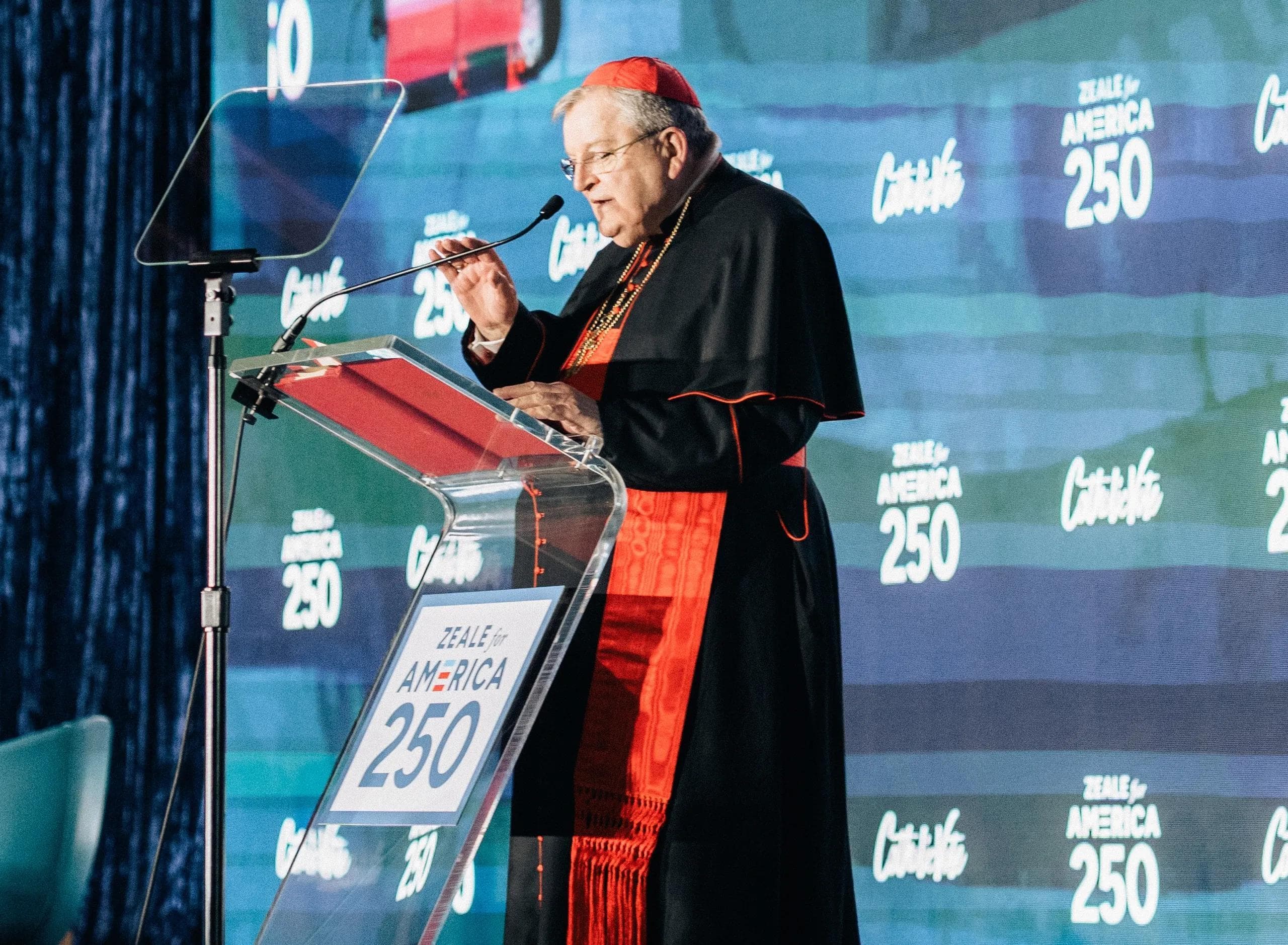
As Catholics gathered in La Crosse, Wisconsin, for CatholicVote's Zeale for America 250 prayer rally June 13, Cardinal Raymond Burke called Americans to renew their commitment to truth, virtue, and authentic patriotism.
The rally, a faith-filled celebration of the nation's semiquincentennial, invited Catholics to reflect on the spiritual roots of the American experiment and to pray for the country's renewal as it approaches its 250th anniversary.
Cardinal Burke’s address reflected on the moral and spiritual foundations of democratic government, emphasizing the importance of patriotism, civic virtue, and the common good in sustaining a just society. He spoke of what he described as the fragility of democratic government.
"The fragility of our democratic form of government," Cardinal Burke said, "seems to be owed, in good part, to a profound confusion regarding the rule of law and its foundation upon the truth about man and the world he inhabits."
Conscious of those challenges, Cardinal Burke said participants of the prayer rally had gathered to implore God's help in strengthening patriotism and civic virtue among Americans.
Reflecting on the proper love of country, he stressed that patriotism must be directed toward the common good.
"Patriotism is not nationalism," he said, "that is, the worship of the nation as an end in itself."
He described patriotism instead as "the respect and love of the nation which, after the family, the first cell of human society, is the irreplaceable servant of the common good."
His address also considered the relationship between democratic government and the good of society, emphasizing that political life must be directed toward the good of all rather than the interests of a majority alone.
"If democracy is 'government of the people, by the people, for the people,'" he said, "it cannot be reduced to the rule of the majority."
Turning to the relationship between freedom and truth, Cardinal Burke cited the teachings of Pope St. John Paul II, emphasizing that "there can be no freedom apart from or in opposition to the truth."
Cardinal Burke also warned against what he described as efforts to separate democratic government from objective moral truth.
"This is the risk of an alliance between democracy and ethical relativism," he said, "which would remove any sure moral reference from political and social life."
Recalling another warning from the late pontiff, Cardinal Burke added: "As history demonstrates, a democracy without principles easily turns into open or thinly disguised totalitarianism."
Cardinal Burke also reflected on the role of the Church in public life, saying the Church's service to the world demands "a witness to the foundation of the political order upon the unchanging precepts of the natural moral law."
Concluding his address, the cardinal encouraged Catholics to make prayer for the nation a daily practice, saying the country’s future depends upon fidelity to the truths and freedoms on which it was founded.
"As we rejoice today in the Declaration of Independence and the truth and freedom for which it stands, let us pray that our nation may be always God-fearing," he said, "that is, faithful to its relationship with God and, therefore, obedient to His law written upon the human heart. Let this be our daily prayer for our nation."

.jpg&w=3840&q=75)
Comments