Cardinal Dolan returns home for St. Louis archdiocese’s 200th anniversary
The St. Louis native preached at the bicentennial Mass only months after retiring from New York, returning to the local Church that formed him for the priesthood and later welcomed him as an auxiliary bishop.

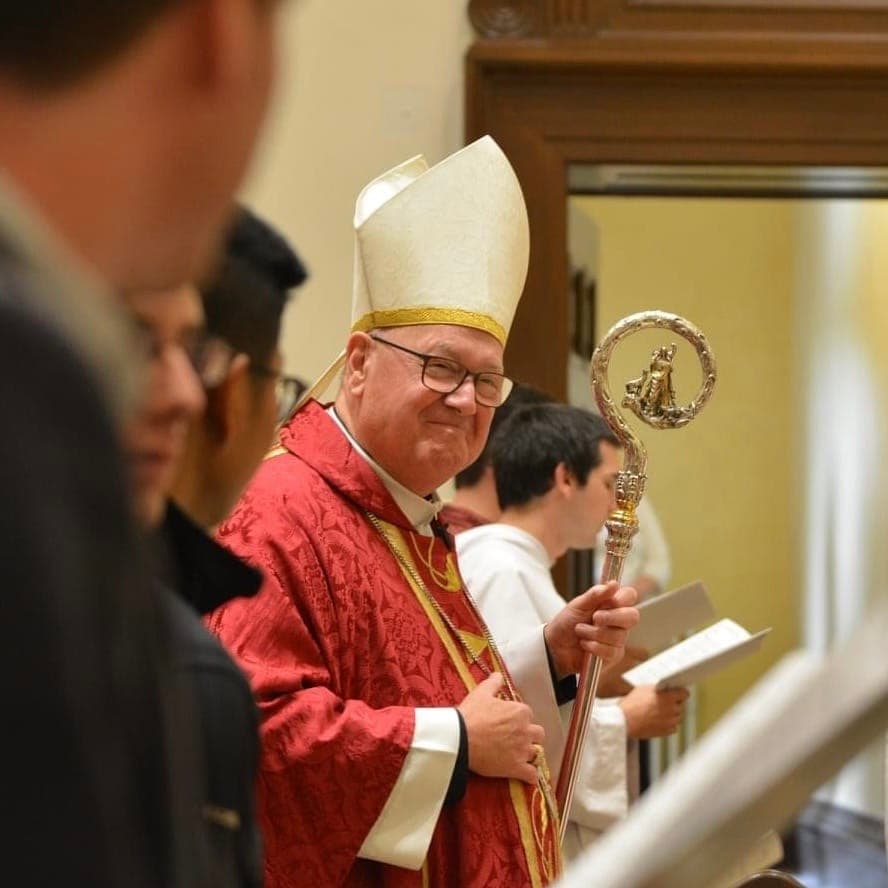
Cardinal Timothy Dolan, archbishop emeritus of New York, returned to his native St. Louis July 18 to preach at a Jubilee Mass commemorating the Archdiocese of St. Louis’ 200th anniversary.
The celebration took place exactly two centuries after Pope Leo XII established the Diocese of St. Louis on July 18, 1826. The 10 a.m. Mass at the Cathedral Basilica of Saint Louis served as the central gathering of a yearlong Bicentennial Jubilee that began Jan. 1 and will continue through Dec. 31.
For Cardinal Dolan, the assignment amounted to a homecoming. The 76-year-old cardinal was born in St. Louis, formed in the archdiocese, and ordained one of its priests in 1976. He served as an associate pastor at Immacolata Parish in Richmond Heights, worked in priestly formation at Kenrick-Glennon Seminary, and taught theology at Saint Louis University.
Pope St. John Paul II appointed him auxiliary bishop of St. Louis in 2001. A year later, then-Bishop Dolan became archbishop of Milwaukee, before Pope Benedict XVI appointed him archbishop of New York in 2009 and elevated him to the College of Cardinals in 2012.
Dolan led the New York archdiocese until Pope Leo XIV accepted his retirement in December 2025. He remains active as a cardinal, bishop, and priest.
The St. Louis celebration came during a significant year for Dolan personally. In May, he marked both the 50th anniversary of his priestly ordination and the 25th anniversary of his episcopal ordination at St. Patrick’s Cathedral in New York.
The archdiocese Dolan returned to traces its Catholic roots to the first Mass offered in the St. Louis settlement in 1764. When the archdiocese was created with Bishop Joseph Rosati as its first head, its enormous mission territory extended from the Louisiana border to the Rocky Mountains.
At its founding, however, the diocese had only 14 priests serving two seminaries, a college, a boys’ school, and 14 parishes and missions across the frontier. Pope Pius IX elevated St. Louis to an archdiocese in 1847, and its original territory has since been divided into 50 dioceses and archdioceses.
The local Church played an important role in building Catholic institutions west of the Mississippi River. Its legacy includes the region’s first cathedral, college, seminary, and hospital, as well as the first U.S. conference of the Society of St. Vincent de Paul. In 1973, Cardinal John Carberry established the nation’s first diocesan pro-life office following the Supreme Court’s Roe v. Wade ruling.
The archdiocese’s own historical account also acknowledges more painful parts of that legacy, including the participation of early bishops and clergy in slaveholding and the segregation experienced by Black Catholics during the 19th century.
Archbishop Mitchell Rozanski has described the bicentennial as an occasion for reflection and renewed missionary commitment.
“We are heirs to this missionary legacy,” Rozanski said in announcing the Jubilee. “Our parishes, schools, charitable ministries, religious communities and lay leaders all bear witness to the enduring light of Christ passed down through generations.”
The Vatican’s Apostolic Penitentiary has also granted a plenary indulgence for Catholics who make a pilgrimage to one of the archdiocese’s designated sacred sites through July 26 and fulfill the customary conditions. The provision extends to the elderly, sick, and homebound who spiritually unite themselves with the Jubilee celebration.
.jpg&w=3840&q=75)

.jpg&w=3840&q=75)
Comments