Cardinal Müller recalls Reformation history in message urging SSPX to defend the Church from within
In a statement acknowledging legitimate abuses of the liturgy and Catholics’ right to engage with a critical lens of certain documents from Rome, Cardinal Gerhard Müller said Feb. 21 that the Priestly Society of St. Pius X (SSPX) should fight to defend the Faith from within the Church and communion with Pope Leo XIV, not from outside.

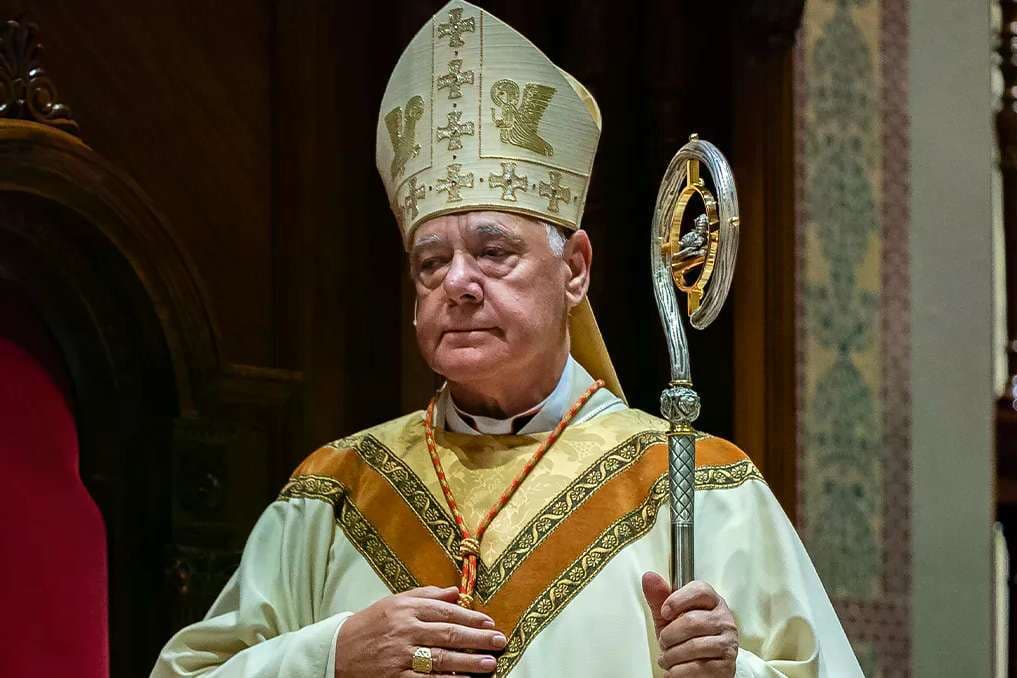
In a statement acknowledging legitimate abuses of the liturgy and Catholics’ right to engage with a critical lens of certain documents from Rome, Cardinal Gerhard Müller said Feb. 21 that the Priestly Society of St. Pius X (SSPX) should fight to defend the Faith from within the Church and communion with Pope Leo XIV, not from outside.
In his appeal, which in part drew on historical instances of schism and separation from the pope, the cardinal recalled the Protestant argument made at the time of Martin Luther, who disparaged papal authority and was willing to risk excommunication in his efforts against corruption within the Catholic Church.
“No orthodox Catholic can claim reasons of conscience if he withdraws from the formal authority of the Pope with regard to the visible unity of the sacramental Church in order to establish an ecclesiastical order that is not fully in communion with him in the form of an emergency church, which would correspond to Protestant argumentation in the 16th century,” Cardinal Müller wrote. He is the former prefect of the Congregation (now Dicastery) for the Doctrine of the Faith.
His statement, published on Catholic freelance reporter Christine Niles’ website Stella Maris Media, comes days after the SSPX announced it would proceed with consecrating new bishops July 1 without permission from Pope Leo XIV. Zeale News previously reported that SSPX Superior General Father Davide Pagliarani met in Rome Feb. 12 with Cardinal Victor Fernández, prefect of the Dicastery for the Doctrine of the Faith, to discuss a possible path of dialogue to work toward the SSPX reaching the minimum requirements for full communion with the Catholic Church. The dialogue path required that the planned consecrations of new bishops be suspended; several days after the meeting, the SSPX announced that it rejects this offered path.
Cardinal Müller wrote that the criteria for full Catholic membership and orthodoxy date back to the beginning of the second century and have continued to be refined, as the Council of Trent did during the Protestant Reformation.
This criteria includes full communion with the universal Church, and particularly with the College of Bishops and the Pope, Cardinal Müller wrote.
“Other ecclesial communities may claim to be Catholic because they agree wholly or almost wholly with the faith of the Catholic Church,” he continued, “but they are not Catholic unless they also formally recognize and practice the Pope as the supreme authority and sacramental and canonical unity with him.”
Vatican II, liturgy, confusing documents, and where concerns could be raised
Regarding the Second Vatican Council, its documents, and the post-conciliar Mass, Cardinal Müller made a distinction between what ecclesiastical authority can and cannot change regarding the sacraments.
The sacraments’ substance and their form — such as the substance of the Eucharist being bread, and the form being the words of the consecration — have been “given to us and are beyond the reach of any intervention by the Church,” Cardinal Müller explained.
However, “ecclesiastical authority is entitled to determine their ritual form, but not arbitrarily and authoritatively, but with great consideration for established ecclesiastical traditions and the sensitivity and sense of faith of the faithful,” he continued.
According to these principles and distinction, this is why “every Catholic is entitled to criticize the motu proprio ‘Traditionis custodes’,” he wrote, referring to the 2021 document from Pope Francis that heavily restricted the Traditional Latin Mass, “and its often unworthy implementation by spiritually overwhelmed bishops, as well as their flawed theological argumentation and pastoral recklessness.”
At the same time, Cardinal Müller said it is “theologically absurd and unworthy of a serious Catholic” to doubt that the Mass according to the Missal of Paul VI (the Ordinary Form of the Mass) is contradictory to the Church’s tradition for reasons like it allows for concelebration or for the altar to face a different direction, or that “Masonic ideas” have had an influence.
“The actual abuse of the liturgy (Carnival Masses, the atheistic rainbow flag in the church, arbitrary changes according to personal taste) is not to be blamed on the rite of the Novus Ordo or even on the Council,” he continued, “but on those who, through ignorance or frivolity, are guilty of these blasphemies and liturgical abuses before God and the Church.”
He noted that many saints — such as Saint Augustine, Saint Catherine of Siena, and Saint Irenaeus of Lyon — have justifiably “complained about certain statements and actions” that the Vatican has done, writing, “No true Catholic can be expected to accept every document that comes from Rome or an episcopal authority without criticism.”
Bishops have also expressed concern at some recent documents published by the Vatican, in which “dogmatic and pastoral arguments have been confused in an amateurish manner, or when ill-considered statements have been made that — relativizing Christ — all religions are paths to God” or when a doctrinal note discouraging frequent use of the title of Mary as Co-Redemptrix disregarded “the Church's teaching on Mary's co-operation in Christ's work of salvation,” he continued.
Cardinal Müller: SSPX cannot effectively protect the faith apart from communion with the Pope
Despite the legitimate concerns, Cardinal Müller emphasized that in examining the Church’s whole history and theology, he is “fully convinced that the Church cannot be overcome by anything or anyone,” whether they are external attacks or internal confusion.
“Not only the Society of St. Pius X, but also a large part of the Catholic faithful rightly lament that, under the pretext of renewing the Church — with a process of self-secularization — great uncertainties in dogmatic questions and even heresies have penetrated the Church,” he continued. “But even in the 2,000-year history of the Church, heresies from Arianism to modernism were overcome only by those who remained in the Church and did not stray from the side of the Pope.”
What this means for the SSPX, Cardinal Müller emphasized, is that its efforts to uphold and protect the faith will only be truly fruitful if they remain in communion with the Pope.
“If the Society of St. Pius X wants to have a positive effect on church history, then it cannot fight for the true faith from a distance, outside the Church, against the Church united with the Pope, but only within the Church and with the Pope and all orthodox bishops, theologians, and believers,” he wrote. “Otherwise, their protest will remain ineffective and will be mockingly misused by heretical groups to accuse orthodox Catholics of sterile traditionalism and narrow-minded fundamentalism.”
Engaging with magisterial documents
The prefect emeritus of the then-Congregation for the Doctrine of the Faith also elaborated on when Catholics’ intellectual assent is required by the Church and when a teaching has binding authority.
He noted that the Second Vatican Council did not proclaim any new dogma but instead presented longstanding dogmatic teaching “in a new way to be believed in a different intellectual and cultural-historical context” and that Catholics have a responsibility to learn about the Church’s teachings. He added, “Anything that does not concern binding doctrine on faith and morals is left to free theological discussion.”
For understanding the revealed faith taught by the Church, the “ultimate norms” are Sacred Scripture, Apostolic Tradition, and the (infallible) Magisterium of the Pope and bishops, especially in an ecumenical council, he wrote.
“The magisterial documents, which claim varying degrees of binding authority, are to be interpreted according to the proven system of degrees of theological certainty,” he added.
Conclusion: There is one path forward the SSPX can choose in good conscience
Cardinal Fernández previously warned that to consecrate bishops without permission from Pope Leo would imply a decisive schism. The SSPX’s founder, Archbishop Marcel Lefvebre, incurred automatic excommunication in 1988 along with the four bishops he illicitly consecrated without the permission of Pope Saint John Paul II.
On the issue of excommunication, Cardinal Müller also noted that there have been unjust instances of it, citing St. Hildegard of Bingen — a Doctor of the Church — who was unjustly subject to this once. He wrote that those who experience this “must spiritually come to terms with this for the good of the Church without questioning the unity of the Church through disobedience.”
“Every Catholic will agree with the young Martin Luther in his fight against the unworthy sale of indulgences and the secularization of the Church, but will sharply criticize him for disregarding the threat of excommunication, rejecting ecclesiastical authority, and placing his judgment above that of the Church in his interpretation of Revelation,” he wrote.
Cardinal Müller emphasized that a Catholic with a well-formed conscience, especially of a bishop or one to be episcopally ordained, “will never administer or receive holy orders against the successor of St. Peter, to whom the Son of God himself entrusted the leadership of the universal Church, and thus be guilty of a grave sin against the unity, holiness, Catholicity, and Apostolicity of the Church of Christ revealed by God.”
Thus, there is only one solution the SSPX can choose in good conscience, according to the cardinal: “Recognize our Holy Father Pope Leo XIV as the legitimate Pope not only in theory but also in practice, and to submit to his teaching authority and primacy of jurisdiction without preconditions.”
From here, a just solution for their canonical status — which is currently in “irregularity” — can be reached, he wrote. “But these are canonical and practical conclusions that only hold true if they are dogmatically consistent with Catholic ecclesiology.”

Comments