Cardinal Sarah urges obedience and unity amid SSPX plan to ordain bishops without papal approval
Cardinal Robert Sarah, prefect emeritus of the Dicastery for Divine Worship and the Discipline of the Sacraments, spoke out Feb. 22 urging the Priestly Society of Saint Pius X (SSPX) — which recently said it intends to ordain new bishops without papal permission — to remain in unity and canonical obedience to the pope, the successor of Saint Peter, emphasizing that this obedience “guarantees our bond with Christ Himself.”

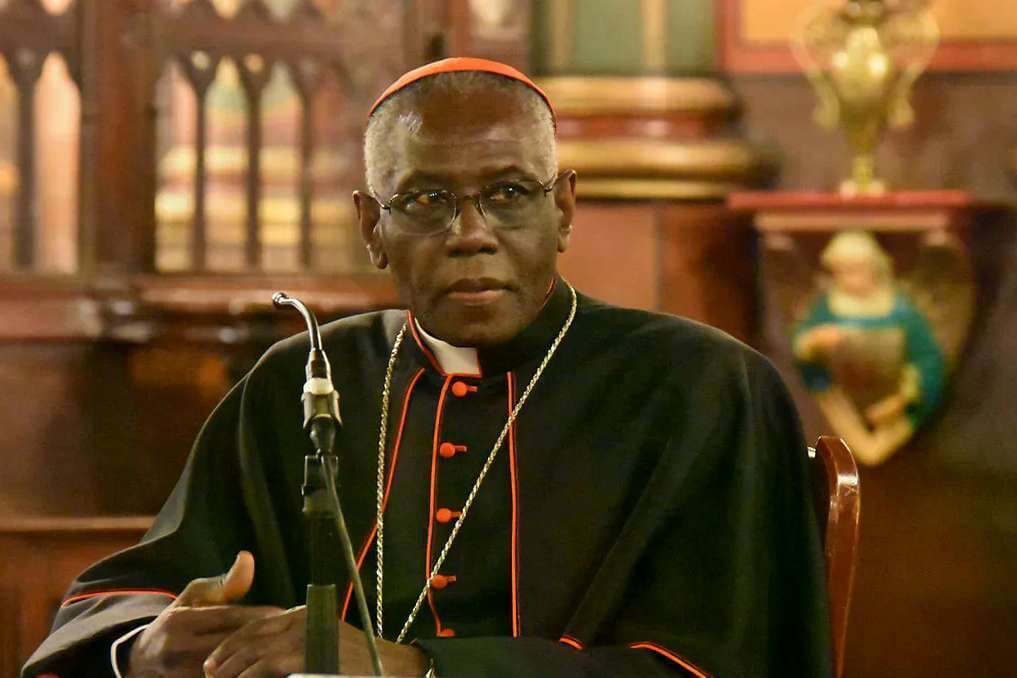
Cardinal Robert Sarah, prefect emeritus of the Dicastery for Divine Worship and the Discipline of the Sacraments, spoke out Feb. 22 urging the Priestly Society of Saint Pius X (SSPX) — which recently said it intends to ordain new bishops without papal permission — to remain in unity and canonical obedience to the pope, the successor of Saint Peter, emphasizing that this obedience “guarantees our bond with Christ Himself.”
Rome-based Catholic journalist Diane Montagna posted to her Substack Feb. 23 the full English translation of Cardinal Sarah’s statement made in the French publication Le Journal du Dimanche the day before.
In the statement, Cardinal Sarah, archbishop emeritus of Conakry, Guinea, and a longstanding supporter of the Traditional Latin Mass and reverent practices in the liturgy, urged the SSPX to remain in communion with the Church.
Zeale News reported Feb. 19 that the SSPX decided to proceed with the July 1 episcopal ordinations without Pope Leo’s permission. The decision followed a Feb. 12 meeting in Rome between SSPX Superior General Father Davide Pagliarani and Cardinal Victor Fernández, Vatican prefect of the Dicastery for the Doctrine of the Faith, where the two parties discussed a possible way forward. Cardinal Fernández proposed future dialogue to address the SSPX’s theological concerns, and after the meeting, the SSPX council considered whether to accept the prefect’s offer of dialogue.
The suggested path required that the SSPX suspend the plan to ordain new bishops. The SSPX decided to reject the offer, despite the prefect’s statement that proceeding with the ordinations without papal approval “would imply a decisive rupture of ecclesial communion (schism), with grave consequences for the Society as a whole.” Fr. Pagliarani told Cardinal Fernández in the Feb. 19 statement that “we both know in advance that we cannot agree doctrinally,” especially related to “fundamental orientations adopted since the Second Vatican Council.” He later added that he does not see how the proposed dialogue could lead to reaching “the minimum requirements for full communion with the Catholic Church.” The SSPX also said it does not believe the ordinations would constitute a schism.
In urging the SSPX to remain in unity with the Holy See, Cardinal Sarah emphasized in his Feb. 22 statement that Christ “is our sole salvation.”
“His Name is the only one by which we can be saved,” the cardinal wrote. “But where can we find Jesus Christ, the one Redeemer? Saint Augustine answers us with clarity: ‘Where the Church is, there is Christ.’ We know that there is no salvation outside the Church. That is why our concern for the salvation of souls is expressed in our constant solicitude to lead them to the one source: Christ, who gives Himself in and through the Church.”
He said that the Church of Rome is “a necessary point of reference” governed by the successor of Saint Peter, who Jesus entrusted to shepherd the faithful.
“The Church is one. She is the Church that Christ entrusted to Peter and to the Twelve. Indeed, the Church is, fundamentally, according to the expression of Mark and Luke, ‘Peter and those who are with him,’” he said, referencing the Gospels of Mark (1:36) and Luke (9:32). “Primacy is therefore given to Peter, and thus one can see one single Church and one single Chair… Can one who abandons the Chair of Peter still claim to be within the Church of Christ?”
Cardinal Sarah said that because of this, “I wish to express my grave concern and my profound sorrow upon learning of the announcement by the [SSPX]” to move forward with the episcopal ordinations.
The cardinal criticized the argument that the ordinations are justified because their intention is for the good of souls.
“We are told that this decision to disobey the law of the Church is motivated by the supreme law of the salvation of souls: suprema lex, salus animarum,” he wrote. “But salvation is Christ, and He gives Himself only within the Church. How can one claim to lead souls to salvation by paths other than those He Himself has indicated to us? Is it truly to will the salvation of souls to rend the Mystical Body of Christ in a perhaps irreversible way? How many souls risk being lost because of this new tear in the seamless garment of the Church?”
Another argument is that the ordinations are intended to help defend “Tradition and the integrity of the Deposit of Faith.” Cardinal Sarah acknowledged that he personally knows “only too well how the Deposit of Faith is sometimes scorned even by those who have the mission to defend it.”
He continued that the faithful should be more fully aware “that there exists an unbroken continuity in the life of the Church — in the proclamation of God, in the celebration of the sacraments — which reaches down to us and which we call Tradition,” and said this guarantees “that what we believe is the original message of Christ preached by the Apostles,” which is at its heart the news of the Passion, Death, and Resurrection of Jesus.
Obedience, even when it is painful, is also essential to the Catholic faith, Cardinal Sarah continued.
He said he both knows and firmly believes “that at the heart of the Catholic faith lies our mission to follow Christ, who became obedient unto death — even death on a Cross. Can one truly dispense with following Christ in His humility, even unto the Cross? Is it not a betrayal of Tradition to take refuge in merely human means in order to preserve our works, even if they be good?”
He acknowledged that supernatural faith in the Church’s indefectibility — meaning that the Church is immutable until the end of time — can cause the faithful to lament along with Jesus “when we see the betrayals and cowardice of an ever-increasing number of high-ranking prelates” who teach their own opinions and personal visions, rather than the Deposit of Faith, on issues of doctrine and morals but said that “it can never lead us to renounce obedience to the Church.”
Continuing, Cardinal Sarah wrote: “The good of souls can never be served by deliberate disobedience, for the good of souls is a supernatural reality. Let us not reduce salvation to a worldly game of media pressure.”
Numerous times in the statement, he quoted Saint Catherine of Siena — whom he noted rebuked cardinals and the pope — who nevertheless emphasized the importance of obedience to the pope, the “representative of Christ on earth” and “shepherd of the Church” tasked with leading souls to Christ.
He also recalled the unjust condemnation faced by Saint Padre Pio, who was prohibited from hearing confessions for 12 years, despite having received a special grace from God to help sinners’ souls. He noted that Padre Pio did not “rebel in the name of fidelity to God” or “disobey in the name of the salvation of souls,” but rather stayed silent.
“He embraced crucifying obedience, certain that his humility would be more fruitful than rebellion,” Cardinal Sarah continued. “[Padre Pio] wrote: ‘The good God has made me understand that obedience is the only thing that pleases Him, and for me the only means to hope for salvation and to sing of victory.’”
Cardinal Sarah also distinguished between devotion to the man who is pope and canonical obedience to the Successor of Peter.
“It is not a matter of worldly or ideological fidelity to a man and to his personal ideas. It is not a matter of being partisans of a man. It is not a matter of papolatry or of a cult of personality surrounding the Pope. It is not a matter of obeying the Pope insofar as he expresses his personal ideas, opinions, or ideological positions on grave doctrinal and moral questions,” he wrote. “It is a matter of obeying the Pope who says, like Jesus: ‘My doctrine is not Mine, but His who sent Me’ (Jn 7:16).
“It is a matter of a supernatural understanding of canonical obedience, which guarantees our bond with Christ Himself. This is the sole guarantee that our struggle for the faith, Catholic morality, and the liturgical tradition does not stray into ideology. Christ has given us no other certain sign. To leave the Barque of Peter and to organize oneself autonomously, in a closed circle like a sect, is to deliver oneself to the waves of the storm.”
Cardinal Sarah acknowledged that, as Christ warned in Scripture, that “there are wolves disguised as lambs” even within the Church, but again emphasized that the best guarantee against heresy and fallibility is in canonical and supernatural attachment to Saint Peter’s Successor.
Concluding, the cardinal drew attention to Christ’s prayer in the Agony in the Garden and warned against acts of disunity that cause further pain.
“How can one remain insensitive to the anguished prayer of Jesus: ‘Father, that they may be one, even as We are one’ (Jn 17:22)?” he wrote. “How can one fail to be moved by this cry of Jesus, who desires our unity, and yet continue to tear apart His Body under the pretext of saving souls? Is it not He — Jesus — who saves? Is it we and our structures who save souls? Is it not through our unity that the world will believe and be saved? This unity is first that of the Catholic faith; it is also that of charity; and finally, it is that of obedience.”
Cardinal Sarah’s full statement can be read here.



Comments