Day 5 of Iran War: Vatican decries ‘law of force,’ Trump admin defends strikes, public polling shows mixed results
Vatican Secretary of State Cardinal Pietro Parolin spoke out March 4 against the joint U.S.-Israeli strikes on Iran as the Trump administration defended the operation and signaled the conflict is accelerating.

Vatican Secretary of State Cardinal Pietro Parolin spoke out March 4 against the joint U.S.-Israeli strikes on Iran as the Trump administration defended the operation and signaled the conflict is accelerating.
Vatican warns against escalation
In an interview published by Vatican News’ Andrea Tornielli, Cardinal Parolin criticized the Trump administration’s logic of preventive war and warned that the events in the Middle East reflect an “erosion of international law” in which “justice has given way to force; the force of law has been replaced by the law of force.”
“If states were to be recognized as having a right to ‘preventive war,’ according to their own criteria and without a supranational legal framework, the whole world would risk being set ablaze,” he said when asked about the justification for the initial U.S.-Israeli strikes.
Cardinal Parolin went on to lament the humanitarian toll of the conflict, saying communities across the region — including already fragile Christian populations — have “once again been plunged into the horror of war, which brutally shatters human lives, brings destruction, and drags entire nations into spirals of violence with uncertain outcomes.”
Zeale News reported that on the evening of March 4 a drone strike struck inside the Blessed Michael McGivney Apartment Complex, a Knights of Columbus-sponsored housing complex in northern Iraq that had served as a refuge for Christians displaced by the radical Islamist group ISIS. According to NBC News, more than 940 people have been killed by Israeli and American strikes, and 11 have died in Israel in Iran’s retaliatory strikes. Six U.S. service members were also killed in action.
While acknowledging that determining responsibility for the conflict can be complex, Cardinal Parolin said the consequences of war are clear: “War will always produce victims and destruction, as well as devastating effects on civilians.”
“For this reason, the Holy See prefers to recall the need to use all the instruments offered by diplomacy in order to resolve disputes among states,” he added. “History has already taught us that only politics — through the hard work of negotiation and attention to balancing interests — can increase trust among peoples, promote development, and preserve peace.”
While Iranian aspirations for freedom from the current regime are also a cause of deep concern and “must be taken into consideration and guaranteed within the legal framework of a society,” Cardinal Parolin said, “we may ask ourselves whether anyone truly believes that the solution can come through the launching of missiles and bombs.”
Trump administration defends the operation
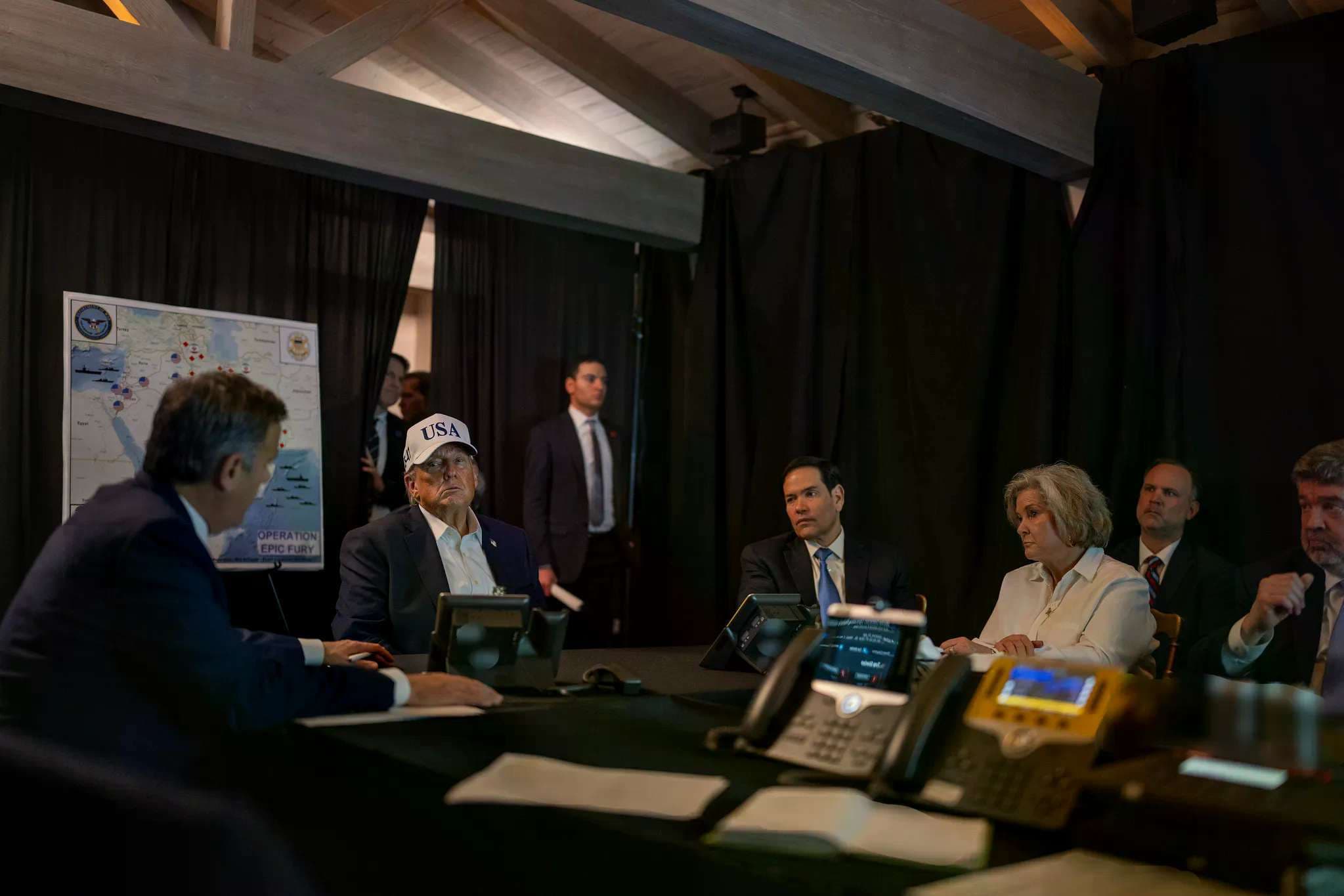
Meanwhile, Trump administration officials continued defending the military campaign against Iran as a necessary action to prevent the Islamic regime from acquiring a nuclear weapon.
Speaking at a White House roundtable March 4, President Donald Trump said Iran could have obtained a nuclear weapon within “two weeks” if the U.S. had not acted. He framed the ongoing operation as a major success, rating U.S. military efforts a “15 out of 10.”
He also argued the strikes were necessary to prevent Iran from attacking Israel.
“If we didn’t do it first, they would have done it to Israel,” he said. He later added that the Iranian government would also have attacked the U.S. “if we waited any longer.”
White House Press Secretary Karoline Leavitt echoed Trump’s arguments during a press conference the same day, calling the U.S. action a “decisive stance against threats to American security.”
Iranian leaders “chose this path of violence and destruction,” Leavitt said, because they “lied and delayed and tried to string the U.S. along” during negotiations.
The Feb. 28 U.S.-Israeli strikes came days after a fresh round of negotiations between the U.S. and Iran. As Zeale News previously reported, shortly before the strikes, Oman’s foreign minister — the primary mediator in negotiations with Iran — announced a “breakthrough” in talks and said Iran had agreed it would “never ever have nuclear materials that will create a bomb.” Trump and other officials did not respond publicly to the announcement but have maintained that Iranian officials ignored U.S. demands.
Leavitt also said the U.S. launched its operation partly out of concern Iran might strike American personnel and assets in the region first. She said a phone call between Trump and Israeli Prime Minister Benjamin Netanyahu before the start of the war was “important with respect to the timeline.” But she added that even before the call, the President “had a good feeling” the Iranian regime would strike the U.S.
Her remarks come amid reports from several other lawmakers and administration officials that Israel’s readiness to act against the regime factored into the timing of the U.S. strikes, as Zeale News previously reported.
Leavitt also said ground troops “are not part of the current plan,” though she added that she would not take any military options off the table on behalf of the President.
Military signals continued escalation
During a March 4 press briefing, War Secretary Pete Hegseth announced that U.S. forces had torpedoed an Iranian vessel in the Indian Ocean that “thought it was safe in international waters.” He claimed it was the first ship sunk by a submarine since World War II.
Hegseth said U.S. forces are “punching Iran while they’re down” and that operations are “accelerating, not decelerating.” He added that the U.S. military aims to achieve full air superiority within a week as additional forces deploy to the region.
The U.S. “is winning decisively, devastatingly, and without mercy,” he said.
Hegseth also suggested the conflict could last longer than initially expected, but reiterated that “we set the pace and the tempo” and will “take all the time we need.”
“You can say four weeks, but it could be six, it could be eight, it could be three,” Hegseth said.
Polling shows divided public opinion
Public opinion appears divided over the conflict. A Reuters/Ipsos poll conducted shortly after the start of the war found that 27% of Americans approve of the strikes, while 43% disapprove. About three in 10 are unsure.
Support varies sharply by party affiliation. About 55% of Republicans support military action, compared with just 7% of Democrats. Among independents, 44% disapprove, while 19% support the strikes.
The national survey — based on a probability sample of 1,282 adults — also found that about half of the respondents believe Trump is too willing to use military force.
The survey was conducted Feb. 28-March 1, before the U.S. military announced the first of its casualties in the operation.
Meanwhile, the U.S. Senate voted 53-47 March 4 to reject a resolution that sought to limit Trump’s authority to take further military action against Iran. Sen. Rand Paul of Ketucky, who co-sponsored the resolution, was the only Republican to cast a vote in favor it, while Sen. John Fetterman of Pennsylvania was the only Democrat to vote against it.





Comments