Federal appeals court upholds detention without bond for illegal aliens
The Trump administration policy does not violate the Fifth Amendment rights of illegal aliens, a majority of the U.S. Court of Appeals for the Fifth Circuit’s judges held in an en banc ruling.
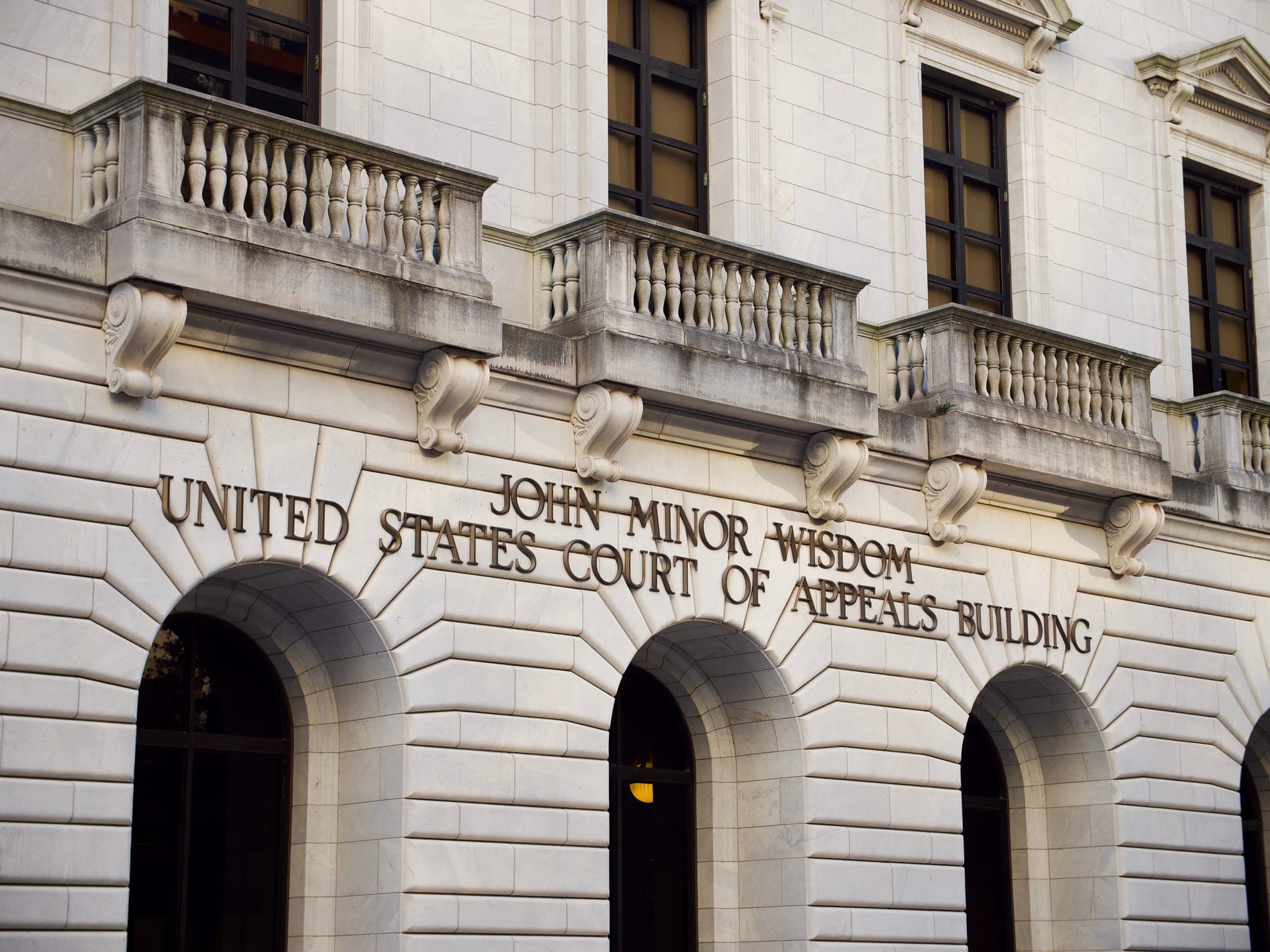
The U.S. Court of Appeals for the Fifth Circuit ruled Oct. 23 that the Department of Homeland Security (DHS) is not constitutionally bound to allow bond hearings for detained illegal aliens, a ruling which legal experts anticipate will make its way to the U.S. Supreme Court and which immigration policy experts expect will streamline President Donald Trump’s promised mass deportation program.
All 17 judges on the appellate court took part in the ruling, sitting en banc, and 10 sided with the Trump administration. Before the court was the question of whether or not detained illegal aliens are required to be given bond hearings under the Fifth Amendment’s Due Process clause. A divided three-judge panel of the Fifth Circuit previously agreed, prompting the court’s remaining judges to order a re-hearing.
“We now conclude that Petitioners were not entitled to individual hearings on their dangerousness or flight risk before they could be lawfully detained by immigration authorities pending their removal proceedings,” the court’s majority concluded Oct. 23. “Moreover, the duration of Petitioners’ detention presented no constitutional issues warranting habeas relief.”
Under the Due Process clause of the Fifth Amendment, U.S. citizens who are detained by law enforcement are entitled to seek a bond hearing, during which the threat they pose to the public and the risk of their flight is assessed by the court and, in most cases, bond is set. Once the bond is paid, the detainee may be released from detention prior to trial.
Three illegal aliens — two Mexican nationals and a Honduran national — who were arrested and detained by DHS claimed that the federal agency violated their Fifth Amendment rights by detaining them without bond hearings.
The appellate court noted in its ruling that the Immigration and Nationality Act (INA) previously allowed illegal aliens who simply “crossed the border” and “evaded inspection” to seek bond hearings while denying the same opportunity to illegal aliens who entered through U.S. ports of entry. This provision, effectively affording greater privilege to illegal aliens who evaded detection at the border than to those who initially entered legally or sought asylum, was amended by Congress with the 1996 Illegal Immigration Reform and Immigrant Responsibility Act (IIRIRA).
The IIRIRA amended the INA to require the detention of illegal aliens who were denied admission to the U.S. or deemed inadmissible, while allowing the Immigration and Naturalization Service (succeeded by DHS and its sub-agencies in the 21st century) to exercise discretion regarding the detention of illegal aliens who had been initially granted admission to the U.S. — such as foreign nationals who legally entered the U.S. on visitor visas and subsequently overstayed those visas.
Since 1996, federal authorities have generally treated all illegal aliens encountered in the U.S. interior as “admissible” aliens, according to the Fifth Circuit, and have thus not mandated detention of those illegal aliens. DHS changed that policy in 2025, re-enforcing the mandatory detention rules established by the INA and IIRIRA.
Given the statutorily required detention mandate for unadmitted or inadmissible illegal aliens, the Fifth Circuit ruled that the process due to the detained illegal aliens in the case was not violated by DHS denying them bond hearings.
“There is no dispute that Petitioners enjoy the protections of the Fifth Amendment,” the court’s majority wrote.
“So the issue in this case is not whether Petitioners are entitled to due process. Rather, the question is what specific process is due for unadmitted aliens pending their removal proceedings,” the majority continued. “The answer to that question is straightforward: Because Petitioners have never been admitted to the United States, due process does not entitle them to additional proceedings beyond what Congress has provided before they may be detained pending removal.”
The appellate court concluded that even if the illegal aliens’ legal challenge to their detention were a possibility, the facts that they wished to assert at their hypothetical bond hearings were “irrelevant” to their detentions.
Andrew R. Arthur, resident fellow in law and policy at the Center for Immigration Studies and an attorney with decades of experience in homeland security law, told Zeale News that the Oct. 23 ruling is “a much bigger deal than many may assume.”
“Much of the majority’s reasoning is premised on black letter law stretching back to the 19th century,” he said. That law “holds: (1) Congress has plenary power to ‘set the procedures to be followed in determining whether an alien should be admitted;’ and (2) that includes the authority to make immigration rules that ‘would be unacceptable if applied to citizens.’”
“What is exceptional is how the majority answered a question that’s been hanging out there since IIRIRA was passed three decades ago, which is whether Congress had the authority to use its power to restrict the constitutional rights of aliens who ‘entered,’ but who had never been ‘admitted,’” Arthur continued. “In 1996, Congress attempted to reverse perverse legal incentives that encouraged aliens with no right to come here legally to cross the border illegallyillicitly instead of presenting themselves at the legal ports of entry. And more than 30 years later, the battle over how Congress did so still rages — and likely will for a good long time.”
The U.S. Supreme Court is slated to weigh whether the statutes in the INA require DHS to detain illegal aliens encountered in the U.S. interior in Rhoney v. Barbosa da Cunha, but the case will not consider the constitutional questions resolved by the Fifth Circuit.
Arthur anticipated that it could be two years or more before the Fifth Circuit’s constitutional holdings reach the highest court, during which time the Trump administration will be able to continue bond-less detentions for illegal aliens, further de-incentivizing illegal immigration and streamlining the removal process, but may also have to fight for similar rulings in other federal circuits.







Comments