In Angelus address, Pope Leo calls faithful to live out the joy of the Gospel
In his Feb. 8 Sunday Angelus, Pope Leo XIV encouraged Christians to respond to Christ’s call to be the “salt of the earth” and the “light of the world” by embracing the transformative joy of the Gospel.

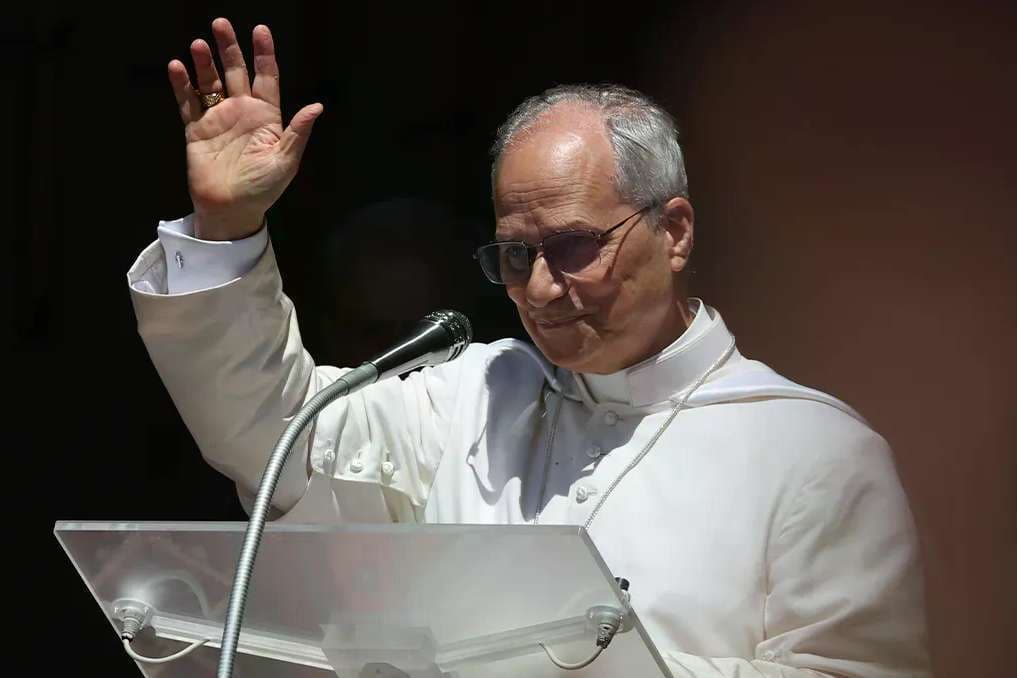
In his Feb. 8 Sunday Angelus, Pope Leo XIV encouraged Christians to respond to Christ’s call to be the “salt of the earth” and the “light of the world” by embracing the transformative joy of the Gospel.
Speaking to pilgrims gathered in St. Peter’s Square, the Holy Father reflected on the Gospel passage from Matthew (Mt 5:13-14), delivered after the Beatitudes, saying authentic Christian joy flows from encounter with Christ and gives meaning to life.
“Indeed, it is genuine joy that gives flavor to life and brings to light something that was not there before,” the Pope said. “This joy springs from a way of life, a way of inhabiting the earth and of living together that must be desired and chosen. It is the life that shines in Jesus, the new flavor of his words and deeds.”
Drawing on the prophet Isaiah (Is 58:7-8), he highlighted concrete acts of mercy — sharing bread with the hungry, welcoming the homeless, clothing the naked, and caring for one’s own family — as pathways to overcoming injustice. Having performed these actions, the prophet says, “then shall your light break forth like the dawn, and your healing shall spring up speedily.”
The Holy Father highlighted Isaiah’s twofold meaning.
“On the one hand, there is light which cannot be hidden because it is as great as the sun that drives away the darkness every morning; on the other hand, there is a wound that was once burning and is now healing,” he said.
The Pope acknowledged that many people struggle with a loss of purpose or dignity, likening those experiences to salt that has lost its flavor or light that has been hidden. He emphasized that God never discards anyone and that even the deepest wounds can be healed by embracing the Gospel.
“Jesus, however, proclaims a God who will never throw us away, a Father who cares for our names and our uniqueness,” he said. “Every wound, even the deepest, will be healed by welcoming the word of the Beatitudes and setting us back on the path of the Gospel.”
Pope Leo also stressed that deeds of openness to others rekindle joy. At the same time, he added, “through their simplicity, such gestures put us at odds with the world.”
“Jesus himself was tempted in the desert to follow other paths, to assert his identity, to laud it and have the world at his feet,” he said. “Yet he rejected the paths that would have caused him to lose his true flavor, the one we find every Sunday in the Bread that is broken, which is a life given and a silent love.”
Concluding the Angelus, the Pope invited the faithful to draw nourishment and light from communion with Christ and asked for the intercession of the Blessed Virgin Mary, whom he called the “Gate of Heaven.”
“Without any boasting, we will then be like a city set on a hill, not simply visible, but also inviting and welcoming: the city of God where everyone, deep down, desires to live and find peace,” he concluded.
In remarks following the Angelus prayer, Pope Leo marked several pastoral and global concerns. He welcomed the beatification of Father Salvatore Valera Parra in Huércal-Overa, Spain, praising the 19th-century parish priest as an inspiration for today's clergy. According to Vatican News, Cardinal Marcello Semeraro, the prefect of the Dicastery for the Causes of Saints, celebrated a beatification Mass for Fr. Valera Feb. 7.
The Pope also expressed sorrow over recent violent attacks on communities in Nigeria, offering prayers for the victims and urging authorities to safeguard human life.
On the World Day of Prayer and Reflection Against Human Trafficking — coinciding with the memorial of St. Josephine Bakhita — Pope Leo XIV thanked those combating modern slavery, declaring: “Peace begins with dignity!”
He also offered prayers for communities affected by floods and landslides in Portugal, Morocco, Spain, and southern Italy, encouraging unity and mutual support with “the maternal protection of the Virgin Mary.”
He closed by renewing calls for peace: “History teaches us that strategies of economic and military power do not give humanity a future. The future lies in respect and fraternity among peoples.”

Comments