Pope Leo issues letter on value of sport as Winter Olympics begins in Italy
Pope Leo XIV wrote a letter Feb. 6, the day of the opening ceremony for the 2026 Winter Olympics in Milan and Cortina d’Ampezzo, greeting those involved in the games and reflecting on the value of sport as a community endeavor shared by both fans and athletes.

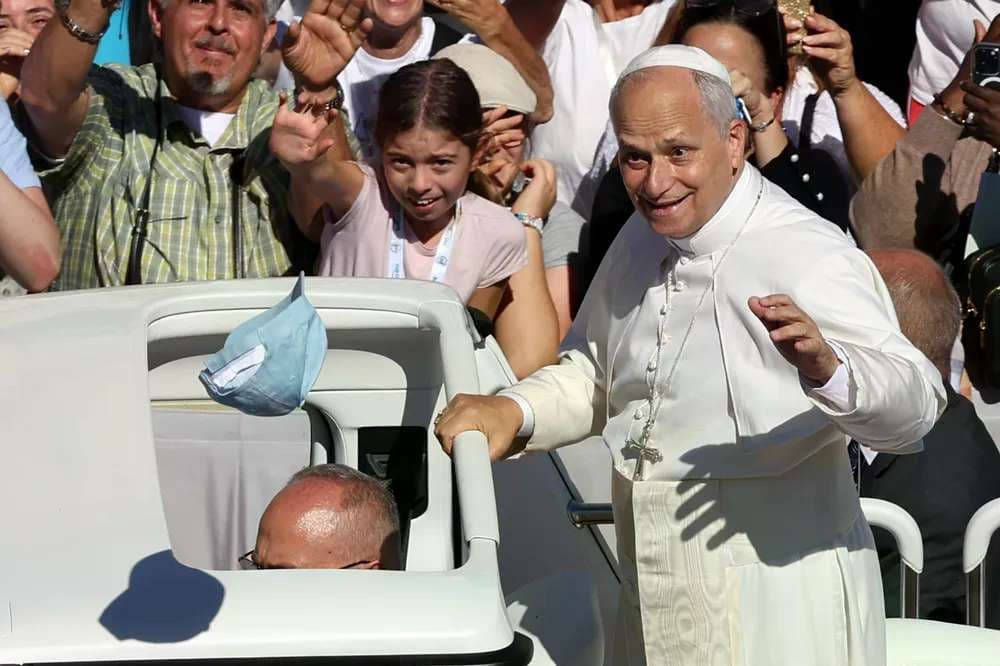
Pope Leo XIV wrote a letter Feb. 6, the day of the opening ceremony for the 2026 Winter Olympics in Milan and Cortina d’Ampezzo, greeting those involved in the games and reflecting on the value of sport as a community endeavor shared by both fans and athletes.
“The educational significance of sport is particularly evident in the relationship between victory and defeat,” Pope Leo wrote. “Winning is not simply outdoing others, but recognizing the value of the journey, of discipline and of shared commitment. Losing, in turn, does not entail personal failure, but can become a lesson in truth and humility.
“Sport thus teaches us a deeper understanding of life, in which success is never definitive and failure is never the last word. Learning to accept defeat without despair and to welcome victory without arrogance enables athletes to face reality in a mature way, recognizing their own limits and possibilities.”
Pope Leo noted that sport is something inherently cooperative and shared, and at its best becomes "a universal expression of our humanity."
He recalled how Pope Saint John Paul II and other pontiffs have reflected on the ability of sports to promote peace, noting that the Olympic Truce in ancient Greece suspended hostilities while athletes and onlookers participated in the games..
The truce “stems from the conviction that participation in public games (agones) constitutes an individual and collective path toward virtue and excellence (aretē),” Pope Leo wrote. “When we engage in sport with this spirit and under these conditions, it promotes the growth of fraternal solidarity and the common good.”
He also warned that war begins with “a radicalization of conflict and a refusal to cooperate with each other,” resulting in a view of opponents as “a mortal enemy” to be eliminated.
“The tragic evidence of this culture of death is before our eyes — lives broken, dreams shattered, survivors’ trauma, cities destroyed — as if human coexistence were superficially reduced to a videogame scenario,” he wrote.
Emphasizing that war and violence never lead to true victory, Pope Leo encouraged nations to reencounter the Olympic Truce as a tool of promoting hope and reconciliation amid current conflicts.
The Pope also reflected on how Christianity approaches sport and the correlation between athleticism and the Christian life. He noted many Christian authors use metaphors of athleticism to describe the spiritual life, highlighting the importance of the unity of body and soul.
“While in past ages there were Christian writings — influenced by dualistic philosophies — that had a rather negative view of the body, mainstream Christian theology emphasized the goodness of the material world, affirming that the human person is a unity of spirit, soul and body,” he wrote.
This theology strongly contrasts that of gnostic and other heretical worldviews that see physical matter and the human body as “intrinsically evil” and opposed to spiritual excellence, the Pope noted.
“In response, Christian theologians countered with the fundamental beliefs of our faith: the goodness of the world created by God, the fact that the Word became flesh and the resurrection of the person, restoring the harmony of body and soul,” he wrote. “This positive understanding of physical reality favored the development of a culture in which the body, united to the soul, was fully involved in religious practices: participation in pilgrimages, processions, sacred plays, the sacraments and prayer that makes use of images, statues and various figures.”
Pope Leo pointed to Saint Thomas Aquinas’ insight that a virtuous life requires moderation, including in work and heavy responsibilities – meaning there is a place “for games and rest.”
Sports can help cultivate individual growth as well, and can bring joy and appreciation simply for their own sake rather than for goals like earning money or winning fame, the Pontiff later noted. Team sports can also foster selflessness for the sake of a common goal.
He also praised the role of coaches and noted that, “given the human complexity involved, it is a great help when a coach is guided by spiritual values.”
“There are many coaches of this kind in Christian communities and other educational settings as well as at the competitive and professional elite levels,” he said. “They often describe the team culture as one based on love, which respects and supports each person, encouraging individuals to do one’s best for the good of the group. When a young person is part of such a team, they learn something essential about what it means to be human and to grow.”
He called for sports to be accessible to everyone, noting that some “pay-to-play”-focused societies exclude poorer families.
“In other societies, girls and women are not allowed to participate in sports,” he said. “Sometimes, in religious formation, especially of women, there is a mistrust and fear of physical activity and sport. Therefore, we must strive to make sport accessible to everyone. This is very important for human development.”
“The moving testimonies of the members of the Refugee Olympic Team, or the participants in the Paralympics, the Special Olympics and the Homeless World Cup have confirmed this for me,” he said. “As we have seen, the authentic values of sport naturally open up to solidarity and diversity.”
In the letter he also greeted those involved in the XIV Paralympic Games, which will also be held in Italy, from March 6 to 15.
Near the end of the letter, Pope Leo urged the implementation of “sporting practices as open and inclusive instruments for communion.”
“Sport can and must be a welcoming space, capable of involving people from different social, cultural and physical backgrounds,” he wrote. “The joy of being together, which comes from shared play, common training and mutual support, is one of the simplest and most profound expressions of a reconciled humanity.”
The full letter can be read here.


Comments