Pope Leo urges German Catholic students to defend human dignity, resist careerism
Amid rapid technological change, Pope Leo XIV on June 5 urged German Catholic university students to become defenders of human dignity who pursue truth and service rather than passive consumers of cultural trends who merely seek wealth and status.

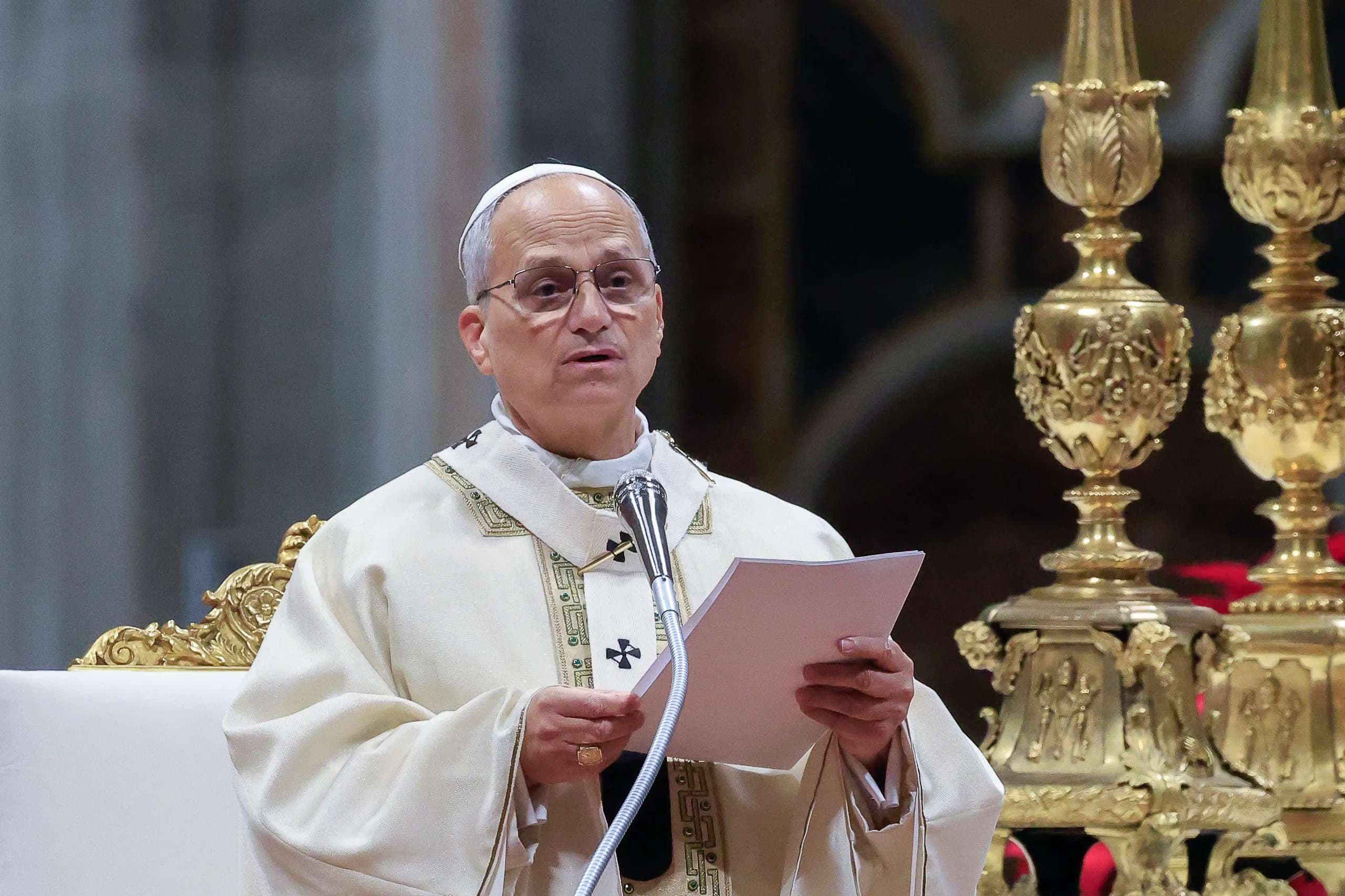
Amid rapid technological change, Pope Leo XIV on June 5 urged German Catholic university students to become defenders of human dignity who pursue truth and service rather than passive consumers of cultural trends who merely seek wealth and status.
He warned the student association members gathered for a joint assembly in Rome that harried technological advances risk reducing human beings. The challenges posed by the technological revolution require renewed attention to the value of the human person, the Pontiff insisted.
“Faced with the challenges of the technological revolution, you should devote particular attention to the study and the promotion of our common humanity,” he said.
He said men and women must recognize that they need to be both accountable to themselves and give of themselves to others.
“In his or her irreducible expression as male or female, the human person is in fact always relational and limited, and therefore called to become a task for oneself and a gift to the other,” Pope Leo said.
The Pope framed his remarks to the assembly around three themes: Catholic identity, communion within the church, and the pursuit of culture and knowledge.
Pope Leo praised the groups’ commitment to the principles of religio, scientia, amicitia, and patria — religion, knowledge, friendship, and love of country — and said Catholic faith must be lived publicly rather than worn as a cultural label.
“In the face of the despotism and ideologies of the past, the Catholic faith has never been merely a veneer or a label, but rather a way of life to be shared in university and in work settings,” he said.
The Pope also encouraged students to engage society as Catholics while avoiding partisan divisions.
“As all of you follow Christ, the only Lord and Master of life, you represent Catholic values in society not as those who carry partisan flags, but as representatives of the common good of humanity,” Pope Leo said.
He warned against placing personal preferences above the Church’s tradition or compromising with contemporary cultural trends.
“In Germany, in Italy and throughout the world, the same Catholic faith strengthens our cooperation, without compromising with the trends of the moment, without placing individualistic preferences ahead of the common Tradition of the Church,” he said.
Truth over careerism
Turning to academic and professional life, Pope Leo told students that education should be understood as a vocation rather than simply preparation for a career.
“You have come to realize that it is not merely a matter of pursuing a profession (Beruf), but of following a vocation (Berufung),” he said.
The search for truth, he added, requires intellectual discipline and personal conversion.
“Study is rather a commitment, requiring self-discipline and conversion: a transformation of the mind,” Pope Leo said.
He cautioned students against becoming consumed by the pursuit of wealth and professional advancement.
“By doing our very best, we become responsible stewards in society without being seduced by careers focused on money,” he said.
Instead, he urged them to recognize culture as a service to humanity and defend objective truth.
“Truth sets us free, while falsehood distorts names and things,” the Pope said.
Call for ‘Christian humanism’
The Pope also appealed to the students to defend vulnerable people and promote what he called “Christian humanism.”
“In the face of what dehumanizes people — especially the least among us, the poor and the sick — I ask you to be witnesses to Christian humanism,” he said.
Quoting Pope Benedict XVI, who had been a member of one of the student associations, Pope Leo renewed Benedict’s call for an “ecology of man,” saying humanity possesses a nature that must be respected.
He linked that concept to the teaching of Pope Francis on integral ecology, arguing that the world is not a meaningless collection of matter to be manipulated for power.
“We are not random aggregates of particles, but bodies open to transcendence,” Pope Leo said.
Invoking St. Boniface, the patron saint and evangelizer of Germany, Pope Leo prayed that the students would become “witnesses to this wisdom of the Gospel in German and in European society.”
“The cultural mission of Christians is to direct society and history toward this pinnacle of a God-centered life,” he said.
.jpg&w=3840&q=75)




Comments