Report: Lebanon village officials say UN forces, not Israeli military, restored desecrated crucifix
Italian United Nations Interim Force In Lebanon (UNIFL) forces — not the Israeli military — installed a replacement for the crucifix smashed by an Israeli soldier in a southern Lebanese village, contradicting claims made by the Israel Defense Forces (IDF).

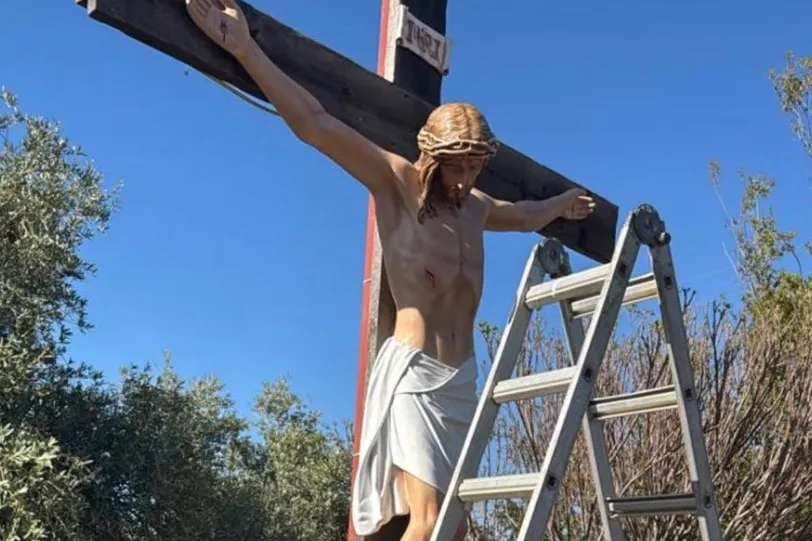
Italian United Nations Interim Force In Lebanon (UNIFL) forces — not the Israeli military — installed a replacement for the crucifix smashed by an Israeli soldier in a southern Lebanese village, contradicting claims made by the Israel Defense Forces (IDF).
As Zeale News reported, the April 19 incident, in which a uniformed IDF soldier was photographed taking a sledgehammer to the head of a statue of the crucified Jesus Christ in Debel, drew international condemnation.
Zeale News also reported that the IDF quickly announced they had replaced the damaged crucifix. But reports on the ground and statements from village officials, translated by Zeale, cast the IDF's claim in a different light.
Two versions of the ‘replacement’ emerge
A statue to actually fully restore the desecrated crucifix was sent by the Italian Church and installed by Italian UNIFIL forces. Papal Nuncio Paolo Borgia traveled to Debel to bless the corpus before it was mounted. The replacement is full-sized and, based on available images, closely resembles the original that was destroyed.
The IDF's earlier contribution, by contrast, was a substantially smaller cross with a different design. The Israeli military posted a photograph of the small crucifix placed with the site of the desecration behind it. The IDF’s post claimed the military had acted "in full coordination with the local community” to restore their crucifix.
However, Debel Mayor Joseph Attieh suggested in comments to MTV News Lebanon that the IDF had brought the statue to the site independently, then informed the village after the photo-op. Attieh also said that Italian UNIFIL forces were due to arrive the following day to install the fully restored cross sent by the Italian Church.
"Yesterday, the Israeli army brought a statue of Christ and placed it back in its original location, and they informed us of this," he said. "Tomorrow, God willing, around one o'clock, UNIFIL will come, I believe with the Italian general present here, and they will install the cross sent by the Italian Church to the town of Debel."
Video footage circulated online April 22 showing Italian forces installing the full-size crucifix, with an Italian general present and no visible sign of the IDF's smaller cross in the area.
Accusations of ‘collaboration’
Reports also spread online linking material aid deliveries to Debel and Christian-majority neighboring villages, Rmeish and Ain Ebel, to Israel — with some framing the aid as compensation for the IDF soldiers’ desecration of the crucifix. Some international media outlets described the aid deliveries as being “deposited by the Israeli Army” or “Israeli-coordinated.”
Attieh identified the aid as coming from Samaritan's Purse, an American humanitarian organization, delivered through a Christian church inside Israel. "This is not an attempt from Israel to make up for what had happened, as some are speculating," the mayor said.
The delivery was made discreetly: the village received a phone call in the night telling them supplies had been left at the entrance — a point residents could reach — and to come collect them.
Fr. Najib Al 'Amil, the village pastor, described initially refusing the aid over fears that accepting it would expose residents to accusations of collaboration with Israeli forces — a serious concern in villages that remain under Israeli military control within the so-called buffer zone.
"At first, we refused it, because we thought the aid was from Israel," he said. "I spoke with the municipality, and I told them we could not receive the supplies because we are an official institution and might be accused of collaboration [with Israel], as has happened in the past."
He ultimately relented after a second call warned that the supplies, left in an open area near the border, would be destroyed by a coming rainfall.
"I thought, ‘Why should I deprive my parishioners of this aid?’" Fr. Al 'Amil said. "’It would be wrong to let it go to waste.’"
He added that the village's roughly 6,500 residents need far more than the grains that were delivered — including vegetables, fruit, medications for chronic illnesses, baby diapers, and sanitary products. A Caritas convoy managed to reach them for the first time in weeks earlier this week, providing a significant portion of aid.
Residents ask for focus on aid access and sovereignty
Village residents, according to MTV News, are frustrated by what they view as efforts to manage the optics of the situation rather than genuinely address it.
“Residents are asking people not to get distracted by what they consider trivial details, and instead to focus on securing humanitarian corridors for critical medical cases,” the reporter stated, “and restoring full state sovereignty over all its territory so that this kind of senseless war does not continue.”
As Zeale News reported, U.S. Bishop Abdallah Elias Zaidan warned in early April of a deepening humanitarian crisis in Lebanon, urging President Donald Trump and global leaders to expand aid as Israeli strikes killed thousands and displaced over one million. He asked for prayers for the civilians — especially Christians — in the area, stating it’s “not their war, but they’re the victims.”
Lebanon's official death toll since Israel launched its new military campaign March 2 stands at 2,454, and an additional 7,658 have been wounded, according to the Lebanese Health Ministry.
>> US bishop highlights humanitarian crisis in Lebanon: ‘not their war, but they're the victims’ <<




Comments