Tech executive launches Canary Project to help parents reclaim kids’ formation in digital age
In the middle of the pandemic, exhausted by online polarization, Terry Gromes deleted Facebook from his phone. He expected relief. Instead, he felt alarm.

In the middle of the pandemic, exhausted by online polarization, Terry Gromes deleted Facebook from his phone. He expected relief. Instead, he felt alarm.
“Just minutes later,” he said in an interview with Zeale News, “I swiped back to my phone and out of habit pressed the empty space where the Facebook app used to be. I was angry and horrified at the same time. I thought, ‘They did it to me. I’ve been engineered.’”
That moment became the catalyst for what is now The Canary Project, an initiative aimed at helping parents, educators, and community leaders rethink how technology is shaping their children.
Gromes, a former director of technology in the industrial robotics industry and founder of The Canary Project, spent two decades working at the forefront of product development in tech. When the iPad debuted in 2007, he quickly integrated touchscreen tablets into his company’s robotics systems.
But as he tracked these emerging technologies, he also learned how social media platforms were designed.
“They hired hundreds of behavioral scientists,” he said, describing the algorithms behind social media feeds. “The algorithm would captivate the most disciplined adult mind. And then, unknowingly, adults just went handing it off to kids who have a prefrontal cortex that is not developed, and they (kids) don't have any discipline, they don't have any self control, and they will endlessly spend hours upon hours at a time on a phone.”
Not rejection, adaptation
Careful to say he is not anti-technology, Gromes compares the current digital moment to the early days of the automobile.
Raised in northeastern Ohio, he pointed out that the first recorded car-to-car accident occurred in Cleveland. Soon after, the nation’s first electric traffic light was installed there.
“When the first car accident happened, they didn’t say, ‘All this technology is bad. Throw it away.’ They invented traffic lights,” he said. “They adapted society.”
The lesson, he suggested, was not abandonment but adjustment. The Canary Project seeks to be a cultural traffic light in its own way for the digital age.
Reclaiming the household
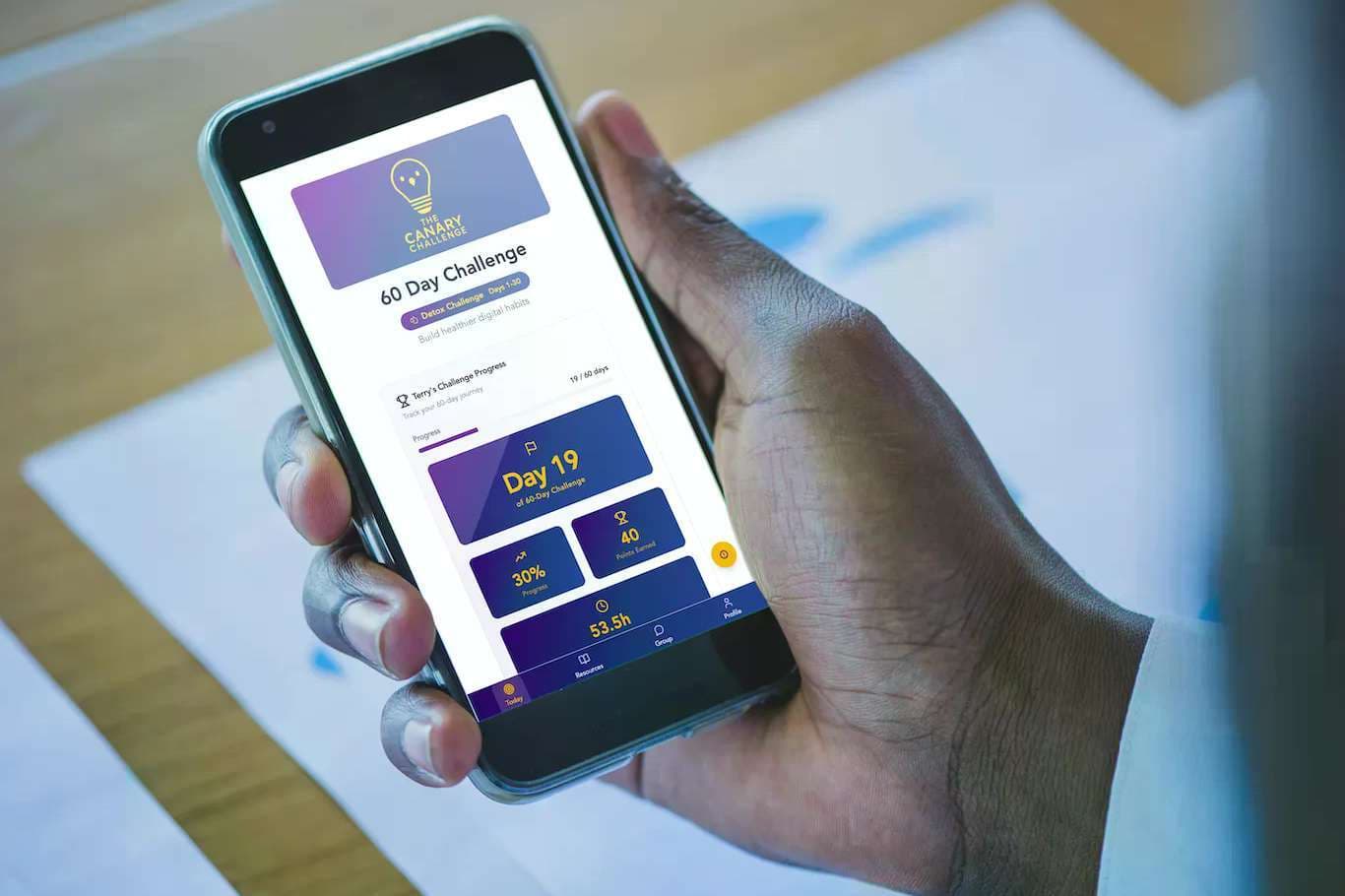
The organization’s primary audience is adults: parents, educators, and community leaders. Its centerpiece is a gamified app that guides families through daily challenges designed to build awareness and gradually reset digital habits.
“I can’t sit down with a five-year-old and reason with them about why they shouldn’t be on TikTok,” he said. “It starts with the parent.”
He framed the effort as an invitation for adults to reclaim authority within their own homes.
“If that parent isn’t the center of that kid’s life, and they have that device with the internet, they will find mentorship somewhere else,” he said. “Who do you want to raise your kids?”
Small challenges in the app — such as putting a phone away an hour before bed — are intended to reintroduce intentional use.
“Small tasks can really help people take tiny steps away and become more aware of how much they’ve been using their phone,” he said. “Then slowly reintroduce it as a tool instead of the central entertainment focus of your life.”
Children’s formation in the digital age
For Gromes, the core issue The Canary Project addresses is the formation of children in the digital age.
He described what he called a “digital divergence,” a break from the traditional patterns through which children had historically matured.
For centuries, he said, childhood development unfolded in a predictable arc. Infants were nurtured through physical presence — eye contact, facial expressions, the subtle reading of nonverbal cues. As children grew, their formation expanded outward through family life, church communities, and school structures, gradually preparing them for independence.
“As infants, they were coddled and nurtured. They used eye-to-eye contact,” he said, describing the early bonds he believes are foundational. Over time, he added, that integration led to “the autonomy of adulthood.”
What concerned him was how quickly that had changed when parents increasingly replaced those formative interactions with screen-based engagement.
“Parents have substituted learning and growth patterns with screen devices,” he said. “Are you using your cell phone as a tool, or is it using you?”
Gromes acknowledged that technology itself is not new, and previous generations grew up with televisions and desktop computers. But those devices were stationary, limited, and confined to shared spaces.
“The television was this big box on the ground in the living room, and so is the desktop computer. So it's not like you just pick up that clunky box and take it to the playground with you.”
Smartphones, by contrast, are portable, constant, and deeply immersive.
“People are enslaved to these devices and some of these little screens that fit in our pockets,” he said, “these little rectangles they deal with us everywhere, and they control us everywhere.”
“Our goal,” he said, “is to help reroute that digital divergence back into the traditional forms of well formation of how kids have been raised and educated and brought up within a proper society.”
The first smartphone generation
Gromes said the long-term effects of this formational shift are now visible in Generation Z — the first generation to grow up with smartphones from early childhood.
He pointed to workplace patterns he believed reflected deeper formation gaps. According to data he cited, one in five young adults brought a parent with them to a job interview. Another one in four Gen Z applicants declined to turn on their camera during Zoom interviews, something he attributed to discomfort with eye contact and direct communication.
“These are the horrifying results that we're finally seeing from the first generation that's been raised by cell phones,” he said.
Gromes also pointed out similar trends in what employers described as difficulty with in-person interaction, conversational confidence, and independent decision-making — developments he linked to prolonged digital immersion during formative years.
Learning to be present again
“Back in the day, I used my phone to call my friend and say, ‘We’re heading to the basketball courts at 4:30. See you there,’” Gomes said. “Use the phone as a tool to go do something in the real world, instead of making it the central entertainment focus of your life.”
He pointed to additional statistics he found troubling, particularly how deeply phones had embedded themselves into daily routines.
For most people, he said, the day both began and ended with a screen. Seventy-five percent of people fell asleep with their phones within arm’s reach, and 90% looked at their phones first thing in the morning and last thing at night.
“We’re not even creating an opportunity to detach from the digital world,” he said. “Read a book. Drink a cup of coffee. Be fully present.”
Still, he says he finds reason for optimism.
“What gives me hope is that Gen Z knows something is off,” he said, citing survey data indicating that many young adults have attempted to reduce their social media use and wish certain platforms had never been created.
“They’re trying to self-help,” he said. “But there’s nothing in place. We want to create something concrete that drives toward a solution.”
The goal, he said, is simple: “Control the tool instead of letting the tool control you.”









Comments