Pope Leo Electrifies Massive Crowd at Youth Jubilee: "You Are The Light of The World!"
During the Jubilee of Youth Pope Leo reaches out to influencers – Tom, Josh, and Erika share their thoughts on this message directed at them and their peers. China is trying to backpedal their birth policies, Erika has thoughts on Sydney Sweeney, and an NYU study has truly shocking results: sympathy for Trump supporters!? All this and more on the LOOPcast!
This podcast is sponsored by Charity Mobile! New customers can get a free phone after instant credit, plus free activation and free standard shipping, when they switch to Charity Mobile with promo code LOOPCAST at https://www.charitymobile.com/loopcast.
TIMESTAMPS:
00:00 – Welcome back to the LOOPcast! 01:30 – Charity Mobile 02:37 – Pope Leo Jubilee of Influencers! 17:51 – China enters the baby race 32:46 – Good News! 44:29 – Erika has thoughts on Sydney Sweeney 53:05 – Twilight Zone
EMAIL US: [email protected] SUPPORT LOOPCAST: www.loopcast.org
All opinions expressed on LOOPcast by the participants are their own and do not necessarily reflect the opinions of CatholicVote.
Transcript
Read the full transcriptAuto-generated · 13,916 words
And we're live. Welcome to the LOOPcast. It's Tom, Eric, and Josh. The LOOPcast, of course, brought to you by The Loop, every American Catholic's favorite morning newsletter. If you don't have it, subscribe now. A warm welcome to everyone here live in the chat. I mean, I'm always surprised how many people are here every Monday, Wednesday, Friday with us here at 11. So, I really appreciate you guys. Welcome. We got a great show for you today, and I'll say I personally was just so encouraged by this jubilee of youth in Rome right now.
Just raucous crowds. It was so cool to hear a pope address people in English. And we got all the sights, the sounds, and addressed to the digital influencers, as they are known. Kind of hard to say that out loud, but it is an important part, I think, of the future of the pontificate, so we have all the coverage there. Second, we have China entering the baby race. No one's making enough babies, at least in the Western world, and China as well.
Yeah, come on. Hey, wait, right. I mean, I did my part. Yeah, not a big show. The co-hosts of the show were... Erika didn't even die once. You know, that is crazy. So, between the three of us, we have got 15. I mean, that is pretty good, right? I appreciate you bringing us up here.
We get a little pat on our backs here at the LOOPcast. I am sure our audience, if we were to take demo information, probably is well above replacement, but if this reaches anyone, you know, hopefully that is the goal.
We got good news. We got Twilight Zone. We have a fantastic show for you today. We did it the right way, not Genghis Khan. Right, right, right. Not Elon Musk. Not Elon Musk way. Oh, man. Okay. Speaking of, if you want to do some good things for the world with your money, go check out Charity Mobile. Now more than ever, it's important to buy the way you believe and do business with companies that support what you stand for, and that's why you should switch your cell phone service to Charity Mobile, the pro-life cell phone company.
They send 5% of your monthly plan price to the pro-life, pro-family charity of your choice at no extra cost to you. Unlike some other mobile carriers that resort to gimmicks to retain customers, Charity Mobile doesn't do three-year price locks because they have never raised their mobile plan prices. In their 30-year history, and all plans start under $50 before taxes and surcharges, you can save even more money every line you add, making them a perfect choice for families, for our homies here populating the earth.
So, new customers can use promo code LOOPcast to get a free phone with every new line, plus free activation and free shipping, or you can bring your own compatible devices. You'll enjoy the same nationwide coverage as the big guys, and their live customer service is based right here in the United States. To get started, visit charitymobile.com and use promo code LOOPcast. That is charitymobile.com, promo code LOOPcast. Thank you, Charity Mobile, for sponsoring this episode.
All right, I say we get into it. On July 29th, yesterday, Pope Leo XIV hosted a significant event at St. Peter's Basilica in Vatican City, marking the Jubilee of Digital Missionaries and Catholic Influencers, which coincided with this broader Jubilee of Youth. And the Jubilee year, I actually learned something new on this, it's a tradition rooted in Catholic practice dating back to 1300, occurs every 25 years and is a time of pilgrimage, repentance, and spiritual renewal. The 2025 Jubilee, themed around hope, is expected to draw approximately 32 million pilgrims to Rome for various events, with the Jubilee of digital missionaries and Catholic influencers being a unique addition tailored to the digital age we live in now.
And in Pope Leo's address, he emphasized challenges posed by the digital age, things like artificial intelligence and its societal implications. I have a clip here from this message that I think was somewhat of the main takeaway. Deeply characterized and formed by technology, it is up to us, it's up to each one of you, to ensure that this culture remains human.
Science and technology influence the way we live in the world, even affecting how we understand ourselves, how we relate to God, how we relate to one another. But nothing that comes from man and his creativity should be used to undermine the dignity of others. Now, this cameraman knew what they were doing. Yeah, they did. We had a last five-second shot of someone texting on their phone. A nun texting on her phone.
Dude, we got our Coldplay cameraman here in the Vatican just nailing people in the act, but I have some, just a little bit more before we get into more commentary. At least that's not intrinsically immoral. That's right, that's right. Not only is it from a woman that's not your wife, but... Yeah, yeah, yeah, yeah, of course, of course. You know... Implied.
I mean, actually, that would be a case where, like, sometimes a priest will have his iPad and he has the breviary on there or whatever, or the readings, and so it's not inherently a problem. Good defense. Good defense. Good point. Actually, we got nailed for, we did an interview with Father Mike Schmitz, and you two, no disrespect, you two were on your phones. I know that there were questions on that. It was my notes for the interview. Exactly. There were notes, but everyone was like, you're talking about the dangers of phones and technology, and you're on your phones.
Kind of got a point, but, you know. Gotcha. I've never been able to vocalize that. Hey, who was on point that whole interview? Like this guy right here. I think you're a little underwhelmed, but anyway. We were talking about Long Lake, Minnesota. We've got to reel it in. It was great. Okay, okay. We've got to reel it in. I have another part of his address. It is not simply a matter of generating content, but of creating an encounter of hearts. This will entail seeking out those who suffer, those who need to know the Lord, so that they may heal their wounds, get back on their feet, and find meaning in their lives.
Above all, this process begins with accepting our own poverty, letting go of all pretense, and recognizing our own inherent need for the gospel. Be agents of communion, capable of breaking down the logic of division and polarization, of individualism and egocentrism. Center yourselves on Christ so as to overcome the logic of the world, of fake news, of frivolity, with the beauty of light and truth.
It's usually we use the word frivolous. There's sometimes some words that just don't translate as well into their other, you know, way of saying it. But even the fact that we have a pope using fake news now is pretty sick. Yeah.
There's a lot of this, and I'm like, wow, he's young. He deserves to say it, given how many, you know, these fake AI videos of Pope Leo have taken over the internet. Yeah, you got to be super careful. So, what do we think?
Yeah, I mean, this was really moving to me. Yeah, the first line that stuck out, I was reading through the whole speech. I think Rosie just threw it in the chat, and it's worth reading for those of us who are online a lot. I mean, our jobs are so much online, especially like you and me, Pogo. Josh actually does real work for the world, like out on the ground. No, but it was a great little wake-up call, moment of reflection.
What is the purpose of what we're doing here? This chat community is so amazing, and I feel like we get to do a lot of fun things on the show and hopefully bring truth to the world, but it's always good to have that pause and that reminder that everything we do, every facet of our lives, including our online digital lives and jobs, should be a moment of reaching out.
A moment of encounter with other human hearts, even if we're not physically in the room together, for the glory of God, to have an encounter, like he says, with Christ, to seek out the suffering. So, yeah, it was really a beautiful moment yesterday. I was feeling kind of down. It's been a lot of dark news the last few weeks here on LOOPcast. I mean, we just stepped in it with Gaza, Israel. We've got frustrations with this and that and governing, and it was just really good for me.
To have that reminder and that kind of like reset button yesterday. It was a palate cleanser for you. It was, yeah. Thank you. That is a good phrase for it. Yeah, but I think, so he addressed the influencers in there, but then he goes out in the Popemobile and does this surprise appearance.
For the other side of the spirit, there's a hundred, I think it's over a hundred thousand people in this crowd, all over the world, young people, I saw a Texas flag, maybe that was Peru, and... Well, the Chile flag looks like... Yeah, there's Chile. That was it, yeah, yeah, yeah, flag talk. Anyway, just really electric. I think they're really... I don't know if... So, I'll show the speech, part of the speech that he gave, which, again, just people just clamoring.
Buenas tardes. Good evening. Jesus tells us you are the salt of the earth. You are the light of the world. So, he speaks in English when he doesn't have his notes, you know. I mean, it makes sense. Well, if you keep watching the clip, though, he goes on to do it again in Spanish and again in Italian, I think. Well, if it's just the one thing, then yeah. Yeah, yeah. Right. No, that was awesome. Is anyone else getting like John Paul II from the early 90s vibes?
You know what I'm saying? Just the age? I'm glad you said it, not me, because I thought it, and I didn't live through John Paul II. I have to say, the energy here at this event. And I'll show the picture. The pictures from this event are so cool. Um, but here he is, you know, staring out into this massive crowd of youth from all over the world, and the message he has is, we hope that all of you will always be signs of hope in the world.
Today is the beginning. In the coming days, you will have the opportunity to be a force that can bring God's grace, a message of hope, and a light to the city of Rome, to Italy, and the whole world. Let us walk together, and with our faith in Jesus Christ, we must also cry out for peace in the world. Let us all say, we want peace in the world, and everyone Screamed back. We want peace in the world. Let us pray for peace.
I mean, I used electrifying. I can't remember if it made it in the title, but... I mean, this kind of stuff gives me chills. I don't know if it's because we didn't have something like this in a while, or because there are so many dark things going on right now, and I've really been encouraged by the church leadership on this, but this feels like just such common sense encouragement to give to the youth of the world, and the youth clearly desire this.
Not just people there, but also me watching this here. This is a really uplifting message. Right? Am I crazy? It's different in the sense, I mean, John Paul II was an actor, and so he had this natural, you know, for the stage, and he was so full of energy and excitement. This just comes from...
Almost like just an earnestness, like he really means this well. Not that John Paul didn't, don't take that away, but John Paul had a lot of acting training, so he would be able to perform in a way, and I don't mean that in a bad way, whereas Pope Leo, it just seems like he's coming out there, and he just comes from just this pious love of these people that he's speaking to, and that is very electric. I mean, I love... Pope Benedict so much.
I think he's done so much for the church, and it was funny because every time I would see a photograph of him, he'd always look really horrible, and then I saw him face to face, literally this close away, and he had just like the softest eyes and the nicest smile, and it was wonderful to actually see him face to face, and it's like some people just do not photograph well. And they feel awkward or stilted in big crowds or whatever, and Pope Benedict did his best, and then Pope Francis, I mean, yeah, well, whatever, I don't know.
We are going forward, Josh. We are going forward. It has been a while since we had someone with a little bit more of a natural charisma or ability to connect with the crowd. Yeah, and I think the simplicity of the message is always what strikes me, too, that it would elicit.
Everything he says is just, be centered on Jesus Christ. Be centered on Jesus Christ. We want peace. We want truth. That's it. I mean, that's the message, and then he applies it to different things. And it's wonderful to just have that sort of like re-centering on the true center of human history, and that's Jesus Christ. And he doesn't need to be fancy. He doesn't need to come up with the next brilliant thing that no one's thought of saying before. Yeah. And that's the role of the papacy, like that continuity, that security in...
This is the church founded by Jesus Christ. We've had one message for 2,000 years. It's not changing, and it's still new. Here's an observation. I'm curious what you guys think, because this is just maybe my personal opinion. I can't speak for anyone else, but I don't know if it was...
Pope Francis himself, or if it was the digital age surrounding Pope Francis, because I've gone back and read some of his encyclicals, not the super controversial ones, but other ones, and he has said some really beautiful things. So, I don't know if it was just the media environment surrounding him, if it was his actions himself, maybe a combination of the two. It felt like everything kind of got distracted from the Pope being the... Holding the keys, the inheritor of the faith, and you're just presenting and building upon the traditions that we've already had, and bringing forth Jesus to the world, basically.
My observations of Pope Leo, I don't know if it's just because it's aspirational or if this is really the case, he just strikes me as someone that is hyper-focused on unity. Bringing Jesus to the masses and really just being kind of thoughtful. When he does speak, it is intentional, and then just doing really simple. Everyone keeps throwing stuff at him, which is hilarious to me. I have a couple of clips. I think a bishop gave him an eagle's hat from America, which I am like, if you do that, you are embarrassed, man.
From Chicago. We have Aurelius Pizza. Oh, my gosh. And, yeah, Chicago. I don't think it would be deep. Maybe they do deep. Deep dish. Chicago style deep dish. Don't get him going on the pizza. I don't think it's deep dish from Aurelius. We're not going on the pizza, but people keep giving him stuff.
And then this is the Eagles hat, which is cracking me up. One of the bishops, I think he's from. This is Perez from Philadelphia. Handsome in Eagles hat. He just pulls it out of the way. He laughs. It's just, oh, man. And then he gets to know the Eagles, yeah.
But I guess, is it just like the idea that there's a fresh start here, and there's a new media environment surrounding them, that people kind of all aspire, maybe, to heal some of these divisions? Is it actually Pope Leo himself? Was it Pope Francis himself? I'm not sure. That's just kind of how I've generally been feeling about it.
Well, I mean, again, it remains to be seen. I mean, one of the things that Pope Leo has done, I think, in humility is just like trying to lower the temperature and like not come out strongly on any one thing, you know, just kind of taking your time. Like, you know, conservatives might want him to slam the Archbishop of Detroit on the knuckles for all the things he's doing over there.
I doubt Pope Leo is going to do that. I think he might maybe give him a call and be like, okay, how are things going? Just to slow his roll a little bit, but he is not going to discipline him, for example. We will see. I think everything he is trying to do is just to lower the temperature.
And, you know, that's what you're talking about with unity. I think that's what he's getting at. We'll see. I mean, he just has, I think, a more thoughtful temperament. You know, like, here's the thing. We always confuse ideology with tone, because they often go hand in hand. So, like in politics, you might have firebrand ultra-conservatives or, you know, or far left-wing liberals like AOC, and they're like, they're like, always screaming into the microphone, we got to do this, we got to do this.
And then it's thought that the people in the middle are more, you know, sober tone. Right. But that's, you know, sometimes, you know, you can be very conservative and just have like a... A moderate tone, if that makes sense. So, Pope John Paul II was like that. He was actually pretty darn traditional conservative in many ways. Yeah, the Rantrats still have their beefs with him on a few things, but overall, he was not going in there like, I am going to sack that guy, and I am going to send that guy to be Archbishop of Siberia.
He just tried to slowly, he was like a gardener. He was going to try to eventually try to get things going the better way. That seems like what Pope Leo is doing right now. Again, I would say it's still early to tell, but the fact that he's being thoughtful, taking his time, letting the temperature kind of go down a little bit, is, in general, a positive development for the papacy, given that for the last 12 years before that, it was just like, Waiting for another bomb to go off.
Next time he's on an airplane. Yeah, like, oh my goodness. Rest in peace. How many footnotes are in the next encyclical? So, hopeful stuff. On to the next section here, we have China and babies. So, I came across this article. Uh, China has now entered the baby's arms race, as I'm calling it. Oh, the turns have tabled, I just have to point out.
This was not the case when I was growing up. This is a case of, oops, we made a mistake for 40 years. Yeah, so I came across this article, China to offer $500 per child and move to boost birth rate. I mean, people are basically talking about this ad nauseum, and I have some, there's some interesting Twitter arguments I want to get into at this point. But basically... On Monday, the Chinese government put into place this new policy, which will provide 3,600 yuan, $500 annually, to parents per child under the age of three, retroactive to January 1st, 2025, with partial payments for eligible children born between 2022 and 2024.
So, the scheme is nationwide and centrally funded, expected to benefit over 20 million families, and the cash is meant to be a birthing incentive to remedy the country's ongoing population decline. Which, after obvious policies, China's fertility rate dropped from 2.51 children per woman in 1990 to 1.01 last year, well below the 2.1 rate needed to maintain a stable population, and the number of annual births have nearly halved by 2024. From 2016, the year China's government nixed its decades-long, brutal one-child policy, analysts warned that the modest size of the subsidy won't likely reverse demographic decline.
...or significantly boost consumption without deeper structural reforms like childcare infrastructure, expanded parental leave, or protections for women in the workforce. It's hilarious. I mean, we're having all of these same debates here. We never had a one-job policy, but there's a lot of the same things thrown around. I also saw an interesting note. It really depends to the local governments in China. So, for example, in Inner Mongolia region, they're offering the most generous subsidy of up to $14,000.
Per child. Which is a lot of money. So, really, depending on where you are in China, you can get different things. But kind of zooming out to the broader conversation here, two-thirds of the world's population currently live in countries with below replacement birth rates, including Americans. Sounds like a problem. The U.S. recorded an all-time low of 1.6 births per woman last year, all-time low. The Trump administration has reportedly considered a $5,000 baby bonus, and the recently passed BBB, I believe, $1,000 investment across the U.S.
Account for babies born through 2028, and the big question is, you know, is this something that money can solve, which is where everyone gets into the larger debates of, you know, some studies say yes, some studies say no. I guess, general thoughts on the- My thought is yes and no. I mean, in other words, you know, if you enact a government policy like this that increases the incentives for families to have more children, will you therefore necessarily get more children? Ah, maybe not.
Maybe. The whole point, though, is to spearhead a conversation where you say, look, our country needs more children, and we're willing to do what we can to try to change this around. The bigger thing that drives this truly is culture. There is no question about this. Like, my friend Tim Carney's book, Family Unfriendly, goes through this. I would recommend that book to any parish priest. Like, what are the things that we are doing in this country that are eliminating family formation?
Obviously, a lot of us who grew up in the 70s, 80s, and 90s experienced, you know, the wreck and ravage of divorce culture that came about in the 1970s. You know, there are all sorts of things that we have done.
Travel, sports has been a major hindrance, and it's become a new church for a lot of people. The fact is, there's a lot less people going to church, period. We're going to see something like 100,000 empty church buildings coming in the next few decades as people, you know, I know somebody who goes to church, he's not Catholic, he's like, yeah, I'm one of five families that go to my church. Five, you know, you're just seeing these churches die. So, can you change it?
Well, what happened? Like, there's what? My friend Tim talked about this. What is one country, wealthy country, westernized country, that has had… An increase in the birth rate. It's going to be non-controversial, right? Israel? Of course, Israel. Now, of course, the reason why they're able to do it is because they said, look, it became a cultural thing. You should have six to make up for the six, the six million that were killed in the Holocaust or whatever. So, for them, it was ingrained.
You had to come up with a reason that was greater than yourself, that you're able to make those sacrifices. This is why we have to get… You know, have a third or a fourth kid, you know, and so if China wants to do this, they should. I mean, I think the leader of China should kind of bring up, instead of like communism and Mao Zedong trying to get away from this, go back to Confucius, go back to like Chinese identity and say, we owe it to our prosperity to make sure that we're having children.
The same thing with, you know, like the United States, 250th anniversary of our country. Like, hey, we want to make sure we can celebrate our 500th. I mean, let's go, people. Like, you know, you have to come up with a reason. Religion performed that in many ways for so many people, but you can combine, hopefully, that is the number one, but if not religion, at least some other sense of culture identity, like we are Americans, we want this thing to continue.
Just tossing this out, what if we don't need a mass American culture renaissance, and now all of a sudden everyone has this culture identity where they want to have kids again? What if you just made it easier for the people that already want to have kids? It is like a much, not as hard fight. For example, between the three of us, I think we have 15 kids. Like, the likelihood of someone that already has... Three, four kids to maybe go to five, six, or whatever to make that gap up.
Much higher, right. I feel like it would be much higher anyway, and then if you made it economically easier for them to do so. But I guess the argument back would be they are going to do it regardless of economics. I am like, yeah, I guess that is how it is. The third kid is usually the toughest. Right. Having any kids or then having a third kid are tougher. So, that is kind of why I like this recent big, beautiful bill, which eliminated the penalties.
For cafe standards, for cars, basically, legalize the station wagon. Hey, let us make it affordable. Have a longer sedan that you can fit a few more kids in there. Stack them by cordwood. Let us go. This is helpful. These are the kind of things we can do that can help bring about family formation.
It was funny because JD Vance talked about this. Okay, that third car seat, trying to fit three car seats in a car, it is hard to do in a regular sedan. And people laugh. They're like, what are you talking about? This guy is so crazy. When it comes to having children, people are thinking about car seats. Yeah, in fact, they are, and a study is true. Yeah, no, I mean, that literally is a reason that one of my relatives will give for why they stopped at two kids, and they're like, it just, we didn't want to get a bigger car.
There were other things as well, like, you go to Disney World, and there's all these, like, there's packages for families of four, right, but not for that third, fourth, fifth kid. I mean, and those, they do seem like really frivolous, small things, but for a lot of people, when you add those up, that they add up to, we're going to stop at two. And I think, like, we We do have data, and this has been pointed out by Dr. Catherine Pakaluk in her book, Hannah's Children, another great read that every parish priest should read.
Priests are like, I don't know how to talk about, I don't have kids, I don't know how to talk or preach about children. I'm like, there are these great books that people with kids have written for you, one of them being Hannah's Children, but we know we have data coming back now from countries that have tried these kinds of incentives, not just money per baby. Like China's trying to implement here, but also the other things that analysts talk about, and that Josh was just talking about, policy, marriage taxes, paid leave, universal health care, and they've failed, right?
This is particularly in the Scandinavian countries. They have not turned around the birth rate at all, because who do they incentivize? They incentivize people who already, because of their cultural, because of their patriotism, because of their religion, are already... Having two or three kids, and it pushes them to four, but those people who are making the leap from zero or one to two, three, four, five, that's what I believe can only be overcome with cultural and religious turnaround because, like Josh said, it's hard.
Having kids is really difficult, and it's just easier the way that modern society is set up. Rely on children to take care of us when we're old anymore. They're not working in the fields for us. They're not even working in the halls for us because they're on the travel teams. And so, making that hard choice to have the second, third, fourth baby, that has to be something bigger than yourself. It has to be something coming from within. And we actually have a deep episode coming up on this.
No, actually, I think we need to, Erika, your point there, you made two points there that are so perfect, they need to be highlighted. Thank you, Josh. Let's do it. The fact is, when we were more agrarian, every child you had wasn't just a mouth to feed. They would actually help with the chores. They were a resource. Not just doing the dishes, like literally going out in the fields and helping with the harvest.
You know, and I try to instill that on my kids now. We sort of have our own family business here with my wife. They started, you know, this Marion Center and the bookstore, and so I get the kids to help out with that, so it's a force multiplier. I mean, they're not just a mouth to feed. They're actually helping, you know, ring up the register and helping people sell books. We stack wood. This is good. This is a good thing, which is why stacking wood, why growing a garden, these kind of things, you know, or maybe raising chickens, anything you can do to get the kids involved, because like, hey, You're not just sitting on your iPad all day.
You're actually contributing to the family so that you're not just only a burden. I mean, obviously, we love them, but the whole point is if you can try to change this arrangement a little bit, yeah, it would be helpful. So, I have a graph I want to show you guys for quick reactions because people quickly will just blame the pill in 1960s for the reason for this decline. I saw this graph. Someone said, begging people to look at this chart before 1960, it's been going on.
Since before the pill. Right. So, if you go back to 1800, US total fertility rate was at seven, and then right at 1940, it kind of goes, takes a real dip at 1930 to 1940, I assume Great Depression, down to about two, and then it spikes back up to 1960, and then 1960 crash, and then we're back down to just below two in 2020. Yeah, a lot of this has to do with technology, because what happened in the early to mid-1800s?
Well, you have the Industrial Revolution sweeping across Europe and North America. So, when you talk about the pill being to blame, the pill, we have to understand, is just sort of like the uber-reproductive technology, right? But technology, the rise of human technology, has coincided with the lowering of the fertility rate since the Industrial Revolution. Women going... Out of the house to work, the place that people moving to urban areas where there's less space, less need for children, like we said, to work on the farm.
And so, the demographic decline has been going on a very long time. What else happened culturally in the 1800s? Well, you had the coming off the age of revolutions. You also have sort of the gutting out throughout the 1800s of true Christianity, I would say, and of...
The cut flowers syndrome of Christian morality, it had all been sort of eviscerated by the Enlightenment, and we are starting to see that effect on the way that being Christian affects people's view of the goodness of children, the goodness of family. And then, of course, we really see it after the world wars. In an argument someone addressed with this quickly, because I am sure people are thinking it too, like infant mortality rate is so much. lower now. So, back in 1800, you know, two, three kids are making it past childbirth.
You have eight kids, five survive, right? But someone did adjust this graph for infant mortality, and it still is showing the same general trend. Not as extreme as the seven, but it's at about four. But again, in 1800, you know, the United States is... It's massively agrarian. You know what I'm saying? That's what I was getting at before. You needed all these people in the fields to help them with the work. It was a lot more. It was a family enterprise to try to put food on the table and raise the crops.
Right, but even by the 1830s, in the North anyway, that's starting to shift. Yeah, so you see you begin this decline. 1830s. Right, the Industrial Revolution. I mean, then you're living in a house, and it's like every additional kid is an expense. And then, again, some of these things are sort of cyclical, so then you get arguments justifying why you want what it is. You know what I mean? And then, so to me, it's not a surprise that people were talking about contraception in the 1920s.
Margaret Sanger, she was a big proponent of it. So then the Anglicans in 1930 are like, Yeah, you know what? Artificial conception is legitimate sometimes. That is what they said. I mean, just, you have to go back to, I mean, like, our president, Teddy Roosevelt, he was, you know, 1905 or whatever, he was railing against, you know, artificial contraception, but then the movement was made, like, to try to convince the Christians, like, no, no, no, this is an acceptable thing. They get the Anglicans, they get other mainline Protestant churches to do it, and then every, I mean, I'm not lying to you, like, so many people thought, well, then the Catholic Church was going to make a likewise revision.
And so, like, when the pill comes out in 1960, so again, it is this trajectory that is going in the same way. It did not start with 1960, I know, but again, I cannot help but say, like, They come out with the pill, and then all those professors and Catholic theologians were saying, oh, yeah, by the way, yeah, dude, the Vatican is totally going to change their opinion on this. It was almost like it didn't matter. Local priests were telling women that.
My grandmother was told this in 1960. Like, culturally, it had been decided. It almost didn't really matter at that point what Pope Paul said in Humanae Vitae, which is unfortunate, but it's just the reality. Because he waited too long.
Yeah. He did the right thing, but it took too long. Yeah, so interesting. We'll see if it pans out. Bold strategy, China. We'll see if it pans out. They have a higher hill to climb than we do, but they're not alone. Many countries find themselves in this position. Well, I think, honestly, having millions of people coming to this country illegally and suppressing wages has an effect on our fertility. Absolutely.
Oh, yeah. Yeah. Causes what, you know, black, Hispanic, and white men to drop out of the labor force. That is going to crush family formation. So, yeah, I think it is bad. But, you know, we are the boogeyman if we are not compassionate for allowing people to illegally come into our country. Not a fan.
Not a fan. Okay, on to the good news. Erika, what you got? Okay, well, speaking of family formation, we had a piece from our good friend Brad Wilcox in the Atlantic this week. Are we witnessing a marriage comeback?
So, this is actually, he's pointing out that while, yes, we need more babies, we need more people to get married, we are actually looking at a stabilization of the marriages that are being contracted. So, since the early 1980s, the divorce rate has now fallen by almost 40%, and about half that decline happened just in the past 15 years. The idea that marriage will end in failure half the time or more, which is well-entrenched in many American minds, especially Josh and my generation, right?
Like, half of marriage has ended in divorce, half of it is out of date. How many times did I hear that growing up? Oh, like every day, maybe? Every day in high school. Is that even true? It's like one of those things, I mean, John D. Carson got married five times, you know, divorced four times, like he's kind of bringing the average down a little bit, you know what I'm saying? I do, but that is no longer actually an accurate, if it ever was, it is no longer an accurate description.
Secondly, non-marital childbearing, after half a century of increasing, stalled out in 2009 at 41%, which is still too high. But ticking down to about 40% a few years later, where it has remained. So, non-marital childbearing seems to have stabilized its rates. Divorce has fallen in terms of its rates. A lot of questions still remain about what this actually means about the health and state of marriage in our country. There's no denying that marriage is no longer the primary way young people see to a fulfilled adult life.
There's some shocking statistics about only 30% of Gen Z will say, a college-educated Gen Z will say that they see marriage and family as part of their plan for life, or they think it's necessary for happiness. But this was an encouraging statistic that things can change. Is the thought here that less people are getting married that shouldn't be getting married, basically? Yeah. Before, but now we're just like, well, I don't have to anymore, so I'm just not going to, and then the people that do get married are actually seriously.
Get a chunk of it. Yeah, that would be my thought. Yeah, and I think that was one of the primary reactions in the comments on this piece was, oh, well, in the 1980s and 90s, it was much more sort of, this is what you have to do, and you find that person as soon as possible, so you get into a marriage that you don't want to be in, and on and on.
Then you get more divorce, but now, because we wait longer, we're more sure about the person. So, I'm not sure about that narrative necessarily, but I think that would definitely be a factor in a very complicated story. Yeah, there's definitely more there, but I'm like, I just feel like there's no, and Josh always talks about shame tables, there's no shame anymore to the point where you would do a shotgun wedding. Maybe it still happens, but definitely not to the degree you get pregnant.
Because you get pregnant. Right, there'd just be no reason to. You'd be like, well, I don't have to, and there's all these different things, so, which, you know, say what you want, probably good. People aren't getting in marriages that they shouldn't be. So, yeah, I don't know. That's a complicated picture. It is encouraging, but, yeah, there's a lot there. Josh.
Well, hey, good news. Lawmakers in North Carolina, we sent out an action alert to our loopers in North Carolina about this, encouraging them to contact their lawmakers. And to pass legislation that would override the veto of their, I mean, North Carolina is a good state, a lot of good conservative folks, and they have like an AOC lefty kind of person as governor. There's Josh Stein, he's a psychopath. And so, this legislation would protect women and children, add simple things like state for the record that there are two biological sexes, male and female, like, duh.
It would protect stuff like in terms of books that are You get in the libraries. Again, just common sense legislation, protecting children, protecting parental rights. I look forward to the day we shut down pornography websites, but at least having an age verification, like simple steps. And so, they overwrote the veto, and it is part of the law, so that is good. This is great.
Way to go, North Carolina. Thumbs up. Amen. All right, so I knew this would get Josh especially fired up. I included it. Shout out to this pillar interview done with the new Oslo's new bishop, Frederick Hansen. He is going to be the bishop of Norway.
And really interesting interview for a lot of reasons, because he's 46, and... Younger than me. So, young, very young, and he could be bishop for the next couple decades. And at his ordination in 2007, Asia 27 launched him on a journey that took him to some of the world's great cities, including London, Rome, Vienna, and New York in November 2024, when Pope Francis named him the co-adjutor to the Bishop of Oslo. He was serving as a professor at St. Mary's Seminary and University in Baltimore.
So, I thought it was kind of interesting. The guy spent time in America. He was formerly high church Lutheran, I believe, and then converted to Catholicism, and Norway is a majority Lutheran country, which was previously the state religion of Norway. So, there's just a lot of interesting places going on there, but the first question he asked, or one of them was, how would you describe the Diocese of Oslo to a Catholic who lives on the other side of the world? And he said, imagine the universal church with all the languages and cultures crammed into less than 30 parishes.
Numbering perhaps 250,000, existing in a nominally Protestant context, in a largely secularized society that is slowly awakening to a need for God. Add to that about 90 priests, a growing crop of seminarians, 15 small convents or communities, and the millennial celebration of our evangelization through the martyrdom of our patron saint only five years away, and you have a sense of the Diocese of Oslo. Now, what I will say is I took some time this morning. Going into Saint Olaf, and wow, if you have boys that are like, you know, Catholic reading, Catholic books, boring, Saint Therese of Lisieux, not really appealing to, you know, a man coming of age.
Go check out the Vikings in St. Olaf. Oh my goodness. I think it was, basically, he was a Viking, and the mythology around him as a Viking king Christianizing Norway, he was inspired by Charlemagne, and I believe his dad was the king, and he would just go around killing people, and then they're like, we're not sure. Historians dispute his actual contributions, say, to like Or the way he Christianized Norway, because he was so violent. First off, all awesome. The myth around it, awesome.
Undeniably, a legacy point and a myth for Norwegian Catholics. So, if you're a Norwegian Catholic and you got more on St. Olaf, let me know. I was fired up this morning. Sounds awesome. But I think what really stuck out to me in this interview was that he was asked about his Episcopal model. And I thought it was good enough to share. It's Lex Tua Veritas, Your Law is Truth, from Psalm 118. Why did you choose it? One of my favorites. During many years of my priesthood, I've recited the 1962 Roman breviary.
Breviary. Breviary. Gosh, sorry. I'm bad at reading off this. Sorry, that's why I'm here. Thank you. As a result, I came across the section of Psalm 118 with these very words every Sunday for, I believe it's known, right? Known is how you pronounce that? It's not none. Awesome. They always struck me not only as a canonist who believes in the good and necessity place of law in the church's life, but also as a Christian who seeks to adhere to the law of God as given and lived by his only begotten son.
And then there are different ways to read and understand these words, including that the law of God is truth, again, pointing to our Lord. When time came to select a motto, it seemed a good fit. This guy is awesome. He also said that people in Norway, a lot of them watch. Catholic YouTubers?
He's like, I was surprised by the American influence on, you know, the Norwegian youth here. Like, they go to America for a lot of that. Hey, we're looking at a Catholic Viking right here, people. That's what I'm saying. Come on. Please hit me up. Have we got any Norse in the audience that, like, St. Olaf can give me more on that? You know, incidentally, the timing of St. Olaf was really good. There is actually St. Olaf College in my home state of Minnesota, obviously, in his honor, but St.
Olaf College in my home state. It is not really that conservative, by the way, but the timing of St. Olaf was important because the Viking explorers were traveling, and Eric the Red was not a Christian, but his son, Leif Erikson, was, and when he landed in Vinland, as he called it, which is basically way up in northeastern Canada, When they had a little bit of a settlement there. In fact, that means the very first European born in the New World is a man named Snorri.
Snorri Thorfinson. Snorri Thorfinson? What a great name. And Snorri was baptized a Christian in the New World. So, there you go. That is so cool. Probably the first mass in the New World was up there. Yes, there also was a mass. There was a mass. So, I mean, that is over a thousand years. One of my dreams, one of my bucket lists is to make it up to the Viking settlement ruins. It is way up. I am so excited. I was actually living in Connecticut at the time, when they were doing the 1,000th anniversary.
I'm like, maybe I should do that. I'm like, oh my gosh, it would take me forever to get up there. There's no way. Actually, you mentioned he's the Bishop of Oslo. You know things will turn around in Norway when they change the name of the capital of Oslo back to its original name. Then maybe things will... I'm like, oh gosh, maybe this Christianity has taken off after I was, Christiania was the name of the town.
And my great-grandmother and grandfather were married, and so it's on my family tree. It's like married in Christiania, the original name of the town. Wow, that's so cool. Your massive stature and personality are making more and more sense every day. Yeah, yeah. And, unfortunately, this conversation invited obnoxious Vikings fans into the chat. Hey, skull! They all came out, yeah.
Unintended. Love it, Sean. I love it. It's not going to matter. It's really not going to matter. The lines are unbelievable. I'm consuming all the propaganda. We need to mute Josh now. Tons of Vikings fans. This is great to see. I should have worn purple today if I would have been here. Speaking of inviting things, now, listen, I put the show together every Monday, Wednesday, Friday. I had no part in this. Erika says, I have thoughts on Sidney Sweeney.
I do. Oh, boy. Listen, this wasn't me. This is Erika came forward. It's a hotly debated situation on social media. She, I believe, is now like a part of every dude sponsorship, like American Eagle. I think she just did a Hey Dude ad. Yep, Hey Dude.
You know, some people are like, oh, it's catching attention for various reasons. Erika, this is one of them that you sent me. All right, so for those of you who do not live online, there is a whole brouhaha from the left about Sydney Sweeney, who's an actress, like she was on SNL. She's, you know, not terribly famous, but mostly famous for her. She's pretty famous. You think she's, okay, okay. Very famous. So, she's famous, but she does this ad for American Eagle jeans, and we won't play it because it's a little, it's not G-rated.
We'll just put it that way. Who was that actress back in the 1980s who did the Levi's jeans? Brooke something, Brooke Shields. It's along the lines of the Brooke Shields phenomenon, right? That was Calvin Klein. Calvin Klein, Brooke Shields, and yes. But she does this ad, and it's like, I have blonde hair, blue eyes, jeans help us. ...to have these phenotypes, and I have great genes. Get it? It's like genes. It's good genes, yeah. J-E-A-N-S, like your American Eagle genes, and it's a play on words, and I have to explain this because some people don't understand a play on words for genes like you get from your parents.
And the left lost their mind. Now, I remember the Calvin Klein, and when American Eagle was like, good Christian girls do not shop at Calvin Klein. Because it is the hyper-sexualization of our culture, and it's just playing on men's licentious desires of women to sell products, and isn't this horrible? Well, flip the switch, and now, today's puritanical church ladies are actually leftists who are saying, this is a Nazi ad, because here's this blonde, blue-eyed woman saying she has good genes, and you couple this with the drive to have more babies?
This is... Aryan propaganda straight from Hitler. We had American Eagle being compared to like Joseph Goebbels and Himmler. Well, I mean, to be precise, it's not that they have a problem. I mean, like in the ad, the actress is very, you know, she's basically using lust to try to get you to want the jeans. Right. And so it's not like the lefties are like, dude, this is like a little, you know. ...to cheeky. Objectification of women. It's objectification of women. You're just getting men to be lusting after this woman.
That's not their problem with it, because it was a black... attractive waitress uh actress they would have no problem with it it was that you know it's a white woman and we're doing this tongue-in-cheek good genes and so that they just lose it it's just too rich and i would just want to put out there like two things can be true at once right that yeah this is a hyper-sexualized like objectification of women and we should not be using this kind of like you know Cousin to soft porn, to sell stuff.
But the other thing can be true, too, that the left just loses their minds over the stupidest stuff, and you're like, this is not trying to make everyone into a blonde German. Yeah, if you want fewer people, young people, to be interested in Nazi stuff, don't say, if you like gorgeous blondes, you must be a Nazi. Yeah, exactly. That's not actually helpful. The Nazi discourse is just... It's insane. It's stupid. It's so insane. It's been insane. If it meant something at one point, it means nothing now.
It's like the racism thing. So, you call everyone a racist all the time for stuff that actually isn't racist. You devalue the term, and it's no longer effective. So, even just watching this, first off, I mean, look, there's so many wrong things, right? There's so many wrong things.
I mean, can we just have ads that are fun, that aren't lustful, but then also not have, like, look. I'm not like anyone's dreamboat, okay? So, you don't see a big fat guy like me. You're Lori's dreamboat. You don't see, yeah. Let's do a Josh Lucas ad. But like these commercials where it's like, oh my gosh, why is this person's 350 pounds and they're trying to sell you jeans? Like, you're not attractive. Stop it. And I'm not saying this because I'm, you know, God's gift to women either.
Like, you don't see me putting myself forward on all these cheeky ads. Like, give me a break. So, all of this is all wrong. This whole thing is just like a perfect nuclear bomb to like. Set everyone off. It's like, oh, well, they're not using obese, polyamorous, whatever people anymore, and then it's like, oh, now they're using hot people, but then you're like, oh, but the hot people are a certain race that we don't like, so we got to turn it into a Nazi thing, and then there's people being like, well, you shouldn't be doing a lot of stuff to begin with, and you're like, what are we doing here?
Outrage culture. Just buy the jeans or don't buy the jeans. That's what I'm like. I don't want to talk about this. The whole thing is so stupid. I'm like, oh, an attractive actress is going to... Take money to do ads for companies to sell stuff to men?
Mind blown. Never been done before. And then people are like, oh, this is a great return to normal. I'm like, yeah, I guess it's a return to normal, but who cares? This whole thing is so stupid. Yeah, that's what drives me nuts is that you had people saying like, okay, so for the last like 10 years, we've had these body positivity ads, we've had like men kissing men on jeans ads to show how we've had like trans people like Dylan Mulvaney doing jeans ads.
And now Isn't it refreshing that we got back to just, you know, a woman writhing on the floor, and you're like, um, can we? No. Let me make a more, a broader point here. Maybe what I think people are like fumbling towards and not getting is that there is an objective. First off, we kind of inherited a very puritanical.
The approach to sexuality in America, there's no doubt about that. I don't think anyone would doubt that. Even if you go to, say, Spanish cultures, Mexico, they would even be laughing that we're kind of having this conversation right now. German cultures are just like, you see what people wear to, what do you call it, Oktoberfest, and that's not even, from our perspective, maybe sexualized, but for them, it's like, well, they breastfeed, so you have to take it out. So, anyway, not getting into all that, but I think it might be aesthetically refreshing.
To show the human body in beautiful form again, instead of being like, pretending that something that is objectively not beautiful, and objectively unhealthy, is somehow a good. I think that infuriates people more than, say, the modesty arguments, because if you go back to statues in Rome, like, what are the most beautiful statues in Rome? There's two standards of beauty. Naked people, but also, like, there's the big, powerful, masculine, I think it's Adonis, right? It was like... Probably not even attainable. I doubt that that was even real, but there was that standard.
But then there's also kind of the softer, masculine, maybe more accurate, I forget the name of the other porcelain statue, but there used to be a time where we all kind of acknowledged, like, okay, this is peak human beauty, this is the peak form of what's going on, and it's been just weirdly tarnished, and now you get the hyper-sexualization element of it, and it's like, I'm not denying this there, but at its core, the human body is beautiful, it was created by God in the image of God, And there is an objective form of that beauty, and there is this revulsion against it where they're just like, no, no, no, no, no.
Like, actually, these disgusting things are beautiful, and if you disagree with that, you're... Name the adjective, and then people are mad about that. So, we're just, we're getting close to that again. I'm not saying what's being done is bad, but I think when people are like, oh, it's a good return to normal, it's like, okay, we can acknowledge what's beautiful, what's beautiful. It's a swing back. Yeah, it's a swing back of the pendulum, but it's, I think it's too far, and yeah.
Anyway, I just had to bring up the Sidney Sweeney, because. Anytime you want. Congrats, yeah, congrats. She's like, why are we talking about that? And then you have to have people get, like, to base themselves, to get online, to be like, no, she's actually not hot, and make, like, a clickbait. Oh, that was weird. This whole discourse is so... There's so much rage. There she is. ...levels of stupid. This is not what Poplia wants us to do on the internet. That's right.
Okay, we've got to get back to a serious conversation. Anyway. Return to God. All right, maybe we should talk about books instead. Yeah, yeah. Well, actually, I don't know if we're going to have time for books today. Oh, you're right. Gosh, here we go. Straight. Eric, or Josh, your twilight zone.
So, President Trump issued an order ensuring that federal workers can have a cross at their desk or discuss religion with their coworkers. One late-night comic is not taking it so well. Oh, boy. What he's not doing, everybody, he's signing insane executive actions. The latest is a memo that allows federal workers to persuade co-workers their religion is correct. Oh, dear. What?
Booze? This is a lame duck talk show host. They say any religion, but you get a sense of which one the memo is rooting for, because it says that no disciplinary action should be taken against employees displaying religious items, quote, such as crosses, crucifixes, and mezuzah. Yes, you can display any religious artifacts, crosses, crucifixes, lowercase t's made of wood, the thing that vampires are scared of, and mezuzah, maybe two mezuzahs. Like this. Now, this is Jewish. Before you say that this is going to start a holy war in the break room, you should know that the memo allows employees to push their religion provided that such efforts are not harassing in nature.
Of course, converting people to your religion is always very chill. That's why all those people died in the Spanish gentle suggestion. The new guidelines... Oh, wait, it gets better. Why are you making me watch this? The new guidelines have alarmed some legal scholars. Hey, Stephen.
What's up, Corey? I'm in the middle of the monologue here. You know how it just became okay to convert your co-workers? Yeah. Corey, I'm talking about it right now. Oh, I don't watch the show. Well, what do you want, Corey? I was wondering if you'd want to hear the good news about my dark lord, Malak.
Here you go. I don't want to hear Moloch. You can stop. I mean, the thing is. So, this is, you know, Stephen Colbert, a professed Catholic, who our favorite Jesuit magazine said he was their favorite subversive Catholic, and he's like complaining that federal workers now are allowed religious expression, and he has to use the dark Lord Moloch as a way to kind of make fun of it. Like, I mean, dude, there's, yeah, someone just said in the chat, no wonder he got fired.
I mean, it's like incredibly boring. It cracks me up. I just, you have to laugh at it. Give me a break. This guy. Disgusting person. That's, yeah. That was so, thanks, Josh. That brought me down. They definitely need that laugh track. We went from Sidney Sweeney to Stephen Colbert.
I'm kidding. This is where we're at. I am. Erika. All right. Well, I found the project that the NEA actually should be working on because they were so concerned with DEI and fighting the evil Trump that they missed the fact that minority students and low-income children across the country were being deliberately, in spite of high math scores, were being deliberately kept from enrolling in eighth grade algebra, which then set them up to Actually, never get through advanced math in high school.
This was a... I actually read the whole thing this morning. It took me an hour and a half, but I was so mesmerized by the story here. Hit me with it. It's called The Algebra Gatekeepers. It's from the Center for Educational Progress. Great organization. Two researchers, Janet Johnson and John Whittle, they just dug into this story. So, this study revealed that tens of thousands of high-achieving students, and they're looking first at North Carolina for this data. So, this is in one state.
Particularly low-income and minority students were... denied access to advanced math courses, specifically Algebra 1 and 8th grade, due to subjective teacher recommendations rather than their objective performance data. Remember when test scores were the thing? In North Carolina, even students who excelled on standardized tests and had high success predictions from reliable analytics tools were excluded from 8th grade algebra, which is the number one predictor of success in STEM coursework later in high school. The exclusion significantly impacted long-term academic outcomes and efforts to address this.
So, North Carolina knew that this was happening. So, in 2018, they passed a law mandating enrollment based on test scores. They're like, okay, fine, the teachers aren't moving the minority kids and the low-income kids, and there's all these pressures from the teacher, blah, blah, blah. The school system's not moving them or providing them with algebra in eighth grade. We will just make it the law that if you score this amount on a math score, you have to... To be given eighth grade algebra.
Well, that was undermined when the Board of Education then just changed the scoring thresholds, eliminating most top scores, and the root problem was not a lack of student ability, but systemic inertia, biased gatekeeping. There were stories in this article about parents from high-income brackets whose kids were in classes with low-income students actually petitioning and lobbying the school districts to move the low-income kids back to the standard tracks. And the school district's just caving to it, moving around principals who were trying to change the system, like getting them out of the schools where they were making improvements, and of course, insufficiently qualified teachers, because it's so hard to teach eighth grade algebra.
I don't understand what the rationale was for them keeping them out of this eighth grade. So, they went to the teachers, and they're like, okay. Let's study why the teachers are not recommending for these black kids and these Hispanic kids and these low-income kids to go to the math that they're placing in, testing-wise. Well, some teachers avoid placing students in advanced math because they thought the students hated math and would feel tortured.
Others argued that students needed a better foundation because the high test scores were actually masking the fact that they weren't good at math. Some intentionally placed high-scoring minority students in standard tracks, believing that they would struggle in advanced classes because they were minorities, and these assumptions led to widespread. So, this goes on and on, and the researchers are like, hmm, I wonder if this is just a North Carolina problem. No, it's not. This is a nationwide problem. National research confirmed that these patterns span decades, going back to the 80s and 90s, and states, revealing a two-tiered system where privileged students gain access.
Regardless of merit, while others must meet stricter benchmarks. And it's all there in the data. And I'm thinking, maybe if we really cared about diversity and minority students, this would be where we're focusing our efforts, is on changing this culture of Black kids need to be put in.
Like, standard math tracks, because they can't do advanced math. Maybe that should be where the efforts are. It's almost like the left is the racist, after all. Almost like. Who's been in charge of the educational institution industrial complex for the last 30 years, and this has been going on? Oh, all leftists.
The education, the algebra. You know, it is said that you don't hate reporters enough. And that is actually still true. But we don't hate our public school system enough. It is atrocious. This is a stunning article. I'm totally doing a deep dive on this. So, watch for that in the next couple of months. Maybe a back to school special. But you think of like parent. There were stories in this article of parents who had to get their church leadership and their local neighborhood communities together to go to teachers to.
Force them to give their kids the option, and that is just kids with parents who have the energy and the awareness to advocate. Probably the minority there, I would imagine. This is jaw-dropping. Who has time for this? Great. You know what I mean? You pay the taxes. I have no kids in school yet, but I am like, you got time to leave your job to have to go fight administrators to get your kid into something he tested for? Yeah, at this point.
Well, the purpose of a system isn't, you know, what it claims to. What it says. Yeah. That is what it does. I guess, man. Yeah. Shocking article. Throw it in the chat. Everyone should be aware of this going on. Yeah. Especially if your kids are in public school. So, I actually found a nugget here. I am excited for this one. Oh, I do love a nugget. I got a nugget. So, it starts off with this interview with Keir Starmer, this press interview.
Here we go. He is the Prime Minister of the United Kingdom. Yes. I think he's done a terrible job, the mayor of London, but the nasty person, I think he's done a... He's a friend of mine, right? No, I think he's done a terrible job. I was right back.
Insulting Keir Starmer, like the mayor of London, to his face. He's like, no, no, no, be nice. I know him. He's like, nope, terrible job. Did a terrible job? And first off, just laughed, because it was a classic Trump. And then someone... Brought up a take above it, basically talking about how this type of behavior is revolting to women. So, a direct quote is, most women hate to watch people squirm in embarrassing social situations. My wife can't even watch The Office without physically recalling at cringe scenarios, which, of course, are not even real.
Historically, women were relied upon to uphold etiquette rules and maintain social harmony. Well, that's true. Women feel this responsibility in their gut, even if they've abandoned it on paper. So, basically, because Keir Starmer is trying to save face for his guys, like, no, no, no, no, no, and then Trump just kind of remains locked in. It brought up a lot about Trump's demeanor, et cetera, and then someone was like- That's why women hate Trump, you're saying. That's why- I get that.
The implication being that's why women hate Trump. And then someone made me aware of an interesting experiment NYU did. So, someone said, what's funny is that women absolutely can get away with Trump-like behavior, and there's an experiment that proved this. So, NYU ran an experiment, and I'm going to share the screen. I did not know about this, and now I will have it in the back pocket.
So, the title, What If Donald Trump and Hillary Clinton Had Swapped Genders? A Restaging of the Presidential Debates with an Actress Playing Trump and an Actor Playing Clinton Yielded Surprising Results. Okay, here is a version of it. We are going to enforce the trade deals that we have, and we're going to hold people accountable. When I was Secretary of State, we actually increased American exports globally 30%. We increase them to China 50%. So, I know how to really work to get new jobs, and to get exports that help to create more new jobs.
But you haven't done it in 30 years, or 26 years. Well, I've been a senator, Brenda, and I've been a secretary of state, and I have done a lot. Your wife signed an act that was one of the worst trade deals to ever happen to the manufacturing industry. Well, that is your opinion. That is your opinion. You go to England, you go to Ohio, Pennsylvania, you go anywhere you want, Secretary Gordon, and you will see devastation where manufacturers say, So, for people, the audio listeners, they created two fictional characters, one being a female version of Trump, and one being a male version of Hillary Clinton, and it eventually actually got adopted into a Broadway production, but I think it was done, seriously, and it was done, they scripted it intentionally, they started the mannerisms, you see the woman doing the hands.
And the guy acting like Hillary Clinton, and they were doing it at first to be like, is this really a sexism thing? Was it really a sexism thing why people like Trump and why people didn't like Hillary Clinton? And the results were surprising to them, and I have to read the write-out of their findings. Based on the conversations after the performance, it sounded like audience members had their beliefs rattled in a similar way. What were some of the themes that emerged from the responses?
We heard a lot of, now I understand how this happened, meaning how Trump won the election. People got upset. There was a guy in two rows in front of me who was literally holding his head in his hands, and the person with him was rubbing his back. The simplicity of Trump's message became easier for people to hear when it was coming from a woman. That was the theme. One person said, I'm just so struck by how precise Trump's technique is. Another, a musical theater composer actually.
Said that Trump created hummable lyrics while Clinton talked a lot, and everything she said was true and factual, but there was no, quote, hook to it. Another theme was about not liking either candidate you know. I wouldn't vote for either one. Someone said that Jonathan Gordon, the male Hillary Clinton, was, quote, really punchable because of all the smiling, and a lot of people were just very surprised by the way it upended their expectations about what they thought they would feel or experience.
There was someone who described Brenda King, the female Donald Trump, as his Jewish aunt who would take care of him even though he might not like his aunt. This study is unbelievable. Rosie, you got to send the whole thing to the chat. I love this. Yeah, I'm going to go dig into this one. This is great. Someone else described her as the middle school principal you don't like, but you know is doing good things for you. Then another question. What did you find most surprising?
I was particularly struck by the post-performance discussions about effeminacy. People felt that the male version of Clinton was feminine, and that was bad. As a gay man who worked really hard, especially when I was younger, to erase femininity from my body, for better or for worse, I found myself feeling really upset hearing those things. Daryl, the actor playing Jonathan Gordon, female Hillary Clinton, and I have talked about this multiple times since the performances. Never once in rehearsal did we say, play this more feminine.
So, I think it was mostly the smiling piece. So many women have told me that they're taught to smile through things that are uncomfortable. It's been really powerful to hear women talk about that in a learning experience for me. I was surprised by how critical I was seeing Clinton on a man's body, and also by the fact that I didn't find Trump's behavior on a woman to be off-putting. I remember turning to Maria at one point in the rehearsals and saying, I kind of want to have a beer with her.
The majority of my extended family voted for Trump. In some ways, I developed empathy for the people who voted for him by doing this project, which is not what I was expecting. I expected it to make me more angry at them, but it gave me an understanding of what they might have heard or experienced when he spoke, and so the person that brought the study up was like, I keep this in my back pocket all the time, and he was saying, he's like, Trump's off putting to women, or he doesn't know what he's doing, or whatever.
It's not a sexism thing. I think he said at the end, it's probably not a coincidence that girl boss feminism Died around the same time this experiment took place, women started realizing it wasn't the patriarchy's fault that everyone thought they were obnoxious or, yeah, itchy bee, there you go. So, now you all get to have that in your back pocket. I didn't know this study existed. I watched through it. It's hysterical.
So, whenever people are like, I don't, like, Trump's off-putting, I don't get him, or whatever, man, I think back to those women debates. I think the initial thing that they talk about, how, like, what women just in general have the ideas of propriety and etiquette that's still just built into the feminine genius. And so, you see somebody like Trump, and he's a true iconoclast for a lot of that stuff. He just, he's very boorish. He just doesn't care. Like, no! The Mayor of London sucks.
He's stupid. He's an idiot. And like, oh my gosh, how could you do that when you just said he was your friend? And, you know, I do find that a fascinating thing, because my lovely wife, who was in the chat, Laurie, she would also say that kind of stuff, like, you know, like the rules of society and propriety and all this other kind of stuff. And I'm like, no, I'm sick and tired of this. This person's actually, they're getting away with it because they're being a bully.
I'm going to call them, you know, a jerk to their face. I don't care. Well, you shouldn't say that. I don't care. I don't care. Like, I'm sorry. I'm not going to just, I'm not going to put up with it. I want to live in truth. And so... Yes. I don't want a society where every one of us becomes as boorish as Donald Trump, but I also don't want to live in a society where we're ruled by a bunch of polite tyrants.
Donald Trump might be boorish, but he's trying to prevent us from the people you're talking about in the education bureaucracy that are stifling Black and Latino children. He's the guy who's breaking through the iconoclasts of our age. He's the one that's like, wait a minute, why are we doing these things? Because you end up with a situation where we're practicing the rules, the customs, the mores that were built on a country that was entirely Christian, and the rules over time get adopted and changed, and all of a sudden, they're being used against us, and that's why we say we have too many people out there that are using Christianity as a weapon just against us, and so you know what?
No, I'm sick of this crap. No, screw you. Too many people like Colbert. Exactly. No, you make a fantastic point, because it's almost like- As Emily just said, we need a Trump in a world full of evil. Yeah, like someone brought up the uncle or aunt. I feel like everyone has that uncle or aunt that's politically incorrect, but you have no doubt would do the right thing if it came to it. They have your back. And then they also know people in their lives that would lie really nicely to your face, and then stab you behind your back.
Sell you out. Sell you out. Yep. I think that is really what Trump represents to a lot of people, is like, someone finally said it. After we've kind of gotten this, like, HR-ified culture, I think, like, the internet and social media has expanded that to feel super oppressive of, like, everyone's lives. Like, we were not long ago from an era where if you said someone's biologically correct pronoun, you'd be removed from polite society, at least on the internet. You could no longer interact.
Which is, that is where it just really went too far. Lose your job, et cetera. Academia, medicine, you could be out, right? So, that is the boiling point to me of like, Christianity weaponized to be nice, and then it just gets, gets, gets, gets, gets, and then all of a sudden, it's like, okay, it swallowed you up, and someone finally was like, no, we're not going to do this. There's a real heroicism, I think, in it. Yeah, for me, the peak figure of this, the nice veneer was Barack Obama.
He would come on the stage, and everyone was like, oh, he's so civil. He speaks so nicely. He's all unity. And as soon as he got into a position of power, underneath and behind, it was just this. And people could travel. The scoreboard, John, I won, you lost. Yeah, right, exactly. Well, assuming the Little Sisters of the Poor, and I've even thought about this too, like George Bush, kind of like the sweet-talking Southern guy, and like him lying to the American public to bomb foreign countries, and then for Dick Cheney to get rich off of that, like that's pure evil.
Or how could he be lying to his own voters? Right, that is evil. And, like, you could be nice. You can deliver that in a sweet, southern, you know, honey-dripping tone, but, like, what you did is evil. That's worse than actually just being nice. Like, the end result matters.
Right. But, anyway, go watch the... Like, civility and kindness are lower-order virtues. They are not as important as, I don't know, loyalty, patriotism, you know. I mean, we've got this all messed up in our country. It's like, do I want people who are nice and kind and civil? Yeah, of course. I also don't want a country awash in pornography and abortion. I mean, give me a break. Someone said, polite tyranny is the 21st century liberalism, 100% see Canada. Yeah, it reminds me of C.S.
Lewis. We talked about, like, you know, we envision hell as, like, all full of flames, but sometimes it's like, you know, an office complex where all these little memos and... Isn't there a level, the lowest level of hell, Dante's Inferno, is for frauds? Oh, that's second to last.
Traders is the bottom, BF frauds. Yeah, that's like Judas. Frauds are way below, say, like adulterers or whatever. Oh, lust, yeah, no, the sins of the flesh are like up here, and like it's the, yeah, it's frauds, liars, and traitors, bottom.
Anyway. No, no, no. Pretending something you're not is bad. A traitor is worse. Oh, yeah. Beyond just not, you know, like a hypocrite is not good. Et tu, Brute? Pull out my Shakespeare. You better stop this before I start. There was only one man that Jesus Christ said it would have been better for him not to have been born.
Judas. On that note, let us pray for redemption. Yeah, for real. Okay, but before we get into the daily prayer, if you want to help us out, if you enjoy this, if you liked our Trump experiment nugget, leave a review. Apple Podcasts is great. I am going to go audition. I am excited.
Erika is suddenly going to start using her hands more and come back a little bit more orange than usual. Go beach bond. All right, that is a thought. I am calling Sidney Sweeney. What is your secret? My hot take on Sidney Sweeney, I do not even think she is that good of an actress.
Listen, I will say it. She plays one archetype really well, the kind of like moody, bratty, whatever, daughter. When she was in that rom-com, it was not good. Anyway, I got full of thoughts on that. I am going to keep it to myself. Apple Podcasts, Spotify, Leaders Review, Champions Club. If you want to support us, CatholicVote.org slash champions, best way to support us. Appreciate that a lot. Share this with your friends, too. And, yeah, I guess we definitely fall into what Pope Leo is talking about with digital missionaries.
He's talking about a lot of different things on the show, and nothing we can't say other than we are honest. And that, I can firmly stand myself behind. But, yeah, of course, pray for us. We'll end with today's prayer. In the name of the Father, Son, and Holy Spirit. In a special way, pray for those in the potential path of the tsunami. Yes, yeah, yeah, pray for the tsunami. Loving mother of the Redeemer, gate of heaven, star of the sea, assist your people who have fallen, yet strive to rise again, to the wonderment of the nature you bore your creator, yet remained a virgin after as before.
You who received Gabriel's joyful greeting have pity on us, poor sinners. Amen. In the name of the Father, Son, Holy Spirit. Amen. St. Thomas More, St. Fidelis, Our Lady of Guadalupe, pray for us, and we'll see you guys. We've got a deep dive coming for you Thursday, and we'll be ready for a live show on Friday. Have a great day. See you then. Peace.
More from LOOPcast
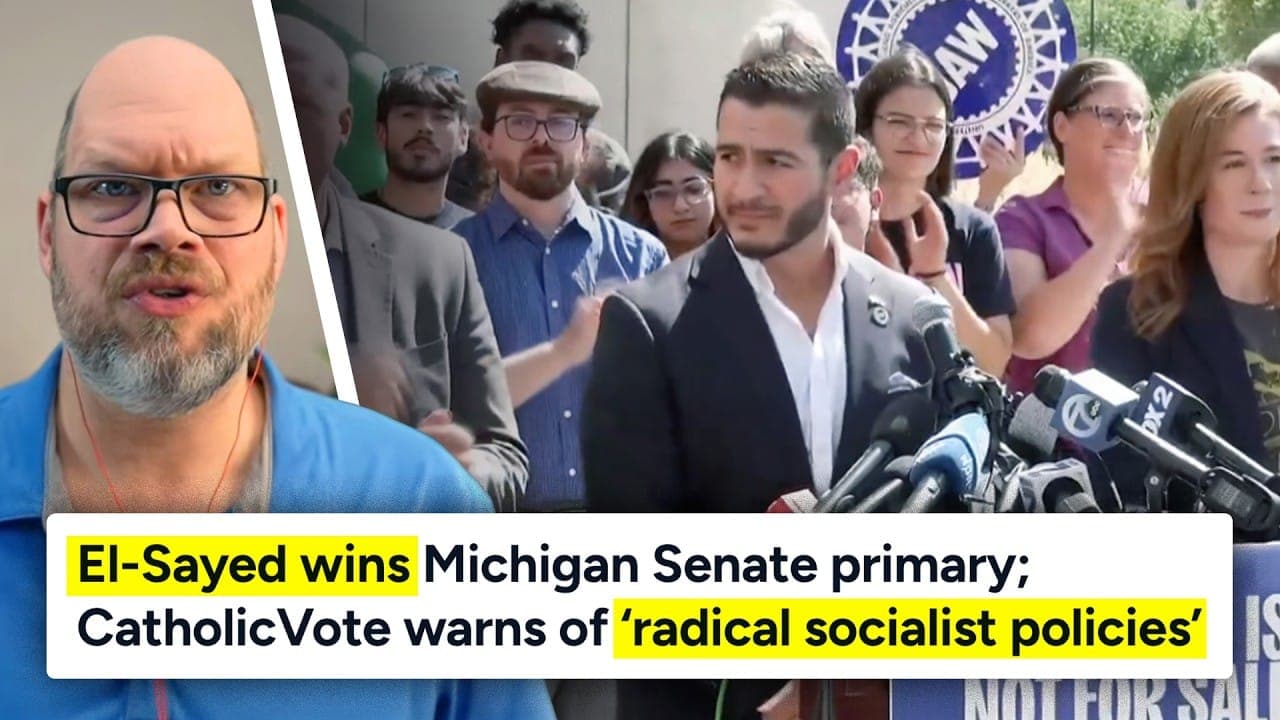
El-Sayed Stuns Dems in MI, Europe's New Migration Crisis, And The WNBA

Fauci Pleads the Fifth in Explosive Senate Hearing, Mamdani's Grocery Stores, And Gen X Bishops
Iran: Trump Vows Revenge for 4 Soldiers KIA, Tom's Backyard Data Center, And Vance x Barron