Socialism was dead. Now it's back. Why?
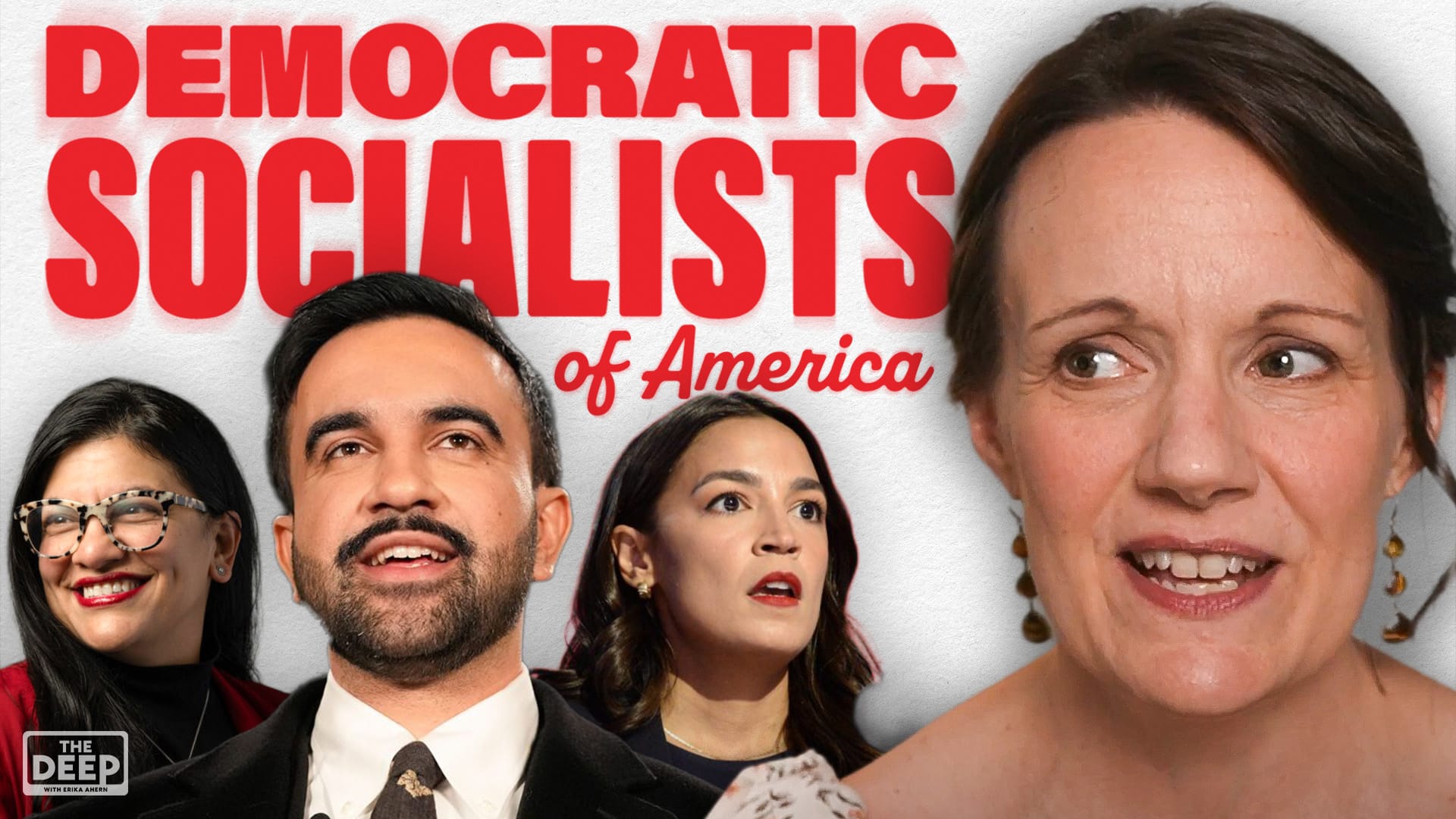
Socialism is back – and it's winning. Why are Gen Z voters embracing the DSA, Zohran Mamdani, and ideas many thought died with the Soviet Union? In this episode of The Deep, Erika breaks down how socialism made a comeback in America – and what it will take to stop it.
Transcript
Read the full transcriptAuto-generated · 3,235 words
When the Berlin Wall fell, Nobel laureate James Buchanan declared, Socialism is dead. The Committee for the Free World, the most spirited anti-communist voice in post-Vietnam America, even closed up shop. We've won. Goodbye, wrote the founder. Charles Krauthammer's Washington Post editorial claimed, The returns are in. No serious country anywhere looks to socialism as a model for development. Until now. Socialism is No serious country anywhere looks to socialism as a model for development. Welcome back. The Democratic Socialists of America, riding on the coattails of New York City Mayor Zoran Mandani, are running as proud socialists and winning elections across the country.
Suddenly, the DSA story is much bigger than Eugene Debs. It's bigger than Bernie and AOC, bigger than it has ever been in our history. The DSA is the political prong of the long march through the... Our institutions, our schools, the arts, media, and now, elected office. Over 35 DSA-backed candidates advanced in 2026 primaries, hoping to join the two current DSA members in Congress. Proudly socialist Mamdani running America's largest city, Louis George winning the D.C. mayoral primary, and DSA-backed candidates poised to add several House...
And the wins are driven by the youth. Gen Z rates socialism above capitalism, which, side note, is just barely more popular than full-on communism. Socialist policies, like Mamdani's government-owned grocery stores, still draw a lot of disdain, and rightfully so. But the fact that we're even talking about them as actual policies means that all that 1990s triumphalism looks like a joke. It's kind of ridiculous now. So, what happened? Why is support for socialism on the rise among young people? Have they forgotten if they ever knew the consequences of socialist policies in every country ever?
And what does it all mean for our country going forward? It seems crazy that the DSA is something we even have to address. If you look at their platforms, you'll see things like this. So we're gonna put up on the screen a few of the things that are part of your platform, and I wanna ask you, just give me sort of a true or false on these. Abolish the Senate. True. Abolish borders and give amnesty to anyone currently in the US illegally.
As a long term plan, yep. Defund the Pentagon. Absolutely. Abolish prisons, at least in large part. Yeah, again, as part of a long-term program, yeah. Enter the worker's paradise. From their website, no bills ever again. Quote, you have no debt, you don't need health insurance, you don't pay a mortgage, or have a landlord because comfortable housing is a human right. I wonder who gets to define comfortable. Your retirement is publicly funded. Food, education, energy, medicine, and transportation aren't for-profit businesses. They're common goods and utilities.
Sounds like the DMV running everything. But it's not quite communism. You get to keep your private property, it will just be taxed and redistributed more. And no one's calling for blood in the streets, except Hasan Piker. This is true socialism, a sort of modified, state-controlled economy with a somewhat free market. And like the transing the kids movement, the platform is so unbelievable that to most middle-class Americans, it's like, well, I don't know, I don't know, I don't know. It seems like it couldn't possibly be real, much less politically ascendant.
Back when Bernie Sanders made his presidential bid in 2015, one author in the pages of First Things speculated that America was somehow inoculated from hardcore socialism. He said, if socialism does ever come to America, it will arrive in severely diluted form, more like Jimmy Stewart than Vladimir Lenin. The sentiment seems to be that the kids, and most DSA members are downwardly mobile college graduates, will grow out of it. Right? Not, I think, without a massive effort. The DSA absolutely must be confronted, and ordinary Americans, to whom it seems totally crazy, must understand what's going on, or the kids won't grow out of it.
We will all grow into it. Some have suggested that Roosevelt's New Deal and the growth of the welfare state have safely preserved America from hardcore socialist agendas like Those of Eugene Debs and Michael Harrington. This hopeful take echoes Pius XI in Quadrigessimo Anno. If the class struggle abstains from enmities and mutual hatred, it gradually changes into an honest discussion of differences founded on a desire for justice. Moderate socialism, then, could eventually resemble the desires and demands of those who are striving to remold human society on the basis of...
Christian principles. And it seems to be true. Americans got a 9-to-5 workday, paid time off, child labor laws, and unemployment insurance, all without nationalizing the factories. We got labor protections without abolishing private property. The revolutionary promise became less appealing because reformers were offering some of the benefits socialism promised without requiring Americans to surrender the political system we already had. And for decades, the bargain basically held. But today, it's cracking. The fact is, we have been slowly building an increasingly socialist society for the better part of the last century.
The DSA's ascendance was made possible in part by the failures of the last 60 years of America's luxury socialist policies. The ones that landed us in a tax system where nearly 75% of our money was spent on the economy, and the rest of it was spent on the economy. ...goes to entitlement programs that don't work. Today's hardcore socialists are capitalizing, pun intended, on a real moment of upheaval in the American experiment.
We're at an inflection point economically, where economic mobility for the younger generations isn't pointing up anymore. Basic human goods like education, housing, and health care are no longer affordable for many millennials... And most Gen Z in the same way they were for our parents and grandparents, and for a huge portion of Americans, they are entirely out of reach. Since 2000, the cost of living has skyrocketed, and while inflation rates have decreased since the pandemic, they are still well above the 2% ideal.
In the last year, real wages have grown in only 5 of our 50 states. Americans owe almost $2 trillion in college debt. And 220 billion in medical debt, and 78% of the individuals who face medical bills they can't pay owe more than $10,000.
59% of American households don't have $1,000 in the bank for an emergency, and the age of first-time homebuyers is now over 40 years old. And this is where the generational resentment against the entire system starts to make sense. Sure, the economy is doing really well if you already had money in the market. If you bought a house before 2021, it might have almost doubled in value by now. If you invested $10,000 in the S&P 500 in 2005, it would be worth roughly $72,000 to $95,000 today.
But for the people who don't have money in the stock market or real estate, 20-somethings or the poor, that leap from the bottom half of the economy to the growing part of the economy seems increasingly impossible. If you're spending half your paycheck On rent, groceries, insurance, and student loans, the Dow hitting another record high doesn't exactly make you feel rich. Hence, massive resentment toward the existing economic, political, and social structures that many of the young conclude got them into this mess.
And that is the itch the DSA is scratching. The Democratic Socialists are very, very good at this. At pinpointing pain points and turning them into viral moments, harnessing the very real anger people are feeling at the economic and, I would add, cultural and spiritual moment that we're in, DSA candidates point to an affordability crisis, the general sense that we are worse off than our parents. It's an effective strategy because it's based on the reality people are facing on the ground. Real suffering makes socialism politically viable long before anyone picks up marks.
You're struggling because someone else has too much. Your inability to buy a house is connected to somebody else owning three. Your student debt exists because billionaires aren't paying enough taxes. Your medical bill is somebody else's profit. Once that framework is offered and accepted, the political argument becomes remarkably simple. And socialists start winning elections in America. But once you win elections, you actually have to govern and get results. And the problem for the DSA is that socialist policy, ironically, is precisely what helped create the crisis on which socialists are now capitalizing politically.
I recently watched an interview with entrepreneur David Friedberg, where he explained why the whole the economy is great messaging is Both simplistic and political poison. The policies America has been putting in place for the last 60 years, while intended to fill gaps in the economy, have actually only made things increasingly worse for the have-nots in America. Redistribution-inspired programs created mass government subsidies and bailouts in education, housing, and health care. And we'll take a look at what happened in each one. The federal student loan programs were predicated on the lie that everyone has to go to college.
So, for equity, the government has a responsibility to make sure that's in reach for any child, at any school, in any discipline. Government subsidies in the form of loans made college more accessible, but they also gave universities access to a vast new pool of Government-backed money, which is really just your taxes redistributed to the schools. As borrowing limits expanded, colleges could raise tuition without immediately pricing students out. Families simply borrowed more. Every year, federal aid increased, and tuition rose far faster than inflation.
The result was a feedback loop of higher borrowing, higher prices, and expanding university budgets. Today, the price tag for a four-year college has risen 914% since 1983, and now the generation that was told college was the indispensable ticket to the middle class is entering adulthood carrying tens of thousands of dollars in debt for that privilege. Housing followed a similar pattern. Federal housing policy was also predicated on a lie. The assumption that the American dream means owning a home. Americans were lured, often willingly, I do love my house, by government-subsidized programs to concentrate their wealth in a single asset, their house.
FHA insurance, VA loans, Fannie Mae and Freddie Mac, mortgage interest subsidies, and the 30-year fixed mortgage made homeownership cheaper and easier to finance. Millions of households today depend on owned homes and rental properties as their key asset. While a majority of Americans also tie up wealth in vehicles and financial assets, the relative value of these assets is nothing next to owning real estate. But as David Freeberg pointed out, this meant the only way to keep the middle class stable was to keep home prices going up.
So, here's the trap we created. Millions of middle-class Americans need their houses to appreciate, because the house is their retirement plan, their inheritance for their children, their emergency fund, and their primary store of wealth. But every dollar that makes the existing homeowner richer makes the house less affordable to the 28-year-old trying to buy it from him. Today, we're at the breaking point of this system. Prices are so high that the next generation can't participate in this form of wealth building until they're well into their 30s or 40s, if ever.
And then there's healthcare. Obamacare subsidies insulated poor Americans from the full price of insurance, but the heavily subsidized system incentivized the medical industry to prescribe more, charge more for prescriptions and premiums, and grow an unsupportable administrative overhead. Costs are through the roof. Between 2013 and 2019, average individual market premiums more than doubled, leaving unsubsidized middle-class consumers particularly exposed. Again, the government made something more affordable to the individual at the point of purchase, without solving the underlying problem of why the thing cost so much in the first place.
In education, in housing, in the community, in the environment, in the community, in the community, in the community, in the community. These are three basic human needs, three things the government spent decades trying to make more accessible through redistribution policies, and three things that today, younger Americans increasingly cannot afford. And the Democratic Socialists of America see this mess, and they say, the problem wasn't the welfare state or the redistribution of wealth or inefficient government. The problem was... We didn't do socialism hard enough, so we have a solution.
Let's do more things like Obamacare. The thing is, we know. We know if we keep doing the whole government subsidizes everything with the wealth taken from the billionaires thing more, we will never crawl out of our hole, because more socialism will mean more of a K-shaped economy, less creativity and enterprise, less opportunity, and a world where Everyone is an atomized worker, contributing no more than they want and taking no more than they need. So, we as conservatives and Christians have to get ahead of the DSA, but not by minimizing the issues that attract people to socialism in the first place.
Socialism is the alternative if we don't have a pathway to give people a sense that the system is not rigged and that the American dream is. attainable. That's like our job. That's what we have to do. I'm not saying Rome was built in a day. It's not going to be easy to undo some of these economic trends. But man, we ran the experiment. We ran the experiment of offshoring all of our industrial jobs, of becoming a services and finance economy, and allowing Wall Street to come in and buy every asset of modern life.
We should be the ones asking why college costs so much and why health care costs so much. And why a starter home requires a middle-aged income? And then we have to offer something better than another federal program, because socialism thrives when society is weak. Yes, we need to build back an economic system based on equality of opportunity, promoting ownership and technological innovation, while building an industrial base. But that still won't be enough, because the economic argument is only part. Why socialism is suddenly attractive.
David Friedberg is missing something even more fundamental and more crucial. We have utterly hollowed out the social structures and third spaces that made even tough economic times possible to endure. Our churches have emptied out. Local societies like the Elks and service clubs like Kiwanis have declined. Women's clubs and ethnic associations that used to provide a social safety net outside of government oversight, have shriveled up, leaving a gaping hole in people's lives. And these institutions did something that is difficult to quantify economically, but without which the economy tanks.
They provided child care and meals when someone was sick. They found jobs for unemployed cousins. They checked in on widows. They organized dances and softball leagues and parish picnics. And they imposed social obligations, too. You had to show up. Somebody noticed if you didn't, and in many cases, you were expected to participate and give back as much as you could. That thick social network has almost disappeared over the decades, and COVID czars like Dr. Fauci put the final nail in the coffin.
Something will fill the social void of our increasingly atomized society, and the DSA is happy to help with that, too. That's why you hear Zoran Mamdani floating a government-sponsored Parents' Night out. With free babysitting. In the past, the state didn't do that. Grandma did. For most of human history, those needs were met through a thick network of family, church, neighborhood, voluntary associations, clubs, unions, and civic institutions. But when those things disappear, the need doesn't disappear with them, and something fills the vacuum.
The DSA is promising to fix... Everything. The government will take care of your food. It will take care of your child care. This is where the argument against socialism has to get deeper than charts showing GDP growth. We know what happens when a nation goes socialist. Productivity falls. Economic mobility is frozen. Slavery happens because the workers are locked into the labor force forever, except for a few lucky guys at the top. Cuba, Venezuela, Nicaragua, these are all names that pop up when people are reacting against the DSA.
But we don't even have to go abroad. It's not like we don't have the receipts for state-owned, privately-run grocery stores in places like Kansas and Florida. They don't work. But if we make the entire case against socialism about empty shelves and BAs in lesbian dance studies and lousy government grocery stores, we are still only fighting a small part of the enemy. The DSA is offering younger Americans something larger than an economic program. It's explaining to them why they are miserable. It's offering villains and scapegoats.
It's offering a community built not on forgiveness, but on resentment. And it's offering redemption by promising to tear down the enemy class. That is a much more powerful promise than free groceries. Socialism preys on the goodwill of Christians and Americans who see suffering and want to do something. But unlike Christianity, socialism, as all leftism, preaches that the end, their utopia, justifies the means. As Roger Scruton once put it, everything done in the name of equity is well done. They promise things that sound Christian and appeal to the human heart, social justice, liberation.
But what they mean is something utterly opposed to the gospel and to the American founding. Socialism means emancipation from the structures of civic and human order, from the family, customs, the rule of law, social norms, negotiation, from the church and the constitution. It means the total rearrangement of society, which is precisely what the DSA platform promises. But we must not misidentify its center of gravity.
Pope Benedict XVI wrote 16 years after the fall of the Berlin Wall, the communist systems collapsed under the weight of their own fallacious economic dogmatism. But the greatest catastrophe encountered by such systems was not economic. It was the starvation of souls and the destruction of the moral conscience. So, until we recognize that socialism is also a prescription for the abolition of man, to borrow a phrase, we might win an economic battle, but utterly miss the war. So, how do we reorder our house so that the classes can cooperate in building the common good?
We all have obligations that rise from our human dignity. To be good citizens, to engage in the project of self-government, to raise our children to know history and how to live nobly. These obligations belong to men of all social classes, which at their best cooperate in building up the common good. And there is hope today. People are rebuilding third spaces. Gen Z is seeking a deeper faith. On the political front, leaders and advisors are reimagining what a family-friendly, free market Socially conscious civic order could look like.
The DSA offers to tear everything down. But I believe that the better angels of our nature must and can prevail. The God-given human dignity that heals, builds, and preserves. If you liked this episode, be sure to subscribe to The LOOPcast. We bring you a new episode of The Deep every Thursday at 4 p.m. Eastern.
.jpg&w=3840&q=75)