How the War on Toxic Masculinity Backfired
We told boys their masculinity was toxic. Now we’re wondering why so many are checking out. In this episode of The Deep, Erika digs into the trouble with men to ask: what does it actually take to become a man? The answer goes far beyond macho posturing, and women have more at stake than we think.
Transcript
Read the full transcriptAuto-generated · 3,045 words
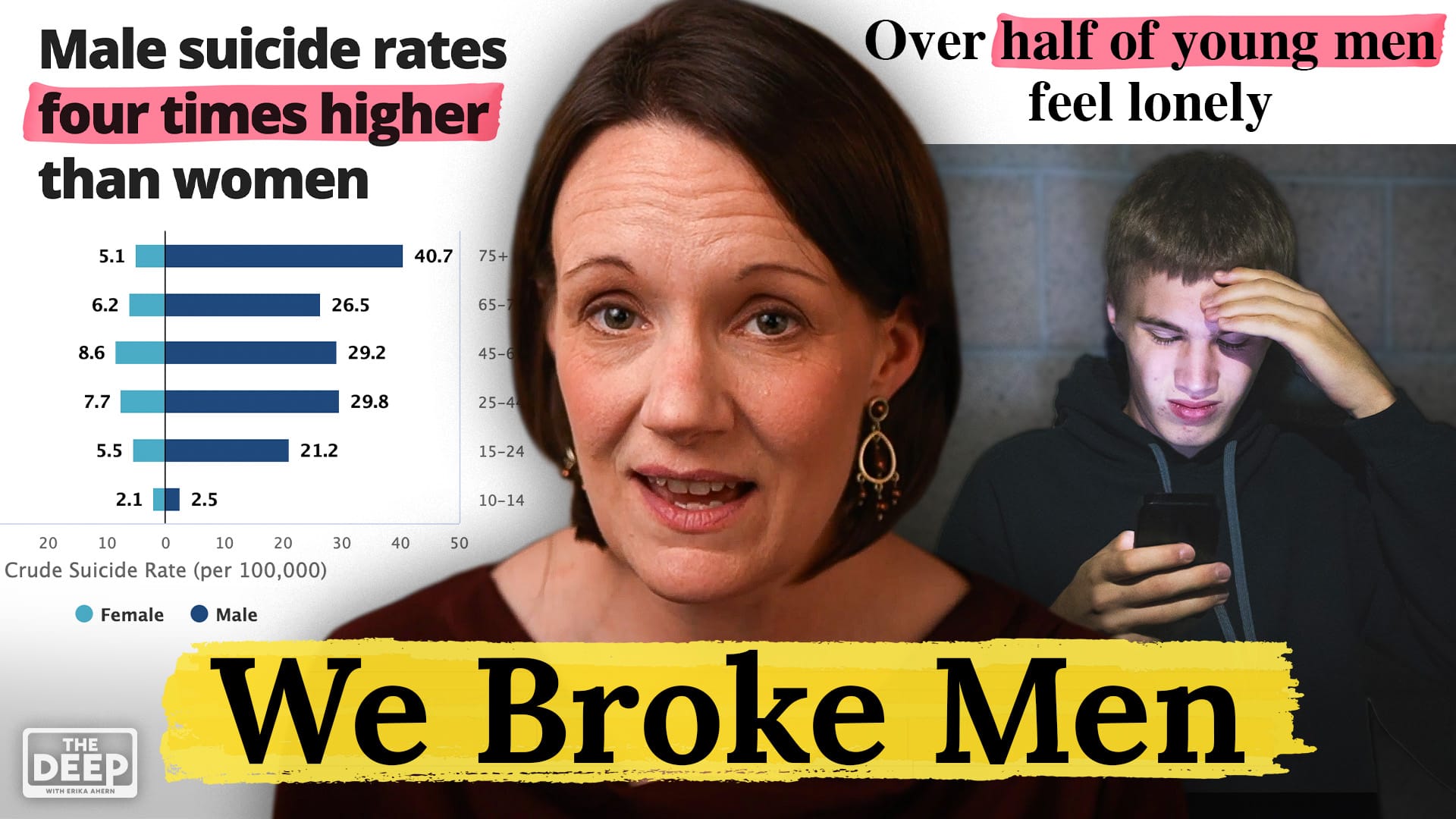
If you hadn't noticed, men and women are in a zero-sum battle of the sexes, and men are losing. Millennial and Gen Z men are checking out of social life. Symptoms include poor mental health, addiction to pot, porn, gambling, and gaming. Today, the male suicide rate is 22.3 per 100,000 men. For women, it's just 5.6. 17% of young men say they have no close friends at all, and only about a third are in a committed relationship. Half of them agree that no matter how hard I work, people like me will never achieve the American dream.
With stats like that, it's probably no surprise that one in seven young men are NEETs, not in education, employment, or training. Now, I've covered the feminization of society and the... crisis of women many times on this show. But something Dr. Cuddeback told me during his interview this year stuck with me. The failure of men to be men leads to dramatic pain, suffering, and alienation in women. If that's true, then maybe our first question should be, why are men failing to be men?
And what does that even mean? Matt Walsh asks, what is a woman? Maybe we can't answer that without also asking, what? What is a man? Whatever men are, they're behind on every single metric in the first world west. Is this just toxic masculinity eating itself alive? Or are there structural forces at work tearing them down? And what would a real manliness look like that could take those forces head on?
The 1960s feminists were too busy attacking women to hate manliness. In fact, you could even say they were dedicated to making women into manly women. Traditionally, masculine characteristics were great. Action, power, strength, aggressiveness, assertiveness, bossing, not to mention sex drives. Manliness was what women wanted, and they wanted to take it away from the men. Radical feminists like Kate Millett in the 70s officially introduced patriarchy into mainstream feminist theory to attack male supremacy.
Slogans at rallies began targeting the patriarchal systems, and by the riot girls of the 90s, everything was smash the patriarchy. Feminist bell hooks claimed that, quote, Patriarchy is the single most life-threatening social disease assaulting the male body and spirit in our nation. She described it as the political social system characterized by male dominance. She said it is found in the Bible, the Christian church, her school, her family, and especially in her own physically abusive father. America, she said, is an imperialist, white supremacist, capitalist patriarchy.
And if you laughed when I said that, you are a weapon of patriarchal terrorism. In a sense, bell hooks was onto something. Masculinity, when understood as machismo-type domination, can disfigure individual men into repulsive, dangerous gargoyles of themselves. But her prescription was tear down all gender stereotypes, rejecting physical differences, psychological differences, social differences between boys and girls. As Bell Hooks was providing the anti-patriarchy remedy in The Ivory Tower, Popular books like Raising Cain and Lost Boys showed parents how to grow their sons away from the toxic patriarchy.
Little boys, we were told, had to be conditioned away from their physicality towards sensitivity. What boys need first and foremost, authors Kindlin and Thompson said, is to be seen through a different lens than tradition prescribes. Parents forbade toy guns. Violent video games and the Three Stooges. Gentle parenting would, the thinking went, divert male energy away from violence, which is an honorable goal. But in trying to avoid harmful expressions of machismo, young boys were left without a positive vision of becoming men, as distinct from women.
They were left adrift in education systems geared toward the therapeutic and passive learning designed for little humans who enjoy sitting still, coloring, and group projects. In other words, designed for girls. The millennial and Gen Z boys who succeeded in this world were able to play the feminine game. Meanwhile, the message had been sent to entire generations of boys, masculinity is not something to be entertained, explored, or honored.
It is something to be conditioned away from. Why? Because it's toxic. The term toxic masculinity was coined in the 1990s, but for decades, the idea that masculine qualities like strength or action could be harmful was mostly limited to parenting books for boy dads or arguments about social policy. Ideas, however, inevitably jump their sandboxes, and when they do, the bad ideas usually show up on TV. 1990s pop culture gave us two models for men, the sensitive guy and the dumb dad. On the one hand, a man should be more perceptive of feelings, non-assertive and sheepish.
He should be suspicious of other men who hold doors or give up their seats for women. He should cry in public. Insofar as men fail to progress in their sensitivity training, they fall into the second model, Homer Simpson, Peter Griffin, and Ray Romano. The oafish man. Both archetypes are feminist-approved, making it safe for the girl bosses to do their thang without some legit bro stepping on their toes and stealing all the glory. Just like a man. In the mid-2010s, feminism saw a resurgence of popularity.
Think Beyoncé, MTV, VMA set with the giant glowing word feminist. Think Hunger Games, Hillary Clinton, and Believe All Women. At this point, we were beyond Betty Friedan's wildest dreams. Gender parity was coming for medicine, law, and the entertainment industries. The women were strong, and the men were good-looking. So, feminism entered its post-feminist, popular era. Just in time to link arms with trans poster child Bruce Jenner in 2015. But something was very, very wrong. As the hashtag MeToo movement of the mid-2010s proved, giving women sexual license to act just like men in every aspect of their lives had not diminished male sexual prerogatives.
In fact, if anything, it had deprived boys of the formation as gentlemen. That kept them from devolving into what Erika Bakayaki so eloquently calls coital animals. Feminism had told boys that girls were just as good and just the same as them, that sexual liberation was good, and that all you needed to do to be a good guy and legal was to make sure the girl you slept with consented enthusiastically.
At the same time, though, boys were being hit by unprecedented exposure To the most bestial, dehumanizing male behaviors in history, internet pornography. Between 2008 and 2011, exposure to porn among boys under the age of 13 jumped from 14% to 49%.
Today, 80% of males ages 13 to 18 report viewing pornography once a month or more, and one in four teenage boys report that they view it every day, a rate of habitual use that is more than twice as high as 10 years earlier. Over a third of the most popular porn videos for teens depict some sort of violence against women. Over 6% of all videos depict sexual harassment against women. Over a third of all videos depict sexual harassment against men. Clear, non-consensual acts of sexual violence.
Boys are consuming toxic masculinity in buckets on their phones. Is it any wonder that they're failing to flourish as men? As story after story of sexual abuse and assault came forward, the fanatical slogan Believe All Women became, for many Americans, a fundamental civic principle, and toxic masculinity became a kitchen table term. Men and some women who raised concerns about a rise in self-loathing, antisocial behavior, and failure to mature among boys were met with feminist derision. Quote, all that time they spend sniveling about how hard it is to be a poor persecuted man nowadays is just a way of adroitly shirking their responsibility to make themselves a little less the pure products of patriarchy.
Pauline Harmange wrote in her 2020 screed, Appropriately titled, I Hate Men. She was representative, and she continued, quote, all models of masculinity since antiquity have been mechanisms for asserting and imposing patriarchal power. The extroversion and swagger of the toreador look very different from the gallantry of the Victorian gentleman, which is in turn quite distinct from the laconic glamour of the cowboy, but they are all equally culpable. of the masculine superiority complex. Sadly, an entire generation of boys seems to have taken the feminist critique to heart.
Pauline and Bell Hooks both took their fellow women to task for ignoring what was wrong with men and focusing too much on women. The idea was that men themselves never had to think critically about being good men, because they had historically held all the power.
So now it's up to us, the macho women, to tell men how to behave again. The problem is, none of this is true. It is not the case that men can't critique machismo. In fact, I would say that the evidence suggests men are better positioned by nature, and thus have a responsibility to make the first move in undoing the harms of the sexual revolution. The first step is to ban all porn. But at the same time, men have to reclaim something that can take the place of the flaccid, passive, you-got-this-girl simpiness that we've consigned them to.
Let's call it manliness. Men have been very interested in what it means to be a man, and highly critical of unmanly men throughout history. The conversation has been passionate, and today's young men desperately need to reopen that conversation. Human beings, especially post-Enlightenment males, struggle to bear in mind the limits placed on us by nature and nature's God.
So, naturally, in fallen nature, individuals and societies assumed male superiority based on rather superficial assessments of what is better and best. But it's equally true that men have been highly critical of other men in poetry, literature, mythology, religion, philosophy, politics, and, of course, in war. Men are deeply concerned, at least as concerned as women, about what manliness is. Harvey Mansfield's book, Manliness, demonstrates this point with many examples, but my two favorites are Mark Twain and William Shakespeare.
Tom Sawyer is Twain's lovable hero because of his very male propensity for foolish daring that makes for great adventures, a joy in life, and heroic deeds. Twain also uses a childish dispute between Tom and the new boy in town. To gently critique the ridiculousness of some foolish daring, the boys end up in a fistfight over a literal line in the sand. Mansfield writes, manliness is childish, only perhaps not so funny and its irrationality not so obvious or so innocent when assumed by adult males.
In the adult version, the scuffle is a war. Twain's point is that manliness must be formed. So that foolish daring is channeled by honor and care for the innocent, as Tom shows when he saves poor Muff Potter. Shakespeare also honors masculine action while pointing out that it requires guardrails. At the end of Julius Caesar, Mark Antony pays homage to his fallen enemy, Brutus, saying, quote, His life was gentle, and the elements so mixed in him that nature might stand up and say to all the world, This was a man.
Although Brutus lost his war and died by his own hand, his cause, defending Rome from tyranny, whether real or imagined, was just. For Shakespeare, manliness was biased toward action, overthinking, or listening, if only Caesar had listened to his wife. It's often to the detriment of men, but also to the benefit of Rome. So, contra the post-feminist narrative, Western culture has been very demanding on men. And willing to constantly rethink what a good man looks like. And what is that? Well, let's call what the feminists hated about men machismo, as we've been doing.
The mark of machismo is the braggadocio of the male poser. It's pride. It's the rant of someone demanding his rights because he does not have the courage to face his responsibilities. It's the supposed manliness of someone who's not yet a man, like Tom Sawyer when he beats up the new kid. Machismo is a disfigured manliness. It's about as manly as Elliot Page. It's obvious that masculine traits can be particularly destructive if left unchecked, but they can also be uniquely salvific when formed properly.
Human males can also transform animal action, like fighting or guarding or sex. With reason. Reason sets the moral guardrails that humanize manliness. A man can take his more animal strengths and, like a sacramental, raise them to the dignity of the sons of God. For most men, this happens when an outside force calls him to something higher, be it a drill sergeant, or a mentor, or a coach, or the ultimate male initiation ritual, marriage and children. Now, when I asked my male colleagues for their thoughts on this script and why we have a crisis of boys and men, Their unanimous response was fatherlessness.
Estrangement, abandonment, or even simply emotional distance from the primary man in a boy's life inflicts a terrible wound that no mother or male figure can heal. A boy without a father is vulnerable to the ravages of addiction, self-hatred, and the inability to make himself a man. But there is healing. A boy whose father failed in manliness can himself grow into a hero. I know some of these men, personally. First and foremost, men need mentors and heroes. Books and films are important, but they can only get us so far, which is really hard for me to say as an academic.
Boys need lived experience and live-action men who get them off their duff, off the phones, and make them go for a run or build something together. Proverbs, which is a super-manly book, I am told, says, A wise man will hear, and will increase learning, and a man of understanding shall attain unto wise counsels. Before he can provide or protect, a boy needs to learn to submit to just authority. A father...
A mentor who ultimately represent God. Assertion must submit to correction, and action to discipline. Everyone can see that boys are, in general, far more physical than girls. Suppressing physicality damages boys, but training that physicality, as in sports, for example, strengthens it and targets it toward a common good, toward the team, the win, the glory.
That's how a two-year-old boy's monster truck mentality gradually becomes a 32-year-old's capacity for life-giving love. A man formed this way will be gallant, and that's an old-fashioned word for being considerate of others in action. Manly men aren't just empathizing with feelings. They're putting themselves on the line to do something about it. Feminism has trained us to be suspicious of gallantry. If a man is holding the door, he's just showing off his physical superiority.
And sure, ladies, some men have a superiority complex. But manliness would remind him that he holds the door for her, because she is first in God's eyes. The men on the Titanic gave up their lives so that children not their own, and wives not their own, could get seats on the lifeboats. And sure, we can imagine that they had chauvinistic reasons, and as they sank in the icy water thought, I'm so superior, long live the patriarchy. But it's more likely that they acted with honor.
Rather than machismo. Their act was noble, and 80% of the victims that night were men. If enough young men were raised to give up their lives for women, the Cornell 7 would never have happened. Part of becoming a manly man is having dependence, which our culture tells us is a very bad thing for everyone. Modern women are conditioned to avoid dependence, in part from the very real betrayals that many very real women experienced in the past. But when a woman allows herself to depend on a man who is worthy of her trust, she gives him the most profound opportunity he will ever have in his life to be a man.
And part of this for the woman is accepting one of the defining tasks of masculinity, physical protection. For feminists, this kind of a role is just a power play. Again, all we've been taught to see is the dark side of male physical power, violence, and often sexual violence. Perhaps like poor bell hooks, their first experience of fatherhood was an evil gargoyle whose protection meant domination. Or even just a self-satisfied jerk who saw himself as the benevolent caretaker of some dumb kids and his airheaded wife.
That is not manliness. In his letter to Charles Dickens, G.K. Chesterton quipped, There is a great man who makes every man feel small, but the real great man is the man who makes every man feel great. The real great man realizes that he is in turn dependent on those in his care for the opportunity to be manly. We aren't in a world where men need to flex their autonomy and independence, while women have to embrace their weakness and dependence.
Rather, manly men and feminine women recognize their mutual dependence. It is not good that the man should be alone, and they honor each other as friends, and sometimes lovers. There's an inherent reciprocity between male and female. The man, according to Pope John Paul II, however, is the guardian of this reciprocity. He wrote that the man has a special responsibility to, quote, maintain the balance of the man and woman's mutual dependence, and to re-establish it if it becomes violated. In other words, women need men like fish need water.
Men can learn to grow up to be less like beasts and more like the god-men. Men are called in a unique way toward responsibility, self-gift, and they are called in a unique way toward self-gift, self-gift. and sacrificial love. This has always been difficult, but boys today face a particularly challenging battle and need a particular virtue in spades. In Greek, that virtue is andrea, which is the word for both manliness and courage. With this courage, today's boys will be better men than their fathers, and they might just save many women.
If you liked this episode, be sure to subscribe to the LOOPcast. We bring you a new episode of The Deep every Thursday at 4 p.m. Eastern.