How Feminists and Tradwives Are Both Wrong About Womanhood
Hollywood gave us the unbeatable girlboss. TikTok answered with the Pinterest perfect tradwife. In this episode of The Deep, Erika digs into Disney princesses, forgotten women who formed families and grew civilizations, and two modern saints who offer a richer vision of feminine strength.
Transcript
Read the full transcriptAuto-generated · 2,579 words
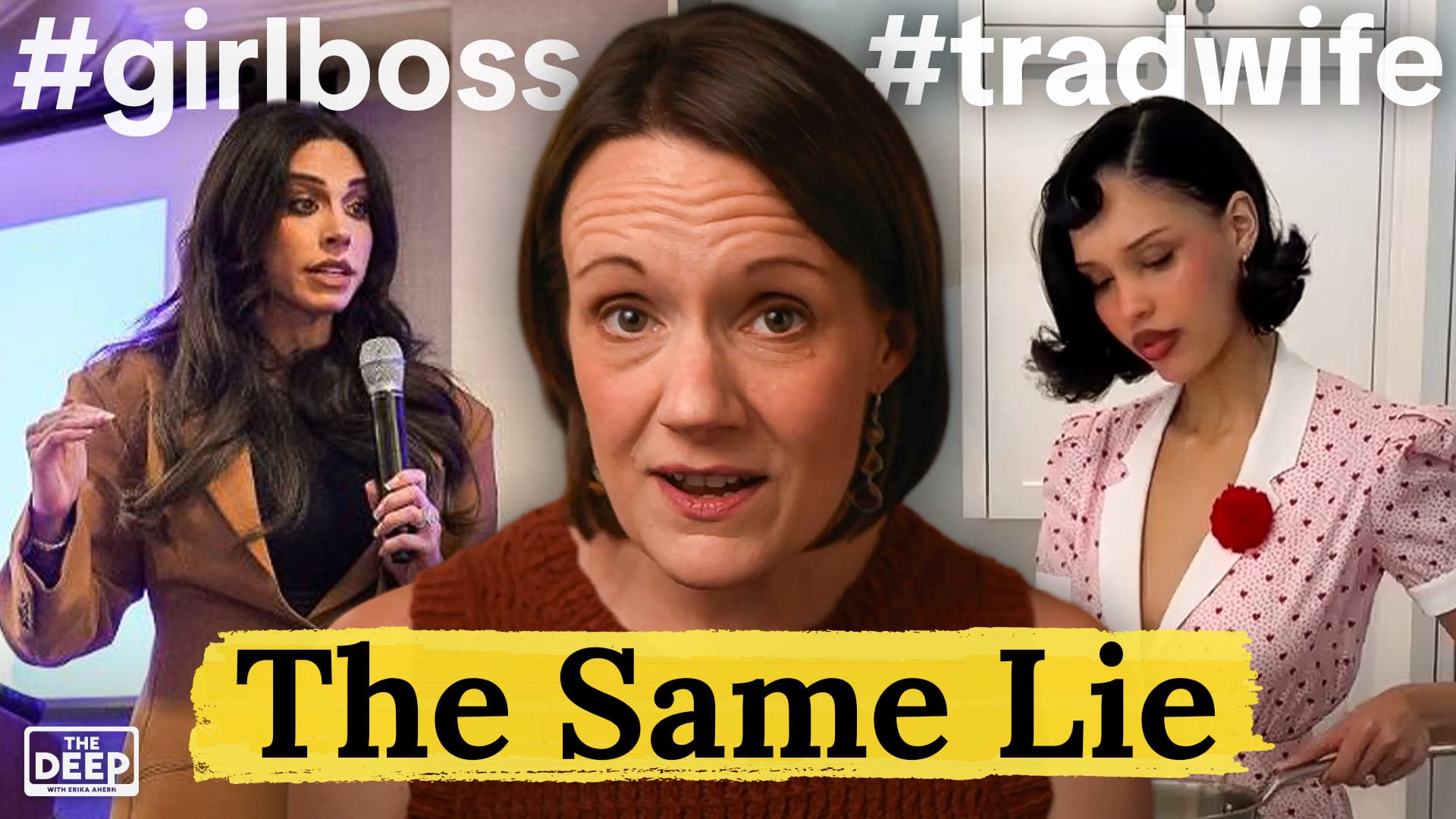
Today, as we stand at the far extremity of feminism's long and twisted path, we have lost what it is to be a woman, and in the post-revolutionary wasteland, we're left with two polarized caricatures, the box office-busting masculine girlboss and the vacant feminine tradwives of social media. As a millennial, I grew up in a world where female heroes sported ever more Herculean physiques. Professional domination, emotional stoicism, and a sex drive that would make Zeus blush. By the close of the 2010s, though, the girl boss was becoming a cringe parody of herself.
Suddenly, being just as good as a man wasn't enough. Now, we need layers of intersectionality, alien crossovers, and completely unbelievable Jedi warriors, all in the name of the Jedi. of strong female characters. We got so sick of it that the temptation to hit the rewind button and go back to the imagined 1950s became too great to resist. But what we seem to have come up with as an alternative is a shallow, entirely soft, consumerist cosplay of Harriet Nelson. The resistance gave us Sourdough, Marilyn Bobs, and traditional gender roles.
Where traditional meant the stay-at-home 1950s housewife of Betty Friedan's worst nightmare. A very loud minority of the far-right is even pushing to repeal the 19th Amendment. There seems to be a particularly contagious historical amnesia when it comes to female archetypes. Our foremothers labored and sacrificed and bled, often unseen. Every man you read about only has a page in the history books because of a woman, and they weren't Amazons. They weren't Stepford wives. So, is there somewhere out there we could find women who lived serious, feminine lives without turning into men with boobs?
And what would it take for us as a culture to regain a true idea of what it means to be a woman? Millennial girls grew up inundated with the girl boss aesthetic. Our American history curricula gave us role models like the first wave feminists, Amelia Earhart, Margaret Sanger, a hero, and Eleanor Roosevelt. Hillary Clinton was our first lady, and Madonna, Gwen Stefani, and TLC were our pop stars. We weren't just equal to men, we were better. Even the men said so.
If you put women in charge of every government, I have a strong belief that things would, they wouldn't be perfect. But they'd be better. But they'd be better. Even if we didn't remember who said it, the phrase, a woman needs a man like a fish needs a bicycle, sounded to us like words a girl could really live by. Instead of finding the prince, princesses find themselves.
Stupid guy saved by strong woman. Every time. Almost everyone in entertainment, politics, and the school systems told us to plan our lives as if there were no meaningful difference between men and women, psychologically, emotionally, and even physically. The women became more like the men, and the men started to look more like the women. In 2018, five sociologists came together from around the world to quantify. Just how androgynous Disney characters had become over the years, because we need science to tell us whether or not we can believe our own lying eyes.
According to their results, in the era between 1930 and 1950, the Snow White, Cinderella, Sleeping Beauty era, princes exhibited six times more masculine characteristics than the princesses. But, in the 2000s to 2010s era, The princesses exhibited 40-50% more masculine characteristics than the guys. That is quite the shift, but I was more shocked by the way the researchers were measuring this rather obvious phenomenon. Here's how the researchers put it, quote, princess characters in movies released in this period may have more positive gender role portrayals.
The world-class scientists designing the study started with the assumption that masculine traits are more positive than feminine traits. The particular feminine traits they marked characters for were fearful, victim behavior, and defined by romantic relationship. On the other hand, the masculine traits used for the study were strong, assertive, and brave. There is something seriously wrong with this measuring kit. If we start with the assumption that feminine is negative and the masculine is positive, we are going to end up with Aristotle. The entire strong woman narrative that women must adopt the traditional masculine as in 1950s coded roles is a caricature of the much maligned philosophy of Aristotle.
To him, a woman's physical weakness is just a symptom of her failure to be male. Feminists love to quote Aquinas, too, who wrote that women are simply men gone awry. White male patriarchy, they cry. The irony is that second wave feminism actually embraced the idea that women are defective men, which is exactly what showed up in that Disney study. The only way a woman could be valorized was if she shed the feminine and embraced the masculine stereotypes. Our heroines, excuse me, our female heroes, smashed every glass ceiling as they climbed career ladders built by and for men.
We have crushed men in academics, from kindergarten to doctorate, and we have closed in on gender parity in white-collar careers. See my video on the great feminization. But we did it all on the wrong metric scale, because it seems to me that great men and women, whether fictional or historical, all exhibit at various times fear, vulnerability, emotion, strength, and courage. So, the question isn't, is this set of admirable attributes masculine or feminine? The question is, what is a believable female way of reacting to fear?
What is a believable female way of reacting to fear? Acting with strength and showing that courage. But instead of calmly packing up the girl boss babes and trying to build back better, the cultural whiplash has sent us from extreme power woman to extreme trad wife. The trad wives took to social media to promote their well-manicured homes and traditional gender roles. Now, I have some sympathy with them. They are protesting a deeply anti-woman feminism. I have some sympathy with them. Specifically, the sentiments perfectly captured by Simone de Beauvoir's infamous line to Betty Friedan, no woman should be authorized to stay at home and raise her children.
Tradwifery is not trying to become something we're not, men, and certainly it's a rejection of the you-can-have-it-all myth. Tradwifery tries to return to a simpler time when we imagine women packed shiny children off to school. Cleaned their house, cooked dinner for dad, and rubbed his feet when he got home. The problem is, it is just as shallow and fake as girlbossing.
TikTok tradwifery was just the flip side of the girlboss coin. They are both performative tropes that are trying too hard. Both identities based on conforming to trends instead of doing the hard work of thinking about a woman's actual, real life. And relationships. And they're both just really weird historical anomalies. For most of human history, women didn't have the luxury of debating whether we were sufficiently represented or empowered. Now, I am grateful for the post-industrial world. I like my epidurals and my penicillin.
I like the possibility of keeping my own teeth well into old age. But I also think remembering more challenging times Could give us some perspective, and a way out of our feminist and post-feminist follies. In medieval Europe, the vast majority of men and women had to work the land. Partnership between the sexes was the only way to keep civilization going. Women raised livestock, we tended gardens, brewed the ale, and spun wool. Danger be damned, in 1270, 5% of coroners' reports on women's corpses Indicated death by brewing accident.
Women worked the family trade. They raised, and more often buried, the children, and they ran the households when the men were off fighting wars. In fact, the only activity strictly limited to women at the time was childbirth, which was more dangerous than it is today. Their role models were probably limited to the older women of their towns and villages, and to the Blessed Virgin Mary and the saints. But they had their more colorful heroines as well. One Italian work from 1360 gave literate women a sort of female Plutarch's lives, De Mulieribus Claris, on famous women.
It profiled 106 women from Greek and Roman history and mythology, the Bible, and contemporary politics. We don't have many written records of ordinary mothers and their home lives left. But we have plenty of heroine material from the upper and royal classes. In 1420, a courtier wrote a poem praising Margaret of Burgundy. After her husband's death in 1417, she fought battles and suffered intrigue, defending her only child's claim to his lands. The poet compared Margaret to famous women from ancient mythology and history, Penthesilea, Dido, and Medea, as well as Sarah, Rebecca, and Esther from the Bible.
Any number of stories of women enduring plague, famine, and war would make a better action movie than Supergirl. Even right here in America, we have an endless treasure trove of women who fell into neither girl boss you can have it all, nor tradwife dumb blonde archetypes. Martha Ballard delivered hundreds of babies in 1700s Maine. She treated the sick, prepared the dead for burial, and still found time to plant her garden, weave cloth, brew beer, and keep a daily diary for 27 years.
You've heard of Ma Ingalls, but she wasn't a one-off. In 1836, Narcissa Whitman crossed the Rocky Mountains with her husband and helped establish a mission which is now Washington State. Why haven't we heard of her? Catholic women, sisters, nuns, mothers, and wives were and are forces of nature in ways both uniquely feminine and breathtakingly heroic. I can think of founders like Saints Francis Xavier Cabrini and Elizabeth Ann Seton. But we also have women who kept their families together and homes alive in dire circumstances.
Mae Braddock, the wife of Cinderella man Jimmy Braddock, and Mary McGivney, the mother of Blessed Father McGivney. Then there are women whose maternal life expanded beyond their own homes. For example, Margaret Howery, the mother of New Orleans orphans. If we're looking for real female role models, maybe we should start by rediscovering women we've forgotten, and then we should start by rediscovering women we've forgotten. They exercised extraordinary strength, judgment, ingenuity, endurance, and tenderness because their families and communities depended on them. It was entirely indispensable.
As we have moved progressively more away from nature, living close to the land, and spending most of our time in survival mode, we've lost touch with what it means to be male and female and the trusting partnership necessary. For human survival, reproduction, and building a life worth living together. Our technology gives us the illusion that a woman needs a man like a fish needs a bicycle.
We have lost touch with our very real interdependence. And all we have left is a false choice. The total autonomy of the girl boss, or the utterly one-sided dependence of the wilting violet. St. Bonaventure observed how men and women possess different strengths, and he chided his fellow academics, like Aquinas, for mistaking difference for defect, or for seeing women as undeveloped males. Woman, he said, isn't a mistake of nature. In fact— Nature cannot accomplish its purposes without her, precisely because she is different from man.
On the obvious level, you can't make babies without a woman, although we are trying our best to get there. A strong, interesting woman is not a strong man wearing a woman's face. She's not a woman who's overcome her feminine defects to become as masculine as possible. She is a female who has discovered the unique complexities of her soul, how she has been formed by her own biology, and how she has been formed by her own biology. But also by her family, education, her relationships, and emotions.
And she's striving to overcome her defects, some of which females are, yes, more susceptible to, by becoming more deeply who she was made to be, not what society tells her she has to be. Now, Blessed Fulton Sheen saw the changing role of women as an opportunity for the world to rediscover this complexity. In The World's First Love, he wrote, the very emergence of woman into the political, economic, and social life of the world suggests that the world needs a continuity that she alone can supply, for while man is more closely related to things, she is the protector and defender of life.
St. Edith Stein explained that the frustrations and distress of so many modern women in the world are the same as the frustrations and distress of so many modern women in the world. stem from a deep confusion about why the world needs her so much. Quote, we will always find fundamentally the compulsion to become what the soul should be. At the core of feminine nature, she wrote, is a longing for authentic relationships, so many of which were disrupted by the industrial revolution and eviscerated by modern ideologies.
Women also possess an intense desire. To help others become who they were meant to be. Most importantly, saints. We also, being more physically vulnerable ourselves, have a particular sensitivity to the relationship between our physical and spiritual lives. Our soul, a well-formed will and reason, must lead our body, the seat of our beauty and our emotions.
Edith was well aware of women's vulnerability to emotionalizing and pathologizing everything. She was adamant that female education must strengthen the intellect, not to be more masculine, but so that the truth can inform and channel a woman's powerful emotions.
The real drama of the female character isn't in suppressing her feminine, or as the Disney researchers would say, weak characteristics. Both Fulton Sheen and Edith Stein tell us to discipline those qualities according to the truth, so that the woman can fulfill her mission of life-giving love. And this is going to sound flippant, but that's why female characters like Katie Herron or Dr. Ellie Sattler, and yes, Elizabeth Bennett or any Jane Austen female lead, keep us coming back. I mean, how many adaptations of Pride and Prejudice are there now?
They're tapping into a deeper female archetype that feels real, because it is real. Only women can be formed into mothers, whether physical, spiritual, or metaphorical. The best female characters and the most admirable real women face whatever challenges their unique situations and souls offer to become fully themselves, fully women. That formation demands much from us and from the men in our lives, but often without a dramatic payoff. Its heroism is meted out over years, in thousands of small sacrifices that nobody sees.
But if we want to understand the female archetype, Sheen reminds us, we need only look to the passion. The road to Calvary was littered with men betraying, denying, and abandoning Christ. The only man who helps him, Simon of Cyrene, is compelled by force. The women stand at the cross. And the name of each one is Mary. The three types of female souls are forever found beneath the cross of Christ, the penitent, the mother, and the virgin. We can rediscover on Calvary the model for all female characters, literary, cinematic, and real.
If you liked this episode, be sure to subscribe to the LOOPcast. We bring you a new episode of The Deep every Thursday at 4 p.m. Eastern.

.jpg&w=3840&q=75)