The Real Reason Muslims and The Left Are Joining Forces
Pride flags and hijabs: America’s most bizarre political alliance? Erika unpacks the “red-green” marriage joining progressives and Islamist leaders, the history behind Islam’s expansion, and what’s really happening here. Is this coalition a temporary grab for votes, or something bigger?
Transcript
Read the full transcriptAuto-generated · 2,617 words
According to Pew Research, in 2025, 20% of American Muslims were not raised in Islam. They're converts. 77% of adults raised Muslim in the United States are still Muslim today, compared with just 57% of Catholics. If current trends hold, in 2040, Muslims will surpass Jews as America's second largest. At the same time, Muslims still make up just 1.2% of American adults, although that number has tripled since I was a kid. At face value, those numbers don't seem too significant. I mean, what kind of influence can 1% of the population really have?
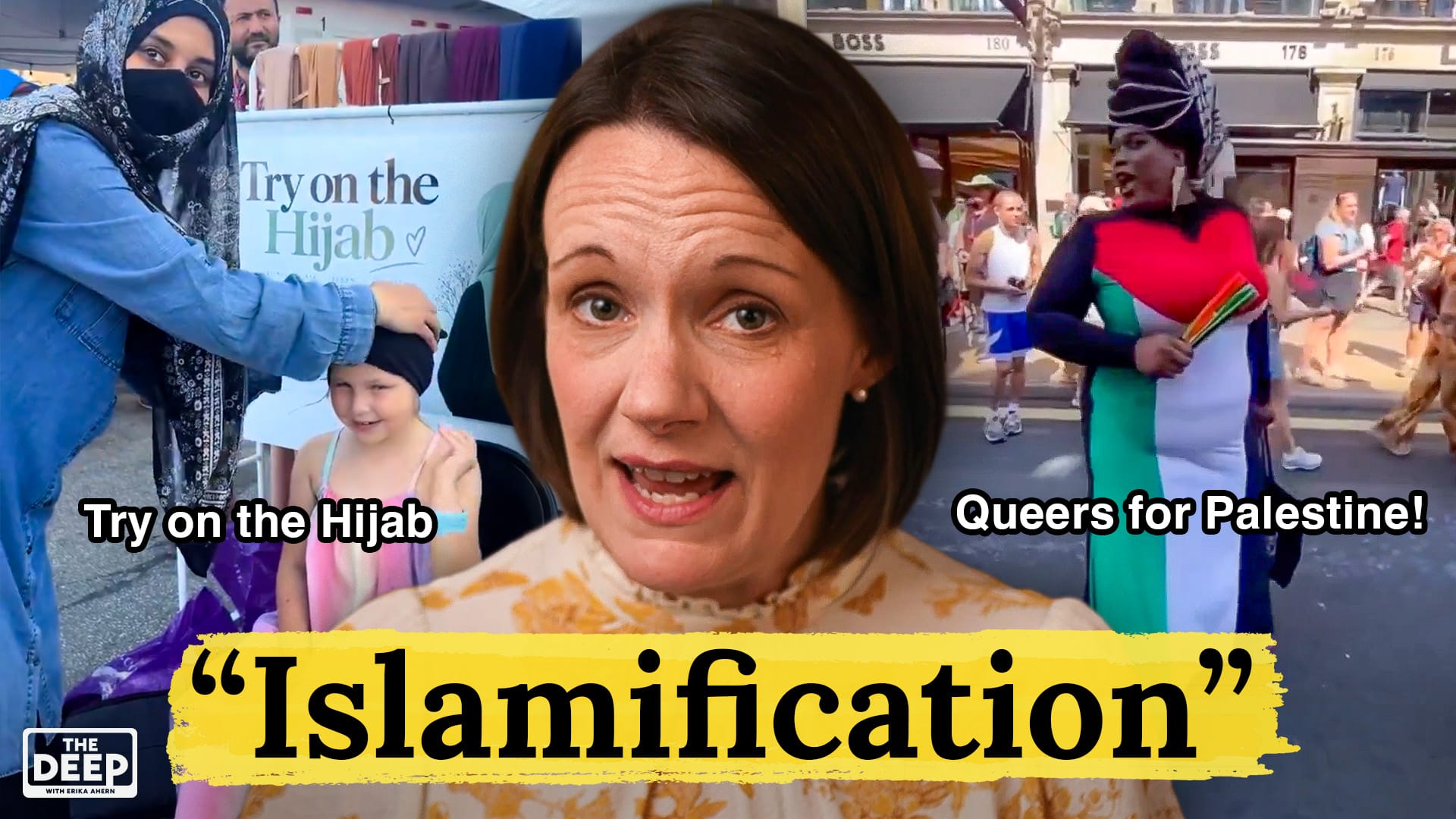
Well, the left certainly thinks it's important. In fact, a strange alliance, a red-green alliance of democratic socialists, LGBT activists, and so on. and Muslim political leaders has defined the 2026 midterms. Pride flags, keffiyahs, and hijabs all march together. This is the most bizarre political marriage in American history. Is this just a temporary leftist power grab? Or are we witnessing a historical moment, a new Islamification that will transform our country forever?
If we're going to understand the growth of Islamic influence in America, the first thing we should notice is that we're talking about a religion that's relatively new here, but at the same time, much, much older than America. Islam has been around for 1,400 years, and in that time, has become the dominant religious political force for 2 billion people around the world. Its primary challenge has always been the Christian faith. And it has successfully faced that challenge by way of the sword, but also through persuasion and a stubborn pressure.
Robert Louis Wilkin, may he rest in peace, warned that we forget this history to our peril. He said, by focusing on Islamic terrorism or Wahhabism or on radical Islamists, we miss ways in which Islam is adapting constructively to a changing world. When we think of the clash of Christianity with Islam, most of us first think, very apologetically, of the Crusades. Educated Catholics might even think of the great battles like Tours or Lepanto, where decisive victories pushed back the crescent flags. If we went to public school or studied the AP Euro History exam, we might think Islam is a religion of peace, and Islamic terrorists are radicalized exceptions to a sophisticated...
The Muslim faith is based upon peace and love. The bad guys were the ugly white Christian crusaders, and good riddance to them when they failed. But a more accurate understanding of what happened in the Middle East flips the public school narrative around. It was actually the multi-century Turkish conquest of Asia Minor, or modern-day Turkey, that had a much greater impact on history than Catholic failed efforts to take back the Holy Land. Because The Turkish conquest succeeded, and it's that success that Muslims want to replicate here in America.
Whether we will be like the Muslims of Spain, or are we going to be victorious? Like those that took this banner of La ilaha illallah to every corner. That was Sheikh Uthman ibn Farouk speaking in McKinney, Texas this year. He's a viral Muslim influencer with 1.8 million followers across social media. As The Federalist reported, he was speaking at an event that's become increasingly common around the country. He's fundraising for an expansive Islamic facility in one of the most densely Muslim-populated areas Between Richardson and Plano, Texas.
On the former site of a Christian church, the four-acre campus and its facilities, about 40,000 square feet in total, will be used to host Islamic K-12 education, a seminary, and training in Dawah, that is, Islamic proselytization. That is the actual playbook, and it has been used before to great effect. In 2009, Wilkin, who I just mentioned, wrote one of the most clarifying analyses of Islam. And what it means for America today that I have ever read. Islam, he noted, did not set out to conquer an empty waste of desert when the Rashidun Caliphate, the first generation of rulers after Muhammad, began their military expansion in the 600s.
In reality, the land was already civilized and settled. Christianity was the dominant religion not only in North Africa and the Mediterranean, but also as far east as western China. Archaeologists have uncovered 7th century schoolboys' writing books with copies of the same psalms and sayings of Christ from as far-flung sites as monastic Ireland and modern-day Uzbekistan. But all that changed in the span of a century. By 750, 50% of the world's Christians lived under Muslim rule. It seemed like the Christians of that time perceived their new masters as conquerors who were...
interested primarily in political and military power. They didn't realize that military conquest was in fact only the beginning. Islam would build an entirely new civilization. Arab Muslims followed the armies and formed new communities in North Africa, Spain, and East into Iran, Pakistan, and India. They brought their wives and children, and at first kept themselves apart from the local communities of mostly Christian neighbors. They jealously guarded their identity and, except for the ruling class and intellectuals, mostly kept to themselves. Muslims described the next 500 years as their golden age, when Muslim scholars produced foundational contributions to algebra, medicine, optics, astronomy, chemistry, and geography.
But this was only possible because many Muslims were willing to engage with Christian and Jewish scholars. Call them the moderates. Muslim scholar Sherman Jackson has demonstrated the many situations where Muslims had surpassing political power, but ruled with a practical acceptance of pluralism and civic accommodation of non-Muslim beliefs and behaviors that violated Islam. But civic accommodation didn't stop gradual cultural replacement. Wilkin points out, though originally conquered by the sword, most of the subject peoples eventually embraced ...the religion of their conquerors. By a gradual process of soft coercion, Islam was able to gain the loyalty and kindle the affections of those who were subjugated, and make them part of the Muslim Ummah.
No small accomplishment. With the exception of North Africa, where the decline was very rapid, the Islamification of the East was very gradual. In the 11th century, the population of Asia Minor, or Turkey, ...was still almost 100% Christian. In 1458, the Ottomans conquered Constantinople, shifting the political center of Islam closer to Southeast Europe, and by 1500, Asia Minor was 92% Muslim. By contrast, Islam has never suffered any kind of setback that massive. The vast majority of places that were Muslim 500 years ago...
Are still Muslim today? The same can hardly be said of the Christian West, which is, in fact, no longer Christian. Now, the West is still the place to be. Witness the massive migration from the Muslim world to the post-Christian world. But that inheritance springs from principles that do not exist in the lands conquered by Muhammad's followers. A tradition of freedom, the rule of law, the primacy of conscience, personal responsibility, a system of representative government. E pluribus unum. If we look at what's happening in Europe and America today, it looks a lot more like the first stages of a 300-year welcomed transformation than a dramatic military showdown where Britain loses to Iran.
Islam marshals a massive population and geography, a cultural, political, and historical base from which to expand. The diaspora in Europe and America have become increasingly aggressive about claiming public And cultural spaces and funding for Muslim identity, even Muslim-only communities. The UK, France, Germany, Belgium, and Sweden today have large politically mobilized Islamic populations. Here in America, that kind of clout is still relegated to a few geographic centers like Dearborn, Michigan, Lewiston, Maine, and Chicago, Illinois. But those Muslim enclaves are not just oddities.
There are throwbacks to Christian Asia circa 750. This is a very uncomfortable conversation to have, and our ruling class would much rather peddle the horseshoe theory. Radical Islam and Islamophobia are equal threats to the American order. I want to speak to every child who grows up here, who feels that they carry a stain that can never be cleaned. Growing up in the shadow of 9-11, I have known what it means to live with an undercurrent of suspicion. What is sufficient in this city?
Islam is a religion of peace. She talked about going to the Islamic center and trying to make sure that our Muslim American citizens knew that we didn't blame them for what had happened. I also made it clear that Islam was a religion of peace. But Islamic ascendancy is supercharged when the ruling class decides they're useful. The red-green coalition of Muslims and communists is top of mind in American politics these days. Islamists are increasingly uniting with radical left activists like the Democratic Socialists of America to oppose the American order, capitalism, liberal democracy, and Zionism.
Their visions of a post-American order couldn't be more different. The radical left champions women's autonomy, sexual liberation, and secular governance. Islamist political theology holds to the authority of Sharia. Hierarchical gender roles and the supremacy of religious law. These are not minor differences.
They are irreconcilable visions of human life and social order. But one thing unites them, the desire to leverage the people's own votes to destroy the existing democratic order. The radical left needs votes, and Muslim voting blocs can deliver them. Muslim turnout in 2024 was about 80% of registered Muslim voters. And in an America where a couple thousand votes can decide elections at every level of the government, 1.2% of the population can, and does, make all the difference. So, Democrats are more than happy to secure the Muslim vote, or promote Muslim candidates like Mamdani or El-Sayed, as in Britain, the conditions are perfect for joining seemingly opposing ideologies.
As former Muslim Ayaan Hirsi Ali has pointed out, we have, quote, a left that needs votes, an Islamist-aligned network that can deliver them, and an institutional culture that treats any scrutiny of the arrangement as bigotry. So, we have to ask ourselves, what is the most immediate threat to a Catholic, a human future for the land of the free? Is it radical Islam, or is it the post-Christian progressives? Who convinced us Islam is a religion of peace? Is it enclaves like Dearborn, Michigan, or the spiritual nihilism of the rainbow jihadi socialists?
Are we where we are today because of the green flag or the red flag? Different religions produce very different cultures, and Islam is incompatible with constitutional democracy, and constitutional democracy is also certainly incompatible with the democratic socialists of America. As Rusty Reno has reminded us, it was not radical Islam, however, that gave us Roe v. Wade. There were no Muslims to speak of here when we signed American industry over to the globalist cabal. We can't blame Sharia law for the vice economy.
It was post-Christian nihilists who stripped our world of forgiveness by convincing us there are no sins to forgive. It was post-Christians who convinced one in four American women to believe in God. ...to murder their unborn children and call it mercy. And it was post-Christians who opened the national borders and declared us all citizens of the world.
America grew her own worst enemy right here at home. Sure, this Catholic church in Buffalo is now a mosque, and this church in Plano, Texas is being torn down and replaced by an Islamic center. But these churches are only mosques and Islamic centers because the Christians had already swapped Christianity for practical atheism and complacency. The progressive vision of the human person and politics Islam is as thoroughly inimical to Christianity as it is to Islam, though for different reasons. But because it sees Muslims as victims of the West, it hates Christianity and welcomes Islam.
Moderate Muslim scholars in both America and Britain have pointed out that maybe Muslims should be wary of the Red-Green Alliance. Aggressive secularism is just as bad for Muslims, they warn, as it has been for the Christian churches. Jacob Williams, for example, warns his fellow Muslims that, quote, The progressive vision of limitless human autonomy, arbitrary self-expression, facile hedonism, and idolatrous identitarian obsession has almost no common moral ground with Islam, or, for that matter, with traditionally understood Christianity or Judaism.
Progressive sympathy for Muslims is primarily based on their purported status as the West's original victims. Williams argues that Muslims' best allies in America are religiously observant Christian conservatives, whose faith makes them authentically empathetic with Jews and Muslims. But when it comes to seizing the power to decide whether dialogue and reform should even be part of America's future, Muslim politicians are happy to take advantage of progressives' suicidal empathy. Mamdani has repeatedly defended calls to globalize the Intifada, and has campaigned with Hassan Piker, who insists that the United States deserved 9-11.
The LGBT progressives love it, and many conservatives are still willing to overlook this language so that they can continue to live in the mirage of the borderless world of free markets and universal democracy. Neither the left nor the right take seriously enough the fact that serious Muslims want to make the world Muslim. On its own terms, Islam is not a tolerant religion, nor is it structured for critical self-reflection and adaptation to modernity. It is literally the struggle. Some Muslims want to do it by violence as was done in Spain, the Balkans, and North Africa.
Others are happy to take the long view, just as their forefathers did in Asia Minor over 1,000 years ago. The immediate threat we face right now. Comes from the ideological soup of nihilism, Marxist atheism, and transhumanism. But by America 500, it is possible that Islam has subsumed them all. Radicalism has, as Cardinal Pell once wrote, a way of filling emptiness. If we are going to help the moderate forces within Islam defeat the extremists. We need to take seriously the fact that religious faith cannot be cut out of politics, and if we try, a new faith will fill it.
If I had to make a prediction, though, I would err on the side of hope, that America may just turn this around. America is not modern France. Our revolution was infused with the biblical faith, and despite its decline, we are still a people disposed of. to take religion seriously. Religious Americans are best poised to understand the secular sources of emptiness and despair, and to know how to meet them, so that people will choose life over death. And in fact, Americans today are confronting both Islamification and wokeism in ways not seen in our cautionary tales of Europe and the UK.
Our Christian lineage predates Islam by 600 years. Our faith has nurtured many different cultural forms in the course of our history, and unlike Islam, we have been refined by the fires of modernity. We have what Wilkin called, quote, a deeper and more coherent relation to our own tradition, and we command the intellectual resources to understand and engage with other religious traditions as well as nihilism. But to do that, we have to love the church. And to love her, we must know her.
So, teach your children our history, share with them the lives of the saints, and deepen your devotion to Christ. Learn to love the cross that Islam and secularism shun. Believe in the resurrection that they have both denied. Then we shall have enough Don Juans and Pope Leos, enough Benedicts and Blackfriars, to win a new Battle of Lepanto, a new Vienna, and a new Granada.
If you liked this episode, be sure to subscribe to the LOOPcast. We bring you a new episode of The Deep every Thursday at 4 p.m. Eastern.