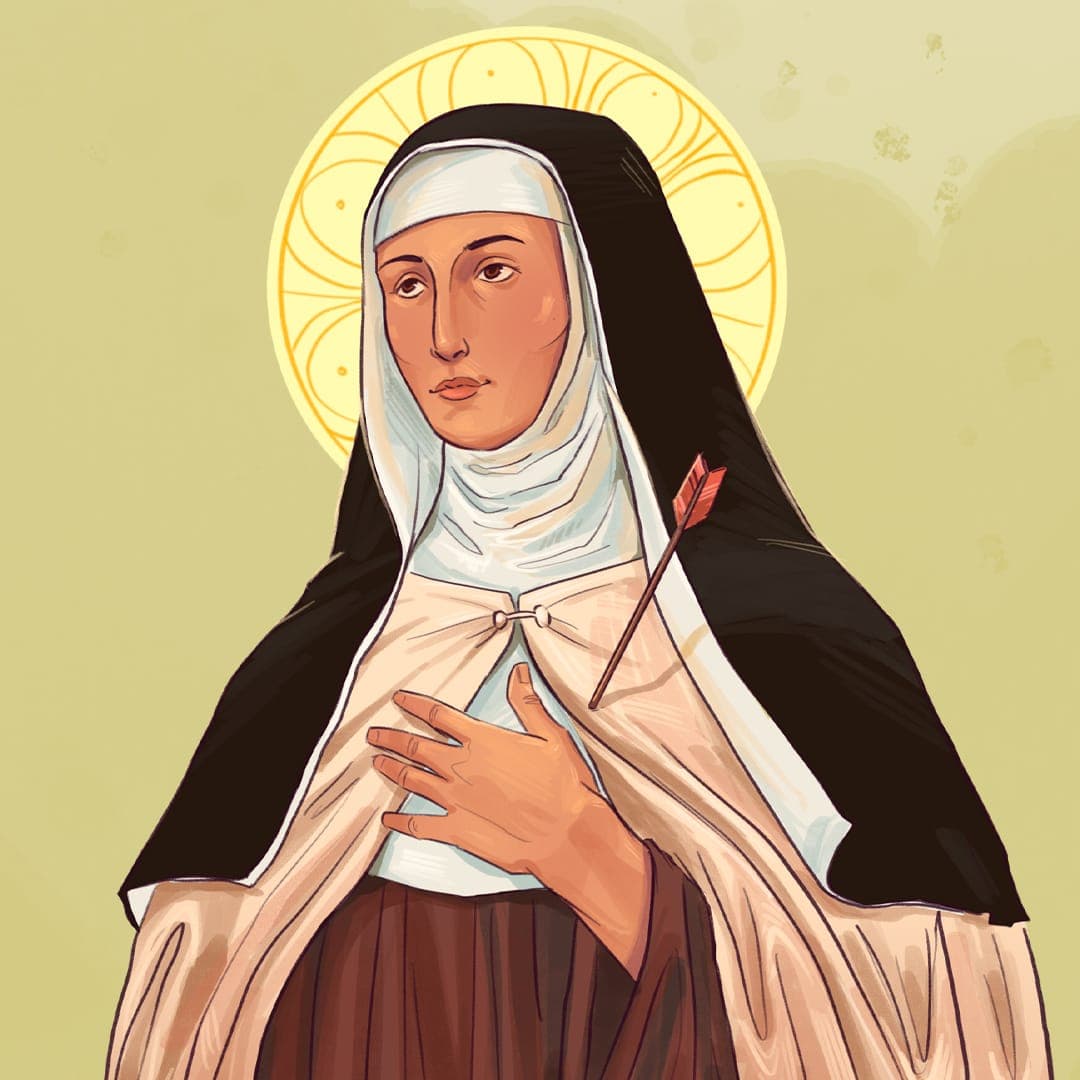
In this episode, we’ll explore the extraordinary life of Saint Teresa of Ávila.
Transcript
Read the full transcriptAuto-generated · 778 words
Welcome, young history buffs and curious minds, to My Daily Saint, the podcast that digs deep into the incredible lives of the saints, those remarkable people who shaped history and continue to inspire us today. Forget dusty old portraits and boring stories. Today, imagine two children, a young girl and her brother, packing their things and sneaking away from their noble home. Their goal? To seek martyrdom. This wasn't a modern movie plot. This was a real event from the childhood of Saint Teresa of Avila.
That fiery child grew up to be one of the giants of Christian spirituality, known for uniting deep mysticism with a realistic, honest approach to human weakness. She was a reformer, a mystic, a writer of some of the most important works on spirituality, and a doctor of the church. But she wasn't born a polished, perfect saint. She had to fight through illness, suspicion, And she did it all with a robust, unstoppable spirit.
Teresa was born on March 28, 1515, in Ávila, Spain, to a noble but not extravagant family. As a young person, she wasn't a quiet, statue-like figure. She was lively, highly sociable, loved conversation, and was vain at times. When she grew up, she decided to enter the Carmelite convent of the Incarnation, partly because she felt a vocation to be a woman, and to be a man, and to be a man, and to be a woman. But also partly to avoid marriage.
At first, her religious life wasn't very strict or disciplined. The convent was large, socially entangled, and she remained very attached to her friendships and social visits, which diluted her focus on prayer. But then, a massive crisis struck. Teresa fell severely ill.
She suffered from paralysis-like symptoms and physical debility that brought her extremely close to death. This intense physical suffering did something unexpected. It forced her inward. During her recovery, Teresa's relationship with God completely transformed. She realized that she could not sustain her religious life with only a partial surrender. Prayer became the absolute center of her life. But it wasn't just vague piety. For Teresa, prayer was a true, honest friendship with Christ. This friendship required complete honesty, detachment, humility, and And the determination to persevere through distractions and times when prayer felt dry.
Over time, her mystical experiences grew incredibly intense. She experienced visions, locutions, ecstasies, and a famous experience called transverberation, where she felt her heart was literally pierced by divine love. Yet, Teresa was incredibly realistic and ruthlessly honest about human nature. She feared being deceived, so she sought out confessors, submitted her experiences to discernment, and always insisted that the real test of a deep prayer life is not having extraordinary visions, but actually growing in real virtue.
Out of this deep prayer life came a calling to reform her order. She saw that the Carmelite life needed to be restored to its roots of poverty, enclosure, silence, and prayer. But her plans met fierce resistance. When she founded her first reformed convent, St. Joseph's in Avila, she was met with hostility from townspeople, religious authorities, and even members of her own religious order. But Teresa knew how to negotiate, when to yield, and when to fight.
She traveled rough roads across Spain to build new convents under exhausting conditions. She dealt with complicated property questions, legal conflicts, hostile clerics, weak confessors, and endless administrative details. She even had to navigate suspicion from the Spanish Inquisition, which closely examined some of her writings. Her works, like The Life, The Way of Perfection, The Interior Castle, and Foundations, are now celebrated because she understood the human mind from the inside, our vanity, our fears, and our tendency to deceive ourselves.
She collaborated fruitfully with St. John of the Cross, bringing about one of the greatest contemplative renewals in the Church's history. When she died in 1582, she was still in the middle of her reform work. Today, she is honored as a Doctor of the Church, and she is the patron saint of Spain, writers, those in contemplative life, and those seeking interior prayer.
Teresa showed us that prayer isn't a performance. It is a friendship with Christ that requires absolute honesty. Today, take five minutes to sit in silence. Talk to Jesus as you would to a trusted friend. Be completely honest about your day, your struggles, your distractions, your worries, and even your mistakes. You don't have to be perfect to talk to God. You just have to be real. Thank you for joining us on My Daily Saint. We look forward to sharing another incredible story of faith and courage with you tomorrow.