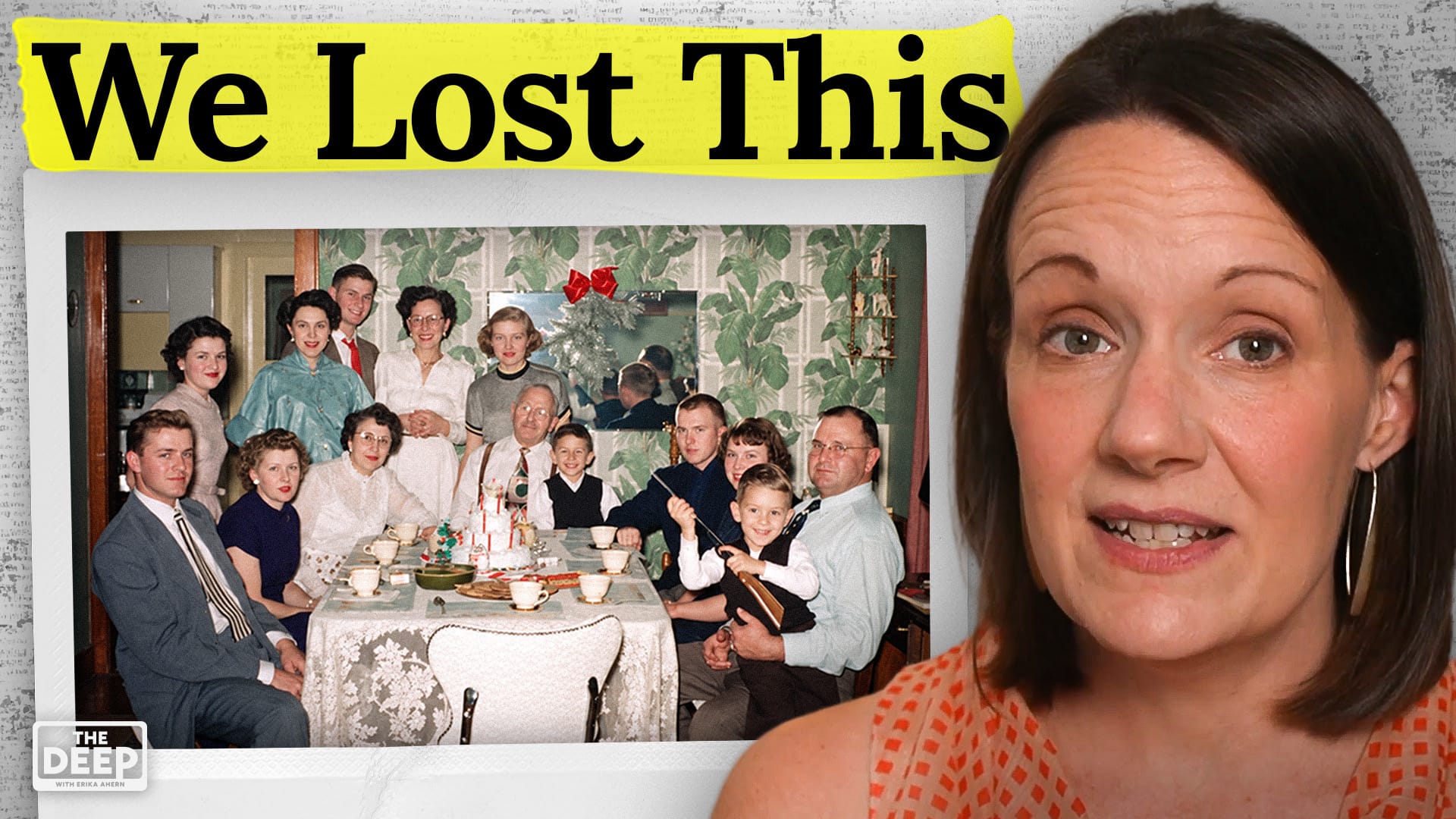
The American Household Is Dying. Can We Save It?
The American household is emptier, busier, and more stressed than ever. In this episode of The Deep, Dr. John Cuddeback joins Erika to explain what we’ve lost and why rebuilding family life doesn’t mean going backward.
Dr. John Cuddeback writes at LifeCraft: https://life-craft.org/
The Intentional Household is available from Ignatius Press: https://ignatius.com/intentional-household-the-inhp/
Transcript
Read the full transcriptAuto-generated · 4,028 words
The American household has been eviscerated. We see it in neighborhoods where the houses stand empty from 7 a.m. to 7 p.m. We're lonelier, more isolated, and more overwhelmed than ever. But I mean this in that they've lost their innards. They've lost the heart. They've lost the bowels. That which most constituted. This community of daily life has been basically just broken down such that we're not really living there. We're as busy as ever attending to household needs, but the nature of those tasks has become increasingly disembodied and centered outside the home.
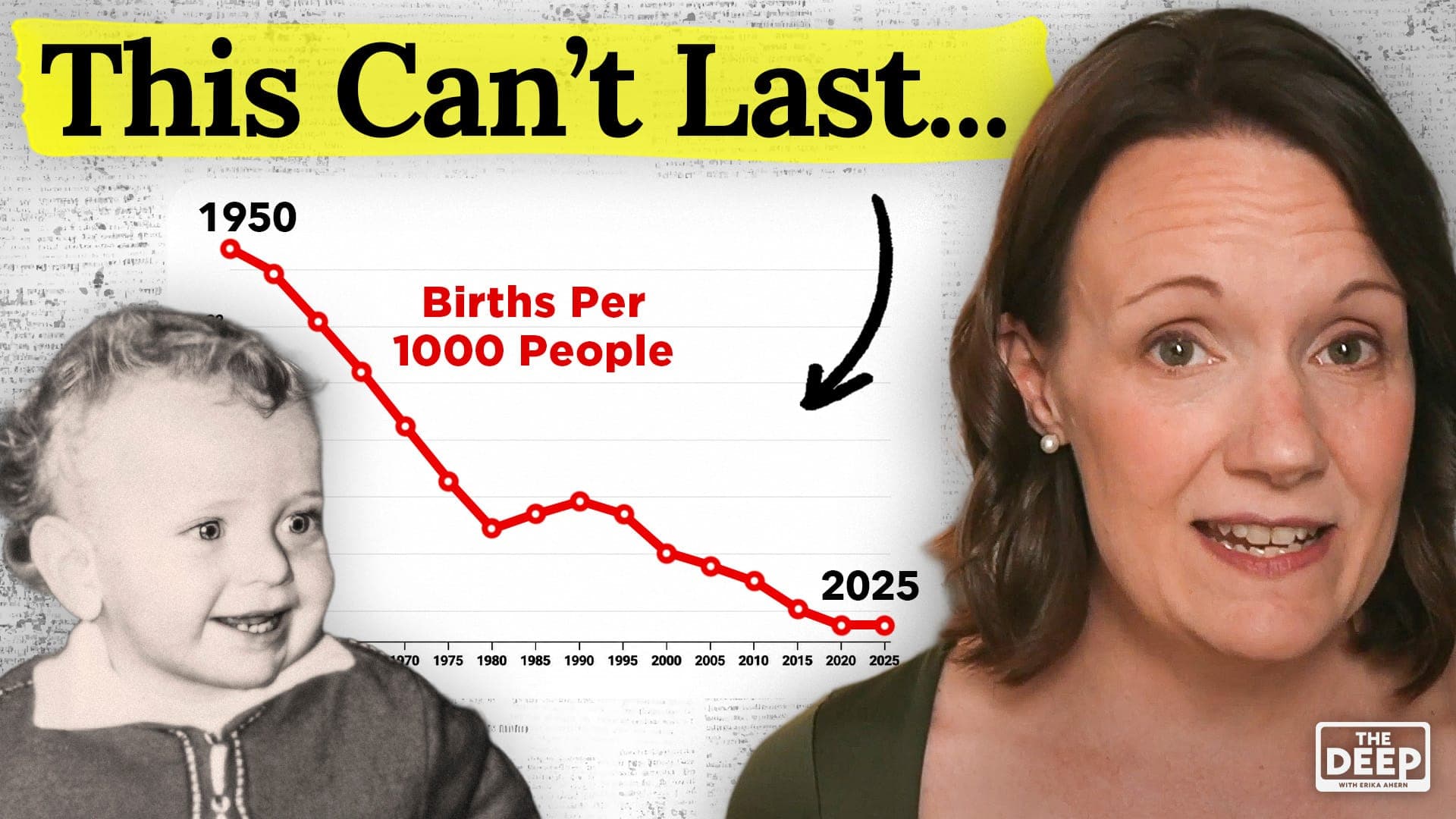
We spend less time on food preparation, building and repairing things, clothing care, but much more time on buying stuff. Managing schedules and commuting out of the home than our forebears did. Not only that, the number of people we live with has also been declining for decades. In 1960, the average American household held 3.33 people. By 1980, it had fallen to 2.76, and today, it's just over two and a half people living as a household unit. Our homes are emptying out, and the people who are left are more tired, more stressed.
What happened in the American household is a dramatic, dramatic story, and of course, it's a complex narrative. One thing is sure is this key aspect of the effect. Is that we're doing much, much less in our homes. Today, I'm speaking with Dr. John Cuddeback. I've followed his work for years on his website, LifeCraft, and his new book, The Intentional Household, gave me an excuse to reach out for an interview. And I wanted to know, why does household life seem to be dying all around us?
Why, despite our best efforts, is it so hard to keep one together? And what would it take to turn things around? For most of human history, the household, that small group of people living daily life together and providing for each other's needs in community, seemed like the natural state of things. Men and women left their father and mother and formed new households, comprised most often of their children, perhaps an aging relative or two, their staff, and maybe servants. It took a revolution to break that system down.
At the Industrial Revolution, there was a major movement of that work away from the home. Women, too, start to leave the heart of the home. And so, that, I think, is one of the key things to see, because it's nuanced. It's going to be hard to fix that. In other words, it's not as though the answer is going to be, we're going to go back to the pre-industrial model. Right, outage industries. No, no, exactly. As attractive in certain ways as that might be.
Usually, when we lament the loss of the traditional home, we're thinking of the 1950s. You know, the good old days that produced the 1960s. But Cuddeback pushes us to think more radically, to go further back. They think of like a television show like Leave it to Beaver. Which obviously, in certain ways, is much more intact. It is, in certain key ways, closer to a traditional household structure. However, what is not noticed there is it's profoundly post-industrial in this way. The man tends to be rather remote.
He has been pretty much plucked out. We're getting closer, but we still need a real, robust definition of the household. Because if we're just pointing back to the way things were 60 or 600 years ago, we're going to get really sad and depressed. Why? Because we can't go back in time. We are sitting here, now, in 2026.
We know something went very wrong, but we also know we can't go back. What we need to rediscover are principles, and we need to figure out how to apply those principles to where we actually are today. So, we're both philosophers. I want to define terms. So, when you speak of household, and in the book you bring in Aristotle, and I mean, you've got all the philosophical underpinnings, but just if you were to sum that up. and define what you mean by household it's not leave it to beaver it's not even probably like victorian you know structures that we think of um but how do you define it for your project i i would say it is a community established by nature for daily human life the most common Form of which is rooted in a marriage.
And so, let us just unpack that a little bit. For Aristotle, the key is, it is a natural communion. It is determined by what human nature is. I think that is so important. We need to have a sense of docility. I love to put it this way. No human person could have come up with such a plan.
Really. It's an astoundingly beautiful, challenging, but astoundingly rich plan of a small number of people that I'd like to say you have the privilege of getting to work with, live with, rest with, eat with. Basically, every day of life. This is called for by human nature. One can live in other ways, but it's clearly profoundly natural. So, it's determined by nature, and it's a community of daily living. Another way of putting that is, it addresses the daily needs of human persons, and those daily needs begin with the bodily, the physical ones, but it also includes emotional.
And spiritual, intellectual needs each day. Now we're getting somewhere. We're not going back to pre-industrial Europe. We're not going to don our Amish bonnets and ditch our jobs for a subsistence farm. To save the household, we have to start by asking, what do we need every day? We need food. We need to work. We need rest. And we need love from one another. What is the end or goal, according to Aristotle, of this household community? It's directly, most of all, about cultivating a virtuous, rich relationship between spouses and between parents and children.
It's always about people. It's always about relationship. It's always about living a certain kind of virtuous life. And so, given that the goal is always this very rich thing, it's not about material wealth. It's about being a certain kind of person, having certain kinds of relationships. This is the basis for thinking about every aspect of the household. So, when I look, and when we look together, like, wow, okay, we don't have certain kinds of work that we used to have. Normally, people just kind of maybe go, well, gosh, maybe that's kind of a loss.
Well, that's too bad. But But, well, what are you going to do about that? And, well, really, in the end, what does it really matter anyway? This is where it comes home to roost. We have learned something that you never could have learned until there were the kind of technologies we have now, until there were these post-industrial changes, where now we gave up on that daily work, the traditional, especially, home hand arts. And what I'd say, one way of putting what we've realized is Those things were the natural contexts for forming character and forming relationships.
So, now we have a situation where we have to look now in the point of the intentional household, is again, in view of the principles, in view of wanting to reestablish relationships, build character, grow in virtue, we're going to look again at our work context and ask which ones are best naturally suited.
To serve people, and so that is the answer to the question is that we have lost that deep connection. One of the things that inspired me, Erika, to write this book was seeing so clearly. What we have to reckon with, the epidemic of profound unhappiness, which fundamentally is rooted in loneliness and isolation, the lack of connection, the lack of a sense of real belonging, kind of who I am, that comes from the kind of deep-rootedness of a certain kind of richer home life that almost all of us are suffering from the lack of.
And we have to rediscover the simple, ordinary things that make that difference. Because we're working from principles and not trying to recreate a medieval fiefdom or pre-industrial American villages or colonial Williamsburg, we can actually get really creative when it comes to renewing households. Those groups could be made up of lots of combinations of people. Sisters, A few friends, a religious community, even state-run governments and schools, as long as they're rediscovering those ordinary projects and simple tasks, right?
Not quite. The problem with our households today isn't that we're too narrow-minded in what we're willing to call a household. It's that we've lost the primal form of the household that gives rise and shape to all these beautiful variations. There's a certain beauty in flexibility, but obviously the most natural and full sense is rooted in a marriage. Aristotle says, when a man and a woman get married, they thereby immediately have started a household. They now are the principles. The root, the source, as it were, of this amazing community.
They need to make a life together now, and obviously, a natural part of that is an openness to the natural fruit of their love for one another and children, and so much of how then we unfold this beautiful pattern written into who we are that is the household is by looking at what naturally flows. So, the key is marriage. A man and a woman getting together and forming a new household.
And that's precisely what we're not doing anymore. The Institute for Family Studies estimates that record shares of today's young adults, about one in three of them, will never marry, and one in four will never have children. And a big reason seems to be the widening divide between men and women. The gender divide in youth political affiliation and religious interest has exploded. In 2020, The gap between young men and women identifying as Republican was just 6 percentage points. Now, it's 22.
And when it comes to religion, Gen Z is the first generation where young men are more religious than young women. If guys and girls getting together is the key to renewing the household, are we doomed? How will that happen? What kind of healing needs to take place for men and women to reconcile? I asked Dr. Cuddeback, and unlike some conservative influencers, he didn't blame liberal women. His answer was far more surprising. The difference between man and woman is always a greater gift than we've yet realized.
The natural place that we discover it and feel the beauty and goodness of it is in the household. And so, this is all going to go together. It's a little bit circular, right? Restoring the household is going to be what restores a sense of masculinity and femininity. Again, by the way, so many people wondering, why am I a man? Why am I a woman? The beauty of a household is what shows us why it's so beautiful to be each. Now, man always has to take first responsibility.
And there is much going on in what you said about what is going on with the men versus the young ladies. I think it is so important to understand so many aspects of feminism, and it is very controversial, but in the case of radical feminism, to understand it, we must understand that this is the whole point.
Not to exonerate women as though it's just a problem with men, but we must understand the failure of men to, if I go biblical, to cover, to lead, to protect, to take responsibility. The failure of men leads to dramatic pain, suffering, and alienation in women. And so, my position is a key that we need to say to the young men. First of all, let's just say something that is so obvious and so critical. The restoration of chastity is absolutely essential because, let's face it, a woman can never trust a man who is not chaste.
Because unchastity is always directly undermining the trust that is necessary for men and women to relate in the beautiful way that they're called to relate. So, a restoring of chastity is going to be key, but wait, this beautifully more, we need to rediscover the real richness, and this is why I say it's a whole topic, as you know, in itself, because there are these simulacra, there are these shells. Shells of... The traditional view of man, of men thinking, well, this is where I kind of get to go out, and I just kind of take control of the situation, and that can be close to taking first responsibility, but so often, it actually ends up as being offensive, because it's not really seeing that the whole point of first responsibility is to serve the good, and that's why masculinity, being a husband, being a father, is always Fundamentally, an exercise of unselfishness.
When women experience again men who have discovered their own identity well enough to be other-centered, To be unselfish in their discovery and their living out of masculinity. That will be the first key to bringing them back together and discovering an amazing plan so that when a man approaches a woman and says, will you marry me? Will you say no to everyone else and say yes just to me and make a life together with me that she knows that she can trust and that she will Now, it's easy for conservatives and Christians to say, yeah, the libs need to get it together.
Men, be more chaste. Women, be less crazy. At least we have it all together in our Christian households, right? So, why does it still feel so hard for people who have it together to make a household? I wanted to know what Dr. Cuddeback thought good Christian moms and dads are still missing. I think what often goes on in these great families is they see very clearly the primacy of the spiritual, which is absolutely central in life. But a danger that comes with seeing the primacy of the spiritual is if we don't see and have a deep sense and feel for the connection between the spiritual and the material, the deeply embodied, then we can miss the importance of those other things and think, well, if we just focus on the spiritual, everything's going to be fine because it's most important.
Here's the antidote. There's a very rich principle that Needs to be then unfolded in many different ways, but the primacy of the spiritual is the root for seeing the rich necessity and importance of all the lower things. In other words, the more that we see how important God's plan for kind of connecting us to the higher things, man is ultimately made to, you know, to soar with the eagles, as it were. But at the same time, we're not angels. The way that that primacy of spiritual goods actually is enacted is very incarnate.
It's very much through the importance of the ordinary, and it's the ordinary that our society has particularly lost. It's also lost the primacy of the spiritual. But the antidote to that is not just, okay, now we see the primacy of the spiritual. We have to rebuild and rediscover the ordinary, which should be in service of that. You're having this sense of the ordinary goods of human life are key to human flourishing. We need to rediscover and reconnect with those as part.
Of our spiritual project. Another way, really quickly, Eric, that I would put it is, coming from a slightly different angle, almost all serious Catholic families know we have to focus on raising the children, and that is what is going to unite us in our marriage, and that is what we are going to focus on. But I love to point this out. Raising children is in no way a stand-alone thing in itself. When you get up in the morning, you don't say, I'm going to make a list of the things I'm going to do today.
I'm going to make breakfast, I'm going to do my morning chores, and then I'm going to raise the children. Homeschooling is great, but I'm sorry to say something that might make people squirm a little bit. Teaching your child math is great. It's not the primary natural context for raising him.
Academics are very, very important. But there's a whole set of other rich, ordinary things that need to be going on in the home that center around things as simple and ordinary as how we prepare our food, how we eat our food, how we go about the work, and we haven't used the very key word, how we do leisure. Our homes have not only been stripped of work, they've been stripped of the other side of the beautiful coin of human life, leisure.
We don't know how to do Sundays in a rich way. Mass and church should be the height of Sunday, but then that should give form to a beautiful set of other things of rest and leisure in the rich sense, which should also be going on in the other days in the week. And we find that very difficult. We're running here and there in our very kind of suburban lifestyle, and we've lost the richness of the ordinary. I, yes, and this, okay, so I went to confession this weekend.
I'm not going to share with you everything that I said, but as I was thinking about, yeah, as I was thinking about, you know, looking at the household and we're starting our school year and we do homeschool, but, you know, there's lots of other things going on. And I was, like, ordering all my days and, like, reflecting on it. It seems to me that, you know, reading your book, I was, what I'd been doing was shoehorning into my life. What is most essential to a flourishing human home, and allowing all of the peripheral things, which are also goods, you know, the kids' activities, which curriculum are we going to use this year, how many tests are we going to have, all the schedules.
All of these things were the big pieces, and all of the things that ought to be the big pieces had become little pieces, and as I was running out to confession, I was like, oh my gosh. When am I going to eat dinner tonight? So, I grab a piece of chicken out of the fridge and start eating it as I'm going to the car. I'm like, wait, this is how animals eat. This is not how human beings should eat. So, the family meals should be first, and like you said, mass should be the big boulder in the week that everything else comes to, instead of like, oh, we've got to fit in a vigil mass because we have three soccer games on Sunday or something.
I think it seems like these little things, but it is this radical sea change that American culture, broadly speaking, just seems to get everything in the upside down, as it were, right? Yes. Erika, what you are saying makes complete sense, and please understand, well, I will put it this way.
When talking about the intentional household here, My wife often points this out to me, says, John, you got to be careful how you talk about this, because you know what? It's going to sound like the things that you're recommending are just one more thing that overworked people are going to have to do. We need to take a new approach, and a hard part of this new approach is going to be, we're going to have to find some things to thin. It is true that a big part of Our challenge is there tend to be too many moving parts, too much going on.
Now, I know it is hard to thin, but the thing that is going to make this be doable is it is going to go back to very basic, ordinary things, and we can start with baby steps. I am often asked, so what is the one place to start? I always answer with the same thing, how you eat.
Aristotle pointed out that one of the ancient names for household was simply those who eat together, and so it's part of how God has made clear his plan for human nature, is that we have to eat so often. So, when we consider the daily community of life really tends to be, or should be, naturally, the community with which we live. There's something really weird, and again, Erika, the last thing, of course, we all do this, right? Sometimes you've got to grab a piece of chicken and run out the door.
There is something slightly barbarian about that, but hey, we're doing our best in the circumstances in which we are, right? And so... Obviously, we have to all be able to smile and bend with the challenging times. But that said, as an approach that we say, no matter what else, eating together in this household will have a kind of priority.
Therefore, it will be given a certain dignity, will give it a certain amount of time. When possible, we're going to linger afterwards to just be present with one another. This is the context to develop habits of conversation. I mean, these things are the primordial things. These are the main things that you see, especially, again, you always know more about a household by looking at the young. If the young are suffering, there's something wrong in the household. If the young don't know how to look people in the eye and have good conversations, there's something not happening in the household.
These fundamental human dispositions that... We all are suffering from, but then most you see it in the young. The table is a primary place of bodily presence, of eye contact, of conversation, of a willingness to listen, of a putting technology in its place, because life is about plugging in in relationship.
These, I present, are the primary things. Now, I'm going to go really big. These are things that most form us for our relationship with God. This is not an exaggeration. This is not a throwaway line. This, what happens at our table daily, is perhaps the single most dramatic and direct human preparation and formation For a human person to stand in a certain kind of relationship with God, the evil one knows this, and thus we must look anew at the loss of the ordinary.
Dr. Cuddeback's vision is so beautiful, and the remedy so simple. It's right there in the ordinary and the real. As Virgil puts it, the happy life is already at hand in the good we have. At the end of his book, Dr. Cuddeback quotes the late, great Wendell Berry, who knew something about families and towns broken apart, and even more. About putting pieces back together. It is slow work. Barry wrote, A sports game or playdate can interrupt. A commitment to eating at the table without our phones.
A decision to ditch Netflix for reading great stories out loud, making our own music no matter how off-key, and putting our own hands in the earth to grow living things, and to do it all together, no matter what. We can adapt our household life to the modern realities we live with. We don't have to Let's pretend that the 60s never happened, but the survival of our homes depends on our respect for its profound nature and non-negotiable ends, the good life now and eternal life to come.
If you liked this episode, be sure to subscribe to The LOOPcast. We bring you a new episode of The Deep every Thursday at 4pm Eastern.

.jpg&w=3840&q=75)