Trump's High-Stakes Putin Meeting, Nagasaki Anniversary, and Live D.C. Announcement
Trump is done playing around with Putin and decides to make another bid for peace…this time on American soil. Artificial Intelligence is making major waves in American economics, is another bubble on the rise? Trump dumps Drano into DC crime, Obama is relegated to the back stairs, and no phones in school actually makes a difference. All this and more on the LOOPcast!
This podcast is sponsored by Charity Mobile! New customers can get a free phone after instant credit, plus free activation and free standard shipping, when they switch to Charity Mobile with promo code LOOPCAST at https://www.charitymobile.com/loopcast.
TIMESTAMPS:
00:00 – Welcome back to the LOOPcast! 01:02 – Charity Mobile 02:06 – Trump Meets with Putin 11:06 – AI Economic Bubble? 19:03 – Trump Promotes DC Draino 29:40 – Good News 37:32 – Twilight Zone 47:21 – Closing Prayer
EMAIL US: [email protected] SUPPORT LOOPCAST: www.loopcast.org
All opinions expressed on LOOPcast by the participants are their own and do not necessarily reflect the opinions of CatholicVote.
Transcript
Read the full transcriptAuto-generated · 8,786 words
Josh is reporting in from, where are you coming from? Chaska, Minnesota. Shoot, I can't remember how much of this I was muted for, but yeah, Minnesota, Josh on vacation, still taking the time for the Loopcasters. That's how much we care, of course. LOOPcast is brought to you by The Loop. Every Catholic's favorite morning newsletter. We have a great show planned for you today. We have a high stakes meeting coming up in Alaska. Sorry, Josh is working on that mic if you're getting anything weird for the live chat people.
We also have some thoughts on the AI investment front and how it impacts the economy. Curious to get your perspective living through the dot-com bubble, as I really did not. So, we're going to get to that. DC, so we had some breaking news as of this morning. We were following the live cast from the White House. I believe he has enacted the Home Rule Act, and so we are going to see some real crime clean up. Josh lived in D.C. for a while, so we are going to get his perspective as well.
Very excited. Josh, any quick thoughts before we dive in? Hey, you know, I am ready. Ready to rock? Sounds good, but before we do that, I need to talk about Charity Mobile. So, now more than ever, it's time to buy the way you believe and do business with companies who support what you stand for. That's why you should switch your cell phone service to Charity Mobile, the pro-life phone company. They send 5% of your monthly plan price to the pro-life, pro-family charity of your choice at no extra cost to you.
And unlike some mobile carriers that resort to gimmicks to retain customers, Charity Mobile doesn't do three-year price locks because they have never raised. Their mobile plan prices in their 30-year history, and all plans start under $50 before taxes and surcharges. You can save even more money on every line you add, making them a perfect choice for families also. New customers can use promo code LOOPcast to get a free phone with every new line, plus free activation and free shipping, or you can bring your own compatible devices.
You'll enjoy the same nationwide coverage as all the big guys, and their live customer service is based right here in the United States. To get started, visit charitymobile.com and use promo code LOOPcast. That's CharityMobile.com, promo code LOOPcast. Charity Mobile, thank you for sponsoring this episode. We always appreciate you guys, and on to the show. So, Friday, Trump will meet with Vladimir Putin in Alaska to discuss a potential ceasefire. This marks the first U.S.-Russia presidential summit on American soil since... This is a good trivia question.
Josh, any thoughts on that? Okay, so it's the first U.S.-Russian summit on U.S. oil since when? That's the question? Yep. That is a good question. The last one, I would just guess Maine. Oh, I wasn't even saying where. I don't know where. I just meant the year.
90, no, Houston, 97. Nope, 1988. Nah, where was it? You're on vacation. I'll give you a pass. I'm actually not sure where it is. We might need to Google from Rosie on that one. But this is strategic because guess where we purchased Alaska from, which I found out live in this podcast. Oh, come on. Of course.
Purchase it from Russia, man. By the way, only state I've never been to. Okay, maybe we need to get up there. Probably not around Friday. It might be a little contentious. Probably going to be some Secret Service up there. Probably.
Yeah, so. Anyway, I just thought it was interesting, and I think it's worth going back. There's been so many other international disputes going on. I believe you just had the president of Azerbaijan over. There's a peace deal there. There's obviously what's going on in the Middle East, and then there's a lot of stuff going on domestically. So, I feel like I've almost lost track of the Russia-Ukraine situation as a whole. Really, the clip that I saw on it was, I think Melania was the one being like, all right, you got to start playing hardball with Russia.
Because he would get off the phone with Putin. He's like, oh, that was a great meeting, and then another missile would drop in Kiev. So, he's like, well, what are we doing here? But just a quick update to get up to speed at this point.
So, where we are. So, the fighting in the Donbass region of eastern Ukraine began in 2014. Full-scale invasion, February 24, 2022. I feel like I don't even know what time is anymore. I feel like that was so long ago, and it really wasn't 2022.
And so, since February 2024, Russia has gained over 28,082 square miles, roughly 12% of Ukraine, and casualties big, more than 790,000 killed or injured. According to an April 2025 estimate, 48,000 missing, and then Ukrainians, 400,000 killed or injured. According to a January 2025 estimate, 35,000 are missing. That is a lot, a lot.
Previous attempts for peace, okay? So, what was happening before was economic pressure, tariffs, issued a 50-day ultimatum to Russia to agree to a ceasefire or face very severe tariffs. Later, he shortened that deadline to 10 days. He has threatened secondary sanctions and tariffs on targeting countries that continue importing Russian oil. If you remember last episode, we talked about India. So, I believe it is up to a 50% tariff on India currently because they continue to purchase Russian oil. Modi said it is to protect the farmers.
Makes sense. Their energy prices would go up significantly. But after somewhat unsuccessfully trying to sanction Russia because we don't really do much trade with Russia, he's now moving on to secondary partners. And so now, what do we get here? We get this kind of relationship before. We said, you know, Putin's a strong leader. I have this relationship. It's really sour. It's turned the other way, and now they want to come for this meeting in Ukraine. I have a clip from J.D.
Vance that I think helps make this clear. What are the objectives? What is the United States helping for? So, I'll play the clip. What we said to the Europeans is simply, first of all, this is in your neck of the woods. This is in your back door. You guys have got to step up and take a bigger role in this thing. And if you care so much about this conflict, you should be willing to play a more direct and a more substantial way in funding this war yourself.
I think the president and I certainly think that America, we're done with the funding of the Ukraine war business. We want to bring about a peaceful settlement to this thing. We want to stop the killing. But Americans, I think, are sick of continuing to send their money, their tax dollars, to this particular conflict, but if the Europeans want to step up and actually buy the weapons from American producers, we're okay with that, but we're not going to fund it ourselves anymore.
Josh? I mean, again, the idea that the United States should be the last resort, that we should always do everything, that we should be involved in every conflict on every… We're stretched too thin. We're borrowing money from China, who could possibly be our own military antagonist in 20 years anyway. So, at some point, we have to be a little bit more constrained. This notion after the fall of the Soviet Union that the United States could be the be-all, end-all, we had the Soviet Union collapse and the successful Iraq war to get them out of Kuwait in 1991.
And so, we're kind of like riding high on our fumes there for a while, like, what can't we do? This is amazing. And the French called us like a hyperpower, because the word superpower wasn't big enough. And so, the idea was, you know, our elites in the Western elites, especially in our own country, were like, there's nothing we can't do.
And so, let us be involved with Ukraine, let us be involved everywhere else in the Middle East, Gaza and everything, and you start to be stretched way too thin. And I think JD Vance is right, we need a foreign policy that is a little bit more tight to the hip, a little bit more constrained, not too extended too far, and we cannot afford it. We literally cannot afford, we are broke.
We are borrowing way too much money, so it is time to involve these Western European countries. Getting them to pay a little bit more for NATO, so that they have more skin to the game, has been a helpful start.
The question is, is Putin going to do anything? For him, maybe he is just perfectly fine with everything the way it is going. I mean, what is the assumption here? Everyone just assumes, like in war, oh. He's going to get exhausted. He's going to realize he's lost a lot of men. It's cost him so much money. He may not care. He might be perfectly happy with this until, I mean, unless someone takes him out. Yeah, I think the frustration on my part is we...
We've essentially created a hardened Russia that doesn't need to rely on outside assistance. If anything, they're on war footing. Russia, historically, has had a very high tolerance for death, for their own people. I mean, you look at those numbers, it's shocking, like how many Russian soldiers have died, and they're really showing no signs of stopping, and they have so many people. So... They're hardened. They have all the hard materials for war that we actually are struggling to get over to Ukraine, because our economy is not on war footing.
I guess we threw a trillion dollars at the military coming up, but unless we were to ourselves get involved, which I guess we are in an indirect way. In a more direct way, you mean, yeah, obviously. In a more direct way, that changes everything, but...
Yeah, I just have a hard time believing, like, okay, he's going to show up to Alaska, and now, you know, something's going to change. I don't know. I'd really be curious, like, what settlement would even satisfy, because both sides are at such an impasse. Well, and the Western elites, they want, you know, they want Putin to go completely back, you know, home with his tail between his legs. And that's not happening, by the way. Yeah, that's not going to happen. Like, there's no circumstance where he's going to cede every territory he's gained.
You know, like, the guy's a bad guy. Yes, fine. Well, that means he needs to unconditional surrender and give back everything he wanted. Okay, if that's your terms, this is not going to end anytime soon. Yeah, but my issue, I think, is that it benefits a lot of people for this to never end.
And there's just an undeniable, it's like the third rail of the American economy is military-industrial complex. So, they'd be just fine with this continuing for years and years and years from a profit perspective. Well, war is beneficial to the state. It always has been. Yeah. No doubt. That goes way back, too. I mean, we were trying to whip ourselves into wars long before the Trump administration, so I guess that's what's frustrating, is you vote for him to get in, no more foreign wars.
It feels like we're more involved in foreign wars than before. In some ways, it's like, okay, how much can you blame him, how much can you not? So, we'll be keeping an eye on that. I mean, the problem is, Putin might come up with a deal where he says, okay, I get all this territory that I picked up, and I'll give up on the rest, and Trump might just say, sure.
And then Western elites will say, no, that is too much, and then Putin does not really believe in it or not. You know what I mean? So, I think Trump is overestimating his ability to pull off some sort of a deal, and I think it is… Shot with the critics on that one. I guess we are going to keep an eye on Friday. I had that up top because a lot more stuff on the D.C. rollout is coming in, but before we get into it, I think that is kind of… I'm hollowing out at this point, but AI.
So, Josh, I wanted to ask you about this. I was reading about this this morning. I've been reading a lot about this. Obviously, AI, a hot topic, but. I took a look at some recent government data when it comes to AI investment in the economy, and so I don't want to get too numbers-based, but more philosophical. From your perspective, you've lived a lot more life than I have, but AI investments accounted for 1.3% of the 3% GDP grew last quarter. This is according to Paul Kudrow.
That's enormous. Yeah, and for perspective, I believe that's a higher percentage than the dot-com bubble. So, I just want to set all that up. That's what kind of caught my eye on this. And he estimates that AI spending already makes up a larger share of GDP than spending on specifically telecom and internet infrastructure did during the dot-com bubble in 2000. Meta, Alphabet, Microsoft, and Amazon collectively spent $69 billion on AI infrastructure last quarter. They plan to shell out up to $320 billion for AI tech and data centers this year, up from $230 billion last year.
But at the same time, consumer spending, the typical engine of the economy, has weakened. AI spending contributed more to the GDP than consumer spending did last quarter. This is according to economic research. This is the head of economic research at Renaissance Macro Research, Neil Dutta. So, the AI spending boom has been a boon to chip makers like NVIDIA and AMD, which have seen their valuation skyrocket. It has also benefited the utility companies capitalizing on growing power demand and land purveyors. In data center hubs like Northern Virginia, also in Indiana, our energy bills have gone up quite a bit.
So, now the question is, is this a bubble? Is this going to bring about an AI utopia? Is this going to put us in the driver's seat for global dominance everywhere? What were the conversations like during the dot-com boom? Do you feel any similarities here, Josh? It is a lot of similarities, but here is what, just to take back a few things, consumer spending is, as you said, is kind of... Low right now, and I think a large part of that is because of the tariffs.
I mean, that's just a natural thing. If it's more expensive to purchase a lot of the goods you want to buy, because a lot of them are imported. So, consumer spending is down because the tariffs are up. And uncertainty, too, by the way. I'm certainly sure. I mean, yeah, and so that's not a shocker here. If there wasn't an AI bubble going on right now.
Or, you know, discovery, it's like a land rush for AI. It's speculative, yeah, for sure. Right. If that wasn't going on right now, there's a lot of money that would still be parked on the sidelines, and the economy would be worse off. So, is it potentially a bubble? Yes, but bubbles aren't always horrible. I mean, basically, what's going on with dot-com, The idea is you had a lot of money come off the sidelines and get into investing, and some of it went bankrupt.
Some speculation, this wasn't the best business plan, and it fizzles out or whatever. We're going to have this dot-com, and it's going to be great, and we're going to sell toys right to kids. Some of these ideas just didn't end up panning out.
The idea behind a lot of the internet is if you're the first one there, And you establish yourself, even if you lose money for many years, you will eventually gain great footing. The best example of this is Amazon.com. And he went on, Jeff Bezos, back when he looked like a nerd, he went on like Jay Leno, and he was explaining all this. And Jay Leno was like, I don't understand. Like, you lose money every year for year and year and year and year.
And Jeff Bezos was like, yep. And everyone's like, and the audience is just like, this is the dumbest thing I've ever heard of, and now he's a gazillionaire, you know, because basically, he had established a market footing, got, changed people's habits, he fixed so many things, like. How to make shipping affordable? How to turn things around on a dime quickly? I mean, I remember for a while there, remember when we used to get stuff in two days? I mean, that was the best.
Yeah. You know, and so... I think we still do, kind of. And then if you're the first one, like Facebook, you're the first one to come up with that idea on social media. Boom, you make a ton of money, you know?
With every Facebook and Amazon, though, of course, there's about 30 or 40, maybe several hundred that tried the same darn thing, and they failed. And so, is it a bubble? Sure, because not all of that money that's brought into that sector of the economy in a speculative manner is going to bring about a A positive return, but overall, the dot-com bubble is not, I didn't see it as that big of a problem because, of course, the money rushes in, and some of it becomes very profitable, and overall, the economy benefits.
Seven years later, your economy is much bigger, much stronger, more efficient, better. I have a problem with housing bubble, because that is usually financed through artificially low federal reserve rates or laws that make it like, oh, we have to lend to poor communities or whatever, because it's racist or whatever, and then you bring in a bunch of people, and they don't have the money, and they foreclose on it. That's a different thing. The AI bubble, again, I think what you're going to see is a lot of these companies, oh, look at this company.
It just went completely bankrupt. Yeah, it might have, but then one of these guys is going to succeed, and it's going to be a huge, I think, economic boom. Yeah, so it's like, so in your mind, less risk, more reward? Well, I mean, okay, so what happens?
As these AI companies are coming up, and they're saying, look at, they're going to the investors, and they're saying, here's why you want to invest with us. This is great. And so, they're bringing a lot of money off the sidelines and investing it into these industries, right? Can you define the sidelines real quick? Well, I mean, like, okay, so if you're a billionaire, and you've got money and stocks, you know, and bonds and all this other stuff, and you're like, well, wait a minute, maybe I'll sell some of this stuff and buy.
AI stock, I'll invest a million dollars in this company. And so, it's money that would just be doing something else in it. It's not like it's stored away in someone's cabinet, obviously. But the idea is, he might have it parked in municipal bonds, or you might have it parked in some sort of mutual fund. And he sees this AI thing come along, he's like, hmm. I want to take some of my money out of my 401k or whatever portfolio, and I want to invest a million dollars in this AI company.
And so, these AI companies are going around, and they're trying to get investors, hey, you got to come with us. We got this great idea. So, then these AI companies get a lot of money. They have to hire engineers, coders, all these guys, and you are ramping up. Well, eventually, you are not going to need all of these people for all of these companies, and there is going to be some that fall by the wayside. So, it is kind of a creative destruction.
Overall, I think it is. It's beneficial for the economy. Yeah, and someone made the point in the chat, too, with the housing bubble. From my understanding, I thought it was like sketchy loans, like tranche loans that are stacked on top of each other to buyers that had no business getting loans.
In fact, you know how I knew we had a problem in the housing market? All right, so I was a single spud. I was 22 years old, or 23 years old, and I was able to get a loan for a house, and I thought to myself, if an economy is giving me money to me to buy this condo, like, actually, I realized it was not that smart. So, I got out of it within a year, made a lot of money, and Oh, wow.
Josh Lowkey came up on top. You came out green in the House of Crisis. I did, but at least the first one. Wow. New Josh lore. I didn't know that. Not many people did. I was going to say, you're probably one of the few. Well done, Josh.
Okay, I want to get into this, actually, before we get into the good news, just because, Josh, you also have personal experience here. So, I was looking up, Trump's doing this press conference this morning. I was kind of watching before the show was going on.
I saw him do the press conference, and he's like... So, I'm talking about how he wants to make D.C. beautiful, and he's like, oh, you know, the reporters here, I know you guys are kind of liberal, but like, I don't want any of you to get murdered, raped, or shot, and I know you've made people, you know, people have done. I was like, what a way to start a press conference. So, I'm seeing here now, President Trump just invoked Section 740 of the D.C.
Home Rule Act, legally taking direct federal control of the nation's capital. The military is involved. D.C. is federalized. From what I saw, I think he also announced he's bringing in the National Guard to do this. Now, Josh, you lived in D.C. He's sending out these, passing out these charts. We actually discussed it, Eric and I, on Friday, the 2024 murder rate per 100K compared to other capitals around the world. It's above Mexico City. It's above Lima.
It's high, and I think we established there's fights over these statistics, but just from people who have lived there, anecdotally, it's like we all kind of understand this is not a very safe place. So, Josh, two things. What do you think about this? Is this like extreme fascist behavior? I don't even know who would argue against this, and is D.C. actually as dangerous as people say?
Yeah, I mean, I live in Washington, D.C., and of course, they had the license plates that said taxation without representation. They complained that they didn't have a member of Congress and two senators. They wanted to be at their own state. Yeah, you want to be your own state, and you run the city this horribly? Now, I lived there, of course, 25 years ago, and you have to understand something. Crime was horrible in the 70s and the 1980s. And so, like, you come up with a movie like Robocop, and they just assume 40 years in the future, crime would be so horrible.
You know, you need to hire cyborg machines. That was Detroit, right? That's right. And of course, I laugh at that because within 15 years, mayors like Rudy Giuliani in New York City had pretty much solved crime. They just got rid of it. New York City was so wonderful. I love visiting New York City. In the late 90s and the early part of the 20th century, I mean, obviously, the terrorist attack of 9-11 was horrible, but that wasn't a homicide problem. That was a crime problem, and that's not really the mayor's problem.
In a lot of these other cities, the crime had been so bad in the 70s and 80s that bipartisanship actually brought an end to crime. You know, Joe Biden actually, at the end of his career as his president, apologized for his involvement in the three strikes and you're out kind of law, but actually, that was the one thing he did I actually liked. Like, we got rid of a ton of crime. Was that Bill Clinton? Yeah, Bill Clinton signed it into law, and Joe Biden was a big fan of it.
I mean, you know. So, but then, again, of course, what happens? You solve crime, for the most part. Cities, big cities like New York City, DC, and all this other stuff become much more beautiful to live in. I mean, I lived near the bus station in Washington, DC, you know, not exactly super safe. And even then, it wasn't so bad. I mean, because they got rid of crime. And But what happens? People get complacent. Things change. Like, this isn't great. These laws are too harsh, and it's like a cycle all over again.
And so, for the last 10, 15 years, crime has just kept creeping up and up and up as these George Soros-backed district attorneys get elected nationwide all over the place, San Francisco, LA, and crime becomes horrible again. And it's like the It is like the leader, what was it, of Nicaragua. Oh, yeah, Bukele, yeah. It is a choice. He proved that crime is a choice. It is the choice you make. Are you going to allow bad people to do bad things?
And you know what? If you punish people harshly for committing crimes, then you are going to get less of it. It is a choice. And so, I applaud President Trump for invoking this rule. I never liked letting the politicians and the political people in Washington, D.C. run rampant. Like, no, I'm sorry. You want to destroy a city? I don't think we should let people destroy cities. I think Detroit, Houston, New York, all these cities should be jewels. Why do we allow— You know, corruption and cronies to ruin our nation's, you know, wonderful cities.
They should be jewels, and especially Washington, D.C. and New York City. Those two especially, because Washington, D.C., you have people, diplomats from all over the world, and as well, New York City, because we have the United Nations there. We want these cities to be something that we're proud of. And we want to be able to visit them. Like, now, who wants to visit New York City right now, you know? And my own family, they're like, hey, do you want to go see Washington, D.C.?
They're like, I don't know if we want to go right now. Who wants to intern there? Like, there was an intern that was just murdered a few months ago. I mean, who wants to do that? And then you mentioned, you know, the guy with the big balls, what a name. And the guy does. I mean, that guy was amazing. But like a roving gang and people trying to beat people up? Like 16-year-olds.
It's insane. It's bizarre. I mean, I was laughing because the message has gone out, although I feel like it's done pretty sheepishly. Everyone acknowledges. That D.C. is not a very safe place, and in multiple parts of D.C. And I actually don't see the same problems in, say, like Alexandria or Arlington. Like, you hop over to Virginia, and it's not the same, but they're so close. Geographically, there has to be a difference. I saw an anonymous quote from Washington Post. Political leadership.
This is killing me. So, quote, this is a safe city, but overhearing and witnessing gang threats and then watching the camera footage of the thuggery is disturbing. Said one resident, speaking on the condition of anonymity over concerns over personal safety.
I mean, come on. The crowd of teens, he said, were roaming the street and appeared to be checking for unlocked cars and things to steal. You know what's going to happen, though? What? He is going to invoke this Home Rule Act, which was the decision that we allowed.
In 1974, the city of Washington, D.C. to basically, you know, run their own affairs, but the idea is if everything goes completely south, we can take it back over. Well, that's what Trump is doing because it's gone south. He's taking it back over. All right. I mean, what's going to happen is he's going to solve crime. It's going to end crime in D.C., and it's going to be an example to places like New York, you know, and Houston and others. You can do this.
You can end crime, and I hope. President Trump will use his bully pulpit and use the Justice Department as well as appropriations to try to get other cities to follow these basic common sense. Law and order policies. We don't have to live this way. We don't have to have our cities full of crime. This is garbage. We don't have to do this. Yeah, here's Sager. He hosts a program, Breaking Points, lived in D.C. since 2010, said it's gone downhill every year since 2014.
Reasons why. One, no prosecution, leniency for juvenile offenders, yearly uptick in vagrancy slash homelessness, 2020 lockdowns nuked the urban centers, MPD has bled officers since BLM, five legalized weed. Man, I can't stand smelling weed everywhere. It's insane. I'm not even in, like, dude, I'm in Indiana, and I smell it. I can't even imagine, if I was in a major city, having to smell that everywhere. Well, it's embarrassing, too. Like, every time I live in Michigan, we've legalized weed, and every time I leave the state, you know, if I'm bordering a state that doesn't have legalized marijuana, how many weed shops are right on the border?
So, people drive into Michigan just to get their weed and turn right around it. Absolutely embarrassing. There's been rumors that the Trump administration is considering rescheduling marijuana as a federal drug, as it's not that pernicious or whatever. And I'm with Jack Posobiec. Rescheduling marijuana is a massive corporate bailout to what he calls big leaf.
Billions will flow in tax deductions, and within five years, the cannabis industry will double to a $50 billion industry. He said that is why they are lobbying so hard to reschedule it. It is pernicious. It is. I mean, like, the idea is like, oh, marijuana is not that bad compared to what? Cocaine and crack? Yeah, of course, those are much worse. But weed absolutely dissipates you. You know, it makes you lethargic, and like, that's the last thing we need in this economy.
Well, it's psychoactive. It messes with your hormones. Like, listen, if you want to use it for legitimate medical reasons, like... Sure. Like, if you have PTSD, like, sure, no qualms. But I always laugh because people bring up prohibition for alcohol. They're like, well, prohibition doesn't work. Everyone still drinks. I was like, you have no concept of how much people were drinking pre-prohibition. It was unbelievable. People were drinking gallons and, like, hard liquor and beating their wives. And then, statistically afterwards, people drank.
We went to go fight World War I, and we gave them the right to vote. We come back, and there's no booze. Yeah. That is not the solution either. No, but I am just saying, the law is instructive of what is acceptable. Again, it is an ordering of society, and I do not like to live in a society where weed is just rampant, and legalizing it has not made it go away. People are arguing, oh, it will be better, it will not go away.
Now, we just have stronger strains. It is everywhere. It is ruining public spaces in a lot of cases. I do not want to have kids around certain areas that are like, it smells terrible, it makes people dumb. If you want to use it for medical, it's one thing. I don't think it belongs in public spaces. It's categorically different than alcohol, in my mind. I think it's just been a net boon on society. So, if I want to live in a society where it doesn't exist in public spaces, great.
Go do it on your farm or whatever. I don't care. Do it in the black market. There's always going to be a black market for stupid stuff, but legalizing it is a tacit acknowledgement that this is somehow a societal good, and I don't think it's a societal good at all. I'm with you, brother. Not good at all. Yeah, I'm tired of it. Okay, we got good news now. Josh. Hey, you want to sell people in the 21st century on a really good idea?
You got to be a little creative. Let's check this out. Roll the tape here. I think I saw this. This is good. What's up, everyone? Here is my four-month product review of this. Baby. Okay, so delivery takes a while, nine plus months, but the product so far has absolutely exceeded expectations. Super lightweight, surprisingly durable, and that new baby smell is just... Chef's kiss. Now, the learning curve, steep, not going to lie to you guys, but once you figure out the whole kind of crying equals need something algorithm, it's pretty intuitive.
Now, the smile feature is absolutely game-changing. Instant dopamine hit every single time. Battery life is only about 90 minutes, and sleep mode still has some bugs, but support says that will be patched in the next update. Now, performance. Okay, this thing is a machine. Processes milk at just incredible speeds, converts directly to energy. And growth, the learning AI is honestly impressive. You know, babies, they're a lot like having your own personal LLM, if LLMs also peed on you. Now, the features, the cute factor is off the charts.
Definitely enterprise-grade adorability, advanced grip functionality, surprisingly good audio, you know. Frankly, the volume could be a little bit lower. And pro tip, the cuddle feature is absolutely worth the premium pricing. Overall, I would definitely recommend this product for families looking to scale. Yeah, they're resource intensive, and they require significant investment. It's kind of like an expensive SaaS subscription with no cancellation policy, but the ROI is already showing massive gains in happiness metrics. So, that's my review. Stay tuned for future product updates.
Time to go change a diaper. Family's looking to scale. That's pretty cute. Josh, that was a good vacation banger. Good news. Way to bring us up there. Okay, mine is good news. It might not seem so at first because there's a lot of tragedy, but so August 8th was the anniversary of the United States dropping the atomic bomb on Nagasaki, and to my understanding, not the first target. It was moved, and it's the Catholic hub in Japan.
So, really sad, I don't know any other way to put it, really sad anniversary, but you get this story of Takashi Nagai, and he was named Servant of God, and he's on his first step to sainthood. I have a thread here from my boy, Ryan Raisins. I went to college with him. Shout out, Ryan, of his story, so I just want to go through it briefly. There's a lot of cool pictures in here, too. So, he was born in 1908. He was raised under the influence of both Confucius and Shinto teachings, considered himself an atheist.
The woman that would become his wife was from a family that helped lead the underground church during the Edo period of persecution. There he is. His future mother-in-law invited him to midnight mass on Christmas Eve, where Nagai was deeply moved. He began reading the Catechism, Theology, and the Works of Blaise Pascal, who was pivotal in Nagai's conversion.
In June 1934, Takashi Nagai was baptized and confirmed. Interestingly enough, a priest who would go on to become a saint, Maximilian Kolbe, who I am sure everyone knows in this audience, was doing missionary work in the suburb of Nagasaki, where he founded a monastery. Takashi Nagai met Father Colby through work with the St. Vincent de Paul Society in Nagasaki. There he is.
As a medical professional, Nagai served the Japanese military as a medic. He witnessed firsthand the atrocities in the Japanese military committed against civilian populations in China. His wife sent him a catechism while he was deployed, which his commander confiscated. Here he is.
Nagai served as a surgeon in the Japanese military until 1940. When he returned to Nagasaki to continue to study medicine and work at a local hospital, he ended up being diagnosed with leukemia, likely a result of his exposure to radiation from x-rays. At 11.02 a.m. on August 9th, the second atomic bomb hit Nagasaki, roughly 2,000 feet from where Nagai was working at the hospital. Despite sustaining significant injuries, Nagai joined the rest of the surviving medical staff and working to treat the wounded as best as they could.
The guy and his wife had taken their kids out to stay with family in the countryside after the bombing of Hiroshima, and they were safe. Two days after the bomb went off in Nagasaki, the guy was able to return to his home. It was in ruins, and his wife was dead.
Three months after the bombing, the surviving Catholics held an outdoor mass outside the cathedral. The guy was asked to speak and make sense of the incomprehensible suffering that the community had experienced. On the morning of August 9th, the world stood at a crossroads. Really cool picture from this outdoor mass post-bombing.
Just gives you chills. A decision had to be made. Peace or further cruel bloodshed and carnage. Just then, at 1102, an atom bomb exploded over our suburb. In an instant, 8,000 Christians were called to God. At midnight that night, our cathedral burst into flames and was consumed.
At exactly the same time, His Majesty the Emperor had made known his decision to end the war. On August 15th, the imperial rescript was formally promulgated, and the whole world saw the light of peace. August 15th is the Assumption of Mary, which Nagai said wasn't a coincidence. Here he said, it was not the American crew, I believe, who chose our suburb. Was not Nagasaki the chosen victim, the lamb without blemish, slain as a whole burnt offering on the altar of sacrifice, atoning for the sins of all the nations during World War II?
What a line. The Lord has given, the Lord has taken away. Blessed be the name of the Lord. Let us be thankful that Nagasaki was chosen for the whole burnt sacrifice. Let us be thankful that through the sacrifice, peace was granted to the world and religious freedom to Japan.
The following year, Nagai collapsed. He was confined to his bed for the remainder of his life, where he spent much of his time writing. It was there that he wrote his most famous work, The Bells of Nagasaki, in which he recounts the bombing and aftermath. Here it is.
I walked with God in the ghostly desolation of Urukami and finally understand the depths of his friendship. Takashi Nagai, servant of God, pray for us that peace may reign in the hearts of men so we never see this scale of carnage again.
It's a beautiful testimony. I mean, what's there even to say? I can't even... To be able to be that holy and to have that kind of reflection, when no one would fault you for being bitter. Yeah, I just aspire to reach that level of holiness, man. Oh my gosh, it's hard to even wrap my mind around that, but... Yeah, pray for us. I hope he becomes a saint, I think.
Well, he is, whether or not he gets recognized as a saint or not. Yeah, for sure. I love that story. I still have to read the book. I haven't read Bells of Nagasaki. I actually had someone recently recommend it to me, and I feel like every year the anniversary comes up, you get the new reminders like, oh, Nagasaki was actually majority Catholic. Even amongst all of the death and sadness, there's these amazing, inspiring stories of people healing that community, and I'm still continually impressed with the Japanese people for how adapted they are.
Like, that they've been able to bounce back and become, like, a pretty successful country after something like that happened to them, and to think, like, there was a period of time where Japan was so dominant over China is also weird. Like, it just completely reordered. I mean, World War II, of course, reordered the entire world for the most part, but, yeah, really fascinated with that Hiroshima and Nagasaki story.
Yeah, let us all pray for peace, though. I agree. Yeah, that's all I got on that one. Josh, we have a twilight zone now. What do you got? Well, okay, so we've talked a lot about President Trump, and of course, everyone, he's, you know, we mentioned before, he's doing an expansion on the roof, but he's making a decorative change inside the White House. He decided to move the presidential portraits of Barack Obama and George W. Bush to a hidden stairwell.
So, as visitors to the White House want to go see, where's that picture of Obama on the chair, and he's like, you know, with the leaves and stuff, and where's Bush? It's like, yeah, the disastrous 21st century presidents, they're nowhere to be seen. So, I've got to say this, I vote for that. Can you leverage your main critiques of the Obama administration?
Oh, I mean, he fomented racial hatred in a way that, I've spoken about this a lot in the LOOPcast, I mean. Not that everything was perfect, but by the end of the 1990s, racial harmony, even amongst, they did polls on this, blacks, whites, we all thought race relations had improved dramatically, and they have nosedived since then, and that is because of Barack Obama, unquestionably.
Obama and Biden both, you know, they took on, I mean, Biden did it with steroids because of the COVID funding and stuff like that, but they enriched their liberal friends with government money. And that is why, as you know, Trump has come by and cut USAID funding, cut all these Department of Education grants to all these different places, and all of a sudden, you know, where are the riots this summer? Where are all these street protests? Like, I haven't heard anything.
It's because all these guys have lost their funding. I mean, it's just out of nowhere, you know, so. By the way, this is one thing that Donald Trump has still not crowed enough about how he locked down the border in six months. That is an amazing feat. No one said it could be done. He did it. That is number one. Number two, no one is giving Donald Trump enough credit for all the work that his cabinet secretaries have done in really squeezing out this, what I call it, it is like All this aid money that was going to these left-wing organizations, like, they have cut all these grants and all this stuff, and, you know, it's just been amazing.
And who would have thought that Trump could have got all these colleges to stop their racist DEI? I mean, it's just, it's, I got to tell you, it's only been six, seven months, and this president has just been incredible. I mean, they're already talking about potentially canceling The View. So, would that be the crowning achievement?
That is what they are saying. That is where Rosie O'Donnell… That would be icing on the cake, wouldn't it? Rosie O'Donnell is… Sounding the alarm. She said that executives at ABC, I think it was like Iger or something, said they got to tone down the politics, and it's the first warning shot to cancel the view.
Marco Rubio going up to USAID, the biggest meanest bully in the block, and just punching it in the face. I'll never forget that. It's good to have a level head. Because it's obviously harder to govern, and there's certain things I'm frustrated with, for sure, but to look back, like you said, it's just unthinkable. Our country was literally invaded, literally invaded for four years. Everyone saw the videos. Everyone saw what was going on. It wasn't even hidden. Total plain sight, and then they were just political hand-wringing, political hand-wringing.
Biden, who knows how with it he was, actually. And it was done within a month. I mean, the census that they did in 2020, they even admitted it was off. So, Democrats got additional seats in Congress and electoral votes because of this malappropriation of the census and the bad count. That's why Trump is redoing it. And they wanted to have... Millions invade the country, because when we do the census, they don't count citizens. They count everybody, including the millions who are illegal.
So, there are states like California and New York and Texas and Florida that get extra seats in Congress because they have people in the country illegally. It's unbelievable, these people. Can't give them enough credit. All right, for my good news, turns out it might have been this simple the entire time I will play this video.
My school, my state, banned the phones. Banned the phones. Today, all of my students, 100% of them, took notes in my class, did their assignment, asked for help when they got stuck, and turned it in. And then when they were done, They talked to each other.
Was it this easy the whole time? I have been pulling my hair out for like eight years. Has it been this easy of a solution the whole time? My answer? Yes. Yeah. Nature is healing. It has. I mean, for the audio listeners, this is a teacher, and look, critique. He is using the annoying TikTok cadence, and he's doing this into a phone. However, his students don't have phones, apparently, and this is the result. Yes, it's always been this easy.
I believe states are now getting involved. I mean, all education is at the state level, but they're now, in certain places, banning phones. Yeah, like Arkansas, they just got rid of them. Dude, this is the most obvious solution of all time. I mean, this is what drives me crazy, is that, you know... Conservatives have lots of different ideas. We're not like right every last time on every last thing ever. We're right on this. For the most part, we're like, yeah, like this, this, this is.
And it's not that we're like geniuses. It's just because we don't say we need to try something new every day. Like, again, liberals are like, let's try something new all the time, and we're like, you know, as Donna says in the chat, common sense. The idea is maybe we should try the things that have been used again and again and again and again and been successful. Like, why? You know, but that's not fun. That's not exciting. You can't get a USAID grant on that.
You can't get millions of dollars from the federal, you know, HHS or education department. Yeah, but Josh, Josh, Josh, you're not thinking this through. If we don't spend, you know, millions of dollars on Chromebooks in Chicago public schools for the kids so that they can end up in Afghanistan somehow, what are we going to do? Right, exactly. You know what I mean?
You know, like, we got to get them out there somehow. They got to find a way to launder it over. I can't believe- I just thought that the liberals think that they're the ones that are the underdogs. They're the ones that are, you know, like, you guys are doing the biddings of your corporate masters. When are you going to wake up? This has to be bipartisan at this point, right? Like, everyone knows that this is just a massive problem, and that all these problems would be solved if you just did not have phones in the classroom.
Or just tech more broadly. I remember even, like, the big craze when I was in school. was that they would have, man, what were they called? They were like interactive boards, like whiteboards, basically, so you could do different stuff with a stylus, and that was heralded as the big new innovation. It's like, or we could just use a chalkboard and we would have been fine. The whole point of education is not how fancy with the tech can we get and whatever.
It's like, okay, strip it back. Let's have conversations. With people in the room about important ideas, formative ideas. I even saw, like, shout out Jeremy Tate, classical learning test. He shared the new Merriam-Webster definition for education. And I think it went from, like, moral formation, you know, the teaching of someone to enter into society successful as properly claimed virtue, and it was like a long, it was like a paragraph, at least a paragraph, and the new one is the process of educating.
Oh, someone said smart boards. Smart boards, someone's defending smart boards. Look, you can keep your smart boards. I think it's different than phones in the pocket, but, yeah. I would like to see more states ban phones. That's another, I think, property of government. It's one of my favorite quotes, though, about, you know, Lincoln. You know, he even mentioned, what is it, conservative? Is it not adherence to the old and tried against the new and untried? Hard to argue with honesty, but it works.
Thank you guys for joining. It is going to be a short show today. It is just Josh and I. Josh, thank you for joining us from your Minnesota getaway. I hope you have a good time, but if you want to help us out, leave reviews, Apple Podcasts, Spotify. Those help us out a lot. Thank you to Charity Mobile. Join the Champions Club. Best way to support us, CatholicVote.org slash champions, and we will be back with another Wednesday episode. Josh, you will be there, right?
We will see. Maybe. We will see. You might get the first Tom Solo episode. We will figure out what we are doing there. Eric is hopefully having a great vacation, a little short-handed, but we will get something good for you guys. We will be here Wednesday. We are going to end with our daily prayer. It is in the name of the Father, Son, Holy Spirit. Amen.
Dane, O Lord, to keep us this day without sin. Blessed are you, O Lord, God of our fathers. Praised and glorified is your name forever. O Lord, let your mercy rest upon us, for we have placed our trust in you. Blessed are you, O Lord, teach me your statutes. Blessed are you, O Master, grant that I may understand your statutes. Blessed are you, O Holy One, enlighten me with your statutes. Everlasting is your love, O God. Do not turn away from the work of your hands.
Indeed, praise, adoration, and glory are your due. Father, Son, and Holy Spirit, now and forever. Amen. Amen. Awesome. Thank you, guys, and we will catch you guys on the Wednesday show. Have a great day. We will see you then. Peace.
More from LOOPcast
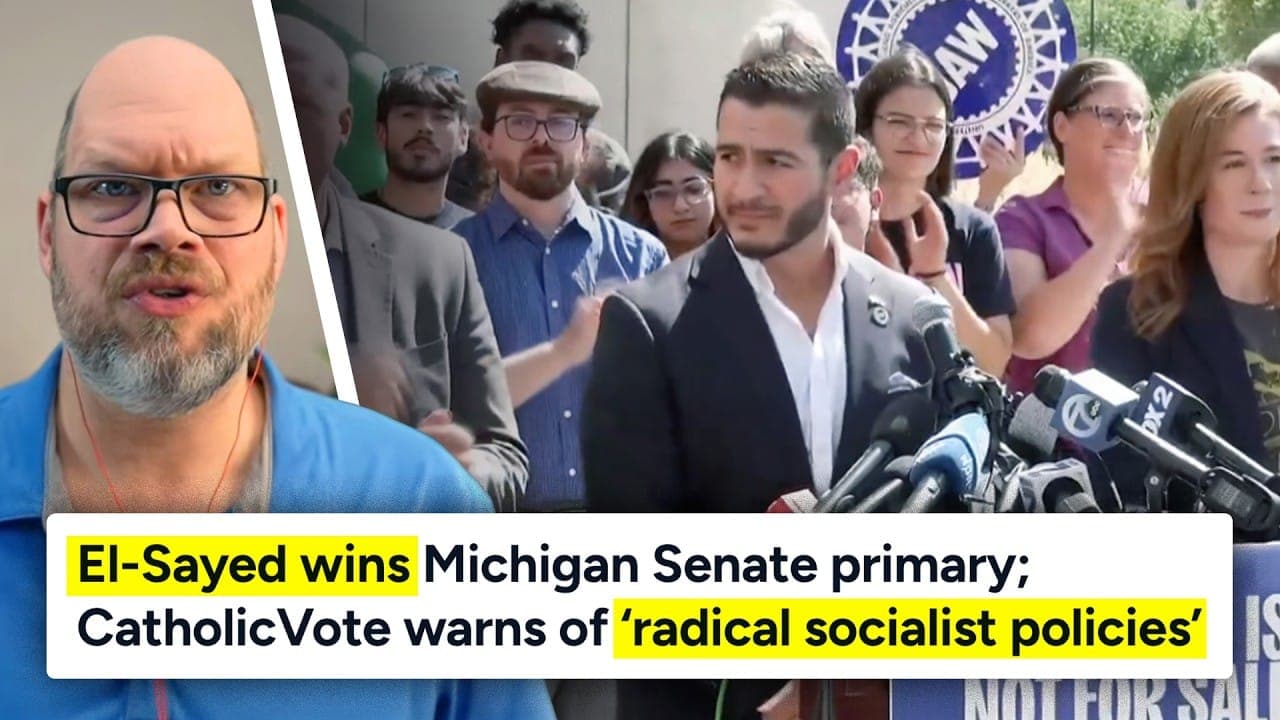
El-Sayed Stuns Dems in MI, Europe's New Migration Crisis, And The WNBA
Fauci Pleads the Fifth in Explosive Senate Hearing, Mamdani's Grocery Stores, And Gen X Bishops
Iran: Trump Vows Revenge for 4 Soldiers KIA, Tom's Backyard Data Center, And Vance x Barron