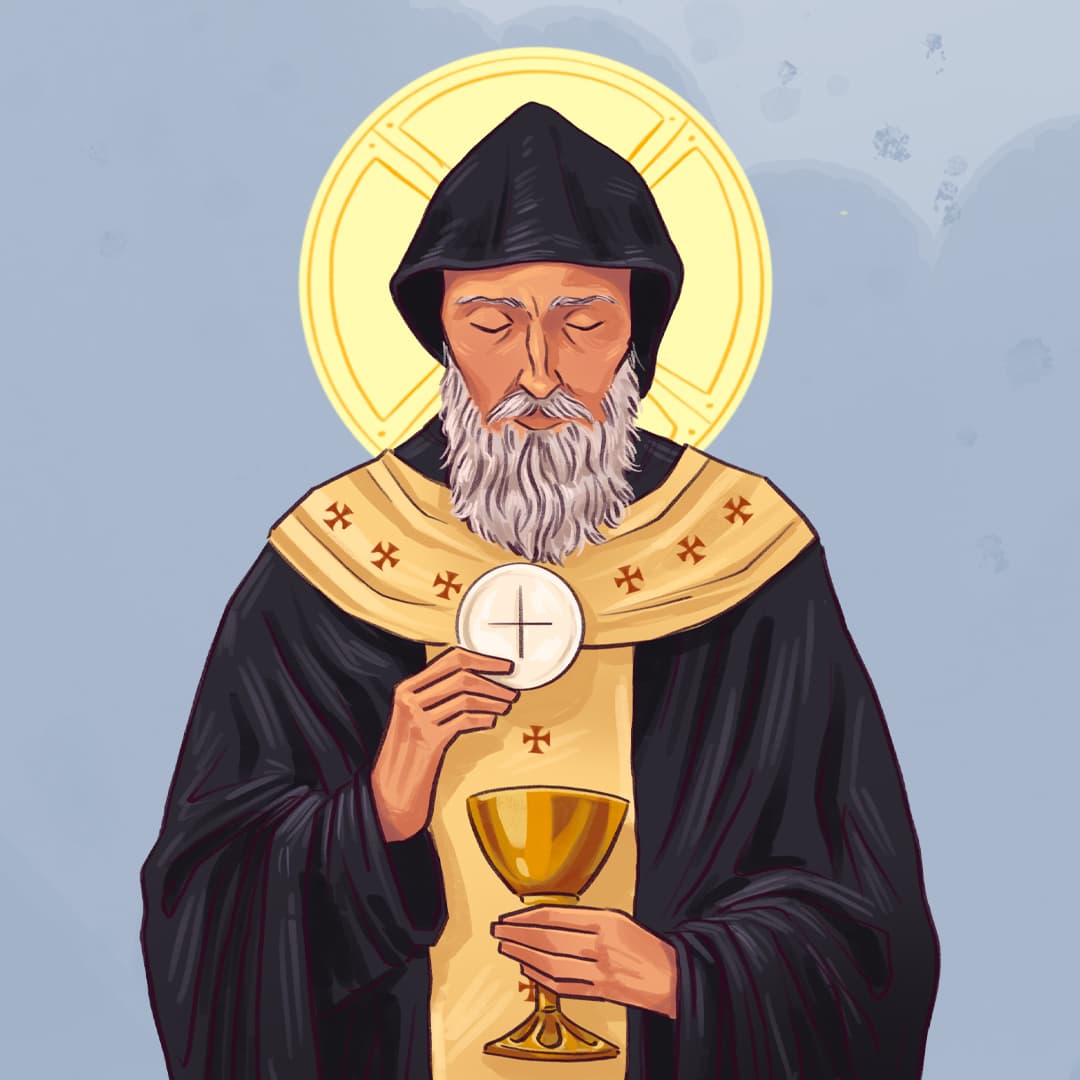
In this episode, we’ll explore the extraordinary life of Saint Charbel of Makhlouf.
Transcript
Read the full transcriptAuto-generated · 897 words
Welcome, young history buffs and curious minds, to My Daily Saint, the podcast that digs deep into the incredible lives of the saints, those remarkable people who shaped history and continue to inspire us today. Forget dusty old portraits and boring stories. Today, imagine walking through the freezing, snow-covered mountains of the Middle East in the dead of winter in the year 1898. Suddenly, you stop in your tracks because you see a strange, unearthly light shining brightly from a freshly dug grave. When that tomb is finally opened, the body inside hasn't decayed at all.
In fact, It is perfectly preserved and mysteriously exuding sweat and blood. People traveled from all over just to see him, hoping to be miraculously healed by him of both physical and spiritual diseases. This is the story of Saint Charbel Makhlouf, the patron saint of Lebanon.
To understand the man in the glowing tomb, we have to go back to his very beginnings. His birth name was Yusef Antun Mahlouf, and he was born in Lebanon on May 8, 1828. Yusef was the youngest of five children in his family. Sadly, his childhood was struck by a massive tragedy early on. When little Yusef was only three years old, his father was forcibly taken away from the family and drafted into the tomb. Turkish army, where he ultimately died. Growing up without a father meant Yusuf was given a lot of responsibility at a very young age.
As a young kid, he was put in charge of taking care of his family's small herd of cows. Now, wandering the fields with cows might sound incredibly boring to us today, but Yusuf used this time in a really amazing way. Out in the total solitude of the fields, while the cows were just grazing, Yusef would fall into a state of deep, intense prayer. He even found a small, hidden grotto, a little cave-like space, that housed an icon of the Blessed Virgin Mary.
This became his secret hangout, a quiet place where he could connect with heaven. Fast forward to when Yousef was 23 years old. It was time for him to figure out his future, and his family had big plans for him. His uncle wanted Yousef to continue working alongside him, and his mother really wanted him to settle down and get married. But Yusef felt a completely different calling in his heart. Defying their expectations, he made the dramatic choice to leave his family behind and enter the monastery of Maifuk.
He dropped his old name and chose the name Sharbel, naming himself after a brave, second-century martyr from the Antiochian church. He professed his final vows in 1853, fully committing his life to God, and began his training to become a priest. Here is an awesome fun fact. One of the formators who trained him, Father Nemtala Kassab El-Hardini, was actually canonized as a saint himself in 2004.
Imagine having a literal saint as your teacher. By 1859, Charbel was officially ordained as a priest of the Lebanese Maronite Order. For the next 16 years, Father Charbel lived in the monastery of Anaya. But even living alongside other monks wasn't quiet enough for him. He wanted zero distractions from God. He asked for permission to move out to a hermitage, a tiny, isolated dwelling where a hermit lives entirely alone. There, dressed in a simple religious habit and armed with his prayer rope, he spent almost all his time in intense prayer, worship, contemplation, and hard manual labor.
Charbel became so completely absorbed in his love for the Lord that people started calling him the saint inebriated with God, meaning he was so filled with the Holy Spirit, it was like he was intoxicated with God's presence. The word spread, and people from all over started showing up at his remote hermitage to be healed of sicknesses and spiritual struggles. On December 16, 1898, Father Charbel was celebrating the Divine Liturgy, which is the Mass, when he suddenly suffered a severe stroke. He held on for eight days, but on Christmas Eve, 1898, he passed away.
But this is where the story gets wild. After he was buried, reports began spreading of a mysterious light shining from his tomb. Officials opened the grave and found his body perfectly incorrupt and exuding blood and sweat. Decades later, because of his incredible life and ongoing miracles, he was canonized as a saint in 1977.
Pope Paul VI beautifully described St. Charbel as an admirable flower of sanctity blooming on the stem of the ancient monastic traditions of the East. What made St. Charbel so powerful is that he found his strength in silence. In our world today, between our smartphones, social media, and relationship drama, our lives are incredibly noisy. We are constantly distracted. Your challenge this week is to find your own grotto. Find a quiet place in your house, your backyard, or your local parish where you can unplug completely.
Leave your phone in another room. Spend just 10 minutes in total silence, away from the chaos, and just talk to God. See what happens when you clear away the noise, just like St. Charbel did in the quiet fields of Lebanon. Thank you for joining us on My Daily Saint. We look forward to sharing another incredible story of faith and courage with you tomorrow.