Baroque Rome
The sculptural elegance of Gian Lorenzo Bernini and the architectural precision of Francesco Borromini come together on the streets of Rome to tell a story of rivalry and devotion to craft in the Baroque Era.
Transcript
Read the full transcriptAuto-generated · 840 words
Piazza San Pietro in Vaticano, really ground zero Baroque Rome, and Bernini takes this space, which is really an oval shape, the same as the Colosseum in Rome, because the Colosseum is really a seat of martyrs, and martyrs being really the seat from which the church comes from, and he communicates this by putting the martyrs on top of each of these columns as, I suppose, pillars of the church.
Also, Bernini was working on the facade. On one stage, he was working on two towers on either side, but he started on the left-hand side, and that tower... Really came into a lot of difficulties, because it was so heavy, it started to subside. Now, he could have avoided this problem if he was helped by Borromini, who was an assistant on the project. But Borromini let him fail. He let him fail because he was jealous. And we can see how this rivalry also is enacted later on in Piazza Navona.
The building dedicated to many gods, Pantheon. It's a combination of Greek and Roman architecture, and it essentially communicates liturgy, the sphere entering into the cube, the eternal entering into the temple. So, in this building, Brunelleschi found the solution for the dome in Florence.
He basically realized that in order to create a dome of this size to cover this space, there was a special technology needed, and that was the herringbone technique of slotting in tiles in a herringbone shape, and to do that all around the building so as to create a fantastic feat of technology.
Here we are in the magnificent Baroque Piazza Navona. Bernini and Borromini. Bernini, the master sculptor, and Borromini, the master architect. The Church of San Agnese is a really good example of Borromini's masterpiece architecture. Here we can see the essential elements of the façade, which undulates with concave and convex forms. Also, the double pillars going across the façade, very signature of Borromini's work. But also, we have these two towers. These two towers were designed by Borromini to really get across.
His expertise in creating an architecture which can support such towers, in a way trying to prove to Rome and the world his expertise, in contrast with Bernini, who tried the same thing, two towers on the front of the Basilica St. Peter, which failed miserably.
A popular legend is that Bernini designed this sculpture here. This figure with his arms faced up is towards the tower to express how he was nervous of the towers falling. Borromini's towers, which Borromini used to show up Bernini and his failure in St. Peter's. Also, we have another fountain by Bernini, the Tritone, in another part of Rome.
I suppose here we depict Neptune coming out of a shell, a bit like a pearl coming from a shell. In a way, we could think of the Renaissance a bit like a pearl, a perfect pearl, and the Baroque more like an abstracted pearl, a bit more theatrical. This is a great Bernini. It captures the spirit of the Baroque in a very passionate way. Explosive fountain.
At the bottom here, you have the Barberini symbol. That is the symbol of the Barberini family, and it has got the two keys of the papacy, so this symbolizes the fact that this was commissioned by the papacy of the Barberini family. We see this symbol in St. Peter's also, another beautiful manifestation of Bernini's masterpieces.
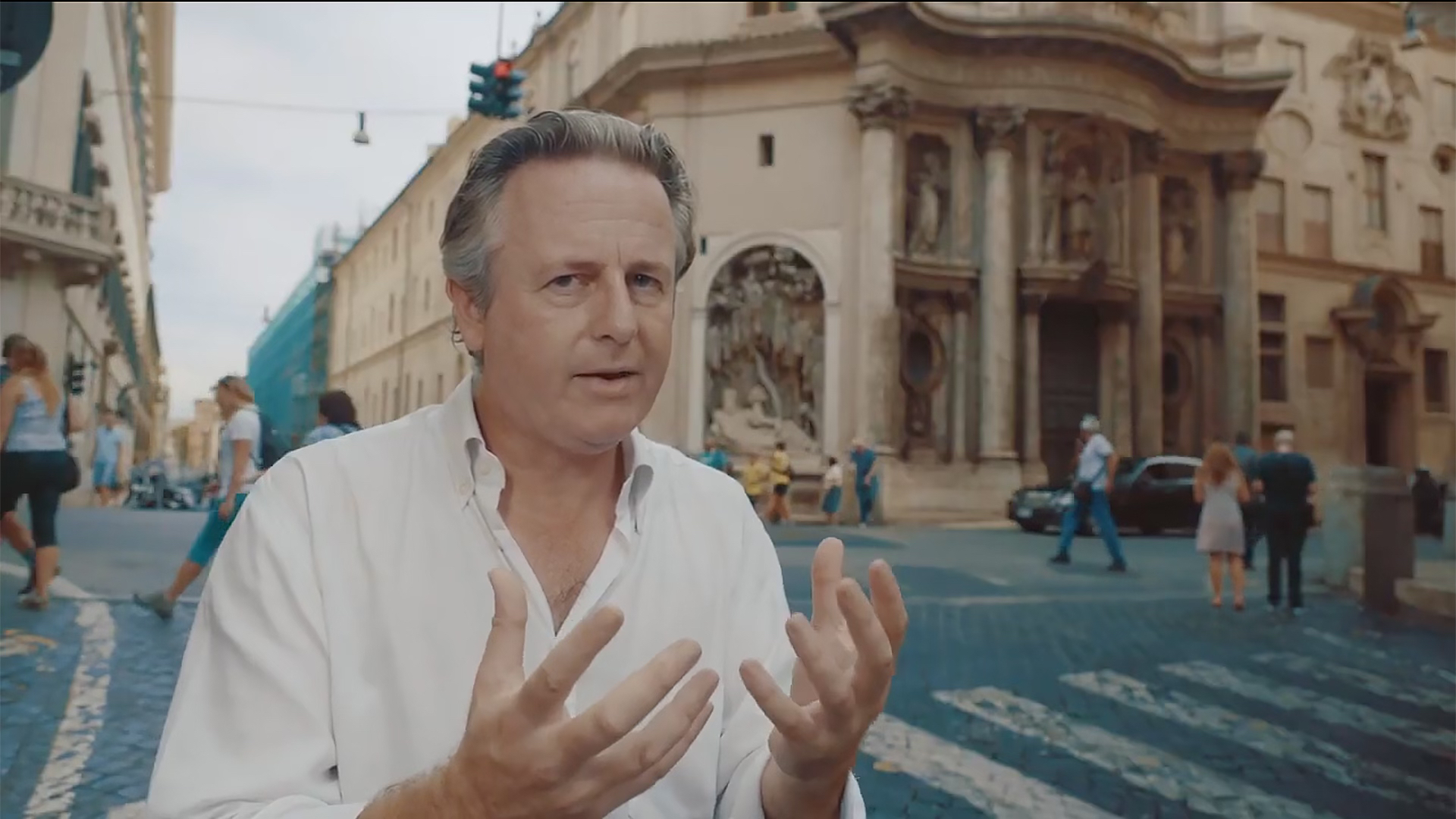
Here at the church of San Carlino, a la Quattro Fontana, by Borromini. Here he takes the architecture of the Greek and Roman ideal, which really was the font of the Renaissance, and here he takes it and brings it into the Baroque ideal of this exaggerated theatrical undulations of the concave and convex, which gives it this dramatic content and expression.
Here we are, a hundred metres from San Carlino to La Quattro Fontana, at San Andrea alla Quirinale. Borromini, Bernini. Bernini here adapts a lot of what he learns from Borromini in the curvature of the convex and concave, and also the use of the oval, very important in Baroque architecture.
In this facade, you see Bernini experimenting with travertine marble, which we'll see later in St. Peter's Square. This is the Pontus and Angelo, designed by Bernini as a processional bridge crossing the Tiber. To cross the Tiber is really to embrace the faith. And this is designed for the pilgrims who come from all over the world to Rome to pay homage to Saint Peter across the Tiber. Each of the figures on this bridge symbolize aspects of Christ's crucifixion. The cross, the crown of thorns, the nails, a beautiful angel holding symbols of the crucifixion.
You have this mix between the agony and the ecstasy. The agony of the crucifixion and the ecstasy of these beautiful angels. Here we are, Piazza San Pietro, really the climax of Baroque Rome, where Bernini communicates the church's willingness to embrace the world, urbe et orbe, from the city to the world.