The Florentine Renaissance
Whether in its churches, museums, or simply walking its streets, a visitor finds in the city of Florence a crossroads of artistic and architectural masterworks by Da Vinci, Michelangelo, Giotto, Pisano, Ghiberti, Brunelleschi and others.
Transcript
Read the full transcriptAuto-generated · 1,496 words
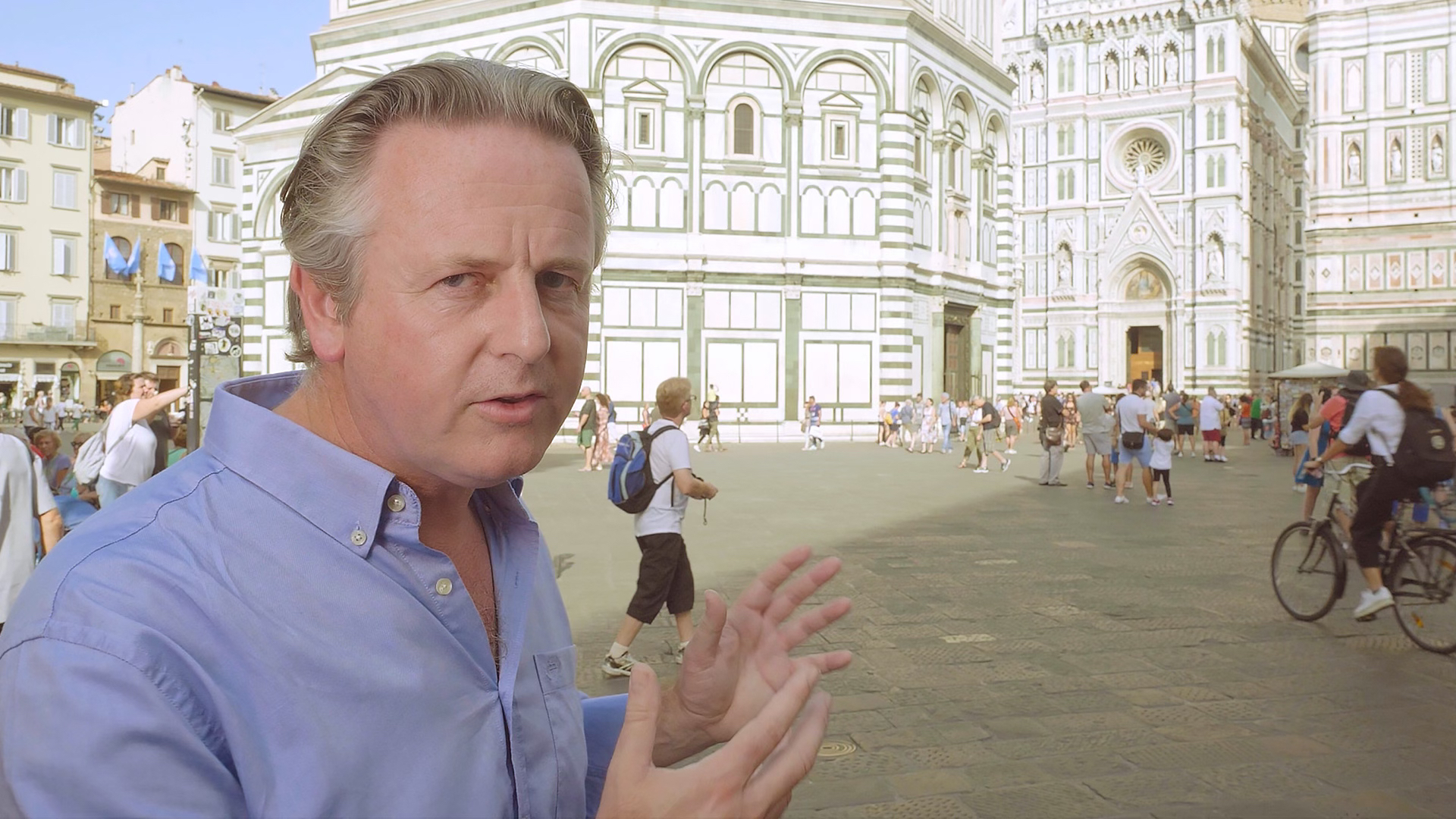
The Piazza del Duomo, Florence, Italy, the birthplace of the Florentine Renaissance. It was here, on the ruins of the Roman temple of Mars, that the Florentines decided to build this baptistry, dedicated to the Prince of Peace. This underlines the transition between Roman paganism and Florentine Christian humanism.
The construction of this baptistery established France as the dominant city in the area. This dominance continued on through the Campanile in the 13th century by Giotto, the construction of the cathedral by Ardolfo de Cambio in the 14th century, and finally in the 15th century where Brunelleschi's done.
The objective behind these liturgical buildings, essentially, is to bring heaven on earth, through the beauty of its architecture and art. This is a statue of the architect Brunelleschi, who... When failing to win the competition to do the Bronze Doors of the Baptistery here in Florence, he moved to Rome with his friend Donatello to study the art and architecture of the ancient Romans.
When in Rome, he studied the architecture of the Pantheon, especially the dome, and through his research, he found a solution for the dome here in the Florence Cathedral. At this time, while Brunelleschi was working on his dome, Ghiberti was working on his bronze doors.
There are three bronze doors here on the baptistery in France. The first was done by Andrea de Pisano, the second was done by Ghiberti, who won the competition between himself and Brunelleschi, and the third was also done by Ghiberti. That is the one we see here before us in gold.
Inside the Museo del Lopo del Duomo, across from the original façade by Adolfo de Cambio, we have the three original bronze doors from the baptistery. The first, by Andrea de Bizano, made in 1330. The second, the last panel here, commissioned from Ghiberti when he beat Brunelleschi in his competition in 1401, which is really the start of the Renaissance. And the third bronze doors.
With these beautiful golden panels by Ghiberti in 1425. When Michelangelo first saw these doors, he referred to them as the gates of paradise, and this name has stuck ever since. Within the panels of this door, we have ten scenes from the major events in the Old Testament.
Surrounded by a frame encrusted with many different examples of figures that were primary movers within the Old Testament, with the exception of two, the two in the middle at eye height. These are Lorenzo Ghiberti and his son, Vittorio Ghiberti. And here they are celebrating their achievement after 25 years of work.
Also, with reference in writing, it says, Lorenzo Ghiberti made this, and what a marvelous work it is. In this sculptural group by Michelangelo Bonarotti, we have his second-last major sculpture. This was a personal work of his, not commissioned. He did it for his own tomb, which was to be in a church in Rome, above an altar.
And here he depicts himself as Nicodemus, placing the Christ figure onto the altar, reinforcing what was then being made very clear in the Council of Trent in 1551, which was re-emphasizing the real presence of Jesus Christ in the Eucharist, sacrificed at the altar. While Michelangelo was making this piece, in 1555, He started to smash it to pieces because he was frustrated with the faults within the marble, which he couldn't get around.
It was later assembled by Vasari and friends, so that we can see it in its complete figure now. What I particularly appreciate about this piece is how Michelangelo uses the pyramid shape, which is for structure. And the serpentine movement of the Christ figure coming down through it, to give it life and animation.
These are the major elements of a really successful sculpture. In this sculpture of the Mary Magdalene by Donatello, carved in 1450s, he expresses... A new form of sculpture which communicates the penitent Madonna in a suffering, prayerful, peaceful pose. This Mary Magdalene figures, in a way, a female version of the patron saint of Florence, Saint John the Baptist. This is one of many great works by Donatello here in Florence.
Here on the façade of the church of Orsanmichele, we see a series of different sculptural compositions commissioned by the different guilds in Florence. This one, commissioned by the guild of armor makers and sword makers, was done by Donatello. It is the statue, their patron statue, of Saint George. This is a copy. The original is in the Bargello Museum. But on this copy, we can see the figure of St. George, a heroic figure looking out towards his enemy, which precursors David by Michelangelo.
At the bottom, we see a composition, a bas-relief, done in a very low relief. He has managed to create a visual distance. With linear perspective and atmospheric perspective to create a very profound relief, which gives the image of maybe two or three kilometers of distance within maybe 10 millimeters of marble. A fantastic feat of composition and relief technique.
Beside the statue of St. George, we have the statue of St. Matthew by Ghiberti, the same Ghiberti who did the bronze doors of the Baptistery. In this figure, you see the graceful pose, the contrapposta, which is accentuated through the flows in the beautiful drapery. The painter, Andrea della Barocchio.
Leonardo da Vinci asked his assistant, Leonardo da Vinci, to help him paint the painting of the baptism of Christ in the Uffizi. While Leonardo was helping him, he realized how talented Leonardo was, that he decided to change his profession and become a sculptor.
Here we see the first sculpture he did after that commission. It is the sculpture... Which captures St. Thomas putting his finger in the side of Christ. In this composition, he decides to make Christ the primary subject within the composition, and he uses the figure of St. Thomas to bring us into the composition.
This is a very painterly approach to a sculptural problem. He uses the full... The canvas, as it were, of the composition, to bring us into the composition through the foot of St. Thomas, and draw us up through his feet, through his body, to his hand, which enters the side of Christ. By entering in the side of Christ, we're brought up to the face of Christ, and the hand of Christ that brings us up to God himself.
The Florentine banker, Cosimo Medici, commissioned Benvenuto Cellini to make this magnificent sculpture of Perseus holding the head of Medusa, to put fear into his enemies. In this sculpture, we can see how Cellini brings to life again the Greek ideal beauty in the contrapposto pose, the contrapposto of the pelvis. Counteracting with the shoulders, to create this beautiful S-curve throughout the body.
And also, we can see in his silversmithing and goldsmithing facility, to work on beautiful details throughout the composition, especially in the back of the helmet, where we see this menacing mass. On the façade of the Uffizi, we have a series of sculptures of some of the greatest artists of the Renaissance.
This façade was designed by Vasari, who was an architect, artist, and art historian, who also designed this Corridorio Vasariano, which brings us from the Palazzo Vecchio all the way across the Ponte Vecchio. To the Palazzo Pitti. The Vasari Corridor continues from the back of the Uffizi, down across the Ponte Vecchio, through Santa Felicità Church, and arrives at the Palazzo Pitti. The Palazzo Pitti being the residential center for the Medici family. The corridor served as a way of getting from their residence, towards their workplace, through the Uffizi, to the seat of government, without making contact with the people of Florence.
This enabled them to be detached, and also enabled them to be able to keep an eye on the people, without the people realising that they are being looked at. The Palazzo Pitti was built almost like a fortress home.
And now houses a collection of art from the 15th to the 18th century. The Vasari Corridor has all the images of the self-portraits of the greatest artists of all time, and the Uffizi also carries a great collection of art.
Here at the Palazzo Vecchio, we have the Statue of David. This is a copy of the original by Michelangelo, which is in the Galleria Accademia, here also in Florence. In this piece, we see where Michelangelo makes the first classical nude since Greek antiquity, and he appropriates the Greek antique proportions and abstracts from these ideal proportions.
To enlarge David's head, his hands, and his feet, so as to emphasize his adolescence as he confronts the giant Goliath. This emphasizes also his vulnerability in front of this giant. In this sculpture, Michelangelo... It brings together the visual language of Greek and Roman culture and puts it at the service of Judeo-Christian spirituality, and in a way that culminates in the perfect representation of Florentine Renaissance art.