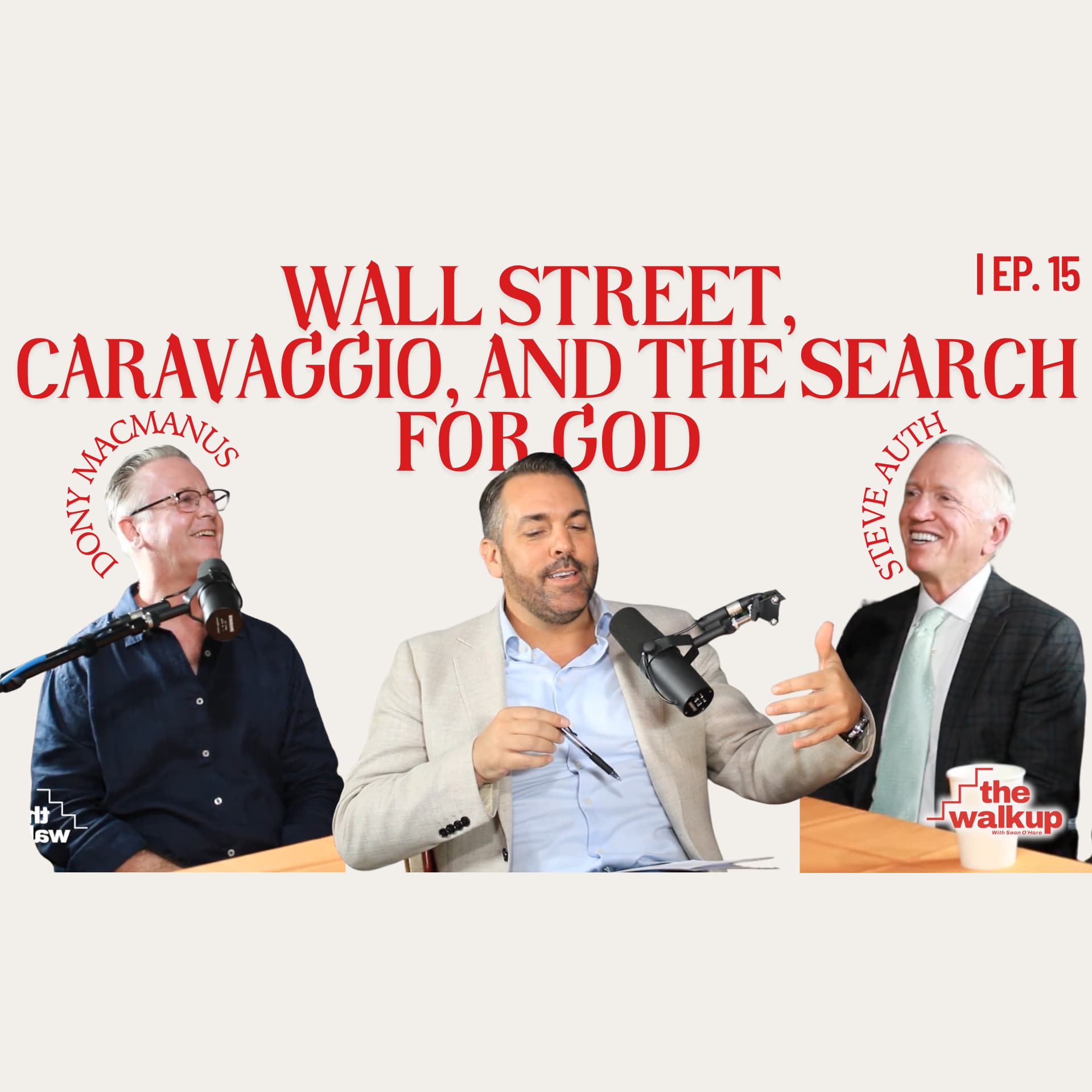
In this episode of The Walkup, Sean sits down with artist Dony MacManus and Stephen Auth, CIO of Federated Global Equities and author of The Missionary of Wall Street, to discuss the soul of Catholic art, the crisis of cultural imagination, and the connection between beauty and evangelization.
From Caravaggio’s chiaroscuro to the spiritual metaphysics of sculpture, Dony and Steve challenge the modern divorce of faith from the creative process—and explain why reclaiming that bond could renew both culture and the Church.
Transcript
Read the full transcriptAuto-generated · 11,982 words
Well, thank you both for being on the podcast. Donnie is a return guest, so try not to be too intimidated by his savvy and experience, or more so, he is quite familiar with how to deal with my personality, and we are both Irishmen.
Yeah, I am overwhelmed. A McManus and an O'Hare, which, by the way, this random side note, I just found out that my last name is... Not O'Hare? That it was changed from Hare, H-E-H-I-R. So, my grandfather, when he moved here, that was his surname, and then it switched to O'Hare. We claim the O and the apostrophe, but yeah, I feel like this is something my parents should have told me. Like all good Americans, I, of course, have a Murphy in my bloodstream, so I'm good to go amongst you Irishmen.
Is that the maiden name of your bride? No, her maiden name is... Moreno. Okay. So, she's Philippine, British, and Spanish. Huh. And what is Oth, then? That's German. In French. Was it cut off at some point? Yeah, it was out. Out. Yeah, out. So, just a different pronunciation. There's not like three more syllables after it like most German words? No, and you confused the Germans. It was out, yeah. Okay, so. And then Anna Rosa Ciccarella. I got the Italians. All right, all right.
I'm a mutt. All right. Like I say, as a quintessential American, so. So, we are here to talk about the beauty of art, the role that it plays in our world, the role that it plays in faith, and this is a show that is trying to explore the intersection between faith and culture.
And here we have an experienced Wall Street executive alongside a sculptor and a painter. People would probably be asking, why are these guys friends? How does this happen? So, why don't you tell me how you guys met? Well, we met, actually. I got a call from Donnie. He was in the Metropolitan Museum, and he was reading Pilgrimage in the Museum, which is a book that I wrote about our spiritual tours of the Met that we give. We think art is a great way to attract people to the faith, and particularly the circles I move, it is hard to get.
Folks that come to a street mission or something like that, then we do those too, but this is a great way to bring people to the museum. It attracts them immediately, and they think it is a tour, but we are pretty careful to explain to them it is actually not a tour. It is a pilgrimage, and pilgrimage to a museum is an attempt to look at the entire history of art over 5,000 years.
And make the assumption that God is using art to help communicate with us, and that artists have a special connection with him through the art, because all artists, you know, we're all creating the image of God. The artists are given this particular talent to describe beauty, and God is beauty. So, in some ways...
And, you know, they mentioned this in Ecclesiastes a few times, like, you guys don't know what's going on, but I've printed the immortal in your soul, and sooner or later, you'll figure that out. So, that's kind of what's happening. So, all the way back in ancient Egypt, and all the way up to the moderns, and the Met's one of those few museums in a world where you could actually embark on a journey like this, and over three and a half hours, We go and see how the artists are trying to find God, sometimes stumbling, sometimes falling flat on their face, and sometimes at certain moments, finding Him.
And then the real insight is we see our own struggles to find God. It is almost an archetype for struggles we all have. And then we go to dinner, and that is three hours. And, I have had priests tell me, Steve, I have never seen a dinner like this. I mean, I have been working with this couple for three years, and in one night, they have spilled their spiritual guts all over the dinner table, you know, and that is what happens, because the art so touches them.
So, yeah, I got a call one weekend from this guy, Donnie McManus. And he says, Steve, Steve Roth, I don't know how he got my phone number, honestly, but he's creative. I'm here in the museum with your book. You're inside my head. You're inside my head. We've got to talk. We've got to talk.
And that is a dangerous place to be, inside of his head. Yeah, not a good place you want to be. No, no, you are trying to encounter God. I do not know if that is the place I would start.
I think there is something going on there. There is beauty in there. Yeah, there is beauty in there. And I just find Donnie to be remarkable, because he is a modern artist who has found God and brings God into his...
Into his work, and it's helped me have greater insights into some of the art that we look at, just because the way he looks at it. Isn't that dissimilar to what I'm imagining is going on in the artist's head as we're trying to pull things together?
Yeah, it's been a wonderful relationship for me to get to know him. And who else would, yeah, as you said, I mean, this guy on Wall Street, you know. Well, usually, yeah, the Wall Street. That we think of, actually, I will use the example of Wall Street, the movie, right? Michael Douglas is portrayed as an amateur art collector, maybe for investment, maybe for beauty, but is essentially... Not, I want to say, just a patron, but his role is effectively one that can patronize artists or add to his own collection, but there's not this relationship with an artist, necessarily, or with the art itself, as you've encountered through your pilgrimages and through trying to understand what the artist intended in these ancient works, and then through the contemporary artists as well.
And then the interesting kind of... The alignment that you all both have is the capacity to evangelize through art. I mean, we've had a lot of conversations on this podcast. We just had our friend, Father Lewis, who is a master at apologetics of the spoken word.
But the idea of using art as a form of evangelization, I think, is not something that people would automatically jump to as a tool set, right? And, Doni, I know that you have had that experience in teaching, right? That the artists themselves encountering, you are often taking those that are more the audience, right? Those that appreciate art, that want to visit the Met, who then encounter that beauty and have some sort of spiritual... Experience with God. Yeah. Through the art. And you're getting it through when you're teaching the artists themselves, right?
As I talked about before, there being four parties to art. The artist, like Doni, the patron, which is often the Wall Street executive like yourself, the audience, which is probably more like me, and then the critic. We're missing a critic. We'll have to get one in here. But that's a fascinating way by which we all participate in beauty in one of those roles, right? So, Doni, when did you discover That by teaching beauty, by teaching both the technique and the theory, if you will, about art, was an opportunity for people to encounter Christ.
I suppose it started with, I came to the New York Academy of Art in 1999 to study. European art. So, ironically, as a European, I had to come to the United States to learn about European art, because we had already rejected it, the culture of repudiation. So, in that, I did this crucifix, which is basically bones and muscles. I wanted to study, I wanted to challenge my faith in my primary grammar, which is form, and that was studying the bones and the muscles of Christ.
Do I really believe that God is man? ...became man. And through that, I returned to Ireland. I founded the Irish Academy of Figurative Art. And through that, I wanted to basically resurrect the discipline of art, because it is the most deconstructed profession on the planet. So, I wanted to reconstruct its dignity and its standards. And then through that, I felt there was something missing. I was hoping that through the beauty that... The students will come to Truth and Goodness, and it wasn't making its way through that deeper transcendentals.
So, that's when I moved to Florence, and I was asked to found the Sacred Arts School by Cardinal Bathory. And in that school, I brought Truth, Goodness, and Beauty together. And then I came over here. To the United States to develop that further on this side of the Atlantic. So, I'm developing that in my own studio in Falls Church, Virginia. So, it's a private studio. It's a teaching studio where I'll be teaching, continuing on this tradition. But did you think that being somebody who is convicted in your faith and that the vocation you were called to was the vocation of the artist?
Did you think that your opportunity to touch souls would be more through their, would be naturally through their appreciation of your completed art, works of art, as opposed to, when did it also become this opportunity to evangelize the artist themselves as one who could discover it also through that vocation? Well, it is completely organic. I don't like the idea of... Like, being a Catholic artist. Right. I think it is more important to be an artist who is Catholic.
So, you must be in love with your profession. You must be in love with what you do. It must be a real passion. And then, that is your vocabulary. So, you become a better, more competent artist, more articulate. And through that...
Your natural interior life will overflow. So, the artistic work, no matter who the artist is, the art they produce is the overflow of their interior life. So, if your interior life is steeped in love of Christ, Then that is the most healthy way to be as an artist, because you are steeped in love, which is the vocation of the person.
And if that overflows in your work, then you are edifying your culture to raise the bar and to come closer to each other and to Christ, to God. So, the whole thing is completely organic, and that is the difference between propaganda and art.
Propaganda is projected ideas, whereas art is the natural, I suppose, birth of beauty through truth. The reflection of the human soul. Exactly. So, I like to think that all artists, well, I know this, all artists are creatures of God.
In some ways, they are all Catholic. They just don't know it. Some of them would be very stunned to find out. Yeah, offended by that, yeah. Yeah, or even, you know, your atheist friend. I remember having a discussion with Carl Junger one evening after one of his talks.
And, you know, I just asked him all just out of curiosity. Who wired us? And, you know, that led to an hour and a half discussion about who wired us. And in the end of the day, of course, naturally, he couldn't explain who wired us, and I couldn't explain who God was. And so, my conclusion was, we're both men of faith, actually. You believe no one wired us.
We just suddenly came to be, and I think someone wired us, and I think evidence is on my side. There are way too many coincidences. So, he is more of a man of faith than you are. Yeah, probably, yeah.
And I would say all artists, they are seeking the image of God in their own souls, even when they don't know it. And when that gets maybe twisted somehow. You end up with unhappy situations. I mean, we have in the history, you know, of the pilgrimage through the museum, we have, you know, a lot of examples of folks who kind of went off the rails.
Even the artists? Yeah, that, you know, were struggling to find God, you know, and maybe in the end of the day took a wrong turn or whatever. Happens to all of us. I mean, I am not being judgmental. We all struggle. We all fall off the wagon, so to speak. The faith helps us get back on track.
Well, you have talked about this, that the universality of beauty, right? Because this, I think, is a confounding thing that, I mean, Doni and I talked a little bit on a previous podcast about somebody like Caravaggio, right, who was only in Malta because he was fleeing, had been accused of, or not accused of murder, but he was fleeing the… Well, the murder in Rome, but he also definitely got into a sword fight with a knight of Malta. Right. Who may have been, I mean, there is a whole mystery around.
Now, the Met actually has the last Caravaggio, although London now, London has an exhibit right now called the last Caravaggio. So, it is a little bit, there is a couple of last paintings, but I like to think of the dial of St. Peter at the Met as his last painting. And...
Because he is a guy who, as you mentioned, kind of got off the rails, but he always believed in the Lord, and he kept trying to get back on track, just like all of us do. And if you think about where his head was at at that time, here is a guy who led a very violent life, grew up as an orphan in Milan, he was kind of a thug, rescued from the streets.
He had this talent that is unbelievable, really. I mean, one of the most popular artists in history, and he is probably injured, or maybe he was poisoned on the boat back to Rome. No one really knows, but he died on a beach on his way to Rome, but one of the last paintings he painted is this.
The denial of St. Peter at the Met, and, you know, the art historians will complain about it, brushstrokes are too loose, it's too dark, can't see what's going on. I don't know. It's a really dark painting. But what I love about it, and what he's reflecting on, you see in this image where you've got Peter, you've got the servant woman, and you've got the soldier.
And the servant woman is pointing at Peter, and the soldier is pointing at Peter, and Peter is pointing three fingers at himself, sort of the three denials, and you can see, and this is what you don't see on Judas, as an example, and you see images of him. You see these creases in Peter's forehead, because even as he denies Christ, he knows.
And the scene is so Caravage-esque in some ways, and in some ways, what all of us end up, right? Peter is on this mission to join the Lord, just to prove that he would, to join the Lord at the trial going on, the fake trial at Sapphias' or the Sanhedrin, whatever, okay?
And he is heading off. It is cold. He sees a fire. Oh, well, I am having a tough night, to say the least. I mean, at least I do. I warm myself by the fire. Yeah, this guy had been following around for three hours. Yeah, yeah. I need to warm myself for a moment, just to rest for a moment, you know, and it is in that moment that this woman catches him, and when he least expected it, boom, he falls.
But what is fantastic and so hopeful about the denial of St. Peter at the Met, and why I like to think that Caravaggio was thinking about this, I know he was. If you look at the painting carefully, as dark as it is, right, it is the darkness of sin here.
Peter has just denied the Lord, and the darkness is overwhelming him, and you see this light. It's bouncing off the armor of the soldier and onto Peter's face. It's the only light. Where's that light coming from? It's coming from Christ, right? That's where he was heading.
And so, even in the darkness of the darkest sins, grace is there. Christ is there. He's reaching out to Peter and saying, get back up. I will be with you, you know? And I like to think that was where Caravaggio's head was just before he moved on to the next life. Yeah, and that is what I find so compelling, this level of spiritual insight, right, that, like you say, the role of the artist is co-creator with God, right, to be able to...
We articulate, in this case, in a visual medium, that level of profundity that we can still look at hundreds of years later. I think of the return of the prodigal son. I was reading that book by Henry Nowen, and it's like, oh, there's going to be an entire book just on one painting? Yeah. Oh, yeah. Yeah, absolutely. I mean, they just take you through the different characters and what each one is. And a great read. And we're each one of them.
And by the way... You just cited another last painting. Of Caravaggio? No, of Rembrandt. Rembrandt, sorry. So, Rembrandt had his own Caravaggesque journey, if you will. You know, illicit affair and scandal. And because Rembrandt, so, he's a little bit like Donnie. Like, sometimes, you know.
An artist sees something so profound, and his audience isn't quite ready, even. I'm not saying your audience is not ready, but... That's true. Rembrandt wasn't particularly successful in his... Early in his career, he was, like the White Night Watch and all that stuff, and he was very popular, and he kind of frittered away the wealth.
Then his wife got sick, got into an affair with his son's tutor. Then, got tired of her, sent her off to an insane asylum, and ended up shacking up with his housekeeper, which created a huge... Well, you can send girlfriends to insane asylums? Well, I mean, I'm kind of giving you a short story. I've never tried that tactic before. I've got to get back to Manhattan sometime tonight.
Okay, so the basic story here is, he's got all these problems, and his art is going deeper and deeper. So, artists in those days are asked to paint, you know, there was wealthy, the wealth now, the Wall Street guys of the day were these Netherland merchants of Amsterdam. Oh, sure, they were very, very rich. Very, very wealthy, yeah. Dutch Golden Age, you know, they were running the world, them and the British, so things were going great. But they weren't so interested in the art of the soul.
And Rembrandt... So, he increasingly believed that is all that he was really interested in. So, he struggled to produce the kind of interior decoration projects that his wealthy patrons, or would-be wealthy patrons, wanted, and a lot of his paintings, late, were rejected. They were images of the person's soul, which weren't always images that people wanted to see.
And, you know, things went from bad to worse for him, and his last painting was The Return of the Prodigal Son. And I like to think of that as where Rembrandt's head was at the end. You know, his mistress had died. He was all alone. He was bust. He had frittered away.
You know, certainly the early wealth that he had, maybe some of his talent, you know, I think it is hard to charge him with that crime, but he might have thought that, and he identified with the prodigal son, and his thought about how the father was going to welcome him back if he came back on his knees like that.
You know, maybe the art critics are the older brother over there, who is sitting there, you know, judging the loser brother, and can't bring himself to get on his knees and tell the father, I love you. So, the brother is left outside the feast, and the younger brother ends up.
You know, being saved, if you will, in this imagery. That is a great image. It is not at the Met, by the way. We wrote the pilgrimage at the Hermitage. The reason is that, you know, when he went bust and died, and he was buried in a pauper's grave, they sold off what was left.
In his studio, and that was an uncommissioned painting. He painted it for himself, and Catherine the Great bought it from the estate, and it ended up in Russia. The Russians would appreciate the suffering. The Pilgrimage Museum has three paintings that are not at the Met. My wife constrained me to three.
Because the book was supposed to be about the Tour of the Met, so I had to be very careful of which ones to choose. This pilgrimage gets very costly if you have to go to Russia. Yeah, yeah, exactly. You might not get back. Steve, you might not get back. What will happen? Well, I mean, especially nowadays, there is a little bit of a war going on.
So, anyway, that is one of them. It is in there. Doni, in your own art, I mean, you have been through challenges and sufferings of your own through, you know, just the part of being human, but also particular to wanting to create schools and your own artwork, and maybe Steve and I would agree, perhaps you were born in the wrong century sometimes, you know, not appreciated fully for your art and your time.
Are there works you can point to where you felt, in particular ways, it being imbued or being instructed by your experiences, your even sufferings, and how it had shaped the way that you actually went about your artwork? Yeah, I think, actually, the whole investment of my life has been faith and culture. And, of course, they are the least valued things in contemporary culture.
So, in that way, monetarily, it is very difficult to monetize culture, period. But if you mix it with faith, especially Christian… It is a losing proposition. It is a double losing. You are making it up on volume. Exactly. Steve would never invest. If this was a commodity, he is not investing in faith and culture, but fortunately, there are commodities.
But the beauty of faith and culture, they are the only thing that cannot be taken from you. Even if you are in a gulag or Auschwitz, you still have your faith and your culture. So, it is the greatest treasure you can invest in.
So, everything has been very counter-cultural. My direction in life has been very counter-cultural. But I suppose... In a way, when a culture hits this level of decline, some people start to realize that faith and culture actually are really, really, really important. Yeah. Because you have faith. If you imagine faith is like, if culture, religion is the head, culture is the neck, and the body is the body politic.
You know, you hear that the politics is downstream from culture. But faith, culture is downstream from cult, and I think that is really, really important to get that connection, so that people have proper cult, so that their culture is informed, and that informs the politics. So, it is getting that direction down. So, that is why I invest in what I do, and the fruit of that is, well, essentially, Ratzinger talks about beauty. It pierces the heart and brings with it the truth and goodness.
I think that is what Steve is doing in his work. He is bringing people to have an encounter with beauty. And through that, the truth and goodness emerges, and it breaks their heart, like that conversation you had with the three hours. It touches their hearts.
And it opens them up. Yeah. And I think that is where the conversation happens, and that is where a deeper relationship with, an encounter with your people happens. Yeah, it is beautiful, and you are on to that just with your art. I mean, people look at it, and it opens them up.
And I was thinking, Donnie, about our conversation earlier, you know, because being true to your faith as an artist in today's culture is very, very difficult and very admirable. And I think of the artists who kind of lost their way, and you see what happens to them, like a Jackson Pollock, you know. He's got a painting of chaos, basically, at the Met, basically, right? Because unlike Michelangelo, with God creating the world, and there's chaos, but it's coming together. All you're left with is autumn rhythm.
Or I'm thinking of another last painting by one of my favorite artists, Watteau, and it's also at the Met, and it's called The Mezzotante, The Musician. And by now, now we're in the Rococo period, so we're even like 100 years after Rembrandt, almost, and now it's just pure interior decoration for, you know, the nobility, the Ancien Regime, that kind of stuff.
And I really think Watteau, you talk about Donnie being an artist, you know, born too late in some ways, or maybe too early. I think I liked your hopeful angle on this. I agree with it. God always wins. We've got to remember that.
But there was Watteau, late in life, feeling like he had prostituted his talents for these interior decoration products. That he, you know, maybe he didn't produce so many of them. Most of his stuff is pretty good stuff, but that was kind of his reflection. And the Mezzaton, it's sort of like, you know, most people know the clown in the Louvre, which was painted at the same time as the Mezzaton, so late in Watteau's life, before he died, he had TB. Similar idea, you know.
You've got this musician who's supposed to be happy. He's just been playing at a party or something. Now he's alone in the garden, and he's taken a wrong turn. He's prostituted his talents, if you will, and he's looking up at God saying, like, I really screwed this up. And that's what you have.
You don't have that. You know what I mean? You have your integrity, and you're following your mission, and that's... That's just a wonder to behold, and it will take you to good places. It has taken you to great places. No, I've been super, super fortunate. Yeah, and you've been able to pursue that. Yeah, which is really, really unusual. It's really, really unusual for somebody of faith and culture to actually survive, just survive. Never mind found two schools, but I think that's a miracle, but I think the real problem with contemporary culture is that the real...
The Michelangelo's and the Leonardo's today are working for BMW, designing cars, or they're working for Pixar, because the people of faith are not backing the people who can actually make a difference in the culture. Yeah. Because I think there's a huge gap, especially on this side of the Atlantic, I've noticed, a big frustration for a European conservative artist is to come here and try and navigate the conservative.
environment and conservatives are not interested in culture they're interested in faith and they're interested in politics but they're not interested in culture and the left owns the culture yeah so it's reclaiming and that's what really gives me a lot of hope because i see a man of faith and of influence who actually recognizes the culture and that to me really helps me connect with what you're doing yeah so where did that start i mean you're you're a finance guy you're you know building your career you You said you spent some time in Tokyo, was it?
In London, in New York. When does this interest in beauty, was it always there under the surface? Was it a particular encounter that opened it up for you? Your reward structure is not tied to spending time at the Met, right? It is reading balance sheets and figuring out the best ROI. So, there is a, I am going to answer your question, but through a piece of art first. Okay, so there is a painting in this new book that we are just finishing up.
It is called Visions of the Divine, and the little story is Paul gets thrown off his high horse. And it is an image that I know Donnie knows well, in the Santa Maria del Popolo in Rome, of Paul on the way to Damascus, and something happens.
And, you know, unlike all the images up to that time, you know, there is always God up there, soldiers milling around, you get the picture, he has this vision of God, not so with Caravaggio. All he has got is Paul on his back, and we are kind of with Paul on our backs, and Paul is looking up at this blinding white light, and there is this giant horse in front of him, it is his horse.
And the horse is a farm horse. So, the horse is already kind of, we're watching the transformation, right, through the horse was, obviously, was a fighting horse, and has become a farm horse in this moment. And Paul sees the light, is blinded, but can now see, right? And there's only one other guy in the picture.
And he's over on the right, kind of in the dark, trying to hold the horse's reins, and he's looking down at the ground. He's busy. He's too busy to look up to the light. He's doing more important stuff.
So, he's occupied by the world, or occupied by his tasks. And, you know, we end the reflection saying, well, of course, I never got thrown off my high horse. You know, of course, Paul got converted. I mean, my goodness, I mean, God appears, and all these things happen, you know. Yeah, if that happened to me, sure. Yeah, I mean, it never happened to me, and then, you know, I ask the question, like, when have you had, like, a health crisis, or a crisis at work that you thought was going to end things, or with one of the kids, or something like that?
So, I think the Lord is always knocking at us, and... I think sometimes we ignore him because we do not like where that might go. And so, in my case, to answer your question in a more, you know… Direct way. Direct way, yeah. Thank you. If Evelyn was here, she would be yelling at me by now. Steve, answer the question. All right, let me get to it. Is she going to like these impressions you do of her? I have never dared to do an impression of my girlfriends.
I just want to be clear that that is not. Well, we have been married 40 years. She has heard of them. You should see her impressions of me. They are really, they are better. Get on the next show. Yeah, she is welcome on the next show.
Yeah, I was raised as Catholic in the Jersey borough of New York City, out in Newark, and a working class background, altar boy. But by the time I got through Princeton, not to blame Princeton, because there's plenty of good Catholics that come out of Princeton, but I lost my faith. And I was at best, I would call myself an indifferent agnostic.
And I married Evelyn, and she was devout Filipino Catholic. She's almost like a mystic, honestly. I fell in love with her, not because of her faith, but, you know, she's beautiful inside and out and all that. And then we got married. She wanted to get married in the church. I said, okay, sure, you know, and raised the kids, taking a mass, good virtues. But I was at best.
By the time I got knocked off my horse, I was at best a, I would call me, a Sunday morning Catholic. No relationship with the Lord, kind of going through the motions. Mainly to keep her happy, or because you thought, yeah, the institution of the church is good for the family and for my kids. Yeah, it's reasonable, good for the family and the kids. I want to have good values, etc.
And, yeah, I mean, there's a lot of virtues in the faith that are useful, but without a personal relationship with the Lord at all, and then in 2002, in the midst of, you know, another big financial crisis, and, you know, in my job, chief investment officer, running a lot of money.
You know, it is a stressful time. Sure, sure, sure. No, I mean, people commit suicide. I come home at night, yeah, how did you do today? I say, oh, I don't know, we probably only lost about a billion today. It wasn't too bad. Oh, man. God.
And a billion back then was a lot then, and it is taking more now. So, anyway, I had a heart, I wouldn't call it a heart attack, because it wasn't a physical, it was an electrical problem, but I had an electrical malfunction that they couldn't quite figure out, and I was in intensive care for 12 days, and a priest showed up.
...and offered me the sacrament of confession. Now, I had not been to confession, I don't know, 20 years at that point, but I thought, well, you know... It's worth a shot. Worth a shot, I mean... Pascal's wager, right? Yeah, this could be... Just in case this thing's for real. ...not turned the right way, so...
And afterwards, you know, the priest said to me, well, Steve, let me just summarize the issue here. This was outside the bounds of confession, so I can tell you what he said. He said, the real issue here is that the Lord has given you more than the usual share of talents, and you have used all of them quite effectively for your own purposes.
Not for his. So, I resolved at that time that if I did survive, I wasn't making a deal or anything. It was more like, if by chance I survive, I will turn those towns to the kingdom, if you will.
And, yeah, that's what led to this whole activity as a missionary on the streets of New York. And, you know, that is why they called the first, Sophia's idea, the Missionary of Wall Street, was the idea, you were mentioning Gordon Gekko and the Wolf of Wall Street, so they were trying to play with that, and, you know, the mission has been very successful out on the streets. We have talked to over 3 million people over the last 20 years, and we have lots of missionaries, and you… You know, you become convinced over time that the Lord is real, you know, because you're working alongside of him, in effect, and seeing these, like, amazing coincidences, not just for myself, but for the other missionaries, of people that were brought to them, who they can uniquely touch.
And as much as the culture... It's a culture of death, and I know a lot of Catholics feel like it's horrible. The good news is this, if there's good news. It's not making people happy. There's a lot of despair out there. The world is not satisfying. No, and if a New Yorker may be on his way to a fancy dinner, or next week... On their way to a Sausage and Pepper at the San Gennaro Festival, we will be down there with our missionaries.
You know, if a New Yorker... Kind of stumbles into one of these missionaries and is approached, you know, we are not up on a soapbox, repent, repent, the end is near. We are just out there with some rosary beads. You can just hit them with the rosary, that is fine. Yeah, and... Not too.
Yeah, hit them, but not too hard. Yeah, and just with a joyful smile and ask them about their faith and how it is going. I like to ask people if they are Catholic, which is a very profound question, actually.
And what I find is, well, first of all, there's a lot of former Catholics in New York City. We've got a big population of those. Yeah, and particularly going to the San Gennaro Festival. Sure, it's a cultural... Cultural Catholic thing. Sure.
But, you know, even folks who have fallen away from the faith can't say they're not Catholic. When they do, they inevitably come back like half an hour later. Going like, hey, you know, I told you guys I wasn't Catholic. I really am Catholic. I go, oh, now you got another sin we got to confess here, and you get people talking, and they begin to see that their problem is they've kind of built a wall between themselves and God, sort of a wall of sin, and they're surprised to hear that He's ready to forgive them.
They've got to just come back and ask. Well, I think that's usually, I think they did some polling about, you know, those that have come back to the faith, or were never brought up in any religion, or what brought you back. Somebody asked. Yeah, somebody asked. And we're not asking enough, right? Right. So, there's this element of encounter that you guys are both involved in. We talked about the...
Reaching the poor. You are talking about the spiritually poor, right? Because we have plenty of material wealth here in the city. That was Mother Teresa's conclusion when she visited here. Right. This place is in... The poverty here is spiritual poverty. Yeah. Yeah. And sometimes that is harder to reach people because their guard is up. Like I say, if somebody is, you know... Needy, or in terms of food or shelter, they're probably open to the idea of you providing food, you know, or a place for them to stay, right?
But somebody who's spiritually poor oftentimes has walls around their heart and being even open to a conversation. I'm curious how these things feed each other. Sean, what's interesting about this is, and like the two mediums I use, one of these anonymous street-side encounters, or one in a museum, but in both cases, different ways, but in an anonymous street-side encounter, interestingly, it's almost the same reaction as the priest about the dinner conversation.
Like, people are willing to open up. In a way that they wouldn't, you know, over Thanksgiving dinner with someone you've known all your life. Sure, sure, there's less risk involved. They don't know you, you know, but you seem like a nice enough person. They start unloading, and then they find a solution, and you get them to the sacrament of confession.
And they come out, like, beaming. They cannot believe they have been forgiven. They have been assuming that they are done, it is over. I had one conversation once. It was actually on Mulberry Street. It was another one of these San Gennaro things. A guy is standing in front of the confession sign, looking at it. And I ask him, you know, pardon me, excuse me, but like... You are interested in confession? And he goes, oh, no, I can't. No, no, I am going to hell.
That is how the conversation starts. Self-diagnosed, too. Yeah, self-diagnosed, exactly. Very dangerous. Yeah. So, you know, when you turn people, and they see God, and they feel his love, and they come out beaming. Once a missionary has had that success, and the Lord always gives it to them at some point, if they just persevere, they're hooked. I tried to cancel one night next week. My family is yelling at me about it because it's my birthday.
And they want to have a party for me back in Jersey. I can't. Oh, no. So, the missionaries, they won't cancel it. They go, Steve, no, we've got to do the 13th. We've got it. We're all committed here. They love this stuff because they feel the Lord, you know, and to see, there's nothing like bringing a soul back to the Lord. Oh, yeah, and it's...
Especially when you see the Holy Spirit working, especially in unexpected ways, right? In a way that you couldn't, it's not your own personality or talents, it's usually in some sort of unexpected way. Exactly. And then having that confidence, but I think the first step that both of you are exhibiting in your own field, right? So you're, you know, this...
Approach of being a missionary on Wall Street to doing what we would call street evangelization takes some guts, right? It takes a lot of, I would use other words, but this is a family program, and don't need to...
To continue to be in the art world, to build arts, to develop art schools, found them, to then be in academia, and say, no, this is how I approach my art, and I want to teach the truths of the faith through my art, and I am not going to be dissuaded from that. And that takes...
You've regularly been in awe of your courage and your boldness in that regard, because it comes often with a fair bit of sacrifice. Yeah, that's the one thing I was going to say about Steve there. You have to get over this human respect, and it's really impressive how you got over that human respect, that fear of getting involved in somebody's life. Christ wants us to be involved. You cannot love somebody unless you get involved. So, that is really admirable, and people struggle with that, but they just have to have the courage of their convictions.
It is not, this is the secret, I think, and I imagine you would agree, it is actually not you doing it. Absolutely, it is the Holy Spirit who is doing it. So, our Lord is doing it. My confidence is not in myself, it is in our Lord. So, that is why I have no problem. So, I am doing what I do and saying what I say and producing the art that I produce because I really don't care what people think because this has to be said.
And the fact that it's an overflow of my interior life, it's an actual authentic manifestation of who I am. And that just makes it that bit more attractive, because it's not packaged as propaganda. It's actually a real encounter with a person. Do you remember... And that's what, just a part of what's shown, but that's what attracts people. Yeah, that authenticity. That authenticity. Like, you know, we do this in New York City.
You can't get away with inauthenticity in this city. Only for so long. Yeah. You get found out eventually. That's why I move around a lot. I like Sean. It wasn't that guy in the East Village? No, he's in West Village now.
But I was just going to say, so... I used to oversee this artist community in Hudson Yards. We had Donnie live there for a little while. We had sculptors and painters and musicians and all those sorts of things. Do you remember when you came to give a talk? I was hosting these dinner parties. I really enjoyed getting a very, shall we say, eclectic group of attendees, which is what New York is all about. And I would say I, more than most...
Practicing Catholics in New York have a very diverse set of friends, and so I like the idea of bringing people into a place of encounter, right, in this interesting former convent, where am I, sort of space, but it's got beauty to it, even if it's a little dusty.
And Donny was now living in D.C., or maybe in Ireland at this point, I can't remember, but he gave a presentation about your work, and do you remember that girl that... That started peppering you with questions, and I kind of told you, this is a mixed crowd, so just tread lightly, and then she asked you about theology of the body, and you gave the most honest answer about the connection between contraception and what that's done to the world, and right when he answered that, I almost ducked.
I was waiting. Oh, no. Here we go. I was like, uh-oh. The plates fly. I was like, I told you to go easy, man. But that led to a very profound encounter with her. Oh, yeah, absolutely. Yeah, you can't... You can't avoid the C word, because you just have to go there. There is absolutely no point in trying to address contemporary culture without addressing contraception. It is like the core of all our problems. We just lost 50% of our audience right there.
It was worth it. No, but that was, I had such admiration for you, because I believe that as well, but I'm more of a soften the edges kind of guy and build. Build consensus over time, and you just went, boom, but she ended up, I mean, you had like hours of conversation with her afterwards. But the problem is that none of those people would ever hear that, even from a pulpit. That is the problem. That is why I do it.
Like, if you see things that are wrong in the world or wrong in the church, you are pointing your finger, three fingers are pointing back at you. The reason why it is there is because I am not doing it. The reason why the Catholic art is so bad is because I am not doing it. So, go and do it, and if people aren't talking about their core issues. We are so like-minded on that, Donnie. Just do it.
People want to pontificate about what the church should do, this should do, that should do. Each of us has a job to do here. Get to it, one person at a time. I'm thinking about a painting. This is one of the three.
That is in the pilgrimage that's not at the Met, the Demoiselles d'Avignon, which is at the moment, so it's close. Okay. And as I explained it to Evelyn, I think it might have been the fourth painting as a result, but... It's still in the air. Are we on the air?
We can edit that out. You know, that painting comes at a point in the movement of art where the soul has already been killed off by Manet and the Impressionists that followed, and Nietzsche killed off God. The culture has begun, because people ask me, is it the artist that affects the culture, or the culture affects the artist? I think it is both. The artists are so inside the culture that they are impacted by it and also influence it.
So, I am not laying it all at Picasso's door, but in 1903, he is painting... What I would call realistic images, you know, during his Rose period, and the Met has the actor there, the blind man's meal, and he discovers in a dusty art gallery El Greco's opening of the Fifth Seal, which hangs at the Met. And I am sure you are very familiar with this painting, and this sort of modern vision of these souls, like El Greco is painting the souls on the outside, the bodies are on the inside, kind of a little bit like how you sculpt, in a way, you know?
And, in any case... But Picasso is mesmerized by the opening of the Faisal. He gets his friend who has more money. He has to buy it. They put it in their living room, and then three years after that, 1907, the Damoiselles d'Avignon gets created, and the first abstract painting, Cubism, the beginning of Cubism.
And as everyone, I think most people know this painting, but just to describe it briefly, it is these five prostitutes, and if you look at them carefully, the grouping is the same grouping as the righteous souls at the opening of the fifth seal in this vision of St. John that El Greco had painted.
They are about to enter heaven. God has, Christ has saved them, etc. And in this ultimate ironic twist, Picasso takes this image of divine love, and he inserts it into the Damocles d'Avignon, they're prostitutes. And then what he does, so he's taken divine love and made it profane love. I don't know how much he was thinking this through theologically, but this is what he ends up doing.
This most talented of 20th century artists, you'd have to say, right? I mean, a guy who gave great talents to. And then he cuts up the images and puts them back together in his own way. So, and as he progresses from left to right, he painted the first woman first. She still looks something like a woman, and if you go back and look at the demo, you will see by the time he gets to the fifth one, Cubism has been born, and the image is completely carved up and put back in Picasso's way.
So, this is the moment, right, where the culture goes to the C word. I, the artist, am the creator. I will do the creating here, thank you very much. I am taking these things that God thinks he created, and I am going to recreate them. I am the creator.
Once I become the creator, that opens the floodgates to everything that we have today, and all the whole thing that we got going on right now. And these are things that we, as practicing Catholics, have been fortunate with good formation, and maybe pursued in our own time of our own theological and doctrinal education, but people hear the punchline here, and they're like, what the heck are you guys talking about? It's like we're seeing the multiverse or something, you know? So, how do you see things?
Going forward, in terms of the church's role in art, when we, at one point, were the greatest patrons of the arts, right, whether it be architecture or painting or sculpture or music, we have retreated a bit from that.
And now there are different mediums available, right? Dhoni is confronting the fact that in the art world, they have lost generations of understanding of the foundations of even how to draw, even how to understand the human body, right? So, there is all these kind of behind the eight ball. But we've got more ability now to distribute and communicate than we've ever had. I mean, this podcast being a small example of that. So, where do you see all that? Don't answer first.
Where do you see the visual arts? And the role of the church as the one who is there to convey the truths of the human person, do we need to look back towards the high point of where the church was in creating art?
Looking forward and embracing new mediums, is it all of it? What is it that, if we believe that beauty is at the core, right, of how we convey the truth of Christ, how do you see the next 50 years playing out? Well, one of the things we have to recognize is that faith...
It is manifest in many different grammars, and architecture and art are both grammars, which we, because we live in a post, basically a deconstructed culture, we realize that art and architecture no longer have structured grammars. They no longer mean anything. So, it is very difficult. We have to reconstruct the culture in the guise of Christ, the logos. So, one of the great advantages we have is we have Christ.
He is the Logos. He reveals man to man. In Gaudium et Spes, it makes that very clear, and I always saw that as the vocation of the artist, written there in Vatican II, Gaudium et Spes. Christ reveals man to man. So, we need to encounter Christ, understand who we are, and then, through our primary grammars, for me, it would be art, but the Church needs to rescue architecture as well. So, the Church is the expert in humanity, as Paul VI once said, because it understands...
The expert in Christ, and Christ reveals man to man. So, once we have that clear, then we have the idea rock solid. So, the truth and the goodness are there manifest in Christ, and that brings us to the beauty.
Overflow of that truth and goodness in the church is the beauty, and that is why I think with Ratzinger talked about the two greatest promoters of Catholic cultures are the saints and the art that comes from her womb. Now, we have to reconnect with that, because one of the really big problems with the church today is that we have dropped the ball for over at least 100 years in the area of art and architecture, and that means that we are disorientated, and ad orientum, I think, is a huge part of this.
With regard to the liturgy, turning towards the Lord, because everything is linked with orientation, and if you think about the architecture, the classical church architecture was ad orientum, so everything was directed towards the high altar where the tabernacle was. So, essentially, it is like a throne room. You are walking into the king's... Presence. So, everything leads you there, and even the railings, the altar rails, are there as an extension of the altar, so you kneel. The architecture tells you what to do, to kneel and receive on the tongue.
And that is an extension of the altar, so that is why it should be the same material. So, art and architecture has a language. It communicates the faith, and the art itself also communicates the faith. I mean, if you look at early Picasso's work, it was very, very reverential, like the Holy Communion of his daughter, of his sister. That is in Visions, actually. It is in the new book. Oh, brilliant, yeah.
The art that we, like, if you look at everything that is of value in our culture, it all actually comes from the mass. All great architecture, great art, great music, great literature, it all comes from the mass, the traditional mass, in fact.
And I think one of the things that we need to reclaim in the Catholic Church is that original mass, because that is the gem in which all this culture comes from. And we cannot afford, and that is why even secular people are up in arms about the rejection of the, and they are writing letters to the Vatican, asking the Vatican to bring back the Latin Mass, because they recognize that it is the source of their culture.
So, I think liturgy is a really important part of this, because liturgy directs us. Ratzinger talked about liturgy being like the spearhead. Exactly. And if we get the liturgy right, that gives us orientation, and if we are going in the right direction, then all the energy that is in modern culture will be projecting in the right direction. But without that direction, we are in great danger. So, essentially, our culture knows how to do things, but doesn't know why we are doing things.
And liturgy gives us the why, and gives us direction. And with all the potential of our culture, with the atom bombs, and digital technology, and AI, if we have all this really powerful equipment, and we don't have direction, we are in a very serious situation.
But if we have direction, and it is the church's responsibility to give that direction, if the church is the soul of the world, no wonder the world is in the mess it is in, because the church needs to...
Re-engage with its real treasure, which is the liturgy, and the Eucharist in particular. How do you see it? So, what I find fascinating listening to Donnie is... He's got a plan, if you think about it. He's an artist. I'm this dopey Wall Street guy. I don't have a plan. The plan's got me. Yeah, okay. The plan's got you. I should have a plan. I'm Mr. Rational. Sure, sure. Of the two of you, I would have thought you had a plan. Right, but I think Donnie...
Has stayed close to the root from the beginning, whereas I would call myself a broken vessel, that the Lord has, I don't know what you would call it, but say, seconded for a mission, and I don't really know what his plan is. I'm just like executing on directive.
So, we start out with this mission out on the streets. That leads to this idea of, well, wait a second, we've got to figure out some way to touch these people in the circles you move in, Steve, and we end up at the museum, right, and we're doing this pilgrimage to the museum. We're doing one tomorrow night. We're going to touch a lot of people that have a big influence on the culture. It wasn't my idea. I just sort of… Fell into it.
It is described at the beginning of that book. And then, and this is what I am just like blown away by, frankly, as I listen to him. He is talking about the Mass. You know, I have been thinking about another book. I actually have a bunch of things in my mind to do, and through a series of so-called coincidences.
The book ends up being a book about the Mass, which wasn't my plan, and I won't go through all the details. It does not matter, but the point is, I just finished the manuscript. It is coming out on March 15th. It is called Visions of the Divine, and A Pilgrim's Journey to the Eucharist Through Art. And the basic concept is that art and the faith got split up after the Reformation, basically.
Because right on top of the Reformation, we had the French Revolution, Reign of Terror, and the art, the diaspora of the art, literally ended up all over the world, torn out of the cathedrals. It's now in museums all over the place.
Abstracted from its origin. Yeah, now you can still find it in certain places, especially in Italy. A lot of the art is still in the churches, actually, which is beautiful. But generally speaking... They're smart enough to just paint it right into the walls. Yeah, they paint it, although, you know... Sometimes they cut it out. Yeah, museums have figured out how to cut it out.
And then the theologians kind of took over the mass. So, they write these fantastic books to each other, explaining all the theology of the faith, which the laity don't read. And the art historians took over the art. The art historians are mostly archaeologists these days, not to offend anyone. But God is a kind of archaeological figure in their explanations and understanding.
They have taken God out of the art, which is kind of hard to do, but they have managed it. And the laity have been left to fend for themselves. So, in the visions of the divine, this journey that I just completed, and you have got to kind of go all over the place to find all this art, so it literally is a modern pilgrimage.
All this comes back together, and it is remarkable. I don't know. I am really hopeful about this book. It wasn't my idea, as I said, but what I have taken away from it is I, as a broken vessel, have a much deeper and richer appreciation of what the Eucharist and the Mass is.
...than I ever imagined. And I'm hopeful that a lot of lay Catholics will be attracted by the art in the book to be drawn back into the Eucharist and understand it in a deeper way. And, you know, I even fantasize that some of our Protestant friends who don't even know why they're not Catholic.
We'll understand what Luther never told them about what's actually happening here in the Mass. You know, you just come away with such a profound internal understanding of it, because the art, the church wasn't, you know, stupid. I mean, the art was being used. It was true art, and it was... It was a way to emote people's souls and to understand in a kind of very visceral way what is happening in the Mass that we have lost now. It is just words on a page.
I think of my oldest brother who was a priest in the Diocese of Arlington. He and I went to the Cloisters together, and I remember thinking, What are these vestments and sacred vessels doing in this glass case? They should be on an altar, right? These gorgeous, I mean, some of those vestments are just gold thread, and I am thinking, this is, it is called the beautiful pieces of art from the church and put it into a museum.
I mean, I understand why, because they have objective value as beautiful artifacts, but as a practicing Catholic, it wounded me to see these. So, these sacred vessels in a glass case, like what is, it is not supposed to be here. They are like orphans in a hospital.
They should be in their home with their mother at the church. Yeah. They should be vehicles of prayer. We have totally disconnected ourselves with our heritage, our traditions, our faith. That is the problem, and the reason, one of the main reasons these sacred objects are all out there is because.
The Church has lost sight of the sacred, and if the Church loses sight of the sacred, we are in real, deep trouble. So, I think it is really our responsibility as Catholics to re-engage with the treasures of our Church, and to use them again, and let those treasures help us understand what we are missing, and re-engage with the full mystery of our tradition. And the fundraiser was for a building or an institution that on the first floor was a soup kitchen, and on the top three floors was a Catholic art museum.
And I said, do you want me to give a speech at this fundraiser that somehow will connect these two together? And the first was, I went to visit the art museum, and I realized it was triage. It was a triage center for all of the churches that have been... That had been removed after the Second Vatican Council, all these altars and sacred vestments and everything else, it was just triage. The priest was like, I can't let these things literally be thrown away.
They were being thrown into the dumpster. And then when I was trying to figure out how to write a talk that would connect these two together, it's a little bit... It connects what you guys are doing in terms of appreciating art, but also appreciating those with spiritual and even physical and material poverty, because I know, Donnie, you do some work in soup kitchens, and I know that that infuses your art, and I turned to my high school English teacher, who had become a friend, and I said, I've got to write this talk.
I don't know how I'm going to connect these things together, and a very humble guy, and he said, oh, well, he was taking care of his mom, who was in her last years. He said, well, I... I don't know, Sean, if I'd be any good at writing a talk for you, but let me see. He calls me back two hours later. He said, oh, you know, mom went down for a nap. Here's your first draft. And he wrote it as if it was me, from my first-person perspective, incorporating stories I had told him about my life, but he articulated this idea of the treasures above, the treasures below, the treasures in art, and the treasures in the poor.
These are all God's creation, and whether you're co-creating as an artist, Or looking at trying to engage the spiritually pure, or Mother Teresa engaging the material and physically poor, God is present in all those things. Exactly. So, maybe, Donnie, to your point, we will wrap up here, because I know you have this job on Wall Street you are going to get back to.
It is to use our medium, right? Or to use what is available to us, right? I do not know if you know this, but it is his fault I have a podcast, because he was like, you need to start one of these things. You talk too much. You might as well subject everyone to the gift of the gab, the gift of the Blarney.
And so, this is a medium. Your art is a medium. You are writing books, taking people to the Met. And also during the street evangelization, those are all the grammar that we have available to us. So, we will have to have you back after your next book, and then I would love to visit you at the Central General Festival, because you will be in front of... Where do you kind of set up shop? We'll be mostly at the corner of Mulberry and Prince.
I shouldn't be advertising this, because then people will avoid that corner, but they really can't. But you can't avoid that corner. You can't avoid that corner. It's the beauty of the whole thing. That beautiful brick wall. We'll have some folks down probably a little deeper into the action, but everyone comes in and out up Mulberry or down Mulberry, so it's a good spot, Mulberry and Prince. And do you guys wear anything that distinguishes you? No. Yeah, we wear a t-shirt that says, you know, that we're missionaries with jeans, so we look very nondescript.
Most folks would never know they're talking to the chief investment officer of some big Wall Street firm, and that's all the better. Yeah, absolutely. Yeah. Well, thank you for joining us. Thank you for coming back, and I think this is a great exploration of how the banker and the artist and all of us have an opportunity to engage in beauty and find our grammar to serve God and to serve others. Yeah. And one person at a time, Sean. So, your listeners out there who want to change the world, just one person at a time.
Oh, I thought you meant you didn't want to be here with Donnie. No, no, no. It was my idea to be here with Donnie. I thought you were saying, I want a one-on-one interview. Listen, we can schedule that if that's what you really want. No, no, no. But one person at a time. Yeah, for your listeners, one person at a time.
Don't try to save everything. Just try to reach out to one person, and let God carry it from there. See where that goes. Because a lot of people get intimidated by becoming a kind of missionary in some sense. Don't, he's a missionary. You're a missionary. I'm a missionary. But they hear these stories, and they go, oh my God, I've got to write a book. Okay, forget all that.
Answer the call. I had a guy, Bill Bennett, interviewed me, and he said, Bill says, Steve, I've been reading your book here, and I'm like, you're a numbers guy. This doesn't really add up here. At that time, it was two and a half million people. Two and a half million people your missionaries have at least introduced themselves to. You've got 250,000 Catholics you identified, and you've got 10,000... Back to, say, maybe a life-changing confession. I mean, you know, you do the numbers on this.
This is like a .05% probability. I mean, guys, you're talents. You're wasting your time here. And I said, Bill, you know what? It's a low-margin business, but kind of as I said to Donnie earlier, I'm making it up on value. And he says, well, how are you doing that? I said, forget the $10,000.
Who knows whether they stuck with the program after that experience of God for the first time in 40 years? Would you give me, you know, 5,000? How about 500? How about 50? Would you agree that one of them is going to make it to heaven, or maybe already may be there, that wouldn't have otherwise?
He says, I will give you one. I say, well, that is it. That is how we do it. One times eternity is infinity, and I make it up on volume. So, my idea to your listeners is, make it up on volume. If you can get one person to heaven that was not going to go, it is worth everything.
There are some stories in scripture about that, I think. Something about the sheep or something like that. Yeah, there is a story. I lifted it. Well, you know, we call it repurposing content. It is not stealing. It is repurposing.
I am always encouraged by when I read stories about... About missionaries and saints who, they would go to a town and get nothing. Nothing. Goose egg. They were not getting through, and they were there for years sometimes. And not deterred, okay, what is supposed to happen here? They go on to the next town. But who knows what seeds were planted, and years later, things flourish. But there is a...
I think sometimes, especially in American mentality, I will leave you out of this being an Irishman, we are always looking for scale. We always want a system, we want a template that we can take all over the place and franchise it, or what have you. Right, that is why I say, I think Donnie has got more of a plan than I got. You know, he is thinking about it, and we all have different talents.
You are unique in what you do, you know, so I get it. It doesn't need to be. One person is scale in this spiritual business. Great. Well, good message, and yeah, thanks again for taking the time to be here. I know you've got a lot of responsibilities in your career, so to take the time is a great blessing to us, and to get Donnie back on the show again, we'll always take that. So, thank you guys both for being here, and look forward to the response from our audience.
More from The Walkup

Against the Odds: The Samurai Lawyer (Chad Flores) | Ep. 52
Faith, Sexuality, and the Fog of War (Iris Bahr & Father Rick Riccioli) | Ep. 02
E2
Church, Conflict, and Community (Iris Bahr, Father Rick Riccioli & Rob Long) | Ep. 03
E3
Hope, Vocation, and the Global Church (Colm Flynn & Colin Nykaza) | Ep. 04
E4