Bishop who was apostolic visitor to SSPX outlines historical perspective of society’s decision to ordain new bishops
The bishop said the SSPX offers “a great service to the entire Church” through its emphasis on the importance of theological and liturgical clarity and argued that it would benefit the Holy See to engage seriously with the calls for clarity.

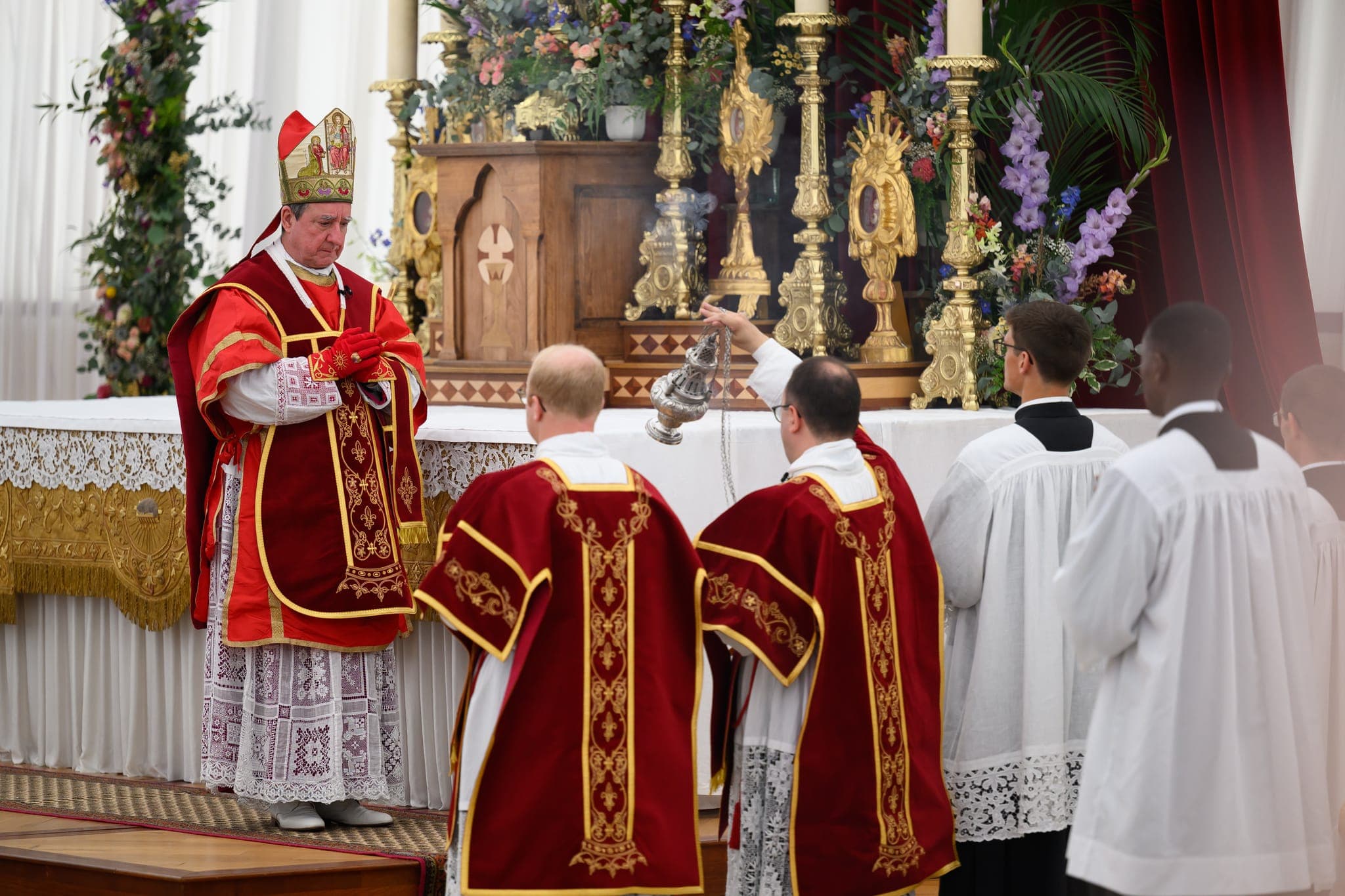
The Society of St. Pius X’s (SSPX) recent decision to consecrate bishops without papal approval is “an instance of [a] rare dilemma” — experienced before by a 4th-century Church Father and saint — of needing to choose between preserving the clear tradition of the Catholic Faith or being canonically recognized by the Pope, Bishop Athanasius Schneider wrote in an Aug. 17 statement.
Bishop Schneider, who himself is not a part of the SSPX, previously served as apostolic visitor to the SSPX amid tense relationships between the society and the Vatican. Before the July 1 consecrations took place, Bishop Schneider, auxiliary of Astana, Kazakhstan, had also appealed to Pope Leo XIV to grant the apostolic mandate. The bishop emphasized that he makes his appeal “with sincere concern for the unity of the Church and the spiritual good of so many souls.”
His Aug. 17 statement, which Rome-based Catholic journalist Diane Montagna published on her Substack, is his first official response since the Vatican declared that the involved SSPX bishops incurred automatic excommunication and that the society is in a state of schism.
Bishop Schneider presented the case of 4th-century St. Athanasius of Alexandria, who was commanded by Pope Liberius to enter into communion with bishops who ascribed to the heresy of Arianism — which held that Jesus was not divine — amid pressure from the emperor at the time. The command came after Pope Liberius had signed “an ambiguous formula of faith” that left out the essential doctrinal term “consubstantial,” referring to Christ sharing the same divine substance as God the Father.
St. Athanasius refused to obey the pope, and according to historical sources, the pontiff, in turn, excommunicated him, “accusing him of troubling the peace of the Church,” Bishop Schneider wrote. Despite this outcome, St. Athanasius continued to shepherd his diocese and even indicated a level of understanding for the pope’s actions. St. Athanasius later enjoyed the support of the pope’s successor, Pope St. Damasus, who thanked Athansius and looked to him for counsel for certain bishops. Athansius was later canonized and declared a Doctor of the Church.
“Today St. Athanasius would be considered a schismatic according to the definition of ‘schism’ in the current Code of Canon Law, since he refused to be in communion with members of the Church (heretic and semi-heretic bishops) who were canonically recognized and thus subject to the Pope,” Bishop Schneider wrote.
The SSPX’s July 1 episcopal consecrations “are also an instance of this rare dilemma: of having to choose between preserving the unambiguous integrity of the Catholic Faith as it was taught by the Magisterium throughout the ages, or being canonically recognized by the Pope,” he continued. “This dilemma is evident in the conditions attached to the Pope’s canonical recognition of the SSPX: it must accept certain newly introduced doctrinal ambiguities (as reflected in some non-definitive teachings of the pastoral Second Vatican Council and in certain affirmations and acts of the post-conciliar Magisterium), and accept not only the validity but also the correctness (legitimacy) of the rite of the New Mass — despite its doctrinal and ritual vagueness, which marks a clear rupture with the traditional Roman Rite.”
The complex situation warrants recalling historical instances that seem analogous to the one at hand and to be clear about the terminology being used, the bishop noted.
He emphasized that clarity of doctrine has been an essential component to the Church for centuries. He pointed out that in the past several centuries, two issues have arisen in the Church: a sort of legalism that treats the legal aspect of the Church “as quasi-absolute,” and papalism, a tendency “to absolutize the person of the Pope and obedience to him,” prioritized even over ensuring matters of the faith and liturgy are clear.
“Yet during every great doctrinal crisis in the Church’s history, the iron rule was to avoid any kind of doctrinal ambiguity,” the bishop said, citing the “doctrinally ambiguous letters” of Pope Honorius I that were condemned by later popes and three councils.
He argued that the terms schism and submission have not been fully clarified by the Church and that “a very narrow understanding” of these terms has recently emerged, considering the action of disobedience to the Pope, regardless of intention, “is virtually equated with formal schism.” He noted that the state of formal schism in principle signifies a rejection of papal authority by creating a separate authoritative hierarchy.
Ahead of the episcopal consecrations, SSPX Superior General Father Davide Pagliarani said in a message to Pope Leo that the SSPX does not want to separate itself from the Church. He also posited that the Pope’s stance may perhaps “constitute proof that the Society is neither schismatic nor hostile to the Church?” As Zeale News previously reported, a number of high-profile Church leaders, including Cardinals Robert Sarah and Gerhard Müller, warned against carrying out the consecrations without the papal mandate; the Vatican had also directly said that carrying them out would constitute a schismatic act.
Others have also offered analysis on the situation and engaged with the SSPX’s arguments; a doctoral student at the Rome-based Pontifical University of St. Thomas Aquinas had pointed out in a June op-ed that there are problems with the SSPX’s claim that they are not trying to set up illegitimate episcopal jurisdiction by consecrating new bishops without the Pope’s authority. He argued that moderating the dispensation of the sacraments, especially the choosing of bishops, belongs to the pope’s responsibility.
“To put it more bluntly,” the op-ed author Eamonn Clark wrote, “if the selection of bishops does not belong to the ecclesiastical jurisdiction of the Roman pontiff, then nothing does. Else, as in the lawless days of the Judges, everyone would be left to do what was right in his own mind. So, in the end, the consecrations are an act of schism, even if it is not the express intention, somewhat like a man who claims he did not intend to kill his victim but only to administer a lethal poison.”
In his statement, Bishop Schneider wrote that episcopal ordinations have not always required a papal mandate, and only later in the Church’s history did this become a requirement.
“Of course, a papal mandate for episcopal consecrations is ordinarily necessary,” Bishop Schneider wrote, “and was wisely established to better ensure the hierarchical submission of the episcopate to the Pope.”
The bishop argued that there is currently a crisis in the Church, caused at its root by “certain vague and ambiguous doctrinal statements” from Vatican II that have since “sown confusion, such as doctrinal relativism” caused by ecumenism and interreligious dialogue that contributes to undermining Christ and His Church as the only way to salvation.
“The extraordinary nature of the current crisis in the Church is revealed, in the present case,” he wrote, “by the fact that a community whose essential characteristic is the desire to be faithful to the Pope — and the Society of St. Pius X regards itself as such — faces a tragic choice: either obey the Pope, and thereby be forced to accept uncertain and unclear aspects of doctrine and liturgy, or disobey the Pope in a matter of grave importance, such as the consecration of bishops, with the sole intention of preserving the means to pass on the faith and the liturgy in their full integrity — as a service to souls, and thus to the entire Church, including the papacy itself.”
As Zeale News reported, the Vatican prefect of the Dicastery for the Doctrine of the Faith met in February with Father Pagliarani to consider a possible path forward. The prefect, Cardinal Victor Fernández, proposed a path of theological dialogue "regarding issues that have not yet been sufficiently clarified," including some questions related to texts from the Second Vatican Council, according to an SSPX statement about the meeting. The path of dialogue also required that the SSPX suspend their plan to consecrate bishops in July; several days after the meeting, the SSPX announced that its leaders decided to reject the proposed plan and proceed with the consecrations.
Bishop Schneider argued in his statement that the SSPX is basically the only community in the Church that outwardly draws attention to doctrinal ambiguities and calls for their clarification, and even their amendment, when necessary, to ensure consistency with the Magisterium. His full statement can be read here.

Comments