Pope Leo prays midday prayer at Barcelona cathedral, encourages walking in Christ’s footsteps
Pope Leo XIV traveled from Madrid to Barcelona, Spain, the afternoon of June 9 and led midday prayer at the Cathedral of the Holy Cross and Saint Eulalia.

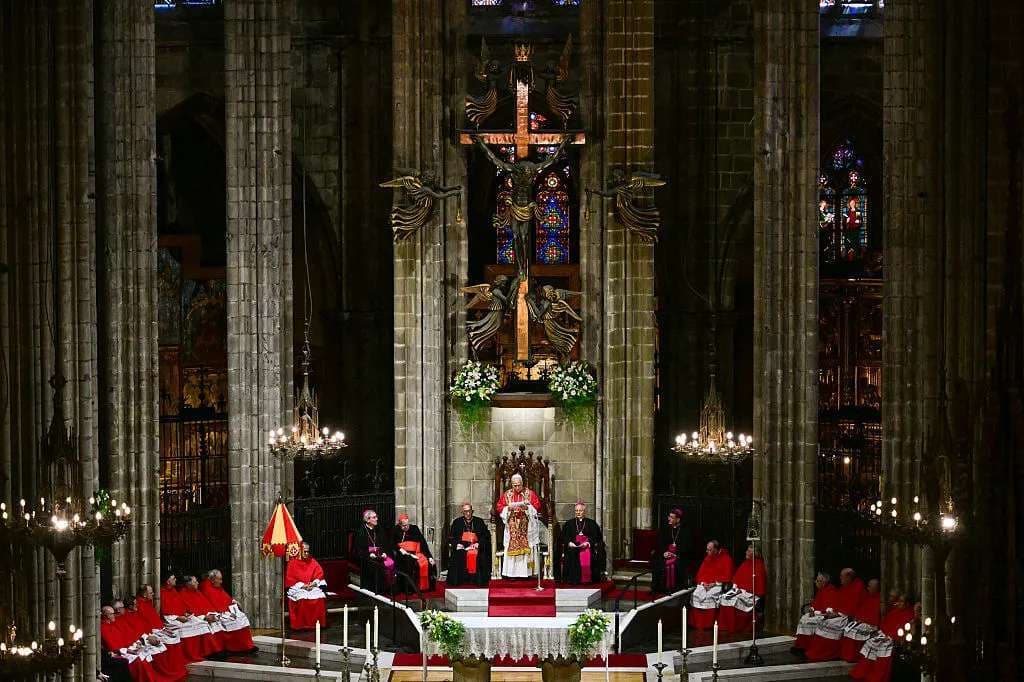
Pope Leo XIV traveled from Madrid to Barcelona, Spain, the afternoon of June 9 and led midday prayer at the Cathedral of the Holy Cross and Saint Eulalia.
Cardinal Juan José Omella Omella, metropolitan archbishop of Barcelona, welcomed Pope Leo at the cathedral, where a crowd of young people, seminarians, religious, bishops, and many others had gathered for the occasion, according to Vatican News. Ahead of leading midday prayer inside, the Holy Father prayed before the Blessed Sacrament in the church’s right-hand chapel and then entered down the main aisle of the cathedral as a choir sang, the Vatican Press Office stated. The cardinal archbishop of Barcelona offered a welcome statement and then the Augustinian Pope led the prayer, which is prayed by all religious communities around the world.
The Liturgy of the Hours, also called the Divine Office, includes Psalms, Scripture readings, and prayers that can be prayed in community or by oneself throughout the day. During his homily after Midday Prayer, Pope Leo recalled how the Second Vatican Council described the Divine Office as “the voice of the bride herself addressed to the bridegroom” and “the prayer which Christ Himself together with His body addresses to the Father.”
He invited Catholics to reflect on the prayer’s reading from 1 Corinthians 12:13, “in the one Spirit we were all baptized into one body.”
The image of the bride, he said, “reminds us that the Church — and in particular this assembly, rich in gifts and charisms and in the diversity of each person’s story — is above all a beloved bride.”
“God has willed you to be here, because in you and in your being together he loves a unique and sacred beauty and goodness,” he continued. “He has chosen you to represent today the ‘communion of saints’ that is in Barcelona. It is with this awareness that I invite you to renew, in harmony, your resolve to walk together — all of you, faithful and pastors alike — in the footsteps of Christ, toward the fullness of life.”
Speaking about the growth of the Church, he emphasized that Catholics must allow themselves to be loved by God so as to carry out works of love for others. He recalled how in 2021 Pope Francis encouraged the archdiocese of Barcelona to remain rooted in encounter with Christ so as to grow in fraternity and in proclamation of the Gospel. The late pontiff also urged seminarians of the archdiocese in 2022 to keep alive the charity that emboldens them to preach the Gospel.
“His words point to the atmosphere we are called to foster in our communities, in our families, in our parishes, in our workplaces and places of learning, within the Curia and in every other sphere of life,” Pope Leo said. “It must be a family atmosphere, where we live together, mindful of our status as children of God and our common calling, showing solidarity, openness, and a capacity for mercy, sacrifice, mutual care and forgiveness.”
He said that Barcelona “has a great ecclesial tradition” in this sense and pointed to Pope St. John Paul II’s statement in 1982 that the people of Barcelona and Catalonia have been led “to share human and Christian citizenship with countless people” and encouraged them to proclaim “that this city and this region are a spacious home open to Christian fraternity.”
Pope Leo commended the many people who strive to overcome polarization and build communion, saying, “Even today [Pope St. John Paul II’s] words find fulfillment in the vitality of the numerous works of proclamation, formation and charity which all of you encourage and practice.”
He then turned his reflection to consider the body of Christ that St. Paul writes about in the 1 Corinthians reading, outlining how Christ is the head and the many members of the body are at the service of the other and are “all called to the same holiness.”
This is crucial because Christians are called to work together based on the grace given to each “according to the measure of Christ’s gift,” he said, quoting Ephesians 4:7.
Christians must respond to this gift by using their individual charisms according to the ministries entrusted to them, he said.
“It is the Spirit who impels us, as parts of a single living structure,” he continued, “not only to give ourselves unreservedly wherever Providence calls us, but to do so according to God’s designs, in obedience and trust.”
The Pontiff also noted that members have different strengths and that some efforts are seen by the outside world, while others are accomplishing hidden, essential work that seems to go unnoticed. When rooted in Christ, this difference in members does not harm the unity of the body but instead reinforces it.
“There are countless contrasts with which we could illustrate the variety and importance of the roles and missions we find among ourselves, but the message is always the same,” Pope Leo said. “That is, in the richness of the gifts we have received, we are strong because we are united, and we are united because we are animated by the same Spirit, the Spirit of Christ, who is the Spirit of communion for the salvation of all.”
As such, he stressed, it is crucial to not permit “anything to destroy the unity in which God has established us and toward whose fullness he leads us day by day.”
He noted that they would soon venerate the relics of the cathedral’s co-patroness St. Eulalia, a martyr, and recalled how St. Augustine said it should not be considered “a small matter” to belong to the same body as the martyrs. In this body, the same Lord is obeyed, the same charity is pursued, and the same unity is embraced by martyrs and non-martyrs alike, according to St. Augustine.
“Dear brothers and sisters: it is in this spirit that we too, in a world torn apart by wars and divisions, in a society that is increasingly fragmented and individualistic, wish to be ‘martyrs’ — that is, witnesses and prophets of unity,” Pope Leo said, “of welcome, of harmony and of peace, even at the cost of sacrifice and renunciation.”
He encouraged them to cultivate a readiness to give up what is temporary for the sake of the eternal.
“Like the virgin Eulalia and so many other martyrs, we wish to say our ‘yes,’ ready if necessary to die to ourselves, to lose ourselves in order to find ourselves again, to renounce the superfluous in order to build upon what is essential and lasts forever. This is what the crucified One teaches us; this is what the Apostle Paul and the examples of the saints invite us to do.”



Comments