The Real Reason Modern Catholic Music Sounds So Bad
Catholic liturgical music wasn’t always like this — so what changed? In this episode of The Deep, Erika traces how Gregorian chant and polyphony gave way to the folk-inspired hymns that have dominated Mass for decades. From Vatican II and the rise of contemporary liturgical publishers to the theology embedded in the songs themselves, she explores how the music Catholics sing shapes what they believe — and whether a new generation can recover the Church’s sacred musical tradition.
Updates:
At 19:02, Erika mentions Catholic Sacred Music Project, but the picture shown is actually a group called Catholic Institute of Sacred Music. (https://catholicinstituteofsacredmusic.org/)
The group featured at 19:06 on video is Canticle. (https://www.canticle.org/)
Read Pius X’s Motu Proprio: https://www.papalencyclicals.net/pius10/tra-le-sollecitudini.htm
Sacrosanctum Concilium: https://www.vatican.va/archive/hist_councils/ii_vatican_council/documents/vat-ii_const_19631204_sacrosanctum-concilium_en.html
Transcript
Read the full transcriptAuto-generated · 2,798 words
If you grew up Catholic any time after 1970, you probably recognize all of these songs. But do you know the words to Faith of Our Fathers, At the Name of Jesus, All Hail Redeemer, King Divine? Something happened that changed what we sing at Mass. It is really, really hard for anyone now in 2026 to think clearly about liturgical music. See, we have a Spotify music culture. Music is primarily a form of entertainment and a matter of personal taste. So, why is our taste in sacred music so universally trapped?
Because isn't the church 2,000 years old? So, I went back and listened. My grandmother grew up with chant like this. Her kids and grandkids got this. And today, her great-grandchildren get this. And everyone loves to point back to Vatican II, but Vatican II actually said that chant should retain pride of place, that Catholics should rediscover the great patrimony of sacred song and polyphony and hymnody, but the liturgy wars gave us the opposite. So, what happened? Was this just natural progress, just a development of our tastes, or were other forces at work influencing what Catholics believe?
By what we sing. Let's rewind 120 years to 1903. St. Pius X was concerned that motifs adopted in the theaters were creeping into religious music. In his Motu Proprio on sacred music, he warned that modern music mainly served profane uses, meaning not sacred. And while the church favors the progress of the arts, great care should be given to music set aside for worship. So, he proposed three unique characteristics of sacred music, holiness, beauty of form, and universality. And by holiness, he meant being set apart for worship, not for entertainment.
By beauty of form, he meant being pleasing to the ear, and universality, delighting men and women of all nations and all ages, not trapped in a particular snapshot of one culture's time. Sixty years after that motu proprio, the fathers of Vatican II promulgated Sacro Sanctum Concilium, the document on the sacred liturgy. They told us that sacred music is, quote, the greatest of the sacred arts, because of its ability, even more than icons or architecture, to evoke divine transcendence. Music, in other words, is a religious experience.
Sacro Sanctum Concilium gave Gregorian chant Pride of place in the Roman liturgy, but it also encouraged other kinds of sacred music, especially polyphony, quote, so long as they accord with the spirit of the liturgical action. And what is that action? It is Christ the priest offering himself the victim on the cross. The music, in other words, must accord with that majesty, sacrifice, and eternal glory. And serve to focus all our attention on the saving work of Jesus Christ. Music, the Council Fathers continued, isn't just a nice add-on or a way to entertain the assembled Catholics at Mass.
It is a necessary and integral component of solemn liturgy. That was in 1963. So, what happened? When implementing the Council, liturgical ministers and clergy honed in on one particular phrase, active participation. Section 14 of Sacrosanctum Concilium says, Mother Church earnestly desires that all the faithful should be led to that fully conscious and active participation in liturgical celebrations, which is great because things weren't great before the council. Catholics may have had the appearance of reverence, but the church was concerned that they were like, Seed falling on the thorns and the rocks, choked by the modern world and starved at the root.
So, for that reason, the council fathers said participation was, quote, the aim to be considered before all else. An expanded use of the vernacular, in our case, English, was encouraged. And between 1964 and 1967, diocese rapidly transitioned from Latin to English. In America, the Tridentine Rite was abandoned. Trident. And priests started using an interim liturgy while they waited for the new Novus Ordo from Rome.
A lot more was going on with the liturgy, and that is, as they say, a whole other episode. But for the story of sacred music, the shift to the vernacular created a vacuum. Suddenly, thousands of parishes needed English-language mass settings and songs that they felt would be more accessible for Catholics in the pews. If most Catholic laity in 1963 couldn't sing chant, The answer was not, well, we should find ways to teach them chant. It was, forget chant, we all love a good Bob Dylan sing-along.
What if, the liturgists asked, we took the melodies, groovy beats, and folk instruments popularized by Willie Nelson, and just put Catholic words on them? Voila, accessible music. The man who won the race to provide this new music was Ray Repp. A Catholic seminarian who loved 60s folk artists like the Kingston Trio and Peter, Paul, and Mary. In his spare time, he would use semi-biblical lyrics in his own original compositions.
In 1965, Rep performed his material at a youth mass for 400 college students, to whom he helpfully distributed free copies of his music. It was the first documented American folk mass, and the audience went wild. Surely this was the sound of the new church that had opened wide the doors to the world. That same year, Friends of the English Liturgy in Chicago published Rep's New Mass for Young Catholics and heavily promoted him through recordings, workshops, diocesan liturgy conferences, and youth rallies.
Rep was in the right place at the right time. While some bishops discouraged his music, the controversy only seemed to sell more songbooks. Today, Oregon Catholic Press hails him as the father of contemporary liturgical music. Through the 1970s and 80s, a second generation of contemporary composers continued Rep's work, including the St. Louis Jesuits, Marty Haugen, and David Haas, among others. And then came Oregon Catholic Press. Oregon Catholic Press, or OCP, began in 1922 as the Catholic Truth Society of Oregon. It was founded to publish pamphlets combating anti-Catholic sentiment from groups like the Ku Klux Klan.
In 1934, it published its first Missal, but it wasn't until the liturgical changes of the 1960s that OCP found its silver load. OCP, like the other massive publisher, GIA, amassed tens of thousands of music copyrights, including popular contemporary hymns and mass settings. Requiring parishes to maintain ongoing subscription and licensing fees for their routine weekly liturgies. By 2020, the company said roughly 35,000 to 40,000 musical selections were available exclusively through OCP. OCP offered simple solutions to parishes for the complexities of navigating the new mass.
Over the years, it has created an integrated product line, quarterly missiles. Coral settings, children's songbooks, and even digital planning platforms like Liturgy.com. It's easy, comprehensive, contemporary, and priests could avoid all legal liability if they signed up. Oregon Catholic Press remains the dominant player in the American Catholic Missile business. In 2018, it reported $57 million in assets, which is pretty good for a non-profit. Breaking Bread is America's most recognizable throwaway missile. Carrying more than 860 songs, the vast majority of which were written after 1975 by a very small group of artists.
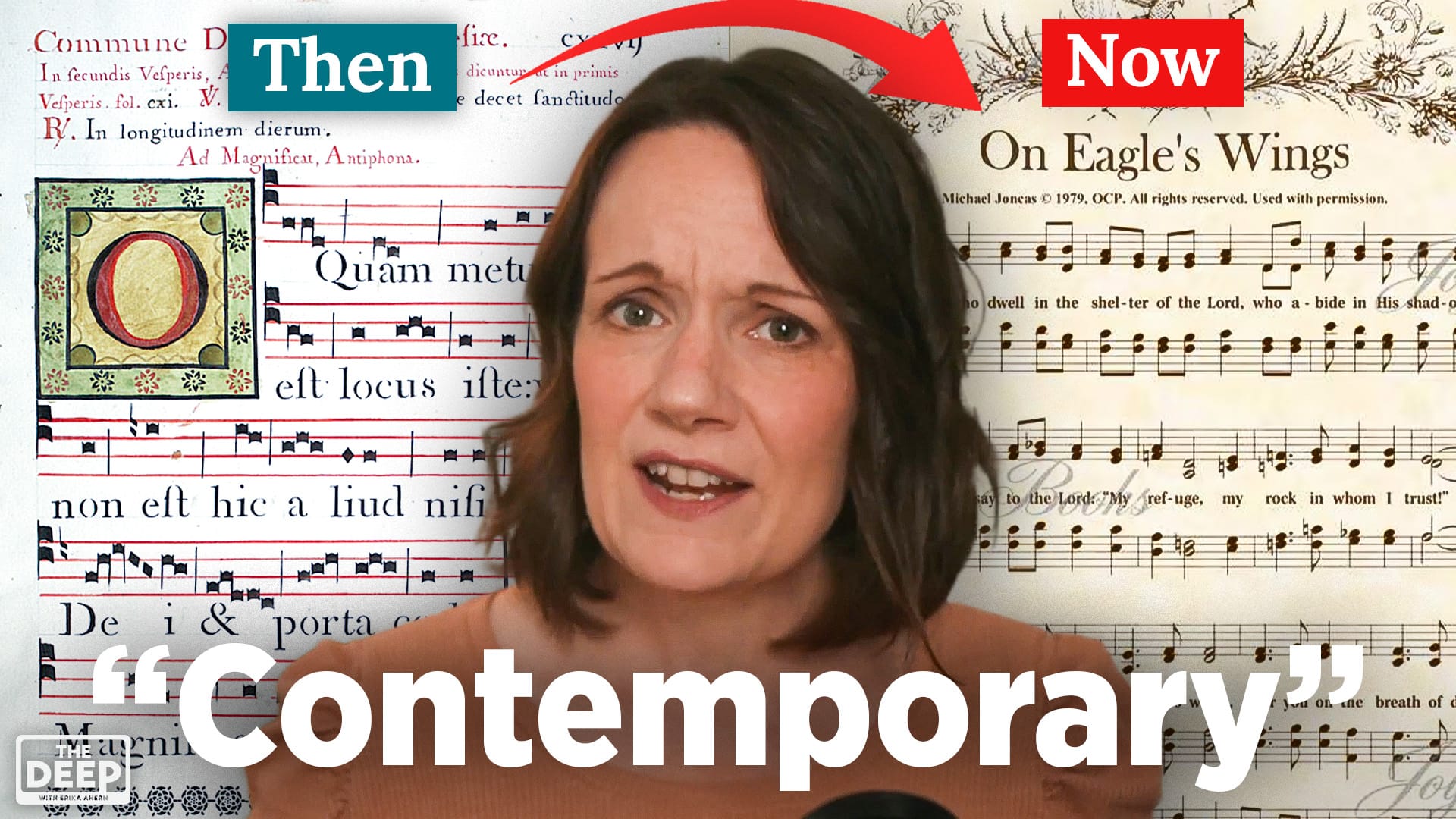
The OCPGIA hierarchy is the reason a relatively small group of composers of a very particular era ended up monopolizing sacred music and shifting the entire American Catholic Church from this... To this. The heirs to the folk mass may have slightly improved on re-rep, but instead of rediscovering the sacred music described by Sacrosanctum Concilium, they emboldened the spirit that animated those first folk masses.
In the Ratzinger Report, the future Benedict XVI called this utility music, designed to appeal to a limited range of emotions through easy melodies and catchy tunes. Today, a Catholic born decades after Vatican II can attend Mass every week and hear virtually none of the musical forms Vatican II explicitly praised. Even the 2011 translation changes to the Novus Ordo Mass parts didn't merit new music. Oregon Catholic Press just shoehorned the new lyrics, as I heard one priest describe it, onto the existing Mass of Creation and the Mass of Christ the Savior.
Meter be damned. In fact, things got so bad that in 2020, the USCCB came together to try to offer some guidance on liturgical music. The bishops warned that hymns can form, and patently have formed, generations of Catholics in defective understandings of the Eucharist. Here is the first thing worth discussing. One of the most common tropes of the Haagen-Dazs Mass, as I like to call it, is that the liturgy is a communal meal of ordinary bread and wine. But at this point, I think we need to dig into some very specific examples.
So, Exhibit A of this phenomenon, All Are Welcome. I think this was the processional hymn at every third Sunday in my rural New England parish where my family converted to Catholicism, and no, we did not convert because of the music. All Our Welcome is all about boosting club membership with a perky Camp Sunshine melody. All Our Welcome. We are building a house. We are growing the love. And we have these cool symbols, like a cross, and bread, and wine. It's all saints and children in our church.
No sinners here. All Our Welcome made the USCCB's Not Welcome list, not because it's cheesy, which it is. They were specifically warning about its Eucharistic and ecclesiological implications. The USCCB said, quote, someone who sings this song frequently would have a hard time imagining that the Eucharist can be and is worshipped, or is in any sense a sacrifice. Now note, I do not blame Marty Haugen here. Marty Haugen is not and never has been Catholic, so it should come as no surprise that he composes lyrics that aren't Catholic, and music that fails to grasp the dignity of the Mass, first and foremost.
As a sacrifice. But to sing is to pray twice, and if you are singing theological error, you're going to end up diluting, if not losing sight of the truth. Eventually, you start to apply how you pray to how you believe. Lex orande, lex credendi. And for heaven's sake, there are so many other options. The church is not lacking for Eucharistic hymns. Speaking of words that matter, another overwhelming trend in contemporary, meaning sounds like the 70s, liturgical lyrics, Centers on us. We, me, the congregation, the church, minus her head, usually.
Musically, it is 1970 forever. Gather Us In sounds like a riff on the wreck of the Edmund Fitzgerald, and it still manages to be one of the top three processional songs for mass, but it's not just the dated music. Give us to drink the wine of compassion. Give us to eat the bread that is you. Nourish us well and teach us to fashion lives that are holy and hearts that are true. We are singing about here and now and each other, everything on this earth.
But the sacred music that the council asked us to preserve and learn how to sing tends vertically to God, to sacrifice, adoration, and supplication. Like the goth expires in the bell towers of our churches, which raise our eyes to heaven, our sacred music, which we have in abundance, should draw our minds and hearts upward. Instead, we sang a new church, and it was all about us. The most offensive example of this trope, sing a new church, the song. Which appropriates the melody of one of the most exalted transcendental hymns in the English language, God We Praise You, God We Bless You, and somehow makes it all about fabulous us.
Speaking of singing new stuff, Dan Shute gave us Sing a New Song, based on Psalm 98. The psalm is 3,000 years old. The music? It has not been new for 60 years. There is no holiness or universality and no musicality to these lyrics.
Schutt's music is not set apart and timeless, but it doesn't have to be this way. Did you know that Joy to the World by Sir Isaac Watts is also based on Psalm 98? Not dated. It's timeless. So, even if you fix up the theology, the actual music of the Hagen-Haas-Schutt School of Sacred Music is plagued by changes in the time signature, by weird interruptive rests, and ties that only a trained musician can sight-read. And let's talk about the poetry for a minute.
The lyrics of so many of these contemporary songs, even when they're based on scripture, they suffer from mixed metaphors and redundancy. Note the unraveling of this typical verse from Table of Plenty. My bread will ever sustain you through days of sorrow and woe. My wine will flow like a sea of gladness to flood the depths of your soul. So now compare that to this poetry for a thousand tongues to sing. Come, let us join our cheerful songs with angels round the throne.
Ten thousand thousand are their tongues, but all their joys are one. The result of this kind of lyric is that it is a song of joy, a song of joy, a song of joy, a song of joy. Active participation becomes more difficult for anyone who's not in the know or in the choir loft. Nobody sings. Dated, secular-inspired pieces that our parents adopted in the 80s and 90s are no longer even entertaining. But it's not a matter of entertainment or taste. The question is not whether I enjoy a song or a musical style.
I enjoy 90s alternative punk rock. That does not make Green Day suitable for the liturgy. The reality is that Catholics have been conditioned to have what modern men think are religious feelings when they hear certain songs, like Gather Us In or Eagle's Wings. The most powerful of those feelings is perhaps nostalgia. And look, Eagle's Wings makes me cry. It's been played at every one of my family members' funerals for my whole life. But as we learned from the great emptying of the churches, emotional gratification is not the stuff of a faith that endures.
Sacred music's primary mission is not to serve religious feeling or personal taste, the way our streaming playlists are. Sometimes that feels good, sometimes it doesn't, but it doesn't matter. because liturgical music has a purpose beyond whatever we happen to be feeling that day. As Peter Kosniewski once wrote, The warm fuzziness of a spiritual atmosphere enhanced by rhapsodic piano music, strumming guitars, and sappy hymns does not communicate the harsh, beautiful, frightening reality of what we believe we participate in at Holy Mass.
We can see from the level of disaffiliation from the Church and denial that Jesus is truly present in the Holy Eucharist, how fragile our belief is. It must be presented richly to the senses in the liturgical action, the environment of the church, the manner of celebration, and perhaps most especially in the music we sing. The great news is, we seem to be emerging from the liturgical winter of our discontent, and time heals. A new springtime of great liturgical music is upon us.
Even through the great Catholic flattening, a few beautiful hymns made the big time, including Sing All Creation, Sing to God with Gladness, and one of my favorites, O God Beyond All Praising. The great composers today might not be picked up by giants like OCP or GIA yet, but they're asking the right questions. Is the text sacred and theologically sound while also being poetically beautiful? Does it sound set apart from secular entertainment? Can people actually sing it? And would people 50 years from now find it dated?
Does it direct our attention toward the worship of the Eucharist? In my own parish, two consecutive music directors have composed entirely new settings for the mass, psalms, and introits in the tradition of sacred polyphony. And the best part?
It's sung by a choir of 13 to 18 people. with no extra training. The Catholic Sacred Music Project runs camps, workshops, and records sacred music both ancient and new. Gregorian Chant Academy is booked every year, and it's growing with hundreds of Catholics completing chant camp. Seminaries and novitiates are once again offering young men courses in the music and the Latin language that Vatican II asked our clergy to promote and preserve. Don't plan on the disappearance of eagle's wings any time soon.
That will make some of you very happy, and some of you very disappointed. But I am hopeful that it will, with time, be remembered with fondness, having then set aside happily and willingly for a more beautiful sound. If you liked this episode, be sure to subscribe to The LOOPcast. We bring you a new episode of The Deep every Thursday at 4 p.m. Eastern.

.jpg&w=3840&q=75)