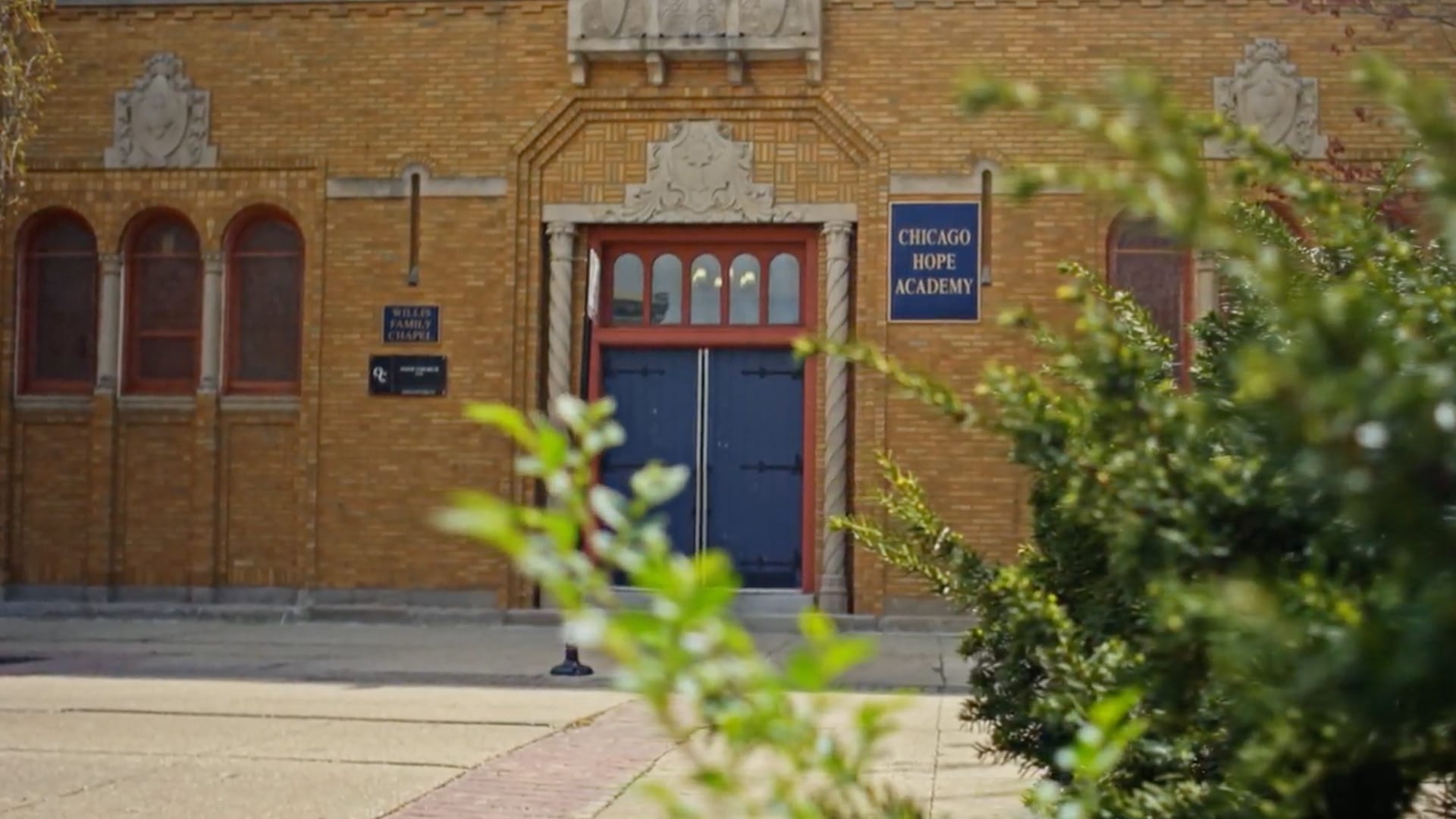
Chicago Hope - Education Freedom in America
Amazing things happen every day behind the doors of Chicago Hope Academy—for lower-income students and their families. Meet Lissette Ortiz and hear her story of struggle and answered prayers, some of them delivered for through the intercession of the students at this extraordinary school.
Transcript
Read the full transcriptAuto-generated · 2,323 words
When they talk about funding the schools, it feels like the teachers are getting paid, but the environment, the education part is not. When we use the word equity, it is to try to produce relatively equal outcomes. But what about a kid who is in an underperforming school and wants something better?
By eliminating this option, you're restricting kids to their zip code opportunities. So, you're stuck at your neighborhood school where the education isn't important. It's not at the forefront of everyone's mind. Just watching the two worlds on this side and this side is so different.
Illinois Invest in Kids program will come to an end in the new year. That legislation would have funded scholarships for low-income students at private schools. School choice, for parents, you want that. Every kid should be able to get a chance and have a choice. Eliminating the choice for a kid to go to a private school is wrong. I think it's an injustice. You can change the world by changing your family, by changing your neighborhood, by changing the city.
I have two boys, one who went to Chicago Public School, never made it through freshman year, and I have another son, the little one, who graduated from Chicago Hope Academy, and now he's a senior graduating from Brown University.
Completely different kids, raised in the same household, exactly the same. So, Michael was seven when I met his dad. I was taking on a role of being a stepmom. Michael would go everywhere with me, everywhere, shopping with me. I went to all of his games.
We lost him along the way. We no longer had a pulse on who his friends were, his education. No one was holding him accountable, right? And we weren't allowed to hold him accountable because he went to public school. Parents are not allowed in public school here in Chicago.
When you're dropping off your kid at school at the front door, but then you don't know that they're leaving out the back door, and then it's late at night by the time you get a phone call that he wasn't at school today, and he missed X amount of classes, he didn't want to do much after a while. Like, he wasn't motivated. He kind of got mixed in with the wrong crowd, started getting involved with gangs and drugs, stopped coming home.
Michael did seven years in prison. He came home, and he went back in March of 2021. So, he was out for three months before he got in trouble again. When I had Jordan, it wasn't as beautiful as I thought it was going to be. It was definitely a fight.
Everything that they said could happen to me as a diabetic did happen. I remember they wanted me to abort my son, and I didn't want to. I didn't believe in that. I started losing my vision. I started becoming preeclamptic, and so my kidneys had shut down. I would wake up from seizures almost two, three times a day sometimes, just from hypoglycemic. The doctor had said, you know, you could lose your life.
How was I going to raise a baby or take care of a baby blind? When we brought him home, I used to trace his face, his nose, and I would smell him and kiss him and kiss his little fingers and feet. And I would pray all the time, and I'd ask God, like, let me see him, even if it's for five minutes, like I want to see my baby. There were moments where I wanted to give up because it felt so hard.
You have a choice. You lay down and give up, or you get up and you push. I prayed and prayed for my vision, and I can't explain other than it was on God's timing when I was supposed to see it.
The first time I saw him was September 9th. I saw all of these swirls of light, and I was like, man, what is that? Like, this is another phase that blind people go through, and I kept trying to focus and look, and then I had to, like, struggle to focus, and then I was able to see. And I'm like, somebody give me my baby, give me my baby, and they put Jordan in my hands, and I remember staring and staring and staring at him.
He looked exactly... What I imagined him to look like. I just started crying. And I thought to myself, am I going to see you make it through kindergarten? Am I going to see you make it through eighth grade? I sat there at his high school graduation thinking, hell yeah, I'm watching you go to college right now.
My name is Ike Muzikowski, President and Principal of Chicago Hope Academy. The greatest thing about education is that it matters, and the toughest thing is that it matters every single day. So, you have to show up consistently. I am outside every single morning greeting the kids, calling them by name. I think when you hear your name, you recognize that your identity is valuable to someone else. We really want To create a strong community where kids feel like we believe in them.
Significant learning happens when there's significant relationship, and when you've created that foundation, lots of good things can come from that. I'm Timothy Lawrence. I'm a freshman. I have two honors classes. I feel accomplished. My life skills are getting better. So, Hope is unapologetically Christian without shoving it down their throats, without proselytizing aggressively. We think, hey, you'll know you're Christians by your love, so the way we treat each other, the way we sacrifice for one another.
I would say she's had the most growth of any other Hope student that I've seen thus far, from start to this point, like literally miles ahead. Give me something right there. Because it's my favorite dean ever. But who would win in a one-on-one? You or Dean Landry? Me. See, now without question, that's where she's still a bit delusional, and, you know, we really want to help her. So, Jordan coming to Chicago Hope came out of nowhere.
I had no clue how we were going to afford it. We just knew we needed another option. I met Lisette after reviewing Jordan's application. He was a super impressive kid. He had great grades, solid test scores, a fantastic personality, a charisma, a contagious enthusiasm for his own hopefulness. Jordan.
Jordan fell in love with Chicago Hope Academy. He came out. He's like, this is my school, Mom. I love this place. He was so determined to come here, he did a PowerPoint. He's like, this is why I want to come here. These are the benefits of me coming here. I was like, yeah, Jordan, I don't know. I can't afford it. This little boy filled out the financial aid. He's like, so, Mom, how much money do you have? I get a letter of acceptance in the mail with the tuition award letter.
It was just him and his mom living together at that time, and she was super sick, and his goal was to become a doctor. He was thinking, like, hey, if I could become a doctor, I could save my mom. I weighed 90 pounds. I was getting blood transfusions every two to three days.
I was placed on hospice. His mom's going through all these different health issues, and every single day, Jordan asks, can we pray for my mom? And Jordan was like, mom, I need you to get better. He's like, so many great things are happening. I need you to get better. I got me. Don't worry about me. I just need you to get better.
We'd always pray for her, and then in chapels, the pastor would say, does anyone have a prayer request? There would be 300 kids in the room, and Jordan would say, pray for my mom. I'll never forget, he was like, Mom, pray with me, and I'm like, pray with you.
He grabs my hands. Praying over me, and I had to open my eyes and look like, who is in front of me right now? Like, you've been around this school for a couple of months, and like, you're so different. It felt almost like it was coming from Jesus. It felt freeing in that moment that I didn't have to worry. This is where he's growing up. He's coming into his own, and I just watched him grow into this beautiful young man.
My job is to make sure that I follow the kids through college, and that they have a support system, they have a career path, and they have direction. This is the place that I want to be a part of, that I want to help every young man, especially when you've got one in prison. When you've got one in prison and you see the little one being...
On the opposite side, it's so different, and so I'm so appreciative that I want to give back at Hope as much as I can. What separates Chicago Hope Academy from other schools is how intentional they are about education and a child's future. How can I come alongside someone and accelerate their likelihood of being successful? By removing barriers constantly, by breaking through a door, creating an opportunity, and going out of my way to give him more access to high-quality opportunities. Watching Jordan arrive here was the most beautiful feeling in the world.
This kid had straight A's all through high school. It's a family environment. Watching them look at each other like brothers and sisters. Really about equipping kids with good values, character, integrity. And then also equipping them with the skill sets to thrive at the next level, whether it is in college or in a career. It is all about the culture and the environment. Everybody is after the same goal. What college are you going to? What do you plan on doing? Everyone has a future set up for them.
It is beautiful to see the kids come in freshman year and to see how they are by the time they are ready to graduate senior year. When you ask the question, should private schools be only for rich kids? The answer is no, but they typically are. You don't see a lot of high-quality private schools that serve a low-income population. All of our students receive financial aid, and half our students were recipients of the tax credit scholarship. The program is a tax credit program worth $75 million.
Over the past five years, 40,000 scholarships have been awarded. Two-thirds of these scholarship recipients came from low-income families. The beauty about the The tax credit scholarship in Illinois was that it allowed low-income students to have the opportunity to attend private high schools. The Invest in Kids Act will expire this year. That is unless legislators in Springfield vote to extend it. Hundreds of people rallied in Springfield this week in a last-ditch effort to keep the program.
Republican lawmakers pushed to bring the issue to a vote, but on the last day of the session, the Invest in Kids Act will not be renewed. I look at the people who are making the policies, thinking to myself, do you not see yourself in this kid? You're taking something from them. For us, it was half our school. We had 130 kids who lost their scholarship in December when it was taken away. Private schools are closing left and right, and canceling a program like this is the facilitation of the death of the affordable private school.
It doesn't feel fair that my son gets to where he's at through the funding of this program, and now all of a sudden anyone after him doesn't get it. Why would you want to pull something like that from them?
When you're earning six figures, right, you choose to send your kid to a private school, but for kids who don't have that option, restricting them to a failing school, an underperforming school, is wrong. I think it's an injustice. Illinois Education Association celebrated the end, saying the focus should be on providing funding to public schools. And I do believe that every single child in America should have a high-quality school in their neighborhood. That's the ideal.
It's just unrealistic. It's hard to just throw money at a problem to solve it, and it's going to take decades to turn so many of these schools around. A lot of kids from many of these schools will have a 10% chance of graduating from college.
I think so many times the world is focusing on race and what divides us rather than what unites us, and then we have so much more commonality than we do difference. It doesn't matter if you're Republican or Democrat. Like, I don't even know where I fall.
What's important here is not about anyone's opinion, it's about the kids. What's beneficial to their future? Because when you're looking at kids, you're looking at your future. And if we don't love on them now, and we don't pour into them now, we're going to miss a whole generation.
It's not just about one kid being that one in a million. Why not two? Why not three? Why not four? Why not the next kid? Why not for Noah? Why not for Malia? Why not for Pablo? Right, why not for Javion? I don't know why anyone would discourage that, and if a strong group of kids can unite over that shared experience, that collective effort down the road is going to create a greater ripple effect that will transform neighborhoods, that will transform that following generation.