The "Buy Now, Pay Later" Debt Crisis is Just Getting Worse | The Deep
We finance everything now – even burrito delivery. Americans closed 2025 with $1.233 trillion in credit card debt. Nearly half of cardholders carry balances. One in five thinks they’ll never pay it off. This isn’t just “bad budgeting” – it’s an economy built on revolving debt and minimum payments. How did we normalize installment plans for lunch? And is modern credit a convenience… or a quiet form of slavery?
Timestamps:
00:00 - The Debt Economy 2:45 - The Rise of Buy Now, Pay Later 5:50 - How We Got Here 10:58 - Is It Just A Self Control Problem? 14:32: - A Way Out?
Watch The Deep on Zeale: https://zeale.co/podcasts/the-deep
Transcript
Read the full transcriptAuto-generated · 2,594 words
We live in a debt economy. Recently, while traveling, I ordered food delivery, and I was blown away to see that DoorDash was advertising buy now, pay later. That's right, I could finance my burrito delivery. You can pay for anything with installment loans, not just for the big ticket items like houses and student loans. You can owe money on furniture, cars, medicine, clothing, pets. And I think we all intuitively feel that this is wrong, but like our federal government, American citizens just can't put down the credit card.
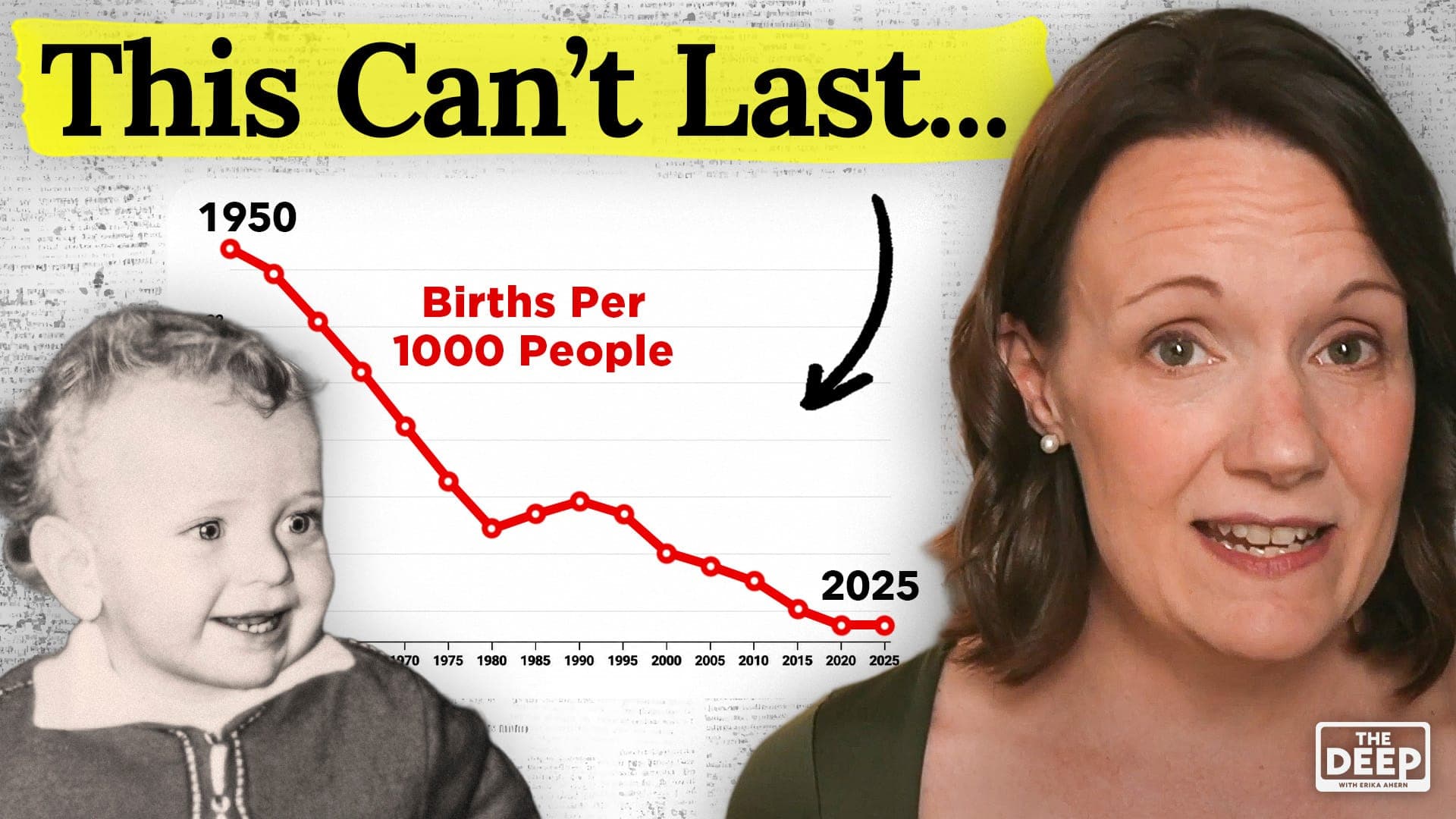
At the end of 2025, we collectively held $1.233 trillion in credit card debt. That's the highest level recorded since the New York Fed began tracking the numbers in 1999. Far outpacing inflation, and there's no sign of stabilization. The truth is, we are swimming in an obvious loan sharking situation, more dangerous because we can go years without seeing it, or even imagining a better world. You might think, well, I make all my payments, not my problem, until you realize the majority of Americans can't.
Nearly half of all cardholders carry a One in five indebted cardholders say they don't believe they will ever pay it off. Fifty-five percent of us say credit card debt is a major source of stress in our lives. We don't feel like free participants in the market. We feel more like slaves. This isn't about a handful of irresponsible consumers who should have budgeted better. People are increasingly borrowing money to meet Basic needs. This is about an economy that runs on debt and increasingly survives by trapping ordinary people inside it and pushing them to the breaking point.
Across geographies and different metrics, default and delinquency is on the rise, putting even more stress on the banks and lenders. Can anything be done? Is the debt economy itself now so embedded in American life that there's no escaping it? We've established an economy on mass-scale indentured servitude in the form of debt. The free market is headed for a calamity, where unfettered license to make our money work for us ends in enslaving its own participants. This is so contrary to the American ideals and Christian understanding of freedom.
How did we get here, and what would it take to free the slaves? It's easy to make fun of people who plan to pay for their DoorDash Chipotle in four easy installments, which, to be clear, you should never, ever do. If we're looking at broad-scale societal trends, though, a lot of people are doing it. Companies like Klarna, Afterpay, and Affirm have exploded in recent years. My theory is a lot of this points to a psychological and even spiritual crisis. People feel like they'll never be able to afford a really big thing like a house or a car, so they settle for little things that seem like they're within reach.
But that's another episode. The point here, credit card and lending companies have inserted themselves into every level of our purchasing lives. And while this might be good for Klarna and possibly for DoorDash, it's very, very bad for anyone using the service. So, is it a youth problem? No, almost every generation is experiencing high reliance on credit. More than half of Gen Xers and Millennials carry a balance month to month, and over 4 in 10 Boomers do. And Gen Z is actually faring better.
Their debt almost exactly mirrors the Boomers. So then, is it a self-control problem? Nearly three-quarters of outstanding credit card debt is tied not to luxury handbags or Disney Park Lightning Lane multipasses. But two essentials. Medical bills, car repairs, home maintenance, groceries, and utilities.
41% of debtors say their credit card balances got out of control when they experienced an emergency or an unexpected expense and couldn't make a monthly payment. The American government isn't entirely innocent here either. The state's own debt addiction, we now spend more annually on our debt interest payments than our defense budget. Certainly supercharged our recent period of out-of-control inflation. Skyrocketing prices under the Biden administration drained working Americans' savings as purchasing power took a nosedive. Historically, times of rampant inflation are also times for the loan sharks to pounce.
Credit cards stopped being convenience tools and became life rafts. A typical family's interest payment alone on revolving credit today. Debt is nearing $2,500 annually, compared with $1,300 in 2021. And unlike mortgages or auto loans, credit cards come with a feature that quietly turns desperation into debt slavery, the minimum payment plan, where over 70% of your monthly payment goes not to principal, but to covering your interest. Debtors who make only minimum payments can fork over hundreds or thousands of dollars while making almost no progress in paying off the money they actually owe.
And that's exactly how credit cards and buy now pay later was designed to work. It wasn't always like this in America. To trace the rise of the credit card empire, we could go back over 100 years. But for the purposes of this video, I'll just go back to the 90s. In 1993, when Burger King began accepting credit cards, people were shocked. Kind of the way you might be shocked at the idea of financing your burrito delivery. The home of the whopper is offering cash or credit.
I think it's pretty bad if you have to use a credit card when you go to a fast food restaurant for something as little as $3.10. If I use my GM card and I get a 5% rebate, if I eat here long enough, I'll be able to buy a pickup truck. Burger King bosses say workers won't have to figure out. How much change the customer gets back? I just hope it doesn't slow things down at the cash and carry that people are going to be having to call New York and get the confirmation or, you know, whatever it is, because when I want a Whopper, I want it now.
Just another way to spend money. I am sure it will work for people on vacation when they don't have to do something, but I can't imagine it working on a day-to-day basis here. So far, the smallest credit has been for $2.50, the largest just over $10. Paying for a fast food burger with borrowed money felt grotesque and unethical. But it didn't feel that way for long. Credit was just so convenient. Shock turned into submission and then full throttle participation. Very quickly.
Before we all started buying our burgers on credit, the idea of taking on debt carried moral weight and even a sense of shame. So, what happened? In his book, A Piece of the Action, How the Middle Class Joined the Money Class, Jonah Serra traces how ordinary Americans, helped along by an enthusiastic finance industry, created a culture of debt, not only for themselves, but also for generations to come. In the 1920s, widespread use of consumer credit exploded, then collapsed spectacularly in the great stock market crash of 1929.
That trauma produced a generation of savers, hoarders even, who feared debt as a form of personal ruin and a mark of shame. But after World War II, everything changed again. A new middle class emerged. New innovations and inventions promised a better, easier life. The American dream. Americans wanted homes, cars, refrigerators, vacuum cleaners, televisions, and they didn't want to wait decades to afford them. Enter the banks. Most banks still distrusted consumer lending at this point. Business loans were respectable. Personal debt was not, and super risky for the banks.
Nevertheless, in 1958, Bank of America launched an experiment, the Bank AmeriCard. 60,000 unsolicited credit cards were mailed to families in Fresno, California. It worked instantly. By the end of the year, millions of cards were circulating. Chase and American Express rushed to compete, and interest rates were generally around 1.5% per month, or about 18% annually. The interest rate was not calculated based on inflation, or the Federal Reserve, or macroeconomic cycles. It was modeled after retail installment plans.
Not for burritos, yet. In other words, the rate was behavioral. Credit card companies assumed at first most people would pay their balances off quickly. They were wrong. Delinquencies soared. Banks adjusted not by lowering rates, but by locking them in. By the late 1960s, something decisive happened. Credit cards stopped being short-term tools and became long-term revolving debt traps. Once the banks realized many consumers would carry balances month after month, interest income, not fees, became the profit engine. Over time, mortgage rates dropped, auto loan rates fell, inflation stabilized, but credit card rates barely moved.
Why? Because credit cards are unsecured, mass market, used daily, and disproportionately held by people leased to avoid interest. This makes them one of the most profitable financial products ever created. Banks routinely generate 3-4% return on assets from credit cards, far higher than most lending operations. Interest income from revolvers, people who make only minimum payments each month, accounts for roughly 80% of their profits. In 2021 alone, Top issuers pulled in over $60 billion in pre-tax income from cards. Average APRs have climbed from about 13% a decade ago to over 22% today.
At this point, someone usually says, people should just have more self-control. And I am all for the Dave Ramsey debt snowball road to freedom. It works. We are suffering from a deplorable lack of limits. And yes, some of those limits are internal. Virtues like temperance and self-control have been languishing while vices like avarice and envy have been left to run roughshod. You can place all the rules and regulations you want on a system. If the people are immoral, it won't stand.
And so, yes, personal responsibility will always continue to be the most important factor in overcoming the debt economy. But some of that lack of limits is also systemic. So, it can't all be about berating Americans who are in debt. No society is well-ordered when its most profitable systems, in this case banks, are designed to exploit human frailty. That's not a free market. That's a vice market. We regulate gambling for this reason. We regulate payday lending. We regulate drugs and alcohol, not because people lack agency.
But because the law exists to restrain incentives that reward predation. Think of Nancy in Charles Dickens' Oliver Twist. She said, we have to sin to eat. Dickens wasn't saying that people lack responsibility. He was saying that systems can make vice functionally compulsory. In a just society, burrito delivery financing would not even be a legal option. Buy now, pay later, and predatory credit card's interest is classic usury, when the lender demands back more than he is owed by the borrower. The Church, since the days of ancient Rome, has always condemned usury.
Dante casts usurers into the seventh circle of hell. As economics evolved, the definition of usury narrowed, but the moral principle never disappeared. And to be clear, interest itself is not sinful. Usury is. Credit systems that entice vulnerable people into a predatory interest trap are the post-war liberal orders case of usury gone wild. Pope Leo XIV recently addressed the global phenomenon of usury not as some relic of the past, but as an ongoing reality. He said, How far from God is the attitude of those who crush until they become slaves.
Usury is not merely an accounting issue. It is a grave sin that can destroy families, consume the mind and heart, and even lead people to despair or suicide. Usury, he continued, begins with a promise to alleviate some kind of immediate suffering, but soon reveals itself for what it is, a burden that suffocates. The consequences Indentured servitude and slavery are borne by those already fragile, such as victims of gambling addiction or families facing medical or financial emergencies. In a remarkable moment in the speech, Pope Leo turns calling out usurious systems into a call to love the usurers themselves.
Like Zacchaeus in his tree, they must be turned from their exploitation of their fellow men. He says, the conversion of those who engage in usury is just as important as closeness to those who suffer from usury. So, what can be done? It's not all doom and gloom. The truth is that America today is still, despite all of our debt, a very wealthy nation. The economy still offers many opportunities for ambitious young people with the right connections and a little bit more virtue.
And yet, we swim in this massive debt. Economy. And just because we're still the wealthiest nation in human history does not change the fact that that wealth belongs to an increasingly small percentage of us. Sure, there's still a lot that individuals can do because we are in a free market scenario.
For families, debt reduction is a must, and I will argue that in that vein, Dave Ramsey has done more for America than any think tank or politician in decades. For young people, a robust education on the dangers of debt and the development of personal virtues necessary to avoid it would be a great first step to a better, debt-free society. But just having a free market system, and even reforming the actors in that system, are no longer enough to address the challenges at hand.
The reality is, at this point, most individuals and families cannot pull themselves out by their own efforts. The reality is, at this point, most individuals and families cannot pull themselves out by their own efforts. That's a cultural as much as an economic crisis, and it will require a new approach to our economic policies to address it. As Ross Douthat put it, while this may be a temporary situation, and hopefully culture and politics will adapt, those adaptations will not themselves be liberal in either a philosophical or a post-Cold War political sense of the term.
They might be in the sense of political regulation of technology. in the sense of religious moral regulation of individual choice, but they will not just emerge organically from the proper application of John Stuart Mill or Milton Friedman. So, what can be done about modern credit card usury? The late Pope Benedict XVI pointed us back to models like the Montes Pietates, church-backed lending institutions that protect their capital but avoid exploitative profit.
Second, interest-free lending is possible. The International Association of Jewish Free Loans, for example, reports repayment rates around 97%. That means zero-interest lending doesn't collapse. It just requires discipline and community backing. Third, institutions like the College of St. Joseph the Worker integrate trade training with liberal education, so students can generate income while they are in school. And legally?
Taking a page from St. Thomas Aquinas, lawmakers could look at limiting or even prohibiting profit on unsecured loans. All of these approaches are controversial, and none of them will fix the problem in isolation from other efforts. The point is this. Usury is not inevitable, and the debt economy is not our destiny. There are workable alternatives that protect capital and the economy is not our destiny. Respect the borrower, and remind us that not every economic exchange must be driven by profit.
But the hour is very late, and the conversation is just getting started. If you liked this episode, be sure to subscribe to The LOOPcast. We bring you a new episode of The Deep every Thursday at 4 p.m. Eastern.
.jpg&w=3840&q=75)